Tag Archives: love

Better Days Ahead?

1

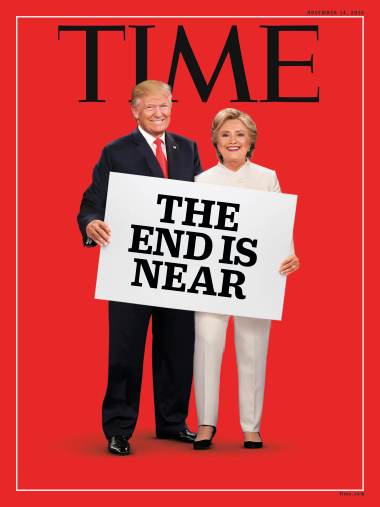
Well, mad props to TIME magazine for mastering the double entendre.

Regardless of the outcome, tomorrow’s presidential election will be historic, and although nobody will remember this bizarre campaign with affection, I suspect that its conclusion will not cool the bubbling hatred that threatens to erupt and make an awful mess.  In other words, I’ll be glad when it’s over, but I don’t think it will be over when it’s over.

So, what to do?  Although Canada is nice this time of century, flight doesn’t inspire a heck of lot more hope than the ugly fight we have endured.  There must be a third way to a better future.

My personal vote is for a commitment to reduce hatred (whether or not it is on the official ballot), beginning in my own heart and extending to actions that will have a similar effect on others.  That seems particularly worthwhile to me.

Don’t be fooled into thinking that life will instantly be better once the results are final.  But don’t be fooled into thinking that things cannot be better.  Better is surely worth the struggle.

I mean, the Cubs won the World Series.  The possibilities are endless.

See. Respect. Listen. Love.

2

When Hurricane Katrina flooded our one-story house in 2005, it claimed treasured and irreplaceable items such as our wedding album and family videos while graciously sparing the crap in the attic that was there because we didn’t want it in the first place.  Gee, thanks.  My revenge came from unwittingly sparing a few boxes of personal mementos in my apparently waterproof office simply because we didn’t have room in the house.  I do my best work by accident.

Included in those mementos, believe it or not, was a college research paper that is now a quarter-century old, presented to Dr. Willard Gatewood at the University of Arkansas in 1991 and titled, “Arkansas Democrats in the Presidential Election of 1928.”  That paper was painstakingly typed on an actual typewriter (yes, boys and girls, a typewriter) and placed in a transparent plastic sleeve with a white binder with my social security number (ID number at the time!) emblazoned under my name on the cover page.  I kept the paper because I was proud of it and have a tiny problem throwing things away.

I remembered that paper last week and had to go for a trip down memory lane.

I don’t think I’m to blame for watching CNN last Thursday when I saw Hillary Clinton and Donald Trump laugh at each other’s jokes the day after trading verbal sucker punches and refusing to shake hands in their final debate.  Curiosity got the best of me.  It turned out that our nation’s top presidential candidates were at the Al Smith Dinner, an annual event hosted by the Archbishop of New York to raise money for needy children, and traditionally the last time presidential candidates share a stage prior to the election every four years.

It was the reference to Al Smith that led me to turn a closet upside down to find that old research paper.

Governor Al Smith of New York was the first Catholic to lead a major party ticket in a presidential election when nominated by the Democratic Party in 1928.  Smith chose Senator Joe T. Robinson of Arkansas as his running mate, the first southerner for a major party in that role since the Civil War, and Arkansas faced a dilemma: The heavily Democratic state had one of its own on the ticket, but Smith’s Catholicism was wildly unpopular across the state.  As a result, Protestant ministers in particular led anti-Smith campaigns that allowed the small contingent of Arkansas Republicans to pull up an easy chair while the Democrats worked both sides of the campaign.

In the end, the Smith-Robinson ticket still carried Arkansas and a handful of other states in the Solid South, but Herbert Hoover won the election in a landslide.  And then the stock market crashed, followed by a great depression and second world war and so on and so forth until I wrote a research paper that I can’t seem to throw away.

Today, it is hard to imagine passionate opposition to a presidential candidate simply because s/he is Catholic.  But it happened.  I wonder what research papers will be written by twenty-year-old students about the Election of 2016 decades down the road?

As Hillary Clinton closed her speech at the Al Smith Dinner, she reflected:

And when I think about what Al Smith went through it’s important to just reflect how groundbreaking it was for him, a Catholic, to be my party’s nominee for president.  Don’t forget – school boards sent home letters with children saying that if Al Smith is elected president you will not be allowed to have or read a Bible.  Voters were told that he would annul Protestant marriages.  And I saw a story recently that said people even claimed the Holland Tunnel was a secret passageway to connect Rome and America, to help the Pope rule our country. Those appeals, appeals to fear and division, can cause us to treat each other as the Other.  Rhetoric like that makes it harder for us to see each other, to respect each other, to listen to each other. And certainly a lot harder to love our neighbor as ourselves.


What Is Your Potential, and How Do You Get There?

14561809_1566746046684481_2882562503231930368_n1

My second post comes early this week because my friend, Tim, died, and I am heartbroken.  His sweet wife, Peggy, called with the tragic news this morning.  It is such a sad day.

Tim and I were close and shared many deep conversations.  For me, this made him special, but from Tim’s perspective, it made me one of hundreds if not thousands of people who felt close to him.  Tim had a way of creating space for deep, meaningful conversations, and all who responded to his invitation to “pull up a chair” helplessly found themselves baring their souls to this kind, sweet man.

Tim’s favorite part of his job was counseling people, mostly students, and I was privileged to be his office neighbor for the past four months.  Today, several grieving souls made a pilgrimage to the place where they shared their deepest fears and greatest dreams to a man full of wisdom and love.

Last week, Tim popped his head in my office with a new idea.  He shared that his typical approach to counseling students had always been to ask about their goals and dreams, which led to all sorts of meaningful moments.  But he had a new idea.  He asked what I thought about a new approach that asks students about their potential instead of their dreams.  He thought that just might be the better approach.

I’m not sure what I loved more, the idea itself, or the fact that this counseling maestro never stopped refining his craft.  Well, what I loved more was him.

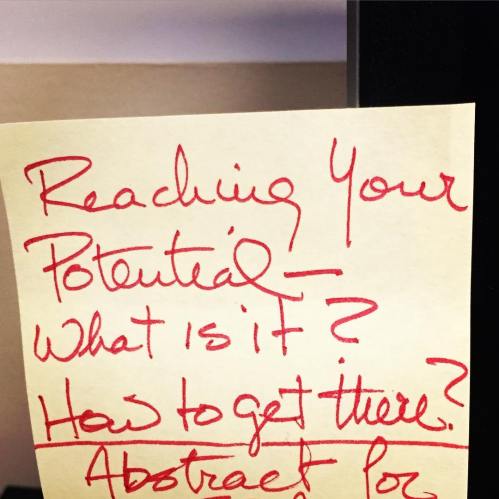
Today, after absorbing the shocking phone call and then sharing the news with his loving colleagues, I walked into Tim’s office just to feel his presence.  I breathed in the spirit of the room and silently took in the sights of the pictures and books and stacks of work waiting for him this Monday morning.  And in that moment I noticed a little sticky note on the side of his computer monitor with the following notes: Reaching your potential – What is it?  How to get there?

I am sad that Tim won’t be able to work this new approach like a street magician, but from this day forward I will use these questions with students to tap into the magic that was Tim Pownall.  I am honored that he left me this final gift to use for good before moving on.


Future Friends

hk1

hk4I fiercely disagree with Donald Trump’s assertion that the firestorm surrounding his 2005 remarks “is nothing more than a distraction” and strongly believe that the resulting conversations on misogyny and sexual assault (not to mention presidential choices) are significant and important.

Same time, somewhere in the neighborhood of a thousand people are dead in the wake of Hurricane Matthew, and as a survivor/veteran/victim of Hurricane Katrina who was a beneficiary of intense public attention and the resulting flood of love and support, my thoughts are especially with those grieving families and all who have suffered from the storm.

Last week, as Matthew grew in intensity, our good friend, Hung, shared a sweet Facebook post that featured a picture from 2005 of cute kiddos working a lemonade stand at Pepperdine University for the victims of Hurricane Katrina.  It touched my heart since the cute kiddos in that picture eventually became friends, classmates, and youth group buddies of our youngest daughter who lost the only house she had ever known in that storm two thousand miles away.  Who could have imagined that years later those same kids would be fast friends?  I am certain that the money collected that day did not specifically rescue us from our homelessness, but as I looked at that picture, in my mind it was as direct a connection as if they had hand-delivered the cash seen sitting in that Tupperware container.

Sometimes I feel overwhelmed by the great needs in this world and the inability to address them all.  As a recovered victim with the luxury of looking back, I can say that the sentiment expressed in both the Quran and the Talmud that whoever saves one life saves them all rings true.  And if we ever need extra motivation to take action, imagining that your pocket change will directly benefit someone you will come to know and love just might do the trick—even more so if you can sense how it will touch the heart of your Future Friend.

hk2

An Opinion That Matters

68th Annual Primetime Emmy Awards - Show

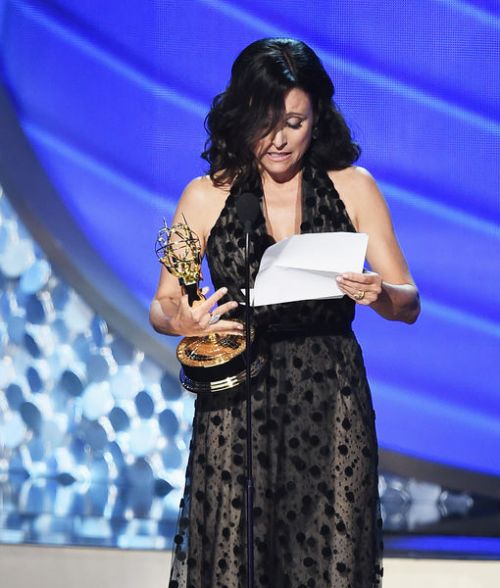
LOS ANGELES, CA – SEPTEMBER 18: Actress Julia Louis-Dreyfus accepts Outstanding Lead Actress in a Comedy Series for ‘Veep’ onstage during the 68th Annual Primetime Emmy Awards at Microsoft Theater on September 18, 2016 in Los Angeles, California. (Photo by Kevin Winter/Getty Images)

We watched the Emmy Awards last Sunday evening only later to learn that it experienced the worst ratings ever for the show.  This demonstrates my personal sense of timing.  Watching the star-studded event also confirmed my complete ignorance of popular television shows.  For instance, I didn’t know that O.J. Simpson had a new reality show that pits everyone against him, and apparently there is a popular game show all about thrones.  I have a lot of catching up to do.

At the Emmys, Jimmy Kimmel was funny what with his peanut butter and jelly sandwich distribution shtick, and Henry Winkler did a fine job hosting the touching annual tradition of the in memoriam video.  But to me, the most poignant moment of the evening came when Julia Louis-Dreyfus accepted the award for outstanding lead actress in a comedy series (for Veep—it turns out that is a television show, too).

The legendary actress’s speech was funny and to be honest pretty typical until the very end when she broke down in tears and said, “I’d like to dedicate this to my father, William Louis-Dreyfus, who passed away on Friday.  I’m so glad he liked Veep because his opinion was the one that really mattered.”

Louis-Dreyfus’s speech apparently struck a chord with an awful lot of people despite the record-low number of viewers.  Her speech led many to tweet expressions of sadness to famed actor, Richard Dreyfuss, wrongly assuming that he was Julia’s father, which is actually sort of funny.  Almost as funny as tweeting someone you think died two days earlier.

But her sweet statement begs a sincere question: Whose opinion really matters to you?  I suspect that the true answer to that question involves a really small number of folks, but I also suspect that we live as if that number is massive.  We are more than a little screwy.

If I can be so bold, I suggest taking some time to consider the real answer to that question—and live accordingly.

Make Them Know

“Make them know.”

In Jesmyn Ward’s award-winning novel, Salvage the Bones, Skeetah, a poor Mississippi teenage boy whispered that phrase to his treasured pit bull, China, before sending her into battle against her nemesis, Kilo.  I found it to be the most gripping line in a terrific book.

Salvage the Bones is a fierce story of a poor family as told through the eyes of a teenage girl, motherless, surrounded by men and boys, secretly pregnant, and trying to understand life as Hurricane Katrina warms up, bears down, and then inundates their world.  Among many compelling topics the novel explores is the idea of invisibility, which is where the phrase “make them know” leapt off the page and demanded my attention.  Unnoticed, overlooked, neglected—those are not good words, and undeniably not a good feeling.

My little family of four lost our home eleven years ago today in Hurricane Katrina, and although we surprisingly have fond memories of that great national tragedy due to a heightened sense of community and the opportunity to meet great-hearted strangers full of love, the raging waters surely had some of our tears sprinkled in.  And, to be honest, from time to time, a little bit of spit in it projected in anger toward institutions including but not limited to governments and insurance companies, pardon the legalese.

And I’ll tell you, if you ever want to get punched by someone from Mississippi (and who doesn’t?), then say that you thought Hurricane Katrina was just in New Orleans.  Please know that it wasn’t.

Make them know.

When you mix marginalization and anger and leave it in the microwave too long, you start to hear those words building in your heart.  And more often than not, they emerge violently.

So why does my family have fond memories of a tragedy in our lives?  Despite the infuriating institutions that failed us?  Despite the relatively speaking inordinate attention our New Orleans neighbors received?  It is because we were loved.  We were known.

In this tragic world of ours, where the recipe for violence is constantly prepared in the kitchen, the best advice I can offer is to be about the work of making others known.  Expecting others to do it themselves is not healthy for anyone.

Summer of Twelve

SUMMER OF TWELVE

I hear tell we had another presidential election and that
London town hosted the Olympic Games,
But everything is hazy since that was
The summer my mother died.

Four years ago today.

Her traitorous liver transfigured her to a dark yellow
And took our sweet mother away from us.
“At least she didn’t have to suffer long” we said
To comfort ourselves.  To no avail.

Four years ago today.

I used to visit her office and unload my troubles as she
Patiently listened to my busy mind analyze the complexities of life.
I now suspect that she marveled and thought:
How did I make this strange man?  I wish she wouldn’t have left us

Four years ago today.

When she knew she was not long for this world she asked me to say
Words at her funeral.  I didn’t want to, but did, and made a
Blubbering fool of myself.  I’d do it again.  I’d do anything for her.
Even write an impromptu poem remembering what happened

Four years ago today.

– Al Sturgeon, Summer of ‘16

On Exploiting Hopelessness

In addition to the steep learning curve associated with a new position at work, I have been preparing to teach a course titled, “Apology, Forgiveness, and Reconciliation,” for the Master of Dispute Resolution program at our West Los Angeles campus.  It is a fascinating and ever-timely topic in this world of ours with no shortage of moving literature, including the book I saved for last, The Sunflower: On the Possibilities and Limits of Forgiveness, by Simon Weisenthal.

Weisenthal survived the Holocaust and gained fame as a “Nazi hunter.”  The Sunflower tells of his being summoned to the bedside of a dying Nazi soldier while a prisoner in a concentration camp where the soldier confessed his deeds and asked for forgiveness.  Weisenthal offered only silence.  Soon afterward, he questioned his response, and in fact, ends his section of the book by placing the reader in his place and posing the heart-wrenching question, “What would I have done?”  The rest of the book shares answers to the penetrating question from fifty-three people around the world, from the Dalai Lama to Desmond Tutu.

Two days after finishing the book, I finally visited the Museum of Tolerance in L.A. and didn’t know whether to be amazed or embarrassed to notice that it was described as “A Simon Weisenthal Center Museum.”  Um, perfect timing?  Although it addresses a variety of topics, the heart of the Museum is the Holocaust Exhibit that guides visitors through the development of Nazi Germany and the terrible atrocities that followed.  It was sadly fascinating to learn that the Nazis began as a few guys sharing burgers in a beer joint, but what struck me most was the statement that this humble beginning grew to such perplexing power to influence fellow citizens to carry out unspeakable acts because they “exploited hopelessness.”

Well, my first inclination was far too easy: Write a blog lamenting how terrible it is to exploit hopelessness and title it, Exude Hopefulness.  But there’s a problem.  Exuding hopefulness is exactly how you exploit hopelessness.  Promise hopeless folks better days ahead.  That’s exactly what the Democrats, Republicans, Libertarians, Greens, and lots of other folks are doing at this very moment.

Hopeless people have to be wary, I guess, but I suspect that wariness is not high on the to-do list of hopeless people.

So, for the sake of the world, I have two thoughts to offer instead.

First, remain hopeful.  You.  Don’t tell others to be hopeful.  You remain hopeful yourself.  Losing hope is too dangerous, and we are susceptible to such terrible things.

Second, remove the reasons others are hopeless.  Actions over words.  Hopelessness is not to be used.  It is to be subverted.  Love people.  Seek justice.  Feed hungry folks.  Give someone a job.  Volunteer your time and your money.

Humanity is both capable of and susceptible to terrible things.  But wow, the possibilities for good are limitless.

A Third Way

It was a disturbing week in these United States.  After celebrating her birthday, America apparently went batpoo crazy.  Thankfully, many people (sadly, not all) posted good statements that condemned all of the violence that destroyed lives in Louisiana, Minnesota, and Texas, so I should just keep my mouth shut, but since I am obviously on a quest to lose all of my friends, here goes.

To begin, although this is admittedly judgmental, I don’t believe people in general and Americans specifically are intellectually honest when condemning violence.  I think we are conditioned to celebrate and rely on violence albeit with sincere opinions on who-what-when-where-why and how much.  Watch a movie (Free State of Jones) or television show (Game of Thrones) or sporting event (UFC) and tell me we don’t appreciate a good guy’s use of violence to take down a bad guy.

Further, the United States makes up 4% of the world’s population and yet shells out 39% of the world’s military expenditures, and of approximately two-hundred nations in the world, twenty-one use capital punishment–and the United States is one of the top five in actually using it.  We hold a strong belief that there is a proper time-place-reason for violence.  Theologian, Walter Wink, called this the myth of redemptive violence—“the belief that violence saves, that war brings peace, that might makes right . . .” It is what we turn to when all else fails.

So when I heard the tragic news about Mr. Sterling, Mr, Castile, and the five Dallas police officers last week, I was deeply saddened but not surprised.  “When all else fails, turn to violence”—that thinking seemed to fuel a lot of the things we now lament happening in schools, nightclubs, police stops, and downtown Dallas, Texas.  Let’s be honest.  We are not outraged by violence per se.  Our outrage concerns who-what-when-where-why and how much.¹

Walter Wink, on the other hand, argues that the very idea of redemptive violence is problematic and that we need a different way.  He suggests creative, nonviolent resistance as the alternative.  Buy his book because I’m not smart enough to explain it well.  What I’ll simply say today is that such a way is based on love.  If you love someone too much to kill them and too much to let them carry on their madness, then creative, nonviolent² resistance is a third alternative.  That was the choice made by Gandhi and King—a true rejection of violence based on a true love of others.

And underneath all three of last week’s major news stories was an absence of love.


¹ I’m not writing any of this to shame anyone for believing that violence can be redemptive.  But don’t be surprised when someone determines that they need to start shooting people because they see no better alternative—that is based on the belief that violence can be redemptive.

² For the obvious questions about police, military force, et cetera, I make an important decision between “force” (the minimum amount of physical strength needed to stop a behavior) and “violence” (anything above the minimum).
 

Kenya Believe It?

IMG_2941

I woke up in the East African village of Kamulu under a mosquito net listening to a rooster that apparently got something stuck in his throat while learning to yodel; in other words, not in Malibu.  Appropriately, a man named Moses led our team’s exodus from the Nairobi airport the night before, but when the morning light replaced the darkness, I was surprised by my surroundings despite multiple reports from previous church trips, including my own family.  It was simultaneously more primitive and wonderful than I had anticipated.

Why did I travel to Kenya?  It isn’t wrong to say that my wife insisted but probably more accurate to say that I needed to see for myself what had stolen her heart. Well, mission accomplished.

Because so many friends have been to Made in the Streets (“MITS”) before me, it would be silly to recount the same observations, like the yummy-ness of chapati, the joy-filled singing of liberated street children, the endless skies on the Maasai Mara, and the beautiful kids jumping streams of raw sewage in the Mathare Valley slums.  Instead, I’ll just share a few personally unforgettable moments:

  1. Meeting Vincent, an impressive seventeen-year-old young man, covered with mud, living in the mud, high as a kite to stave off hunger and cold and yet still able to carry on an intelligent, respectful conversation. I liked him immediately yet left him in such terrible circumstances with a fist bump and will never see him again in person.  But he will never leave my mind.
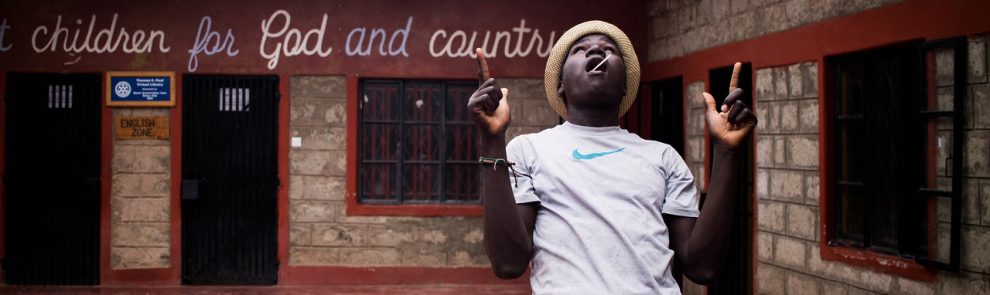
  2. A sunrise run through Kamulu on a crisp morning with Paul (pictured above), a MITS graduate who has become a part of our family since my wife practically adopted him, and for a moment, matching him stride for stride while imagining what it is like to “run like a Kenyan”—and then watching him effortlessly leave me in the dust down the home stretch.
  3. Traveling with Jackton and Millie to meet four MITS graduates now working in Nairobi: (i) listening to reggae music and enjoying a vanilla milkshake at the American-themed Java House with George; (ii) eating scrumptious mandazi prepared by Chef Brian in his apartment; and (iii) sharing in an impromptu Bible study with the two Marys. Four glowing successes.
  4. Standing with my wife in the darkness outside our safari tent and looking up at the African sky to discover more stars than I had ever imagined one sky could hold.
  5. Sitting under the ceiling fans at church in Kamulu and listening to rescued street kids sing Amazing Grace, particularly the verse that proclaims: Through many dangers, toils, and snares, I have already come / ‘Tis grace hath brought me safe thus far, and grace will lead me home.

If I’m honest, I think I went to Kenya to check it off my list.  Instead, it did a number on my heart, too.  Kenya believe it?