Annie Dillard went to Tinker Creek to explain to me that we sleep to time’s hurdy-gurdy; at Lane’s Landing, for a time, Wendell Berry taught me to rest in the grace of the world and be free; and from Provincetown’s kettle ponds Mary Oliver inquired of my one wild and precious life.
They are all gone now. But I am still here in Green Lake, my own special place, and their words live on in my soul. I go for walks in the woods near my house and consider them.
When I feel lonely, as I often do; and the world seems crazy, as it always does; and even when everything seems right and true—the woods welcome me in. Without pretension. Without proclamation. Without qualification. Without even words. I just know that I am allowed to enter a better, simpler world and breathe.
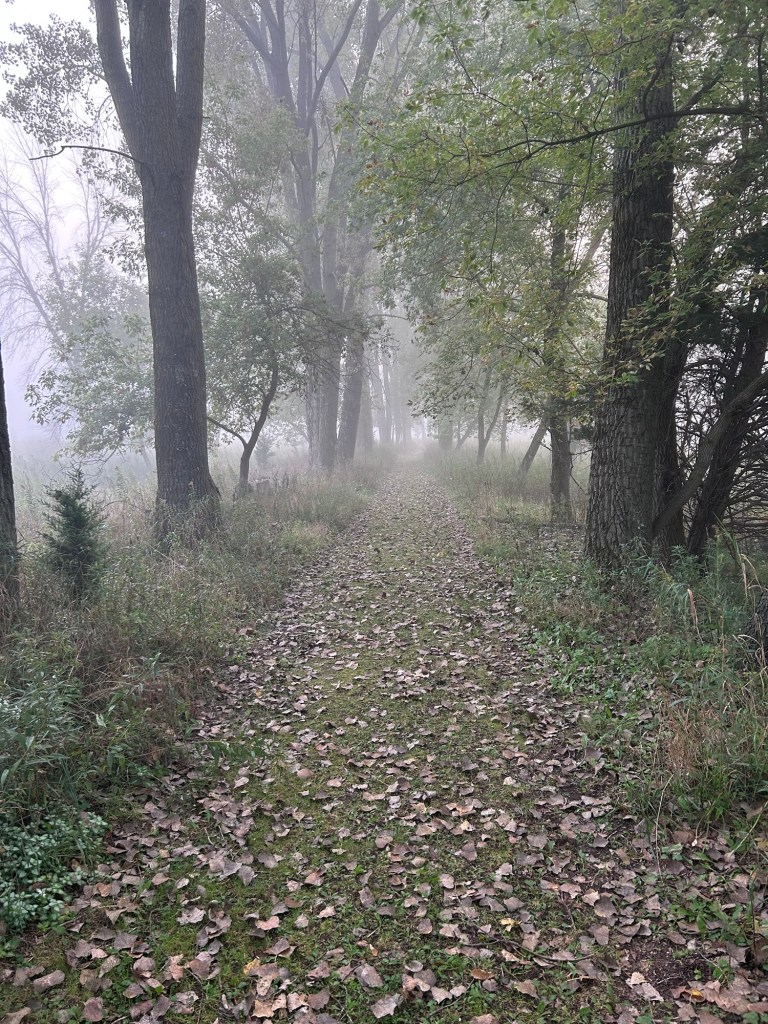
I prefer the early morning version. Cooler. Damper. Foggier. Quieter. Restful.
The squishy, crunchy sounds of my own steps. The shrill announcements of the birds. The glistening artistry of the spiders. The crisp morning air. The heightened sense of place.
I am no expert in the woods. No Berry or Dillard or Oliver. But I carry their expertise with me like a backpack. Like a trail mix for sweet and savory nourishment. I forget their specific words, but as I look and I listen, I remember their subject matter, and especially the way their poetic gifts made me feel.
And it is enough. Enough to feel like I belong here. Like I always belonged here. Like I belong here better than I belong in other places.
I don’t stay. The occasional visits seem to be enough. They give me something, unnameable, that allows me also to walk through the crazy world, the loneliness, and even the happiness. I believe that Thoreau once said that he left the woods and Walden Pond because if he stayed any longer he might have stayed forever and who can accept such a gift?
(Please don’t Google it. I won’t. I want to believe that is what he said.)
So I don’t stay. But I do return. As long as my body allows, I will return. And when my body no longer allows, I will return in my mind.
And when the time comes that I cannot return even in my mind, I will join friends that I never met on the mysterious other side: Wendell Berry and Annie Dillard and Mary Oliver.
And then, a thought so astonishing that it is hard to believe, I will stay forever and ever, time without end. Amen.
Walk around smiling in wonder at your surroundings, As if for the first time.
Take way too many pictures. Don’t be ashamed. Be on the lookout for all the beautiful things you hope never to forget.
Drive slowly, and take in the sights. You will piss off people who are in a hurry, but that’s okay. Because you are a tourist, enamored with your great privilege.
After all, and anyway, we are all just tourists on this floating bed and breakfast we call Planet Earth.
Today is All Saints Day, and as I reflected on this special day on the Christian calendar, I came across a prayer inspired by Oscar Romero. Romero, as you may remember, was an El Salvadoran priest who stood in solidarity with the poor and was assassinated in 1980 just after delivering a sermon in a church-run hospital that cared for the terminally ill. This prayer was not written or spoken by Romero but is inspired by his words and composed in honor of his life and teaching. I think it is beautiful and appropriate for any day, but maybe especially today, on All Saints Day.
A Prayer of Oscar Romero
It helps, now and then, to step back and take a long view. The Kingdom is not only beyond our efforts, it is even beyond our vision. We accomplish in our lifetime only a tiny fraction of the magnificent enterprise that is God’s work. Nothing we do is complete, which is a way of saying that the Kingdom always lies beyond us. No statement says all that could be said. No prayer fully expresses our faith. No confession brings perfection. No pastoral visit brings wholeness. No program accomplishes the Church’s mission. No set of goals and objectives includes everything. This is what we are about. We plant the seeds that one day will grow. We water seeds already planted, knowing that they hold future promise. We lay foundations that will need further development. We provide yeast that produces effects far beyond our capabilities. We cannot do everything, and there is a sense of liberation in realizing that. This enables us to do something, and to do it very well. It may be incomplete, but it is a beginning, a step along the way, an opportunity for the Lord’s grace to enter and do the rest. We may never see the end results, but that is the difference between the master builder and the worker. We are workers, not master builders; ministers, not messiahs. We are prophets of a future that is not our own.
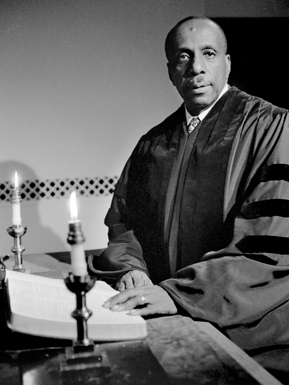
I Will Light Candles This Christmas — by Howard Thurman
Candles of joy, despite all sadness,
Candles of hope where despair keeps watch.
Candles of courage for fears ever present,
Candles of peace for tempest-tossed days,
Candles of grace to ease heavy burdens,
Candles of love to inspire all my living,
Candles that will burn all the year long.
I remember a scene in the movie, Glory, when the brave soldiers of the 54th Regiment Massachusetts Volunteer Infantry are sailing down a lazy river into the South. One says, “Welcome home, boys,” and another replies, “I forgot how hot it is down here.”
Given our recent move and our present heat wave, let’s just say that I have been remembering that line on a daily basis.
So far, I have surprisingly enjoyed the heat. I often say that I prefer hot to cold, but I have secretly wondered if that would prove true once removed from idyllic Malibu weather and back in the land of summertime heat and humidity. Well, so far, so good.
I am so white that at times I’m invisible and have already had two skin cancers carved out of neck, so it is a bad idea for me to spend much time in the actual sunshine. But I have noticed in my walks to and from and around campus the fantastic feeling of sunshine on skin.
Paul Laurence Dunbar is one of America’s first modern black poets, and he described the summer heat in almost sensual terms in his beautiful poem, A Summer’s Night.
The night is dewy as a maiden’s mouth,
The skies are bright as are a maiden’s eyes,
Soft as a maiden’s breath, the wind that flies
Up from the perfumed bosom of the South.
Like sentinels, the pines stand in the park;
And hither hastening like rakes that roam,
With lamps to light their wayward footsteps home,
The fire-flies come stagg’ring down the dark.
I realize that summer has not officially arrived, but that doesn’t stop me from being there in my mind as I delightfully stagger home among the fireflies.
Summer is officially a full month away, but on a university campus that recently put its final graduation ceremony to bed, it now feels like summer. Parking is suddenly fantastic. Campers will arrive soon. Neighbors are flung all over the world. And excepting the nuisance of May Gray and June Gloom, there are more hours of daylight to enjoy.
I love this time of year when the sun shows up early and goes home late. Life just seems full, and opportunities abound. Early morning runs are much easier when the sun beats you out of bed, and coming home from work is simply happier when the world is still bright. It makes me feel a little like a child again.
Robert Louis Stevenson’s poem, “Bed in Summer,” shares the perspective of a poor kid who isn’t very fond of winter but loves summer so much that having to obey parents at bedtime is torture!
In winter I get up at night
And dress by yellow candle-light.
In summer, quite the other way,
I have to go to bed by day.
I have to go to bed and see
The birds still hopping on the tree,
Or hear the grown-up people’s feet
Still going past me in the street.
And does it not seem hard to you,
When all the sky is clear and blue,
And I should like so much to play,
To have to go to bed by day?
I get it, kiddo. You know, today is Monday, and it is going to be Monday all day long. But it feels like a summer kind of Monday to me. And since I am officially a grown-up trying to hold on to a childlike heart, I can soak up the day for as long as I want and go to bed when I want to!
I will head to the Idaho-Washington border tomorrow to spend a few days alone on a personal retreat—heaven for an introvert and a planner. Serving a church family that follows an academic calendar makes this the perfect time for such a thing. There is time to breathe and work to do, and there are dreams to dream and plans to develop. I am ready for all of this and more.
Solitude is an excellent work space and a good planning partner. There is something magical about standing at attention, all alone, listening for still, small whispers transported on air. I cannot wait.
I recall Wordsworth’s vivid description from over two centuries ago of a solitary cloud floating over thousands of golden daffodils and then an inner state of being that he can access so that his happy heart dances among those spectacular flowers. That’s what I’m talking about. That’s what I love about solitude.
I Wandered Lonely as a Cloud – by William Wordsworth
I wandered lonely as a cloud
That floats on high o’er vales and hills,
When all at once I saw a crowd,
A host, of golden daffodils;
Beside the lake, beneath the trees,
Fluttering and dancing in the breeze.
Continuous as the stars that shine
And twinkle on the milky way,
They stretched in never-ending line
Along the margin of a bay:
Ten thousand saw I at a glance,
Tossing their heads in sprightly dance.
The waves beside them danced; but they
Out-did the sparkling waves in glee:
A poet could not but be gay,
In such a jocund company:
I gazed—and gazed—but little thought
What wealth the show to me had brought:
For oft, when on my couch I lie
In vacant or in pensive mood,
They flash upon that inward eye
Which is the bliss of solitude;
And then my heart with pleasure fills,
And dances with the daffodils.




 I will head to the Idaho-Washington border tomorrow to spend a few days alone on a personal retreat—heaven for an introvert and a planner. Serving a church family that follows an academic calendar makes this the perfect time for such a thing. There is time to breathe and work to do, and there are dreams to dream and plans to develop. I am ready for all of this and more.


