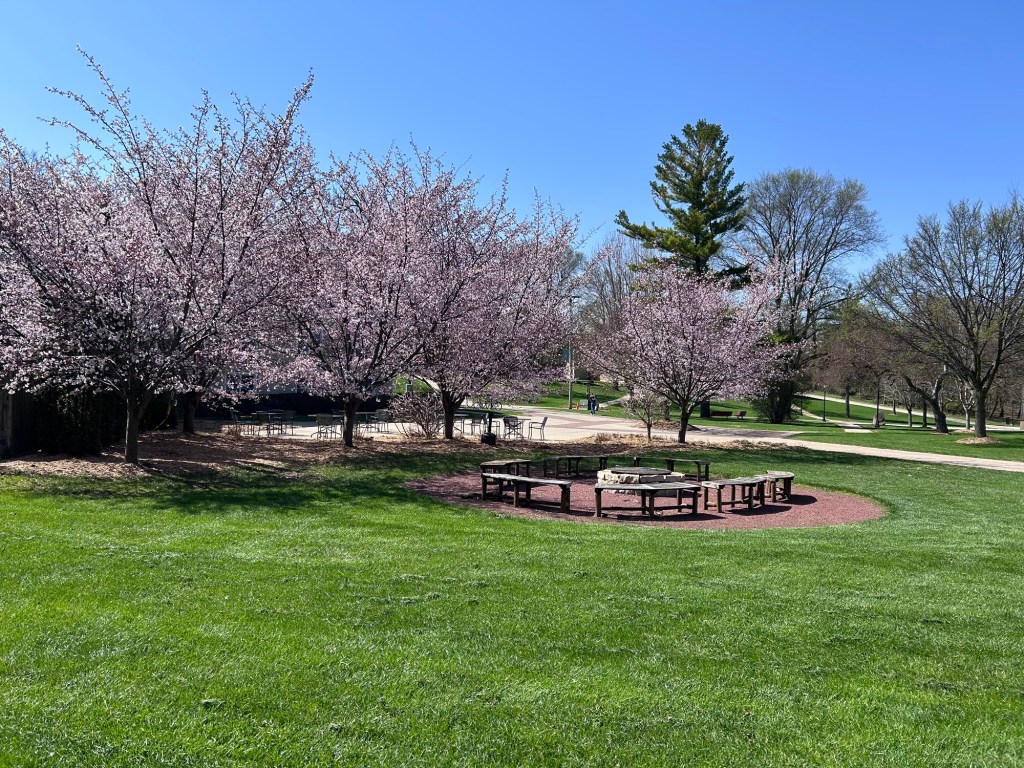
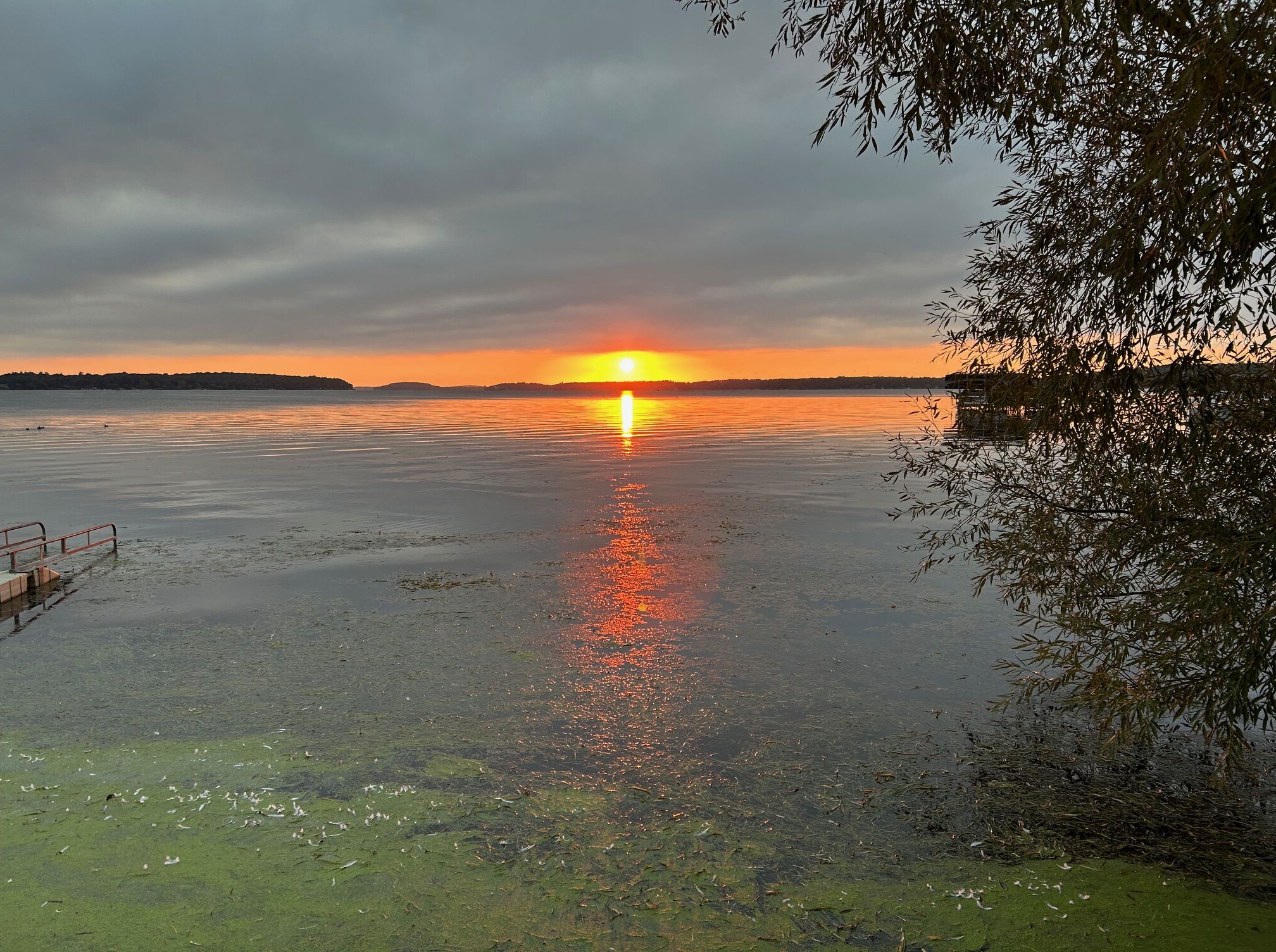
Today turned out to be the day. Tuesday. April 21. Far later in the calendar than those living in other places might imagine.
Oh, there have been springlike days in the last month or so, but we always knew that they were just teases. (And I noticed highs only in the fifties lurking next week.) But today was the day nonetheless. I am sure of it. Cherry blossom trees showing out. Birds singing in the bright blue sky. Smiling students lounging on the stunningly green grass, one calling out to me: Hey Dean Sturgeon, is this what California is like?
Yes, it is exactly like this.
All I recall is that it was at a wedding event sometime years ago when I lived in Malibu, probably the rehearsal, when I met a young couple in from Montreal, friends of either the bride or groom. We talked of the weather, probably how perfect it was in SoCal, which it always was. I am sure that I said that I would love to visit Montreal someday, and I suspect that I made it clear that winter was out the question since I was sure that I would never choose to experience a real winter on my own. I remember that the young man insisted that I would have to visit in the winter, which he described as magical. But he described one other phenomenon that really captured my attention. He described a day that happens every year in the spring after a long, long winter when suddenly, somehow feeling like a surprise, spring would appear, and everyone would emerge from their hibernation with an indescribable joy. He said it was the best day of the entire year.
I remember thinking two things. One, I never want to live somewhere with a bitter winter. But two, wow, wouldn’t that be incredible.
Today was that day in my part of Wisconsin. Tuesday. April 21. And it was incredible.
I drove home from work today with the windows down and the sunroof open. I turned on the news at home and fully expected the meteorologist not to use degrees and atmospheric conditions to describe the weather but to say instead that today was happy outside. Because it was.
When we lived in Malibu we told ourselves never to take the constantly beautiful weather for granted, and I think we succeeded. And it is hard to argue with living somewhere where it is almost always perfect outside. But I have learned that there is also something very special about having to wait and wait and wait for something, through month after month of coats and gloves, warm hats and long underwear, snow shovels and ice scrapers, frozen lakes and runny noses, dark days and air so cold that it literally hurts to breathe. Yes, there is something special about that, too, arguably even better, and when that special long-awaited day arrives, that dude from Montreal was right. I’m not sure it was the best day of the year, but it was a damn good one.
I wanted to title this essay how a third century Italian bishop and a twentieth century Canadian athlete unwittingly combined to inspire a song that has motivated me to embrace life ever since I was a teenager — but that seemed a bit wordy.
So, “Blazing Sky” it is.
Less than 40,000 people live in Formia, a small Italian city located halfway between Rome and Naples on the Mediterranean Coast where two patron saints watch over the town: the famed John the Baptist, and the lesser-known Erasmus of Formia. Not much is known of the early life of the bishop named Erasmus who lived in the third century, but there are many legends of various tortures that he faced living in the era of violent Christian persecution under the Roman co-emperors, Diocletian and Maximian. There are fanciful legends of surviving a red-hot oven as well as rolling down a hill in a barrel filled with protruding spikes. There is a particular legend of miraculously surviving a disembowelment, which led him also to be the patron saint of those suffering abdominal pains, including women in labor. Erasmus of Formia also became the patron saint of sailors, which may be associated with the legend of his continued preaching when lightning struck next to him, the sort of weather event that led many a terrified sailor to cry out to the troubled skies in search of protection.
Rick Hansen has no visible connection to Erasmus of Formia. Rick was born seventeen centuries later and across the planet on Vancouver Island in British Columbia. Rick did not face torture by religious persecution, but he did face tragedy as a teenager when he was thrown from the back of a pickup truck on the way home from a fishing trip and suffered an injury that left him paralyzed from the waist down. And although Rick has no miracle stories, his response to a devastating injury was nothing short of fantastic. Rick worked hard on rehabilitation, graduated from high school, and went to college to major in none other than physical education. He became a high school coach, and more notably, a world-class athlete who won multiple national and world championships. Rick befriended fellow Canadian, Terry Fox, who had a leg amputated due to bone cancer. In 1980, Fox famously attempted a run across Canada to raise money for cancer research, a run that had to end after 3,000+ miles when the cancer returned. Fox died less than a year later, and his heroic story inspired books, movies, and an entire Rod Stewart music tour. It also inspired his friend, Rick Hansen. In 1985, Rick began his Man In Motion World Tour and for the next two-plus years Rick wheeled for 25,000 miles across four continents and through thirty-four countries. Incredible.
Erasmus of Formia died over seventeen centuries ago, but Rick Hansen is still alive today doing inspirational things. (I like that despite the initial accident his love for fishing never waned; and I especially love that today he works to protect sturgeon populations and has written a children’s book titled, Tale of a Great White Fish: A Sturgeon Story.)
What is the connection between Erasmus of Formia and Rick Hansen? I am glad that you asked.
Among the many people inspired by Rick Hansen is fellow Canadian (and uber-famous music composer and producer) David Foster. Foster was working on another project in his Santa Monica recording studio in the 1980s when a movie director friend entered and told him that he had finished a feature film on Rick Hansen and his Man In Motion tour. Foster’s songwriting wheels began to turn, and magic happened when he shared the movie with British singer, John Parr, as they attempted to write a theme song for the movie, St. Elmo’s Fire. The director of St. Elmo’s Fire wanted a song about determination, and after witnessing the story of Rick Hansen, the lyrics just poured out. In a couple of hours they had a megahit song that they titled, Man in Motion. “All I need’s this pair of wheels” turn out to be Rick Hansen’s wheelchair, not Demi Moore’s jeep.
In the movie, Demi Moore, Emilio Estevez, Rob Lowe and the gang hang out at St. Elmo’s Bar, although the movie is titled, St. Elmo’s “Fire.” St. Elmo’s fire is an actual electrical weather phenomenon, a bluish glow that often appears in a stormy sky and can signal a coming thunderstorm, which medieval Mediterranean sailors found most valuable. The movie studio didn’t care for the title, so to keep the title the director wrote a scene into the movie where Rob Lowe’s character explains the phenomenon to comfort Demi Moore’s character. You see, those ancient sailors were comforted by St. Elmo’s fire and attributed that cherished fiery glow to their patron saint, St. Elmo — which is an alternate name for Erasmus of Formia.
Rick Hansen is the Man in Motion OG. And Erasmus of Formia is the St. Elmo in St. Elmo’s Fire.
And for forty years I have been in love with that song.
I never saw the movie way back in 1985. Or since. But I surely heard the song. Each time it came on the radio as I cruised the streets of my hometown something magical happened in my heart. My teenage self consistently reported it as my favorite song even though I didn’t know what any of it meant, but multiple phrases combined with a powerful tune to speak to my young, idealistic soul:
Growin’ up, you don’t see the writing on the wall.
Play the game, you know you can’t quit until it’s won.
You’re just a prisoner and you’re tryin’ to break free.
Burning up, don’t know just how far that I can go.
I can make it, I know, I can.
I can climb the highest mountain, cross the wildest sea.
It has been four decades since I was moved by this classic song. And although I have not been a martyr nor a paralympian, maybe I should not be surprised that my life can undoubtedly be characterized as a man in motion. It has been quite an adventure. And forty years later, I can be driving down a rural Wisconsin road as a fifty-five year old man, and that song can come on the ’80s station, and I will instantly crank it up to an unhealthy level and sing at the top of my lungs. And in such moments, I am fifteen years old again. And I still claim those lyrics decades later: I can make it, I know, I can.
I am glad now to picture a tortured saint literally barreling down a hill and a determined athlete wheeling across a continent. That makes me love the song even more. I instantly feel less tired and more invigorated to face whatever challenge awaits my future. Two people that never knew each other can inspire two people to write a song that can have that effect on a person. Will you join me in chasing after life regardless of its terrors and its unfair challenges?
I can see a new horizon underneath the blazin’ sky I’ll be where the eagle’s flying higher and higher Gonna be your man in motion, all I need’s this pair of wheels Take me where my future’s lyin’, St. Elmo’s fire