I hear hurricanes a-blowin’ / I know the end is comin’ soon / I fear rivers overflowin’ / I hear the voice of rage and ruin / Don’t go around tonight / Well it’s bound to take your life / There’s a bad moon on the rise.
– John C. Fogerty
It’s guilt, I think. I get this odd feeling watching television coverage of hurricanes, you see, like the terrible destruction wrought by Helene yesterday. I’m guessing it’s guilt with maybe some weariness and empathy sprinkled in.
Empathy because although I dodged tornadoes in Arkansas, earthquakes and wildfires in California, a pandemic in Tennessee, and frigid winter temperatures in Illinois, a hurricane in Mississippi holds special status in the disaster-littered timeline of my life. I have absolutely been there.
And weary because thirty-four hurricanes made landfall in these United States since Katrina changed my life in 2005, including four just this year, and if climate change has shown its hand there are many more to come that will be more intense than ever. I feel weary when I see yet another video montage of roaring water, relentless wind, and devastated humans left behind. I know the exhaustion, and there will just be more and more.
But it must be mostly guilt because of the extraordinary response to Katrina. I don’t think there’s been anything like it before or since, and I had a front-row ticket to such incredible love and generosity. That is surely not everyone’s experience, including today. That Katrina turned out to be a highlight of my life is proof that my experience was abnormal.
But this reflection on my emotional salad is all for my personal therapy. I wonder what you think. How should you respond to these perennial tragedies on the evening news?
For starters, I’d say, give when you are so moved. Help the victims of Helene. I know exactly how they will feel when you do. Their hearts are broken. But I can also picture you giving away your piggy bank after one tragedy, then turn on the news the next day only to discover a new tragedy and one less piggy bank. I get not knowing how to respond to the never-ending trail of bad moons that we encounter through various media day after day after day.
I have a general thought.
I recall one of the amazing Katrina volunteers from somewhere in the world coming to tell me goodbye after his group spent several days working their tails off out of pure love. It was killing him to leave with so much undone, and it was my turn to play comforter to another’s tears. I fumbled for something helpful to say to someone so kind, and I mentioned that I suspected he could scratch that itch for helping others in great need back in his hometown, too. Sure, Katrina captured the attention and heart of the entire world, but there are people in great need all around us if we have the courage to look in the dark corners of our own communities. I truly believed that then, and I still do.
So I guess I don’t know how to cure all the problems in the world, including how one person can respond to all the problems in the world. I wish that I did. All I can offer is the idea of adopting a daily posture of keeping our eyes and hearts open to those all around us facing bad moons in their evening sky. Someone close by is in for nasty weather, and if we could imagine a world where we consistently love our neighbors, then maybe we can start to make a dent in the evening news, too.
“Purple haze all in my brain / Lately, things just don’t seem the same / Actin’ funny but I don’t know why / Scuse me while I kiss the sky.” – Jimi Hendrix
I stopped using social media to discuss politics a long time ago, mostly because I just didn’t love the desire to claw out my eyeballs. The following represents only a minor shift in personal policy, I hope.
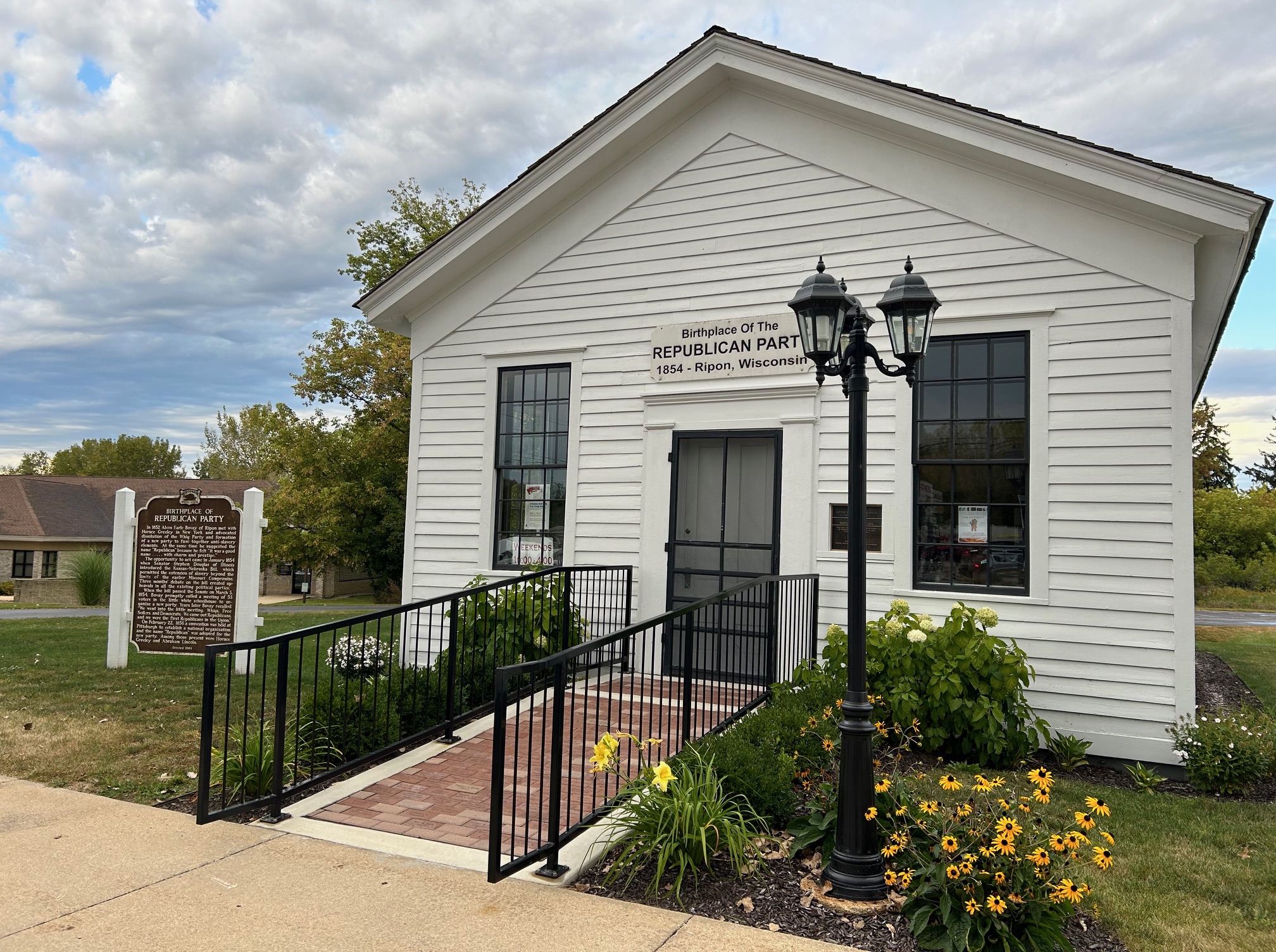
My new hometown is the birthplace of the Republican Party. Alvan Bovay, a lawyer and mathematician from New York City, moved to Ripon, Wisconsin, in 1850, one year after the city was founded, and in 1854, frustrated by the potential spread of slavery in the proposed Kansas-Nebraska Act, called a meeting at the First Congregational Church and proposed forming a new political party to oppose slavery if the bill passed. Well, the bill passed, and Bovay hosted a follow-up meeting at what is now known as the Little White Schoolhouse, a meeting that led to the establishment of the Republican Party. Six years later, the United States elected its first Republican president, Abraham Lincoln, and all hell broke loose soon thereafter.
As you might suspect, when I pass by the Little White Schoolhouse in my new hometown, I often see travelers there taking pictures from their respective pilgrimages. Ironically, I think supporters of both major political parties should take pilgrimages here, albeit for different reasons: Republicans, for obvious reasons, being the birthplace of their party, but Democrats, on the other hand, for historic reasons, too, i.e., to honor an early political movement that stood up for basic civil rights for Black citizens and then held the nation together during the bloodbath that ensued when Southern states seceded to preserve white supremacy. There’s much there for both to celebrate if they so choose.
In a way, I guess my new hometown serves as a nice microcosm of life in a purple state, having something that both Democrats and Republicans can honor.
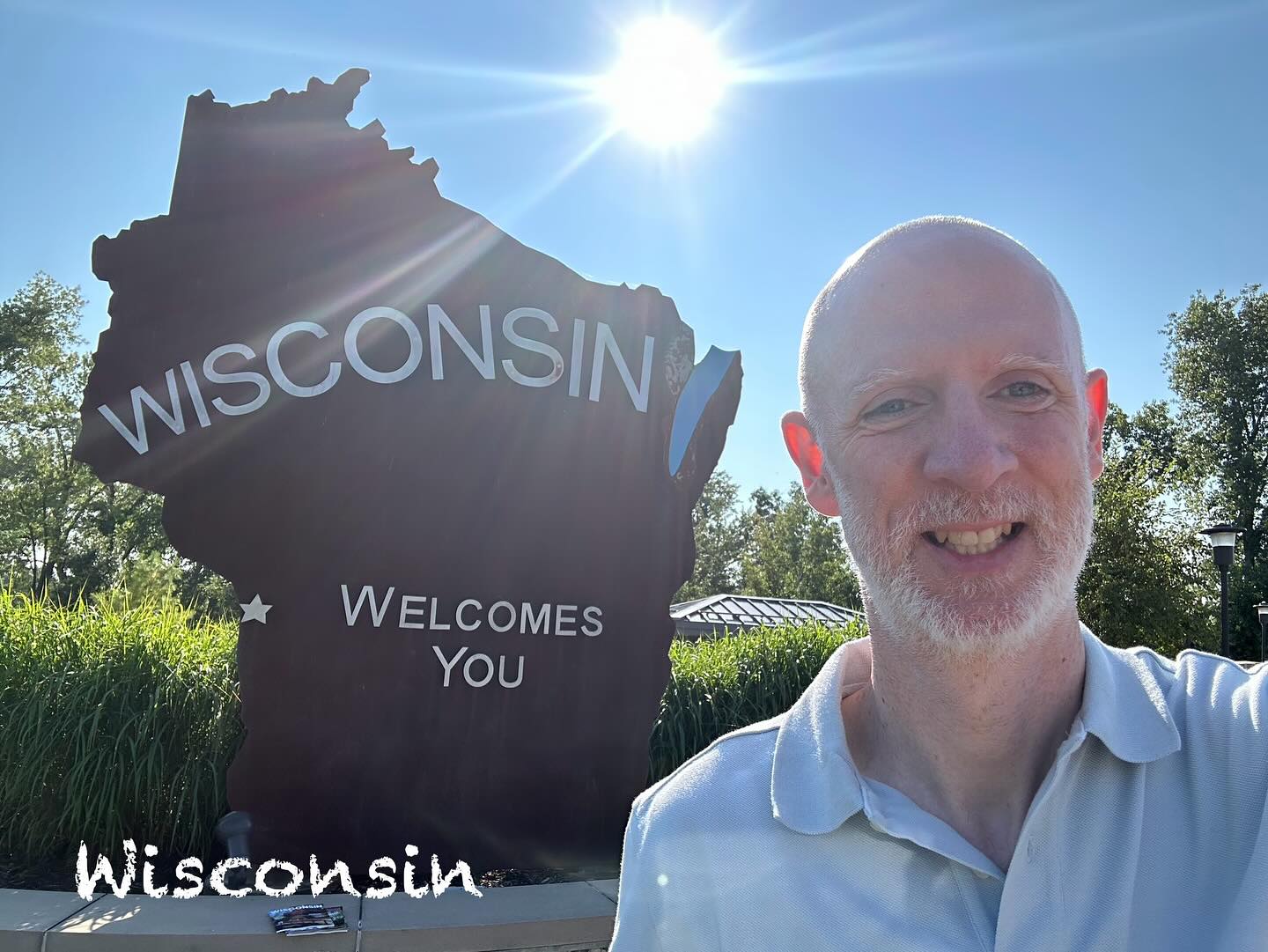
With the 2024 presidential election on its final approach, Wisconsin, my new home state, is receiving a lot of attention as a “battleground” state. (My new academic department chair was quoted in Newsweek just last week.) Wisconsin is one of only five states (along with Arizona, Georgia, Michigan, and Pennsylvania) that voted for Trump in 2016 and Biden in 2020, displaying the capacity to vote for a presidential candidate from different parties. In addition, officially, and this may change following the next election, Wisconsin is one of only three states (along with Montana and Ohio) that has one United States Senator from the Democratic Party and one United States Senator from the Republican Party—down dramatically from twenty-seven split delegations in 1980.[1] Wisconsin is apparently the prototype of a “purple” state, a mixture of red and blue—even though when it comes to colors, this football-crazed state prefers the green and the gold to that associated with one of its historic rivals, the Minnesota Vikings.
I happen to like purple—when it comes to politics.
I’m actually quite blue, to be sure, when it comes to the political team I typically root for, and I have strong feelings along those lines about this particular presidential election, but as one who cares deeply about words like diversity, equity, inclusion, and belonging, and very much dislikes words like echo chamber, groupthink, and homogeneity, I am fond of what are now extraordinary places where people from different perspectives live in community and everyone has the chance to speak up and be heard. So, I like living in a place that is currently known as a purple state.
However, refusing to put my head in the sand, I’m well aware that these rarities are headed toward extinction, and I’m not sure that will change anytime soon.
I sort of like the idea of a purple party. (This is where my wife, a major Prince fan, perks up, and I confess that going back to (political) parties like its 1999 seems surprisingly nice given today’s crazy town carnival, but that’s not where I’m headed with this little essay.)
I sort of like the idea of a purple party, but I’m not going to call a meeting at the Little White Schoolhouse and try to start one, mostly because I only sort of like the idea and think it would turn out poorly. The idea of a purple party would probably end up as a gathering of all the moderates, those tired of the extremists on both sides—almost a call back to the political establishment once upon a time. Make America Moderate Again, if you will. I can see the purple MAMA hats already.
But actually, sometimes, I like extremes. Like, a lot. For example, all things considered, pretty much any landmark movement for human rights was a radical movement once upon a time, and I want to be on those teams.
No, instead of a party for “those in the middle,” though an understandable wish for many, what I wish for instead is not even a party, just a place in this world where people from very different backgrounds with very different characteristics and very different perspectives can be in the same place and learn from each other and refuse to hate each other (which is where the train consistently derails) and choose to respect each other as human beings. Places where Justice Ginsburg and Justice Scalia go to the opera together, and where George W. Bush and Michelle Obama exchange hugs and cough drops, and where friendships develop like Snoop Dogg and Martha Stewart; Ella Fitzgerald and Marilyn Monroe; Sherlock Holmes and Dr. Watson; Harry and Sally; Bert and Ernie; Woody and Buzz.
Wishful thinking, I know, this notion of radical respect and radical friendship across dividing social lines. Who could really imagine that happening anywhere? But if anyone ever calls a meeting at a little schoolhouse somewhere with that in mind, please pass along the invitation.
[1] Sure, Maine and West Virginia also have split delegations, but theirs are Independent and Republican, not Democrat and Republican. And don’t even try with Vermont: nothing split about that delegation!
Life in these United States involves immersion in a culture where bigger is typically considered better. That’s undeniable, I think. We naturally count likes and followers, poll numbers and votes, items sold and bottom lines, box office receipts and numbers of thumbs up, runs/goals/points leading to wins and losses—and judge what is “successful” accordingly. The more, the merrier, so they say. I have yet to see someone enter the Shark Tank and say: My dream is a nice, small business. Hell, no one gets to be a “shark” on Shark Tank for having a small business. Like I said, everywhere we turn: bigger = better.
Not surprising. Our foundational institutions are based on competition: a capitalistic economic system; an adversarial justice system; a democratic political system: in a competitive world, bigger numbers are how we establish the winners and the losers. That is just what we do.
I opened my laptop last Friday to the New York Times article, “Trump Claims Harris’s Rallies are Smaller. We Counted.” Of course, you did. That’s what we do: count sizes of things. It is like we all wear glasses with special lenses so that every person and everything that we see is on one side or the other of a greater-than or less-than sign. Those familiar mathematical signs sit above the commas and periods on our keyboard, and even the words themselves imply value. Greater than. Less than.
This is all well and good (I guess), unless you are on the less-than side. Unless you are (brace yourself)—small. In a competition-based society, the underlying idea is that being small and coming up short is unfortunate and that such misfortune provides the motivation to do more, to grow bigger, based on the assumption, of course, that bigger is better. I mean, one of the very definitions of “small” is “insignificant and unimportant.”
I’m not sure that I buy the entire premise.
__________________________________________
Ten years ago, during the college search journey with our youngest daughter, we learned about small, liberal arts colleges. I confess: as a first-generation, Pell-eligible student myself, I knew very little about an awful lot, and these small colleges were a revelation. My primary experience had been with large, public universities, community/junior colleges, or generally mid-sized, private, faith-based universities. But as we searched, we found these cool, tiny places fascinating.
We learned of the work of Loren Pope, an independent college counselor who said, “The smaller the school, the more impact it can have on a kid. My mission in life is to change the way people think about colleges.” Pope wrote a book titled, Colleges that Change Lives, and we visited several on his list, including a tiny place in rural Wisconsin. We loved our visit to Wisconsin, but our daughter ultimately decided that that particular college was not the place for her college education. But she said to my wife and I: “You two should work there someday.”
Well, life is funny. Several years later, my wife and I did find ourselves working at a small, liberal arts college in rural Illinois that we loved very much. And now, hot off the presses, we are working at a small, liberal arts college in rural Wisconsin — not the same one we visited a decade ago, but nearby, and for us, even better.
I can say from personal experience that, despite today’s disturbing rhetoric, colleges of all shapes and sizes can change lives for the better, but I must also say that I find myself enthusiastically agreeing with Loren Pope that these small colleges can have an extra special sort of impact. In my short time at Ripon College, I have watched the presidential debate and considered the future of our nation with an intimate group of students; watched a football game on a lovely Saturday afternoon where none of the players involved had an athletic scholarship; attended an activities fair and visited with students promoting interests ranging from paranormal activity to equestrian sports, from Greek Life to service organizations, from physics to art, from College Democrats to College Republicans, and affinity groups representing Black students, LatinX students, Asian students, LGBTQIA+ students, and more. All on a campus with less than a thousand students, and all on a campus where these students with diverse backgrounds and diverse interests know one another and the professional educators that love what they get to do here.
There is a particular beauty in something small, but to be small is to be at risk in this world. Small businesses, small farms, small towns, and small colleges are all at constant risk of extinction. But I think there is a corresponding and greater risk on the other side of the equation. In my early days of full-time ministry, I stumbled on some writings of a youth pastor/theologian named Mike Yaconelli, who was considered sort of edgy in a way that I found interesting. It was the heyday of “church growth” strategies, and I remember that he wrote something like, “The only thing you need to worry about with church growth is not to grow too big.”
I liked that then, and I like it now, more than ever.
Aristotle had a similar idea, from what I understand, and wrote extensively on his belief that a city-state should be big enough, but not too big, and that maybe 500-1,000 people was, to quote the philosopher Goldilocks, just right. To present day, Simon Sinek makes a similar argument. In his wonderful book, Leaders Eat Last, in Part 5 he outlines “the abstract challenge,” i.e., as civilizations and organizations grow large, the people the leaders purportedly protect tend to become abstract, invisible to the leaders. Sinek doesn’t hold back on the ramifications and titles chapter thirteen: Abstraction Kills.
All I hear is Yaconelli saying to literally take care not to get “too” big, i.e., so big that you cannot know one another. Don’t grow so big that people become just a number.
What is it that I find so special in the small college setting, the thing about small anything that transcends the typical experience in our particular “advanced” culture? It reminds us to truly see each other.
I often wonder if the world is losing its marbles, and although questioning institutions is one of my favorite things to do, the warlike drumbeat questioning the age-old assumption that a college education is a good thing sort of blows my mind. Is college for everyone? No. Is college too expensive for many? Yes. Should we work to improve things? Sure. But my goodness, I could write forever about the impact of college on the world as well as individual lives and families, including mine.
Instead of feeding our tendency to ask poorly-framed questions (which, ironically, college can help address), maybe the overly broad “Is college worth it?” should be reframed as “Which colleges are worth it?” And if so, I humbly suggest that we check our culturally-influenced tendency to evaluate an answer thinking that bigger is better and be willing to look to the small places. You just might discover a gem.
“Here it is again, the Great Reversal: many of the first ending up last, and the last first.” – Jesus (Matthew 20:16, MSG)
When despair for the world grows in me / and I wake in the night at the least sound / in fear of what my life and my children’s lives may be, / I go and lie down where the wood drake / rests in his beauty on the water, and the great heron feeds. / I come into the peace of wild things / who do not tax their lives with forethought / of grief. I come into the presence of still water. / And I feel above me the day-blind stars / waiting with their light. For a time / I rest in the grace of the world, and am free. – Wendell Berry, The Peace of Wild Things And Other Poems (Penguin, 2018).
I read Tom Lake. I should see Swan Lake. I have seen the Great Salt Lake. I remember Ricki Lake. There’s a British steeplechaser named Iona Lake (what a terrific name). For a few more days, I live in a town named Green Lake. It is my favorite lake so far.
Green Lake is a cool little place. It is four miles from Ripon, which is where I work and will live, and it boasts a population of 1,001. (I like to think the 1 is just for me.) But, in the summer, the population of Green Lake explodes. The “Travel Wisconsin” website explains why:
Visit the deepest lake in Wisconsin and the welcoming city on its shore. Located in the central region of the state, the outdoor recreational opportunities here are endless. Fish for trout and walleye, paddle, hike or bike the 27 miles of pristine shoreline, and stay a while with your crew to experience all the area has to offer. Relax after a long day of adventures at one of the resorts and spas and be sure to take a swing at one of the four scenic golf courses.
Not your typical tiny town. Bottom line: I’m not roughing it.
Growing up poor, we never went to “the lake” like many of our more affluent friends, but growing up in deep church culture, I recall the tsk-tsking of church members who I understood needed to spend less time at “the lake” and pay more attention to regular church attendance. Who knew that poverty could actually be a built-in advantage in the eyes of the Lord? I’m quickly learning now what I was missing then.
I have enjoyed several early morning runs along the lake here, listening to its gentle gurgle, the yawning chirps from the trees, and the occasional splash somewhere nearby, while seeing lazy birds glide by alone, an occasional squawking duck, and the wild turkeys trot clumsily across the road. And I have enjoyed a lovely meal with friends at a popular restaurant here, relaxing at the fire pit together while waiting for a table, watching dark clouds roll across the sky. And I have enjoyed watching the day end at Sunset Park here with a boater returning to shore for the evening, the sun painting the horizon with lavender and salamander brushes, and an elderly couple joining me in awe.
I hear that the winter is a little different, with an average high of 26 degrees and the activities transformed into ice fishing and ice skating, snowmobiling and snowshoeing, skiing and sledding. I may be crazy, but I think that sounds lovely, too.
Why is life at the lake so special? The word peaceful comes to mind. And Wendell Berry’s poem seems to capture it best: somehow, mystical though it may be, it is a magical place of still water that moves you from disturbed despair to rest, grace, and freedom.
I’m just thinking about it all today. And the thought occurred to me: When you sense despair someday, and odds are that it could happen, you might remember to visit a lake. Even if it is on a Sunday.
Well, at least no one can say that Jody and I were boring in the first half of the 2020s.
All that to say: I recently moved to Wisconsin. [Pause for predictable reactions.] And, Jody will join me here soon. We anticipated the jokes about our pinball-machine behavior over the past few years,1 but in all candor, a certain Rhett Butler quote comes to mind. It has been a bumpy road that led to Wisconsin, but it is our road and only our road, and we are grateful for the ride as well as its destination.
Six states now. Six! Six DMV visits. Six license plates, and no, we’re not aiming for the complete set.
You won’t believe me, but as a general rule I believe that staying put should be the default life position. Chasing greener grass is a fool’s game. (Although, full disclosure: I have found that the grass in Wisconsin actually is greener than the grass in Southern California (but that’s beside the point).) Chasing excitement and/or fleeing boredom is not the way to live in my opinion, but sometimes . . . some-times . . . there may come a time to move on.2 I cannot say when that might be for anyone else, if ever, but I can say that if the call ever becomes clear, my experience is that it is worth listening.
For dramatic example, I am currently reading Isabel Wilkerson’s beautiful and important book, The Warmth of Other Suns, a masterful chronicling of “The Great Migration” of Black American citizens to the North and West from the Jim Crow South between 1915-1970.3 I am astounded both by the relentless instances of racial terror that led to the diaspora and the incredible courage required to undertake the harrowing journey.4 Your possible journey to some version of freedom (and mine) will be ridiculously less challenging, less dramatic, and less heroic than the stories Wilkerson shares of other journeys that led human beings, for instance, from Arkansas to Wisconsin, but their stories display in unforgettable fashion that human beings can pursue freedom in even the most terrible of circumstances.
Our journey is not book-worthy, but it is incredibly special to us. I love my Arkansas roots, but if you became a part of our life story in Mississippi, or California, or Tennessee, or Illinois, or California (again) — and you know who you are — then each move was more than worth it for us. I know I speak for Jody when I say that our lives are incomplete and unimaginable without you in it.
So you can laugh at us for moving again all you want, because we know what awaits us here in Wisconsin before it even happens: More special people. Plus, this time, in private and personal ways, our own unique type of freedom.
Stay tuned if you are at all interested as I resume my blogging habit, and I will be sure to narrate as our life unfolds in this new and beautiful part of the country.
And Good Lord, if I might put in (another) request, may whatever years we have left see far more planting and much less uprooting.
Nearly six million human beings made the journey. ↩︎
Wilkerson shares the story of Arrington High, a native of Mississippi who was imprisoned in an insane asylum in the 1950s for speaking against injustice, helped to escape and cross the state line into Alabama, and then nailed into a coffin and shipped on a train to Chicago. ↩︎
This essay was first published in The Smart Set on 2.26.24.
I specifically hoped not to be an old person that longed for the good old days, but, well, here’s the deal: I remember when binge was considered a bad word. Now, it is a weekend plan. And I’m not talking about those darn kids today; I’m talking about my weekend plan.
Decades ago, the only time I heard the word was when someone was characterized as a “binge drinker” or possibly a “binge eater” and such descriptions were assigned with pity, or sometimes even, disdain. It was never a compliment, and it surely was never a self-description. Now, I and a zillion others proudly anticipate, for example, “binging” a television series as a source of entertainment, and strikingly, even as a source of self-care.
Stay with me now.
Here’s what has me perplexed: The word itself means doing something excessively, and to do anything excessively means doing it more than is reasonable or acceptable. If that’s still true and the English language hasn’t shifted just yet, then to binge means to do something too much.
All this to say: I’m (re-)watching The Office. Hilarious. So, so funny. Deep, loud laughter emerges from my body in a way that frightens the neighbors. It is so good. But I can’t seem to stop! An episode ends, and I know that I said it was the last one for the night, but another begins, and the opening is so funny, so I think that I’ll just watch a couple of minutes, and then it’s the entire episode, and then it ends, and I know that I said it was the last one for the night, but another begins… You get the picture.
I should clarify that “discipline” is my greatest strength, and what I find concerning is that more and more I recognize in myself the lack of my greatest strength, and in more ways than watching The Office. This is why I am writing today, to sort through my troubled mind, as well as processing what I suspect is a broader sociological phenomenon.
________
In 1992, Bruce Springsteen released the album, Human Touch, and the third track was a little song titled, “57 Channels (And Nothin’ On).” It was not one of his biggest hits, but it was one of the most-played songs on rock stations that year, and I remember it well. The Boss sang:
I bought a bourgeois house in the Hollywood hills With a trunkload of hundred thousand-dollar bills Man came by to hook up my cable TV We settled in for the night my baby and me We switched ’round and ’round ’til half-past dawn There was fifty-seven channels and nothin’ on Fifty-seven channels and nothin’ on Fifty-seven channels and nothin’ on
Is that not hilarious? Only fifty-seven channels? Those of us who use “fifties” to describe our age now remember what might prompt such a song. We remember a time with thirteen channels, although in reality, there were only maybe four. The Boss’s incredulity was understandable to most of the world in 1992: how excessive was fifty-seven channels!?! Now, we have fifty-seven apps on our televisions, each one filled with never-ending options.
The shift has been nothing short of remarkable. It goes beyond the number of shows we can call up at any given time—even the shows we watch often have options within. For example, it isn’t enough to watch the news: You watch the crawl at the bottom of the screen to get more news than the news you are currently watching. It isn’t enough to watch a game: You watch the crawl at the bottom of the screen to get more scores than the game you are currently watching, including statistics, win probabilities, betting lines, fantasy updates, and more.
[Adopt crotchety-old man voice:] In my day, you had to get up off the couch just to change the channel! And in my day, there were these things called “commercials” that interrupted the show without a skip option if you can believe it. And craziest of all: After your favorite show ended, you had to wait an entire week to watch the next episode.
I guess I’m wondering if there might have been some good in those old days? Doesn’t sound right, but maybe something about less options and more waiting?
_______
My dad was a child in the 1920s, a full century ago now, and he told a certain story that may or may not have been true. Honestly, it sounds more like an adventure of Tom Sawyer, but regardless, he told me that his first job was working in a general store and that on the very first day his new boss told him that he could eat all the candy that he wanted from the candy counter. So, day one, he ate himself sick of candy and soon discovered that he was never tempted to eat from the candy counter again. That was the story, and it was obvious that my dad admired the Solomon-like wisdom of that old storeowner.
Now, I’m afraid that such wisdom is outdated, too. I, for one, am sensing the tendency to eat myself sick of candy, then eat myself sick of candy again, and again, and again, and again. I’m talking way beyond television, of course. Overconsumption of snacks, or scrolling social media, or many other forms of entertainment, among other possibilities. The sky appears to be the unfortunate limit.
When I think back to my law school days, the work product I am most proud of is a paper I wrote for Professor Ellen Pryor in a seminar course on “Law and Morality.” I titled my paper, “Enough Already: How Lawyers Can Respond to the Problem of Greed.” Within, I wrestled with the question: How should a lawyer respond to greed? And as I considered the various definitions of the ancient concept, one of the original seven deadly sins, I found a contemporary theologian’s one-word definition the most compelling. Stanley Hauerwas answered an interviewer’s question, “So, what is greed?” with a single word: “More.”
That seems to work for the binge mentality that I am wrestling with today. More. Always more. Never enough.
To really get ugly, gluttony is yet another of the seven deadly sins, which I once saw defined as habitual greed. “More” but as a habit. That starts to sound disturbingly familiar. I wonder if gluttony is just another way of saying binge mentality?
_______
I like to picture Jacques Ellul at his writing desk in the early 1950s, somehow able to peek into our present century. The French sociologist published a book in 1954 that was later translated into English as “The Technological Society.” If you can imagine, in the year before Bill Gates and Steve Jobs were born, Ellul published a book that predicted that technology would be presented as a servant of humanity but would eventually overrun the world and become its master. In the foreword to the English translation, famed American sociologist, Robert K. Merton described Ellul’s argument by saying, “Ours is . . . a civilization committed to the quest for continually improved means to carelessly examined ends.”
I’m old enough now to understand and remember the desire for improved means. I spent a lot of time watching television as a child while wishing for improved means. Now, I’m wondering if anyone spent real, slow, quality time examining the ends that those improved means would produce? The ends that we are now experiencing?
_______
Stephen Covey shared an illustration in one the books in his Seven Habits empire. Covey proposed something he called the “law of the farm” in contrast to something like cramming for an exam in school. For the latter, you might be successful, but cramming simply will not work on the farm. You can’t cram for harvest. You have to plant in a certain season, water, and cultivate, and only when you have patiently and consistently performed all of the above and the time is right will you reap the harvest. On the farm, all things must come in due time.
Maybe one of the things that works best by the law of the farm is a human being. Maybe, we discover our best when we don’t cram too many things in at once. Maybe, we discover our best when we aren’t rushed, when we learn to wait, and when we go without for a while—until the time is right. Maybe, in all of our progress, we have focused too much on the means so that we have forgotten what we should aim for in the first place: a deliberate rhythm that produces a fruitful life. Maybe “enough” is a more important word to learn than “more.”
_____
The Judeo-Christian tradition values the concept of shabbat, or Sabbath, a day set aside for rest and contemplation. The weekly practice creates a rhythm of life: work; work; work; work; work; work; rest; work; work; work; work; work; work; rest; and so on, and so on. It sets in place a habit that reminds you that you actually can stop, regularly, rhythmically. It reminds you that you can do without for a little while. The concept even extends to agriculture, where land lies fallow in regular rotation so that the very earth is renewed and replenished—the law of the farm.
Today, I am considering whether we should devote increased attention to anything that causes us to stop, to rest, to say that’s enough. Anything that trains us to do without and to refuse the temptation to always say yes to more. If not, the continued acceleration in the availability of more and more and more of the things we desire might not end well.
I’m probably being a bit too dramatic. As always, I remain hopeful for the future, but as the great Michael Scott once said, “I’m not superstitious, but I am a little stitious.”
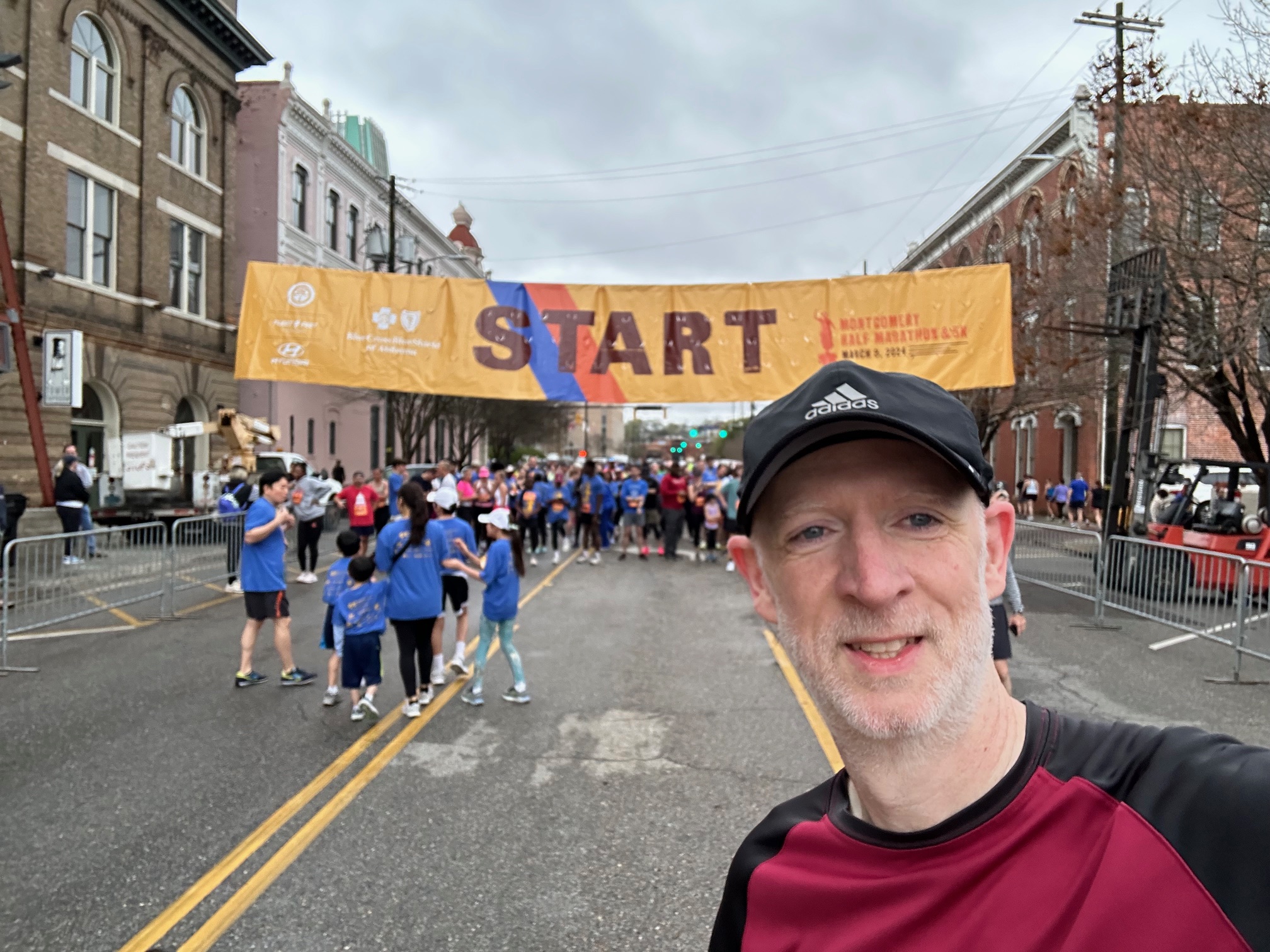
Every weekend I like to go for a long run, so last Saturday when I was in Alabama on the Nootbaar Institute’s “Faith & Justice” trip, I left the hotel about 6:45am to explore. I soon noticed several other runners, a surprising number, and then noticed they were all wearing racing bibs. I then rounded the corner and stumbled upon a road race preparing to start.
I asked one of the runners about the schedule, and he said that a half-marathon was starting at 7am, and a 5k would follow at 7:15am. I looked at my phone and saw that it was 6:50am. After two seconds’ worth of thinking, I raced back to my hotel, up to my fifth floor room to snag a credit card, then back to the race site to see if I could register for the 5k. The gun for the half-marathon went off just as I made it to the registration table, and I was the last person to register for the 5k. Once registered, they provided a bag full of race goodies, which led me to realize that I had nowhere to store it, so I ran back to the hotel a second time to store it during the race, then raced back to the starting line just a few minutes before the 5k began.
There were 500+ runners in the 5k, and I may not have been fully awake, but when the gun went off I took off and won my old-man age group and came in maybe 10th or 11th overall. Life is just funny sometimes.
I’m not 100% sure why I’m telling you all this story. Maybe just an encouragement toward physical fitness. But maybe the encouragement is this: When you walk out the door each morning to face another day, keep your eyes open — you just never know what you might discover.
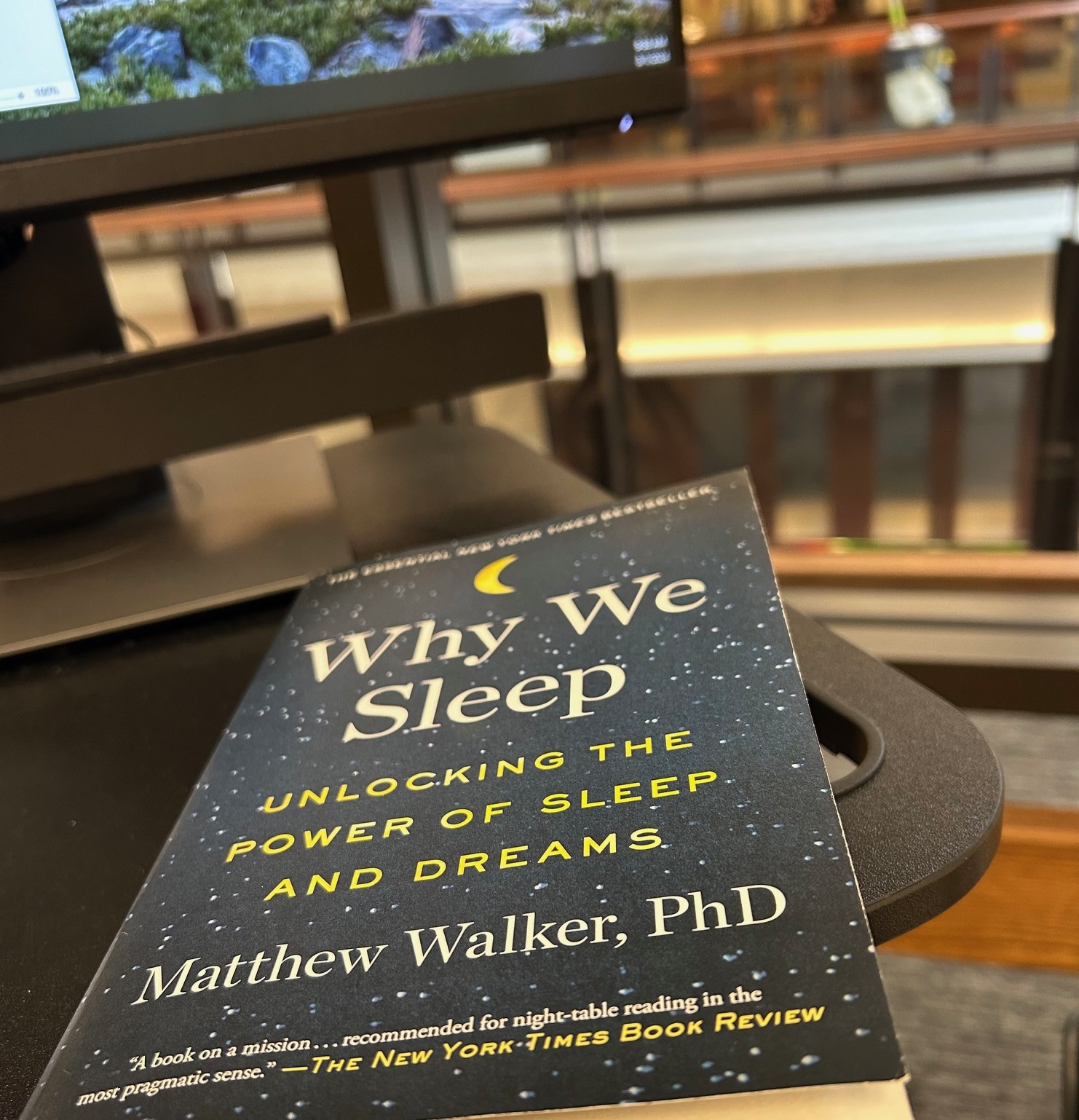
“Sleep is the single most effective thing we can do to reset our brain and body health each day.” – Dr. Matthew Walker, Ph.D.
In early 2015, I asked the following question to Pepperdine’s law students: In comparison to when you first entered Pepperdine School of Law, how would you now describe your practice of rest (e.g., time off, relaxing, Sabbath)? The results: 40% indicated no change; 19% answered stronger; but 41% said weaker. When disaggregated, 52% of first-year students said their practice of rest was poorer than when they started law school. I was not even close to surprised. As the Australians taught us children of the Eighties to say: Been there, done that.
But I was never happy about it. Last semester, nearly a decade later, after discussing sleep troubles with a new law student, I decided that I should at least try to learn something about sleep, so I tracked down a book: Why We Sleep: Unlocking the Power of Sleep at Dreams, by Matthew Walker, Ph.D. I don’t know enough about science to confirm its veracity (there have been critics and controversy), but I do know that after reading it, now I’m having trouble sleeping. But because I don’t want to leave you out of the misery, let me share some of the disturbing (though sometimes cool) information that I read with you. You’re welcome in advance.
For starters, and on a positive note, all animal species seem to sleep, and part of why we humans are awesome may be because of our unique and natural sleep patterns. Specifically, compared to other primates, we sleep in a bed or on the ground instead of perched on tree branches, which allows us a disproportionate amount of REM sleep (the sleep when we dream) because the body is completely paralyzed during REM sleep, which isn’t a terrific idea if you are perched on a tree branch. And while in the cool facts portion of my essay, Walker claimed that the reason we are completely paralyzed during REM sleep is so that we won’t act out our dreams!
Our inordinate amount of REM sleep seems to set us apart in a couple of major ways: First, it heals and helps our mental and emotional health; and second, it enhances our creative and problem-solving abilities. Remember being told to “sleep on it?” Actually, great advice! Although in fact, all sleep phases are beneficial, and messing with any of them causes actual brain impairment.
The human body is fascinating. Just before a baby is born, its amount of REM-sleep is at an all-time high, approximately twelve hours a day. In year one, that declines while deep NREM sleep begins to increase, peaking just before puberty before retreating. The deep NREM sleep during childhood is sculpting the brain, but we all probably remember that it seems like construction halts during the teenage years when all sorts of irrational silliness ensued. Actually, the brain is still maturing then, but rationality is the last to arrive on the scene. Sleep then naturally settles into a predictable pattern in early adulthood. When left to our natural tendencies, human sleep is apparently “biphasic”—about seven actual hours of sleep at night, followed by an hour nap in the early afternoon—but that train apparently left our sociocultural station a long time ago.
In all our societal advancement, however, we have apparently created ways to screw up everything. Have you ever wondered why American life expectancy sucks relative to our immense economic and medical resources? The myriad ways we have created to destroy natural, human sleep patterns and a fingers-stuck-in-the-ears-while-bellowing-la-la-la-la-la-in-the-face-of-research posture toward the importance of sleep may be teensy reasons worthy of consideration.
O sleep, how do I screweth-uppeth thee? Let me count a couple of ways: Darn Thomas Edison for saying let there be light when there shouldn’t be light, and darn alarm clocks (and especially snooze buttons) for daily shocks to our hearts and nervous systems, sometimes multiple times a morning, telling us to get up when we aren’t done sleeping. And since REM sleep is disproportionate toward the end of the seven-to-nine hours of daily sleep we reportedly should be experiencing, about half of all adults in developing countries may be missing out on the unique human benefits that purportedly helped us develop in the first place.
And the consequences are tragic: Weakened immune systems, including an increased risk for certain cancers. Contributions to depression, anxiety, and suicidality. Impaired memory (and while I’m on memory, sleep aids memory both before and after learning, so all-nighters for work or school may be completely counterproductive). Cardiovascular disease. Increased propensity for weight gain, obesity, and developing type 2 diabetes. Drowsy driving—a driver that got up at 7am and heads home from the club at 2am without a single drink is reportedly just as impaired as a legally-drunk driver.
The result? As Dr. Walker wrote, “Relative to the recommended seven to nine hours, the shorter your sleep, the shorter your life span.”
Now we aren’t completely oblivious to our sleeping problems, but it seems that we are unfortunately ignorant to both the extent of the problems and the actual solutions. We typically mitigate with substances, including sleeping pills and/or alcohol and/or caffeine, that can actually do real harm instead of help.
So, what can I do about this to help our law students? I’ll have to get back to you on that one. This seems to be a larger problem than my present work environment, so that’s a major challenge to undertake. But I like major challenges. And it seems far too important to ignore.
What I will do is share with you my summation of the twelve tips for healthy sleep that Dr. Walker shared from the National Institute of Health at the end of his book and hope that someone finds them helpful:
Go to bed and wake up at the same time every single day.
Exercise, but not too late in the day.
Avoid nicotine (period) and caffeine in the afternoon/evening.
Avoid alcohol before bedtime.
Don’t got to bed too full or too hungry, and avoid beverages late at night.
Avoid medicines that disrupt sleep as much as possible.
Don’t nap after 3pm.
Do something relaxing before bed (not on a phone or computer).
Take a hot bath before bed.
Make your bedroom dark, cool (e.g., 65 degrees), and gadget-free.
Get at least 30 minutes of natural sunlight each day (ideally, an hour each morning).
If still awake in bed after 20 minutes, get up and do something relaxing until you are sleepy.
To quote the late, great Edward R. Murrow, “Good night, and good luck.”
Does “hopeless romantic” mean that you cannot help but be romantic? That’s my impression. Could it be instead that you have no shot at ever being very good at it? Asking for a friend.
My life posture is to invest in the community I find myself in, which is far less complicated if you do not move around the country every couple of years. It is difficult leaving people and places that you love, but fully investing in a new community means, for me at least, that I cannot devote too much attention to the rearview mirror. Being wistful for days gone by can be debilitating, but every once in a while, a thought will sneak in from the past that makes me wistful anyway.
Somewhere in our North American tour after leaving Los Angeles in 2019, I’m sure it was around Valentine’s Day, I got all wistful when remembering a tradition that I developed while here in the City of Angels when I would get up even earlier than normal on Valentine’s Day, beat the crazy traffic to Downtown L.A., and snag a parking spot near the Los Angeles Flower District. The Flower District advertises “a spectacular and unequaled array of the freshest flowers, greens and fillers available, many of them California grown, along with an impressive, overwhelming selection of floral supplies.” All I know is that they have a heck of a lot of flowers and that I felt the strong need to go there each year and buy my wife roses for Valentine’s Day.
I understand that you can order flowers in many ways that are far more convenient than driving to Downtown Los Angeles, but I found that I really missed the inconvenient approach. Getting up extra early was never a problem on those occasions. There was something about the experience itself that made it wonderfully worthwhile. Not the shopping or purchasing process so much (actually, I was always utterly confused while there), but the whole idea just felt special.
This year, on our first Valentine’s Day since moving back to L.A., I knew what I had to do.
I arrived at the Flower District at 5:52am on Valentine’s Eve, utilized what appeared to be a legal parking space, and stepped into the craziness. As expected, I was soon overwhelmed. It was dark and yet colorful, and I felt like I joined a swarm of ants attacking an unattended slice of red velvet cake but that I was the only ant unaware of where I was going. I noticed lots of duos carrying long, Christmas-tree-sized cardboard boxes, and they definitely knew where they were going. I’m not sure who all was represented in the swarm, but I assume wholesalers and vendors, small business owners and growers, and maybe even silly husbands like me, although I can’t be sure. I simply wandered in and out of shops, deflecting all the can-i-help-yous until I saw what I wanted, which was news to me, too.
Was I supposed to barter? Well, I didn’t. The price quoted was less than what I would have paid ordering those flowers from the comfort of anywhere other than in-person in Downtown Los Angeles, so I just handed over the cash. Thankfully, I am freakishly tall; otherwise, getting out of the chaos carrying a large vase of roses might have been even more eventful, but by 6:16am, I was back in my car and on the road, driving home one-handed to protect my floral purchase through the burgeoning automotive ant swarm.
I made it home an hour later and proudly presented the roses to my wife, who smiled and laughed the sort of laugh that says, “I am married to a certifiable idiot, but I think he must really love me.”
Which was the reaction I hoped for.
To be candid, I don’t think I am a hopeless romantic under either definition. I like to think of myself more as a hopeful romantic—hopeful that I will be better at it along the way.
Given such a goal, I am glad to be reunited with the Flower District.
I woke up two minutes early, turned off the alarm, and crawled out of bed at 5:28am, glad to go for a run, while never excited to crawl out of a warm bed in the darkness. I exercise daily, but once a week I drive to Malibu Colony Plaza in search of a flat place to run that also has easy parking. I like it there, although I do not care for the early morning darkness in the winter months. On Thursday I was glad to notice a slight hint that the light of spring is coming.
I stretched a bit and took off as normal, trying to wake my legs up, too. My pace is always measured at first, careful not to start too quickly, but on that morning, I soon added a short sprint as I dodged leftover rain puddles alongside the dangers of PCH traffic.
Near the Malibu Pier, I noticed what appeared to be an unhoused individual on the sidewalk ahead, lurking, if you will, in the shadows. I often visit with unhoused people, so this was nothing extraordinary, but knowing that many battle mental illness makes me a little wary in early morning encounters. I noticed that this young man was gathering his things and shuffle-jogging ahead, presumably to get out of my way, so I gave him a wide berth and passed by with several feet between us. We exchanged good mornings, and I added a how’s-it-going, which, although a standard greeting for me, may not be the most thoughtful question for an unhoused man carrying a large pack on his back before six o’clock in the morning. But his response, half-shouted with what I can only describe as great joy, and spoken like he was glad that someone asked, was, “I’m doing f***ing great!”
Well, alrighty then. I was glad to hear it. My mind began to cycle through options for why he was doing expletively great at such an hour, but ultimately, I just chuckled and took it at face value, thankful that he was having a fantastic morning.
After reaching the halfway mark I fist-bumped a power pole and turned back, now in a much better mood, and at some point, encountered my new friend again where I said, “Have a good one, friend.” He replied, “You, too, brother,” with “brother” said in a way that led me to believe that if I immediately fell and busted my head open, I was 100% convinced that this man would take care of me like a brother. I can’t explain how I knew that from a word spoken in passing by a stranger, but I knew it to be true. What a warm and peaceful thought in the forty-degree weather.
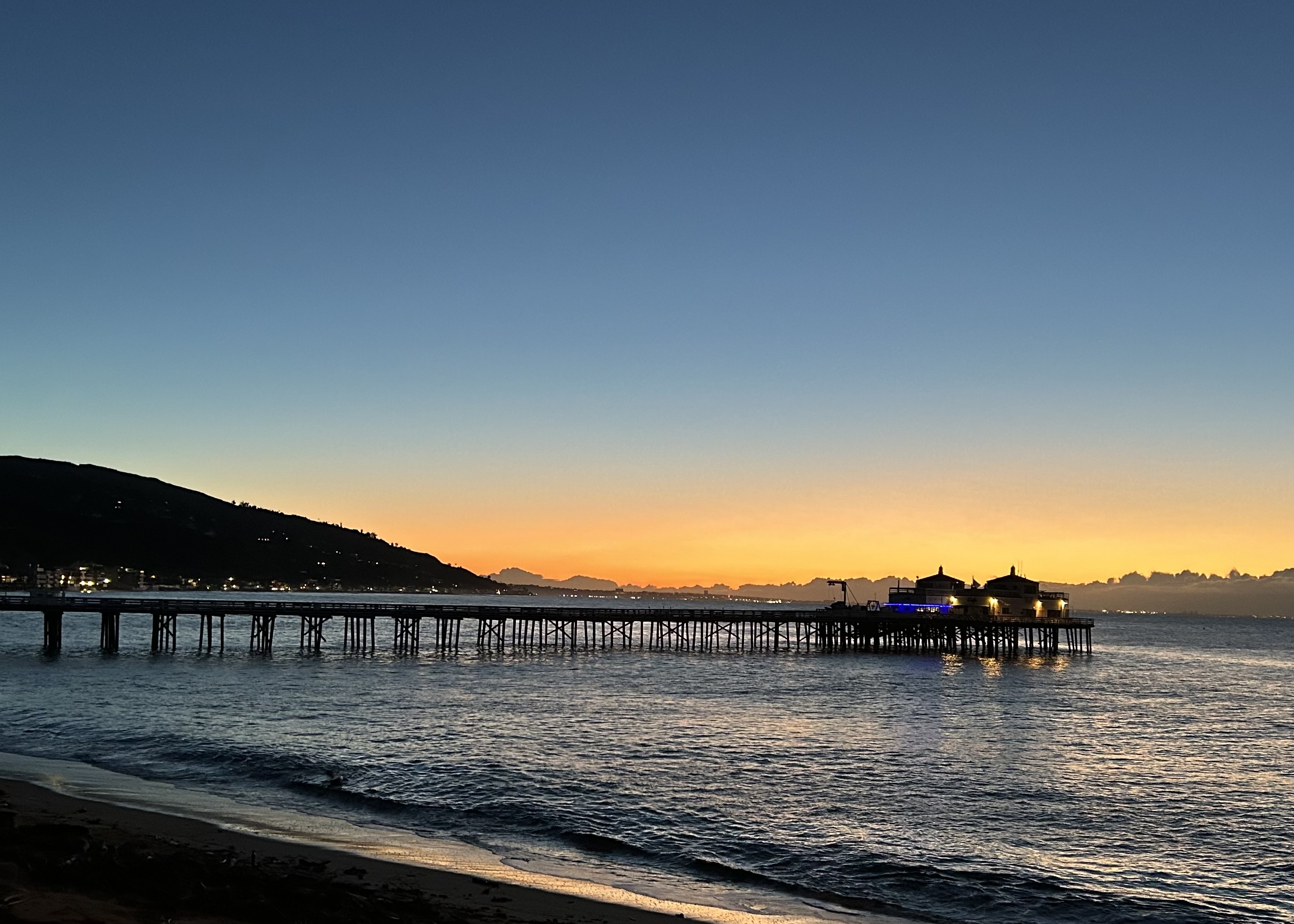
At the Malibu Pier again, thanks to ever-lighter skies, I stopped long enough to take a picture, then took off for my final mile of the morning. I may get my runner’s card revoked for this confession, but I don’t think I have ever felt a runner’s high; however, when I started running again, I felt like a deer bounding through the woods, bouncy and strong, and that last mile was phenomenal. I don’t know that I have ever felt better on a run
My short drive home felt very different from my short drive there, and when I pulled into the neighborhood it seemed that no one else had even stirred from their slumber. Before the sun had truly risen, it felt like I had already had an incredible morning.
I felt the need to write about that first hour of Thursday morning but wondered about the moral to the story. Why should anyone care about that first hour of my day?
Maybe the moral is that who needs a moral to a story when you stumble on anything good? In a life that can be too cruel too often, notice all the good moments. They seem to get us through the rest.






 Starting to Look Up