
Tag Archives: alvan bovay

Time and Place

I am scheduled to teach a class on the “History and Future of the American Civil Rights Movement” at First Congregational Church of Ripon this Sunday. It is not intended to be specifically religious but is a part of a new Fifth Sunday Series of important conversations hosted by First Congregational as a service to the community. Everyone is invited, of course (9:00 a.m. until 10:15 a.m. on Sunday, May 31).

I learned the meaning of impostor syndrome in law school  and since then have convinced many a human that they actually deserve to be in intellectual spaces just as much as everyone else. But I have absolutely no business teaching a class on this topic. I agreed to do it anyway and look forward to the opportunity.

I know that I was asked because of my great honor to host repeated civil rights trips to Alabama in recent years, but it is beyond ironic that a white man who grew up in a Southern sundown town completely ignorant of the true history of the Movement will lead this class. That my rapid education over the past decade or so leaves me more knowledgeable than most is cause for reflection all by itself, but it also explains why I jumped at the chance to contribute to the critical education of others.

Somehow, one additional fact makes this opportunity even more intimidating and even more of an honor.

I assume that few who read this essay outside of Ripon, Wisconsin, will recognize the name Alvan Bovay. Bovay was a lawyer from New York who moved to Wisconsin territory in the mid-1800s and then helped found Ripon College where I now work. He was also friends with famed journalist, Horace Greeley, and was passionate about stopping the spread of slavery in the United States. And in 1854, while closely monitoring the Kansas-Nebraska Act as it was debated in Congress, Bovay convened a meeting and stood in the very church that I will soon teach this class to say that if the Act passed then they must act in response.

It did, and they did.

Specifically, Bovay led another meeting three weeks later in a little schoolhouse that produced a new political party that they named the Republican Party. In a few short years, that infant political party was in the White House in the person of Abraham Lincoln just as the national debate over civil rights exploded in a Civil War.

So I will soon stand in a specific place that is rich itself with the history that I have been asked to teach. And I will do so at yet another important moment in that ongoing history. 

The political party that Bovay inspired shepherded victory in a bloody war but not the war for American civil rights. Despite an Emancipation Proclamation and three subsequent constitutional amendments purportedly to abolish slavery, ensure civil rights, and guarantee voting power, it was another hundred years before a subsequent movement still fighting against racial segregation, hierarchy, and terror led to critical legislation such as the Civil Rights Act of 1964 and the Voting Rights Act of 1965. And today, six decades further down the road, we now live in a time when the Supreme Court has repeatedly declared that provisions of those laws are no longer constitutionally valid because the rights they protected have been achieved.

I disagree with that logic and believe that Justice Ginsburg had it right when she compared it to throwing away your umbrella in a rainstorm because you aren’t currently getting wet.

So today I am struck by both the time and place in which I will soon teach a class on such an important topic. As a spoiler alert, I will not propose a meeting at a little schoolhouse to propose a new political party, tempting though that may be. But I do have something to say. And when I do, rest assured that 172 years after Bovay I will feel the tremendous weight of this time and that place.
Roses Are Red, Violets Are Blue, but Wisconsin Is Actually Purple

Purple haze all in my brain / Lately, things just don’t seem the same / Actin’ funny but I don’t know why / Scuse me while I kiss the sky.” – Jimi Hendrix

I stopped using social media to discuss politics a long time ago, mostly because I just didn’t love the desire to claw out my eyeballs. The following represents only a minor shift in personal policy, I hope.

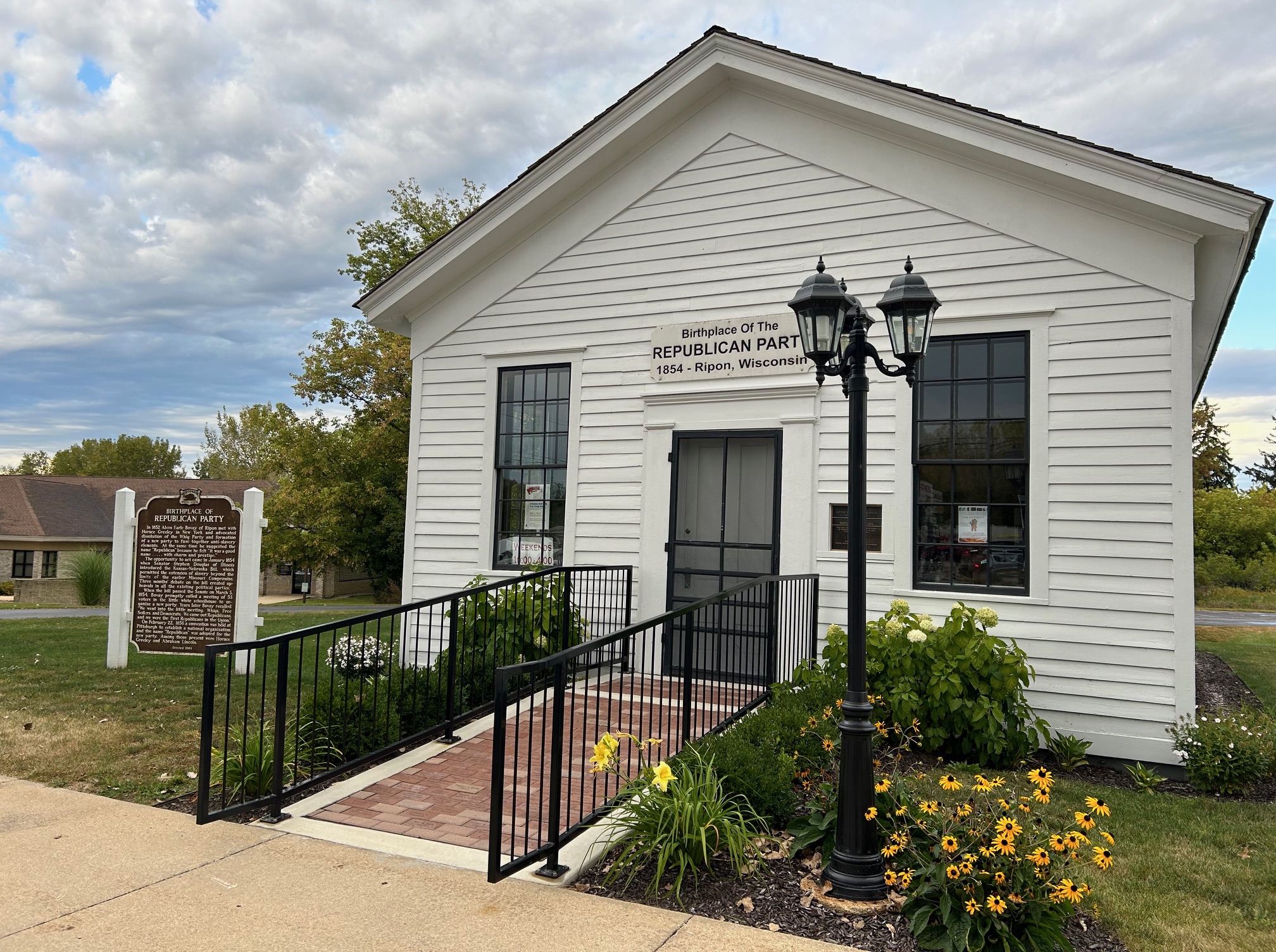
My new hometown is the birthplace of the Republican Party. Alvan Bovay, a lawyer and mathematician from New York City, moved to Ripon, Wisconsin, in 1850, one year after the city was founded, and in 1854, frustrated by the potential spread of slavery in the proposed Kansas-Nebraska Act, called a meeting at the First Congregational Church and proposed forming a new political party to oppose slavery if the bill passed. Well, the bill passed, and Bovay hosted a follow-up meeting at what is now known as the Little White Schoolhouse, a meeting that led to the establishment of the Republican Party. Six years later, the United States elected its first Republican president, Abraham Lincoln, and all hell broke loose soon thereafter.

As you might suspect, when I pass by the Little White Schoolhouse in my new hometown, I often see travelers there taking pictures from their respective pilgrimages. Ironically, I think supporters of both major political parties should take pilgrimages here, albeit for different reasons: Republicans, for obvious reasons, being the birthplace of their party, but Democrats, on the other hand, for historic reasons, too, i.e., to honor an early political movement that stood up for basic civil rights for Black citizens and then held the nation together during the bloodbath that ensued when Southern states seceded to preserve white supremacy. There’s much there for both to celebrate if they so choose.

In a way, I guess my new hometown serves as a nice microcosm of life in a purple state, having something that both Democrats and Republicans can honor.

With the 2024 presidential election on its final approach, Wisconsin, my new home state, is receiving a lot of attention as a “battleground” state. (My new academic department chair was quoted in Newsweek just last week.) Wisconsin is one of only five states (along with Arizona, Georgia, Michigan, and Pennsylvania) that voted for Trump in 2016 and Biden in 2020, displaying the capacity to vote for a presidential candidate from different parties. In addition, officially, and this may change following the next election, Wisconsin is one of only three states (along with Montana and Ohio) that has one United States Senator from the Democratic Party and one United States Senator from the Republican Party—down dramatically from twenty-seven split delegations in 1980.[1] Wisconsin is apparently the prototype of a “purple” state, a mixture of red and blue—even though when it comes to colors, this football-crazed state prefers the green and the gold to that associated with one of its historic rivals, the Minnesota Vikings.

I happen to like purple—when it comes to politics.

I’m actually quite blue, to be sure, when it comes to the political team I typically root for, and I have strong feelings along those lines about this particular presidential election, but as one who cares deeply about words like diversity, equity, inclusion, and belonging, and very much dislikes words like echo chamber, groupthink, and homogeneity, I am fond of what are now extraordinary places where people from different perspectives live in community and everyone has the chance to speak up and be heard. So, I like living in a place that is currently known as a purple state.

However, refusing to put my head in the sand, I’m well aware that these rarities are headed toward extinction, and I’m not sure that will change anytime soon.

I sort of like the idea of a purple party. (This is where my wife, a major Prince fan, perks up, and I confess that going back to (political) parties like its 1999 seems surprisingly nice given today’s crazy town carnival, but that’s not where I’m headed with this little essay.)

I sort of like the idea of a purple party, but I’m not going to call a meeting at the Little White Schoolhouse and try to start one, mostly because I only sort of like the idea and think it would turn out poorly. The idea of a purple party would probably end up as a gathering of all the moderates, those tired of the extremists on both sides—almost a call back to the political establishment once upon a time. Make America Moderate Again, if you will. I can see the purple MAMA hats already.

But actually, sometimes, I like extremes. Like, a lot. For example, all things considered, pretty much any landmark movement for human rights was a radical movement once upon a time, and I want to be on those teams.  

No, instead of a party for “those in the middle,” though an understandable wish for many, what I wish for instead is not even a party, just a place in this world where people from very different backgrounds with very different characteristics and very different perspectives can be in the same place and learn from each other and refuse to hate each other (which is where the train consistently derails) and choose to respect each other as human beings. Places where Justice Ginsburg and Justice Scalia go to the opera together, and where George W. Bush and Michelle Obama exchange hugs and cough drops, and where friendships develop like Snoop Dogg and Martha Stewart; Ella Fitzgerald and Marilyn Monroe; Sherlock Holmes and Dr. Watson; Harry and Sally; Bert and Ernie; Woody and Buzz.

Wishful thinking, I know, this notion of radical respect and radical friendship across dividing social lines. Who could really imagine that happening anywhere? But if anyone ever calls a meeting at a little schoolhouse somewhere with that in mind, please pass along the invitation.


[1] Sure, Maine and West Virginia also have split delegations, but theirs are Independent and Republican, not Democrat and Republican. And don’t even try with Vermont: nothing split about that delegation!