
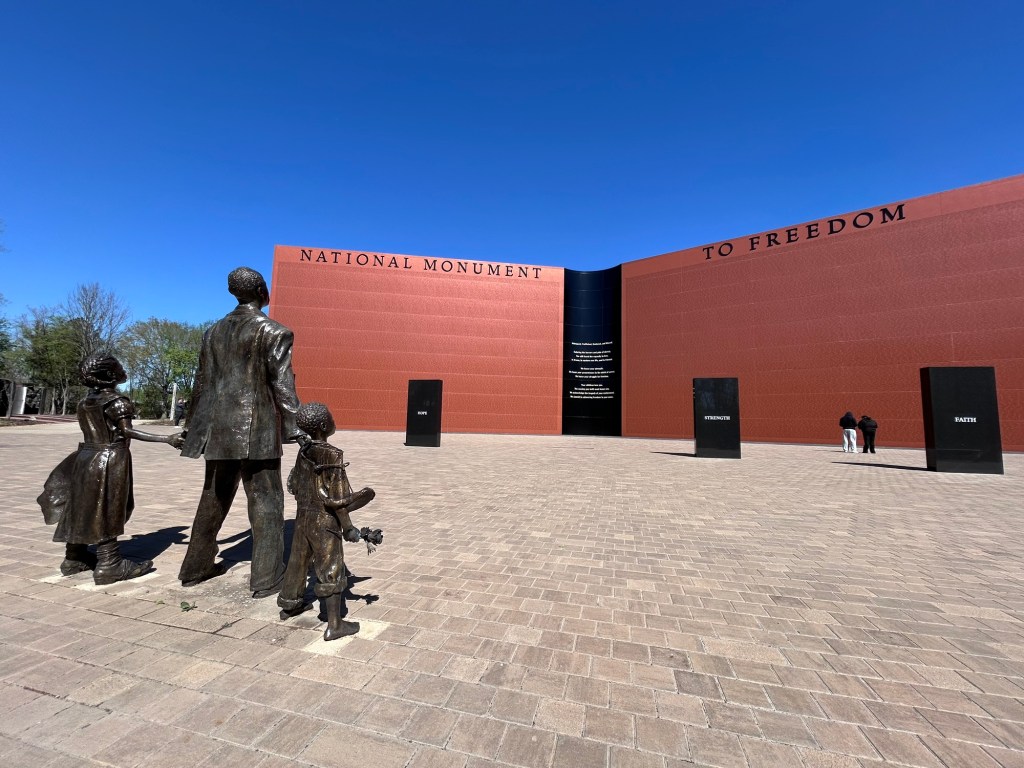
I am scheduled to teach a class on the “History and Future of the American Civil Rights Movement” at First Congregational Church of Ripon this Sunday. It is not intended to be specifically religious but is a part of a new Fifth Sunday Series of important conversations hosted by First Congregational as a service to the community. Everyone is invited, of course (9:00 a.m. until 10:15 a.m. on Sunday, May 31).
I learned the meaning of impostor syndrome in law school and since then have convinced many a human that they actually deserve to be in intellectual spaces just as much as everyone else. But I have absolutely no business teaching a class on this topic. I agreed to do it anyway and look forward to the opportunity.
I know that I was asked because of my great honor to host repeated civil rights trips to Alabama in recent years, but it is beyond ironic that a white man who grew up in a Southern sundown town completely ignorant of the true history of the Movement will lead this class. That my rapid education over the past decade or so leaves me more knowledgeable than most is cause for reflection all by itself, but it also explains why I jumped at the chance to contribute to the critical education of others.
Somehow, one additional fact makes this opportunity even more intimidating and even more of an honor.
I assume that few who read this essay outside of Ripon, Wisconsin, will recognize the name Alvan Bovay. Bovay was a lawyer from New York who moved to Wisconsin territory in the mid-1800s and then helped found Ripon College where I now work. He was also friends with famed journalist, Horace Greeley, and was passionate about stopping the spread of slavery in the United States. And in 1854, while closely monitoring the Kansas-Nebraska Act as it was debated in Congress, Bovay convened a meeting and stood in the very church that I will soon teach this class to say that if the Act passed then they must act in response.
It did, and they did.
Specifically, Bovay led another meeting three weeks later in a little schoolhouse that produced a new political party that they named the Republican Party. In a few short years, that infant political party was in the White House in the person of Abraham Lincoln just as the national debate over civil rights exploded in a Civil War.
So I will soon stand in a specific place that is rich itself with the history that I have been asked to teach. And I will do so at yet another important moment in that ongoing history.
The political party that Bovay inspired shepherded victory in a bloody war but not the war for American civil rights. Despite an Emancipation Proclamation and three subsequent constitutional amendments purportedly to abolish slavery, ensure civil rights, and guarantee voting power, it was another hundred years before a subsequent movement still fighting against racial segregation, hierarchy, and terror led to critical legislation such as the Civil Rights Act of 1964 and the Voting Rights Act of 1965. And today, six decades further down the road, we now live in a time when the Supreme Court has repeatedly declared that provisions of those laws are no longer constitutionally valid because the rights they protected have been achieved.
I disagree with that logic and believe that Justice Ginsburg had it right when she compared it to throwing away your umbrella in a rainstorm because you aren’t currently getting wet.
So today I am struck by both the time and place in which I will soon teach a class on such an important topic. As a spoiler alert, I will not propose a meeting at a little schoolhouse to propose a new political party, tempting though that may be. But I do have something to say. And when I do, rest assured that 172 years after Bovay I will feel the tremendous weight of this time and that place.


