
Tag Archives: american civil war

Time and Place

I am scheduled to teach a class on the “History and Future of the American Civil Rights Movement” at First Congregational Church of Ripon this Sunday. It is not intended to be specifically religious but is a part of a new Fifth Sunday Series of important conversations hosted by First Congregational as a service to the community. Everyone is invited, of course (9:00 a.m. until 10:15 a.m. on Sunday, May 31).

I learned the meaning of impostor syndrome in law school  and since then have convinced many a human that they actually deserve to be in intellectual spaces just as much as everyone else. But I have absolutely no business teaching a class on this topic. I agreed to do it anyway and look forward to the opportunity.

I know that I was asked because of my great honor to host repeated civil rights trips to Alabama in recent years, but it is beyond ironic that a white man who grew up in a Southern sundown town completely ignorant of the true history of the Movement will lead this class. That my rapid education over the past decade or so leaves me more knowledgeable than most is cause for reflection all by itself, but it also explains why I jumped at the chance to contribute to the critical education of others.

Somehow, one additional fact makes this opportunity even more intimidating and even more of an honor.

I assume that few who read this essay outside of Ripon, Wisconsin, will recognize the name Alvan Bovay. Bovay was a lawyer from New York who moved to Wisconsin territory in the mid-1800s and then helped found Ripon College where I now work. He was also friends with famed journalist, Horace Greeley, and was passionate about stopping the spread of slavery in the United States. And in 1854, while closely monitoring the Kansas-Nebraska Act as it was debated in Congress, Bovay convened a meeting and stood in the very church that I will soon teach this class to say that if the Act passed then they must act in response.

It did, and they did.

Specifically, Bovay led another meeting three weeks later in a little schoolhouse that produced a new political party that they named the Republican Party. In a few short years, that infant political party was in the White House in the person of Abraham Lincoln just as the national debate over civil rights exploded in a Civil War.

So I will soon stand in a specific place that is rich itself with the history that I have been asked to teach. And I will do so at yet another important moment in that ongoing history. 

The political party that Bovay inspired shepherded victory in a bloody war but not the war for American civil rights. Despite an Emancipation Proclamation and three subsequent constitutional amendments purportedly to abolish slavery, ensure civil rights, and guarantee voting power, it was another hundred years before a subsequent movement still fighting against racial segregation, hierarchy, and terror led to critical legislation such as the Civil Rights Act of 1964 and the Voting Rights Act of 1965. And today, six decades further down the road, we now live in a time when the Supreme Court has repeatedly declared that provisions of those laws are no longer constitutionally valid because the rights they protected have been achieved.

I disagree with that logic and believe that Justice Ginsburg had it right when she compared it to throwing away your umbrella in a rainstorm because you aren’t currently getting wet.

So today I am struck by both the time and place in which I will soon teach a class on such an important topic. As a spoiler alert, I will not propose a meeting at a little schoolhouse to propose a new political party, tempting though that may be. But I do have something to say. And when I do, rest assured that 172 years after Bovay I will feel the tremendous weight of this time and that place.
Livin’ on the Edge

IMG_2878

There’s somethin’ wrong with the world today
I don’t know what it is
Something’s wrong with our eyes…

If you can judge a wise man
By the color of his skin
Then mister you’re a better man than I…

Livin’ on the edge…
– Aerosmith (1993, inspired by the L.A. Riots)

Jerry Mitchell visited Nashville to promote his new book shortly before the pandemic swept across the United States, and I dropped by his book signing at Parnassus to pick up an autographed copy. Race Against Time chronicles Mitchell’s work as an investigative journalist to reopen unsolved murder cases from the Civil Rights Era, ultimately resulting in convictions of multiple people decades after their terrible racist crimes. It was later during the global quarantine that I took the time to read the book, and although I am aware of the history and reality of racism, I am somehow still stunned by many of its true stories.

With the book still fresh in mind news emerged from Georgia of the unconscionable killing of Ahmaud Arbery, and I had to wonder if anyone is truly winning this “race against time.” As a runner, I was shaken in a new way, forced to recognize that mindlessly enjoying such a simple hobby is yet another unearned advantage that I possess. Even during an unprecedented era of cultural transformation due to a rampant virus, there is unfortunately one thing that remains—the ubiquitous influence of a centuries-long assumption of white superiority.

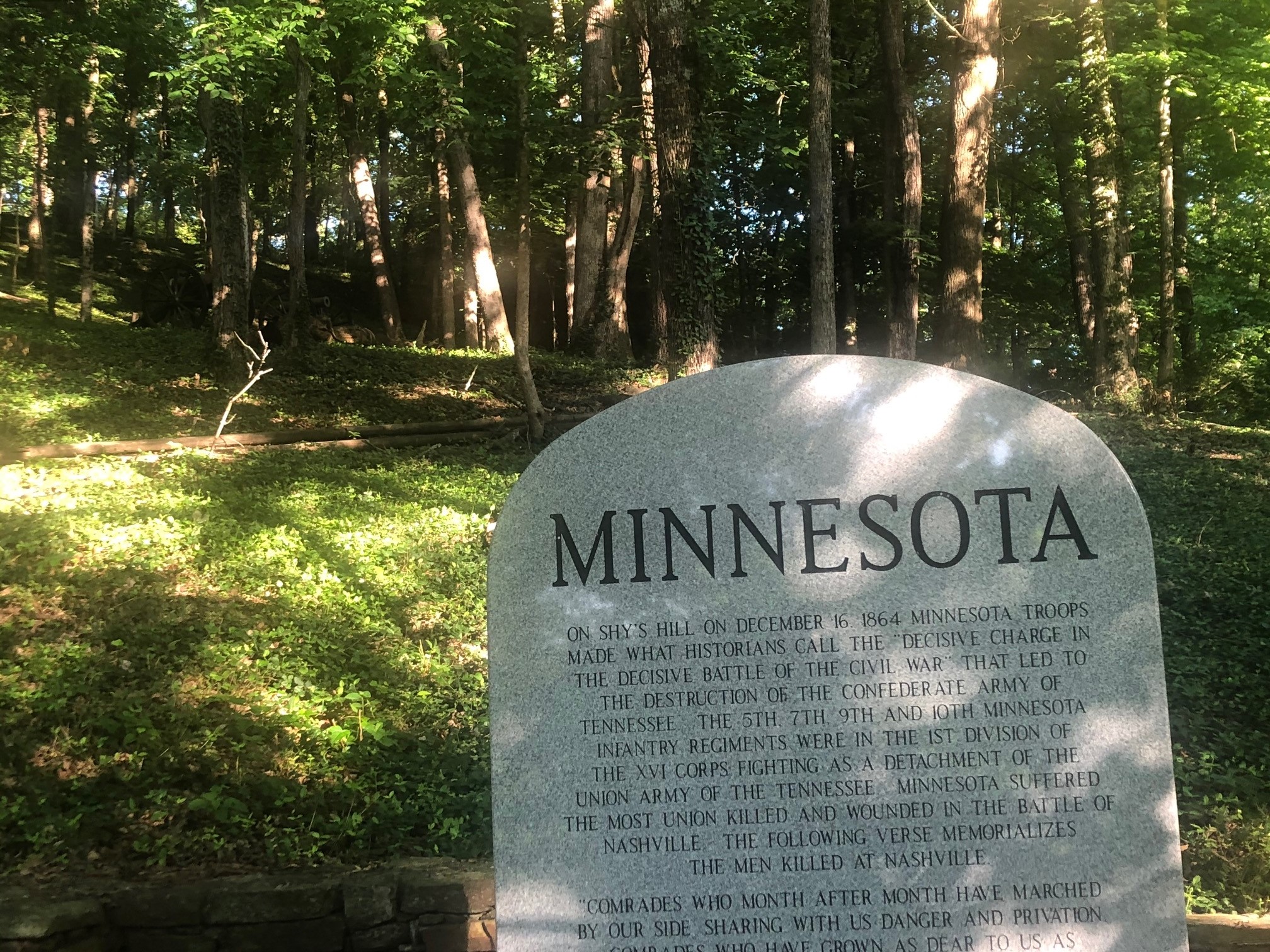
More recently, I read another book titled, Nashville 1864, this time a work of historical fiction that recounted the Battle of Nashville in the American Civil War. The novel was frustrating in its romantic approach to the Antebellum South while helpfully portraying the terrible specter of war, and it simply reinforced in my mind the terribly complicated history of this nation. The novel describes the decisive encounter of the battle that occurred at Shy’s Hill, which happens to be one mile from my house. I finished the book on Memorial Day weekend, and early on Memorial Day itself jogged over to and up on Shy’s Hill to consider all the lives lost. It seemed random to see a marker for Minnesota on Shy’s Hill in Nashville, Tennessee—random until I learned that more Union soldiers from Minnesota died in that battle than from any other state.

And then the despicable murder of George Floyd in Minnesota was televised on the evening news.

Friends, it has been 156 years since a significant number of Minnesotans died in my neighborhood fighting a war that presumably put an end to the notion that Black Americans were less than White Americans. But it is all too clear that all the lives lost and all the efforts made and all the progress achieved has not ultimately prevailed.

For multiple reasons I chose years ago to post less about issues on social media instead of more. Among those reasons was a desire to read and listen more (and talk less), and to focus on things that carry the possibility of creating actual structural changes so that the reality 156 years from now is different—things like using my advantages to instigate conversations that lead to changes in education systems, hiring practices, and ultimately, changes in hearts.

But in times like this I question whether I am doing the right things, or things that really matter, or, maybe most of all, whether I am doing enough.

So today, for what it is worth, I say aloud that I recognize the deep wrongs screaming at us on the evening news—wrongs that exist in a nation where the two people competing to be its CEO are both White men who have independently and recently managed to offend millions of Black Americans. In such a time and place, I simply say that I stand alongside Black Americans and declare their full beauty and worth as human beings. It matters more whether I live it than whether I say it, but in case it helps or matters, I say it.

Living on Top of a Battlefield

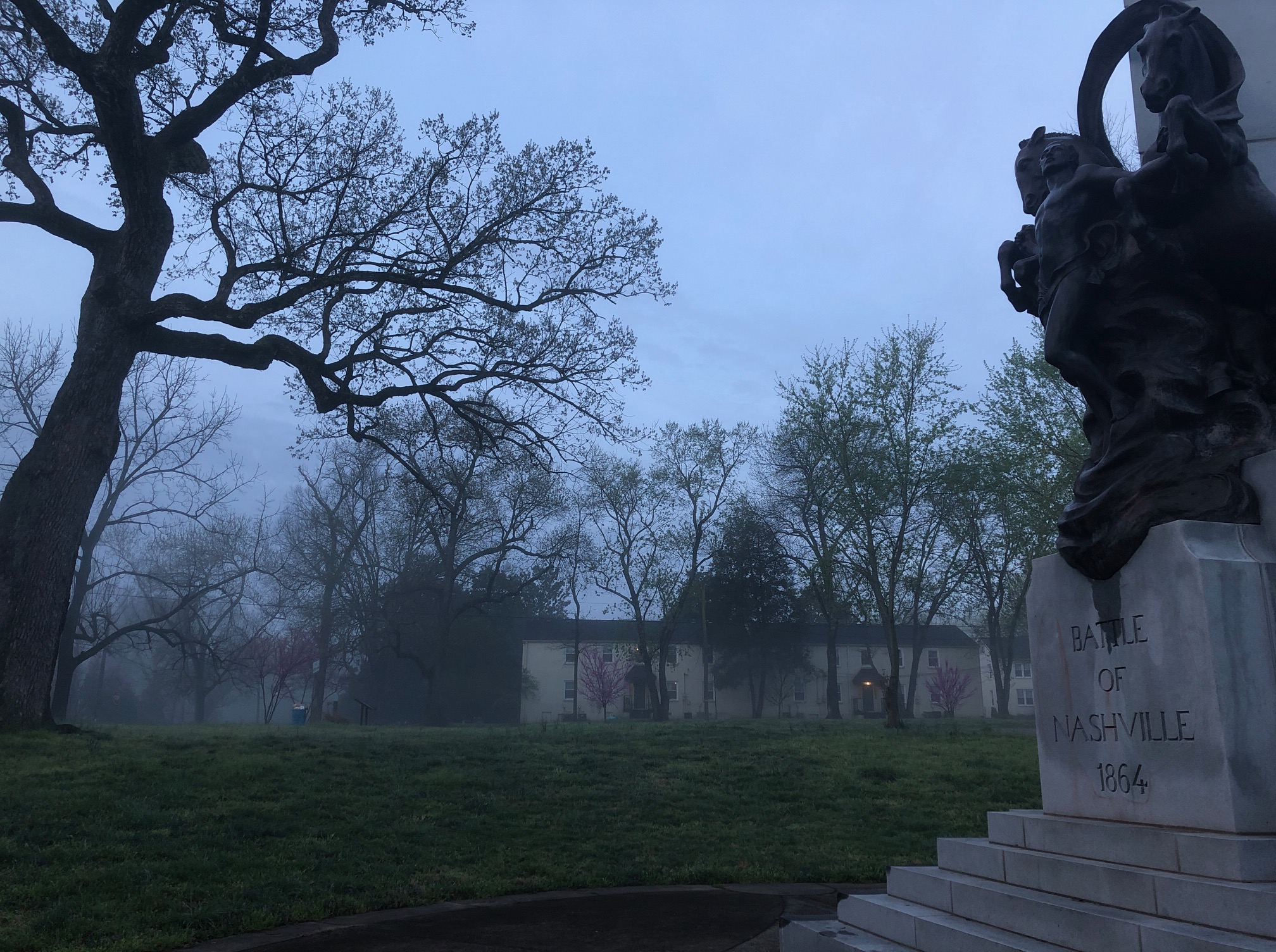
IMG_0235There are several historical markers regarding the Battle of Nashville from the American Civil War in our new neighborhood, including a monument just north of and less than a mile from our current house. I ran over at dawn last week to remember the fallen, and the early morning fog created an appropriately eerie vibe.

I had decided the night before that I should learn more about that terrible battle that occurred in my new hometown, and Wikipedia informed me that in just two days here approximately three thousand soldiers died just before Christmas in 1864. I also learned—and this caught me completely off guard—that we “are living on top of a battlefield.” In fact, our current neighborhood is basically the place where the Confederate troops drew their lines on the opening day of the battle.

I really did not know what to do with that information.

But I could, and did, imagine that fateful day. It was reportedly a foggy morning, and in December it must have been bitter and cold. In my imagination I could see those young men in gray uniforms filled with adrenaline, antsy and eager, thinking they are ready for a fight. They stood there on my street, and we nodded at one another in recognition. I thought of them as contemporaries, but in reality I am much older, and they are just kids—as well as my great-grandparents. By the end of the day many will be on the run, and by the end of the following day many will be dead. But 155 years later all of their spirits remain, and I could see them there, in the fog, yet clear as day.

What were they saying? I heard no voices, but their ghostly presence still spoke to me. But what were they saying? I leaned in and strained to listen.

Finally, one young ghost-soldier, who looked remarkably like me, said in a whisper, “We are the same, you and I. We are no different. I once lived on this battlefield, too, and I stood here just like you do now, proud and brave and self-assured and afraid. I once lived on this battlefield, too, but I died here. You still have the gift of life. Don’t waste it. Don’t waste your life. Choose carefully what you live for — and would die for.”

The ghostly images of those who came before me faded from my mind’s eye, but their presence and their voices remain. They keep saying, “We are the same. Choose carefully.”