Category Archives: Original Essays

Their Eyes Were Watching God

37415

“The wind came back with triple fury, and put out the light for the last time. They sat in company with the others in other shanties, their eyes straining against crude walls and their souls asking if He meant to measure their puny might against His.  They seemed to be staring at the dark, but their eyes were watching God.” – Zora Neale Hurston

Read more novels. That was #2 on my list of 20 goals for 2020, and I have read four so far, including the classic from Zora Neale Hurston, Their Eyes Were Watching God. It was probably Oprah’s made-for-television adaptation in 2005 that placed the captivating title in my subconscious, and I am glad. Whatever made me pick up a copy at the used bookstore has my deep gratitude. What a powerful and beautiful story.

I won’t soon forget the primary characters, including the moment I walked with them into the line that generated the title of the book. Having lived through a powerful hurricane myself, sitting in the dark with Janie and Tea Cake as a reader was easy to do, straining and staring in awe at God.

Nor will I forget the Afterword by Henry Louis Gates, Jr., as he attempted to share the author’s complicated life and legacy. Gates introduced me to Hurston, Barnard grad with multiple Guggenheims, prominent author and figure of the Harlem Renaissance, who died an ignominious death in a welfare home and was buried in an unmarked grave. Gates showed me Hurston, criticized by her rival, Richard Wright, for the way she approached Black America in her novels, who responded that she wanted to write a novel that was “not a treatise on sociology.”  As Alice Walker (The Color Purple), whom Hurston inspired, wrote, Hurston portrayed “a sense of black people as complete, complex, undiminished human beings.” Black people as, in a word, people.

It took all this to help me understand what captivated me so about this particular love story. I appreciate treatises on sociology, particularly those that help me develop a greater sense of race consciousness, but this was quite simply—and by “simply” I mean that highest compliment of somehow making the ineffable obvious—a human love story.

It helps me remember today that, although Black History Month is now over for 2020, black history month is, in fact, every month.

Fast Away

quote-the-best-of-all-medicines-is-resting-and-fasting-benjamin-franklin-52-29-44

“You can’t be open to new opportunities if your life is full.” – Bob Goff

I grew up in Arkansas but moved away with my wife and daughters twenty-one years ago this month, and it was obvious that we entered a new world when our move coincided with “Mardi Gras break” in our new hometown.

Everyone has heard of Mardi Gras, French for “Fat Tuesday,” the colorful spectacle of parades and beads and general losing of minds associated with New Orleans, but it is a cultural phenomenon across the Gulf Coast in Louisiana, Mississippi, Alabama, and the Florida panhandle. And if you don’t live there, you might not realize that it is this week.

Everyone has heard of Mardi Gras, but having grown up in a small town with very little contact with the Christian calendar, I did not understand the point of the party until I moved in next door. Fat Tuesday, the day of indulgence, precedes Ash Wednesday, the day of fasting that marks the beginning of the season of Lent.

Although I grew up in a very religious environment with a strong emphasis on the Bible, the biblical practice of fasting was practically invisible to me. But I have grown to understand its great value.

We can talk food, of course, which anyone who has attempted any measure of self-control with food can appreciate, but fasting can refer to anything one chooses to do without. And we could all use some help learning how to give something—anything—up. In the workplace, I have heard it said that it is just as important (and possibly more so) to have a Stop Doing List next to your To Do List.

What do you need to stop doing?

Habit is powerful. Try breaking one, and you’ll see. But try flipping it on its head and develop a habit for stopping things. This is the week when the Christian calendar asks us to consider such a challenge.

Withdrawals

IMG_1903

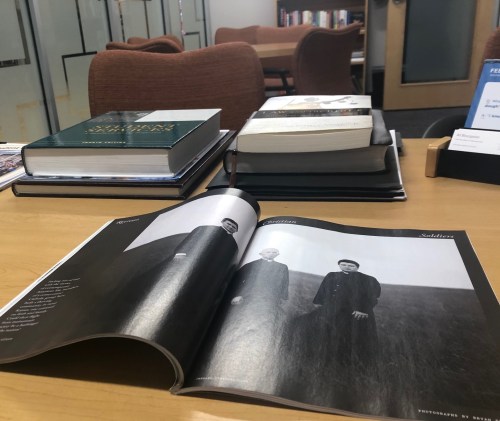
I recently canceled my subscription to Runner’s World and replaced it with a subscription to The Atlantic Monthly. For one thing that makes me feel smarter, but more importantly, I wanted to enhance my intellectual curiosity and the broad offerings of The Atlantic promised a more balanced diet.

The first issue in 2020 did not disappoint.

Specifically, I was intrigued by Emma Green’s article, “Retreat, Christian Soldiers.”  The article introduces the town of St. Marys, Kansas, and in so doing, the Society of St. Pius X that has come to define the town. The online version of the article (located HERE) uses the headline, “The Christian Withdrawal Experiment,” and describes it this way: “Feeling out of step with the mores of contemporary life, members of a conservative-Catholic group have built a thriving community in rural Kansas. Could their flight from mainstream society be a harbinger for the nation?”

Green draws attention to Rod Dreher’s 2017 bestseller, The Benedict Option, which advocates that particular posture—withdraw and circle the wagons. Both the article and book highlight the flight of those with conservative values, but the monastic approach has been used irrespective of political preference. All types of groups have been escaping the world in search of utopian community for time immemorial.

I surely understand the motivation. Hopeful to instill specific values in our children and attracted to surrounding ourselves with said values, it is logical to gather with like-minded people in community. I get it. I even desire it from time to time.

But it isn’t my cup of tea.

I love where I grew up, so don’t here this as criticism of my beloved hometown, but when I read about St. Marys, Kansas, in certain ways I thought of Paragould, Arkansas. I grew up in a peaceful homogeneous world where values were consistent at home, church, school, and town, and I felt safe and well. Who could argue with such a thing? On the other hand, I raised my children in non-insular environments, which is risky by nature. Diversity creates friction, and friction is, well, combustible.

So I do not write today to make judgments. I went to law school and can therefore make valid arguments for—and against—both.

But I do write from my particular experience. I understand the attraction to insularity, and I understand the attraction toward diversity. For some unexplained reason, I am drawn more to the latter.

Kindertransport

Blog Pic (Kindertransport)

I caught a bit of the Oscars last night and found myself wondering if I might see someone from the Lipscomb University Department of Theatre walk the Hollywood red carpet someday. I am a big fan of Lipscomb Theatre! On Saturday evening my wife and I went to campus to see Kindertransport, and although I expected to be impressed, I was not prepared for the show. When I first saw the name, Kindertransport, I envisioned a play about a school bus. Oh no. Kindertransport is an intense and powerful story.

The story is historical fiction. Prior to the outbreak of World War II, thousands of Jewish children refugees were hastily transported out of Germany to escape the coming savagery. As Dr. Jay Geller, Professor of Modern Jewish Culture at Vanderbilt University who served as theater consultant wrote in the program, “German Jewish parents and their children faced the terrible dilemma of choosing between a perilous staying together and a temporary—quite possibly permanent—separation as well as having to imagine the parent’s possible death and the child’s possible survival.”

Kindertransport is a vivid portrayal of how that might have played out for one family. The entire cast was amazing, and thanks to their masterful storytelling, I cannot stop thinking about it.

As a former history teacher, I am always stunned when I learn of moments in world history that I had never heard of before. I learned on Saturday evening that the United Kingdom welcomed 10,000 unaccompanied Jewish children before Nazi Germany closed the borders prior to the outbreak of World War II but that the United States rejected legislation to do the same based on public opinion polls. The talk-back after the show shared that a large number of Jewish refugee children actually arrived at an American port but were sent back to Germany because of the policy. How many of those children were murdered as a result of that decision?

It was easy to connect the Kindertransport story line with our friend at Pepperdine, Hung Le, simply substituting a different place and a different war (Vietnam), and how his beautiful story came to bless so many lives (read it HERE). It made me wonder what stories are being crafted today?

That is the potential power of an incredible story like Kindertransport. Aching with that mother, making it up as she went along, hoping to save her child. Aching with that little girl, also making it up as she went along, trying to survive on her own far too soon. Aching with that good soul, also in uncharted waters, attempting to welcome a stranger in need.

How will that powerful story change me?

Gifts

Ashley Lahey

Ashley Lahey entered the final semester of her senior season as the top-ranked women’s tennis player in the nation (not to mention one of the top students at Pepperdine), but more importantly to me, she ranks among the best human beings.

Ashley (reluctantly) came to the church where I preached in Malibu with her boyfriend and my good buddy, Treet, but I had no idea at the time that she was in a season of struggle. She broke down in tears at a tennis match the first time we had a brief conversation, which led to a longer sit-down where I got a glimpse of what was really in her heart. From that time on I simply had the great privilege of watching her immense intellect and strong will in action—just like on the tennis court—as she journeyed to faith. After my last sermon there, Ashley asked if I would baptize her, and I had that opportunity on my very last day living in Malibu. What a tremendous gift.

I am writing about Ashley because last week was a rough one in my world. I lost an old friend and traveled to honor his life, and on the way unexpected chaos broke out among the work I had left behind. It was a hard week. And then Friday night, sitting at home and processing all that had happened, Ashley sent a video of her sharing her faith story that day at Celebration Chapel at Pepperdine where she graciously gave me a prominent place in the story. What a sweet gift on any day, but especially for me on that day.

In the unpredictable messiness of life, the unexpected gifts are extra special.

Ashley Baptism

Finish the Race, Keep the Faith

IMG_1721

Note: I wrote this post before the tragic helicopter crash in Calabasas near one of my old running trails, but the message still somehow applies. RIP to Kobe, his daughter, and all who died in such a terrible accident.

When I was fourteen, Shawn invited me to run a 15k in Memphis at Oktoberfest, and since there was little adventure in our small-town Arkansas life I quickly agreed. I was bright enough to know that fifteen kilometers equaled 9.3 miles but not yet bright enough to prepare by running more than three miles in advance. Coach Watson warned us, but we were invincible junior high schoolers, so we weren’t worried.

We rose in the early morning darkness and rode the hour and a half to Memphis in a custom van with Ethan and Everett. We thought both men were ancient, although I realize now that Ethan was only fifty-three (and Everett sixty-seven). Ethan was a legend in our hometown, completing over forty marathons, including three Bostons, and Everett was a legend in several ways—college football at LSU, one-time world record holder for sit-ups, pole vaulter in the Senior Olympics. We were unable to comprehend our great privilege.

The race was something else. I had only run a couple of local 5ks, so this was the first time I had experienced the exhilaration of a major race with a thousand runners—much less the distance. Filled with adrenaline we started way too fast, and at the second mile marker I could not breathe, where it occurred to me that I still had over seven miles to go. So I let Shawn, the far better runner, go on while I slowed the pace to focus on survival. I never stopped, in spite of the monster incline up Riverside Drive near the end. I may not be a natural runner, but I am naturally stubborn.

Last weekend, thirty-five years later, I remembered that race on a seven-mile run at Percy Warner Park, alone in nature with my memories. The trail is hilly, and the temperature was frigid, and as my aging body huffed and puffed up a small mountain I remembered Shawn’s impression of the whistling sound Ethan made as he inevitably caught and passed us at each race. I had to laugh. At an overlook at the top of a major hill I stopped to gaze at the Tennessee winter forest and realized that I love Ethan and Everett now more than ever. I was in California when each passed and could not pay respects in person, but they helped shape my life. And then I thought of Shawn, killed in that tragic automobile accident so long ago. My very first running buddy.

The cold and the hills and the memories combined to bring tears to my eyes. I realized that I am the only one left from that 1984 Oktoberfest quartet, the only one left even to remember.

I decided to dedicate the run to my old friends (may they be somewhere running in peace), so I turned from the overlook and hit the trail again—alone. Not sure why I am the only one still on the course, but as long as I can I’ll keep running.

Law and the Bible

51-ASgVtsvL._SX331_BO1,204,203,200_

I am beyond honored to teach an undergraduate course this semester titled, Law and the Bible, in Lipscomb’s Fred D. Gray Institute for Law, Justice, and Society—even more honored that it is based on a course built (and using a text edited) by friend and former colleague, Professor Bob Cochran. To have the opportunity to combine my legal training and ministry experience in a classroom is pretty great, and that there are eleven brilliant and passionate students enrolled is almost too good to be true.

Professor Cochran divided the Bible in nine sections and teamed legal scholars and theologians to write each chapter (he joined his friend, Dallas Willard, to approach the Gospels) and explore what the Bible teaches about law and its relevance to current issues.

We have much to discuss.

I have a complicated relationship with politics and rarely write publicly on political issues anymore, not because I no longer have opinions, but for other reasons. To sit in a classroom, however, and consider contemporary issues starting with the Bible, that has me excited.

I confess disappointment that religious folks often react to major political moments by supporting their predetermined political candidate/party without wrestling with the individual issue at hand based on theological arguments. One would think that those who claim religion would avoid automatically supporting one political party and examine each individual situation in light of their sacred text. Maybe the penetrating question is: What is truly sacred?

I’m excited to consider such questions this semester with a gifted group of college students.

20 for 2020

blog image

Here is my 2020 bucket list for your consideration on this first Monday of the new decade:
1. Vote anyway.
2. Read more novels.
3. Write fiction.
4. Become an expert at something new.
5. Make family memories.
6. Run farther.
7. Serve my new city.
8. Deepen a friendship.
9. Be productive at work.
10. Provide stronger leadership.
11. Do something revolutionary.
12. Make a discovery.
13. Cheer loudly.
14. Visit someplace iconic.
15. Recover joy.
16. Meet more neighbors.
17. Learn from respected magazines.
18. Promote conservation.
19. Encounter unfamiliar cultures.
20. Teach.

Respecting Time

IMG_1639

“Time is an illusion.” – Albert Einstein

Tick, tock, the clock does its rhythmic work without fail, and without complaint, while we lament that it goes too slow or marvel that it goes too fast. But time never misses a beat. And as the 2010s approach their finish line and the 2020s prepare to take the baton, like everyone else, I stop to reflect on the mystery of it all.

A decade ago I was approaching forty, smack dab in the middle of law school, living in a university residence hall with my family in California. For obvious reasons I anticipated launching a new life as an attorney in my forties, but here I sit a decade later in Tennessee, approaching fifty as a university vice president. Life surely is unpredictable.

I dare not venture a guess at life a decade down the road. The past has at least taught me that much. Two decades ago I was a baby preacher in Ocean Springs, Mississippi. Three decades ago I was a college student in Arkansas preparing to coach high school basketball. Four decades ago I was wearing a yellow ribbon to Mrs. Conley’s fourth grade class for the hostages in Iran, and fifty years ago? Well, I was born nine months later, so I’d rather not think of that too much.

Einstein said that time is an illusion. And that dude was pretty smart.

Last week we spent Christmas in Arkansas with extended family. It was a great visit. Most of our trip occurred in or driving by farmland, and it reminded me of what Stephen Covey referred to the “law of the farm”—his way of describing how certain things cannot be rushed. One might cram for a test, but you can’t cram on the farm. Planting, cultivation, and harvest must occur in order, and in due time, and the rhythm cannot be forced.

Life apparently subscribes to the law of the farm. Tick, tock, the clock does its rhythmic work without fail, and without complaint, while we lament that it goes too slow or marvel that it goes too fast. But time never misses a beat.

Reading List (2019)

IMG_1521

“I guess there are never enough books.” – John Steinbeck

I am happy to report that I read twenty-five books for the third year in a row in spite of a crazy cross-country move. I have every intention of keeping up this particular discipline as the 2020s roll in. Here are a few observations from 2019:

#1: Five of the books were authored by friends: I sure have talented friends.
#2: It feels like Reimagining the Student Experience: Formative Practices for Changing Times was written just for my new job.
#3: I’m still enamored with Jesmyn Ward but am embarrassed that it took me this long to read beautiful novels from literary giants like James Baldwin, James Joyce, and Toni Morrison.
#4: Educated by Tara Westover blew my mind
#5: All in all, The Children by David Halberstam was my Book of the Year.

Here is my overall list for 2019:

Novels (6 this year—6 in 2018, 3 in 2017)
* Sing, Unburied, Sing by Jesmyn Ward
* Bowling Avenue by Ann Shayne
* Your Killin’ Heart by Peggy O’Neal Peden
* Dubliners by James Joyce
* Sula by Toni Morrison
* Go Tell It on the Mountain by James Baldwin

Books written by friends (5 this year—1 in 2018, 6 in 2017)
* White Jesus: The Architecture of Racism in Religion and Education by Allison Ash; Christopher Collins; Tabatha Jones Jolivet; and Alexander Jun
* Kingdom Come by John Mark Hicks & Bobby Valentine
* Colonel Jonathan: An American Story by John Francis Wilson
* Ten Frames at the Galaxy Bowl by Kyle Dickerson
* Letterville: The Town That God Built by Aaron Sain

Theology/Church (4 this year—8 in 2018, 6 in 2017)
* Conversations with Will D. Campbell, edited by Tom Royals
* Homosexuality and the Christian by Mark A. Yarhouse
* (Re-read) Falling Upward by Richard Rohr
* (Re-read) Law and the Bible: Justice, Mercy, and Legal Institutions, edited by Robert F. Cochran, Jr. and David VanDrunen

Leadership/Politics/Sociology (3 this year—0 in 2018, 0 in 2017)
* Whistling Vivaldi by Claude M. Steele
* Dying of Whiteness: How the Politics of Racial Resentment is Killing America’s Heartland by Jonathan M. Metzl
* Dare to Lead by Brene Brown

Biography/Memoir (2 this year—3 in 2018, 5 in 2017)
* Educated by Tara Westover
* Cash: The Autobiography by Johnny Cash

Education (2 this year—0 in 2018, 0 in 2017)
* Roaring Lambs: A Gentle Plan to Radically Change Your World by Bob Briner
* Reimagining the Student Experience: Formative Practices for Changing Times, edited by Brian Jensen and Sarah Visser

History (2 this year—1 in 2018, 1 in 2017)
* How Nashville Became Music City U.S.A.: 50 Years of Music Row by Michael Kosser
* The Children by David Halberstam

Poetry/Essays (1 this year—1 in 2018, 1 in 2017)
* The Farm by Wendell Berry

Sports (0 this year—3 in 2018, 3 in 2017)
Writing (0 this year—1 in 2018, 0 in 2017)
Crime (0 this year—1 in 2018, 0 in 2017)