Tag Archives: united states

Swimming in a Culture of Violence

At the beginning of David Foster Wallace’s famed commencement speech at Kenyon College in 2005, two young fish encounter an older fish as they are swimming along, and the older fish says to them in passing, “Morning, boys, how’s the water?” As they swim on, one of the young fish eventually looks at the other and asks, “What the hell is water?”

The profundity of Wallace’s illustration has many applications, but I’m thinking today of how we swim in a culture of violence.

At almost the exact same time on Wednesday and hundreds of miles apart, two acts of violence occurred in school settings: a 16-year-old with reportedly anti-Semitic and white supremacist views murdered two high school students before taking his own life, and a 22-year-old with reportedly anti-fascist views murdered an enormously popular politically-conservative speaker on a college campus. And both happened on the day before the anniversary of the terrorist attacks on September 11, 2001. The confluence of these terrible tragedies produced a flood of emotion, naturally, and many in their grief offered expressions like “this is not who we are” and “how did we get here” and “who have we become.” Sadly, my thoughts turned to Wallace’s little parable.

I am (always saddened but) no longer surprised by acts of violence, although I am often surprised when others are surprised by acts of violence. We live in a culture of violence, and I’m not talking about the United States of America (only), and I’m not talking about something that has occurred in the past few years, or even in our lifetimes. I believe that humanity itself, at least human civilization as we understand it, has historically and continually believed at its core that violence can make things better, that violence solves problems, that violence produces justice. We condemn certain acts of violence and condone (sometimes celebrate) others as good, and as a result, violence is as ubiquitous to our lives as water is to a fish.

Governments seek the death penalty under the banner of justice. Nations go to war under the banner of justice. Cartoons and movies and television series create heroes who beat the hell out of villains and in so doing make the world a better place. Logically, while we (can and should and do) condemn the actions of abusers and assassins and terrorists, it should not surprise us when others perform terrible, violent acts that they believe will somehow make something better, too. This is water, as Wallace might say.

Theologian Walter Wink called this “the myth of redemptive violence” and claims that this really is who we are, at least in the sense that this concept is the water in which we swim unaware.

I was a pastor in my early thirties when the 9/11 attacks shocked our nation. At the time, my job was to think deeply about Christianity and translate that into the life of a church. I recall that I quickly became troubled by the natural (and national) response to the tragedy. To be specific, I had understood that my faith tradition looked at war as a terrible event, although for many the just war theory stood as a reluctant option that was developed in an attempt to wrestle with the moral challenges with classic pacifism. All that went out the window quickly when our nation was attacked, and shortly, even preemptive attacks on nations unaffiliated with the attacks seemed justified by large swaths of Christians regardless of the wisdom of centuries of church teachings.

Wink clarified for me at the time that a belief that “violence is both necessary and effective for resolving conflict and achieving justice” may be a far deeper value for many who claim Christianity than Jesus’s call to “love your enemies.” Wink went so far as to claim that “[i]t, and not Judaism or Christianity or Islam, is the dominant religion in our society today.” I recommend his book “The Powers That Be” if you truly want to wrestle with his thoughts and address the “what-ifs” that probably come to mind first (i.e., What if someone breaks into your house to threaten your family? What if nobody stands up to Hitler?). Those are valid questions, and Wink takes them on, but that is not my point today. Instead, I simply point toward the ocean that we swim in together. Violence is an ugly word that we condemn in times of tragedy, yet violence undergirds and defines our culture, and we should at least be aware.

The diagnosis runs deep, and the prognosis is not encouraging, but after decades of wrestling I have adopted an approach to life that does not include despair. While I personally support pathways leading to fewer dangerous weapons instead of more, and while I long for vast improvements in mental health care, neither strike at the root of the redemptive violence mindset. So, what to do?

My choice is simply to reject violence in all its forms, including those popularly conceived of as redemptive. I choose, if you will pardon the metaphor, to attempt to live as a fish out of water.

How to do that is ridiculously complicated, but at least the why is not. Why I choose to pursue a path that rejects all forms of violence is because the ocean I would like to swim in is one where every human being is imbued with dignity and respect and worthy of love. With that perspective, violence is no longer an option because violence is inconceivable toward someone that you truly love.

I know. When someone told me I live in fantasy land, I nearly fell off my unicorn. But I’m not talking love in the silly sentimental sense. I’m talking love in all its messiness. The sort of love that will do the hard work of creative resistance, but never attack or demean or destroy. How can you attack someone you love?

This is how I still claim to be a Christian, despite myriad reasons to disassociate based on popular conceptions of what that means. I believe that indiscriminate love, which includes your worst enemies, is the heart of Jesus’s message, and I am bought in. I cannot imagine that such a radical thought would ever be popular, but I can imagine what it would be like if it were, and that is enough for me.

America Raw

I am going to share a disturbing metaphor. It is unpleasant, so consider yourself warned, but I do hope you will read on and consider.

To begin, I confess that I have not followed the professional wrestling craze over the years. As a child, I spent Saturday mornings watching Mid-South Wrestling on a local Memphis television station and rooted for “Superstar” Bill Dundee over Jerry “The King” Lawler, but when professional wrestling later consolidated and exploded into a mammoth empire I was occupied with other things. It wasn’t a moral choice at the time; I was probably just too infatuated with traditional sports.

However, while channel surfing over the last couple of years, I stumbled on and appreciated several A&E documentaries featuring the biographies of famous wrestlers whose names I could not have escaped had I tried: “Macho Man” Randy Savage. Jake “The Snake” Roberts. “Stone Cold” Steve Austin. The Undertaker. And of course, I also watched a movie or two, so names like Hulk Hogan, Dwayne “The Rock” Johnson, and John Cena are more than familiar.

But it wasn’t wrestling fandom that led me recently to watch all six episodes of the current Netflix docuseries, Mr. McMahon, chronicling the life and times of the legendary promoter, Vince McMahon, who transformed wrestling into a national phenomenon and himself into a multibillionaire. Instead, as a higher education professional, I was interested in the McMahon story since Linda McMahon, Vince’s spouse of fifty-eight years (though very recently separated), has been nominated by President-elect Trump as the next leader of the federal department of education. I felt the need to learn more.

I did watch all six episodes, and many were very hard to watch.

Episode Five, titled, “Family Business,” was one of the hard ones and the first to really feature Linda. It shared when Vince’s evil (“heel”) character began to incorporate his wife and children into the storyline, which involved times when Linda would slap her children on camera and others when she would portray a drugged spouse whose husband would carry on affairs in front of her. This phase in the story of the World Wrestling Federation (at the time, later changed to World Wrestling Entertainment (“WWE”) due to a lawsuit) coincided with the rise of reality television, and the McMahon storyline blended reality and soap opera with a blurry line as to which parts were real. But it turns out that this post is not so much about Linda McMahon specifically.

The previous episode, Episode Four, titled “Attitude,” is another hard one and the centerpiece of the docuseries. It showcased the “Attitude Era” as announced on an episode of “Monday Night Raw” in 1997 when Vince McMahon (the business mogul) became “Mr. McMahon” (the heel/character, and docuseries title). The Attitude Era featured marked and intentional increases in hardcore, sadistic violence as well as sexually provocative content that objectified women—and the business exploded in popularity.

Episode Four reminded me that the Attitude Era was not a cultural anomaly in the late 1990s. It recalled the rise of “trash television” like The Jerry Springer Show and radio “shock jocks” like Howard Stern that were wildly popular, too. In an earlier episode of Mr. McMahon, famed bodybuilder and wrestler, Tony Atlas, described the era by saying, “We would have been looked upon in today’s society as some of the worst human beings walking the face of the Earth. I mean, we abused the hell out of women. All of us did. You know, they were like a toy for us.”

On a personal level, Episode Four led me to recall a particular prevailing [A]ttitude in the dark parts of my own childhood. I remembered when I learned terrible racist jokes (starting in elementary school). I remembered when shaming queer people was the standard. I remembered when offensive terms for disabled people were used to mock others. I remembered when the objectification of women was the societal norm.

I found it intriguing that Tony Atlas sensed a difference “in today’s society.” Times did change in certain important ways in the 21st century. The “#MeToo” movement created a major backlash against clergy sexual abuse and the Harvey Weinsteins and Larry Nassers in the United States. The creation of a “Pride Month” was a major national statement that queer shaming is unacceptable. The “Black Lives Matter” movement demanded recognition of the legacy of historic racial terror and the white supremacist foundations of the United States. “DEI” departments were established to work toward campus environments where everyone is included. The word “woke” entered the national vocabulary to say that we should no longer turn a blind eye to the terrible abuse that exists in our country. A “cancel culture” for offenders emerged.

As did accusations that these movements were going too far. Even though the movements used mild terms that reflected centuries of humiliation like the simple “me, too” (in response to being silenced) and “pride” (in response to being shamed) and “matter” (in response to being deemed insignificant) and “inclusion” (in response to being excluded) and “woke” (in response to being invisible), the accusations mounted that things were going too far. And following the 2024 presidential election, exit polls suggested that more than a few agreed with the accusations.

Given the perceived mandate, President-elect Trump then began to nominate unorthodox public figures to be his top leaders, including several accused of sexual assault; and including Linda McMahon to be the face of education.

As I watched the Netflix docuseries alongside the national news, here is the ominous metaphor that entered my mind: The current United States of America as a WWE crowd in the Attitude Era. In fact, while the thought first entered my mind in Episode Four of Mr. McMahon, the sixth and final episode begins by chronicling the rise of Donald Trump from business person to reality television star (including WWE) to popular politician and refers to “the wrestling-ification of America.”

No, I’m not claiming that all Trump supporters consciously and specifically voted for WWE values from the Attitude Era, although I am positive there are a disturbing number that did. What I am claiming is that whether enthusiastic or willing to compromise, whether reluctant or unaware, it seems clear that the nation—through the ballot box—purchased a ticket to the outrageous show. At the very least that is what the Cabinet nomination process displays so far.

In a sense, I guess the story of Vince McMahon’s astounding business success displayed that the United States already was a WWE crowd, but the pendulum swing toward a return to the Attitude Era on a national level is troubling, especially when you remember what that looked like. At some point in Episode Four, a wrestler asked a pertinent question: “Which is worse: the people who do it (i.e., sadistic violence; abuse women), or the people who love it?” I’m not sure of the answer, but it is a good question. And while I fear the cultural pendulum swing, I hope that it is less of a pendulum and more of a roller coaster drop with an ultimate upward trajectory toward progress. But I can’t say that with any confidence: It doesn’t bode well that, while we have seen this before, it is the first time that we have witnessed it with the massive power of the federal government.

If you haven’t tuned me out and still truly wonder why many are heartbroken and scared following the presidential election, consider this: While many hear the slogan, Make America Great Again, as an innocent return to a time when one income was sufficient for a family and students prayed in school, many others—especially given the actions and rhetoric of the politician that coined the slogan—hear “Again” as the time when racist jokes were commonplace, queer people were shamed and ostracized, disabled people were mocked, and women were abused and silenced. And for those facing such a recurrence, enthusiastic Christian approval is particularly painful.

It is possible that my voice is guilt-inspired. I am okay with that. Looking back at my life, I am surely not innocent. And speaking up for victims of centuries of racial, gender, and “other” abuse is literally the least I can do.

I encourage you to watch Mr. McMahon even though it is a painful experience, especially if you are willing to consider what makes it so painful. Doing so now seems timely as we fill the arena for a brand-new season of “America Raw.”

On the Eve of an Historic Election

As my limited gambling history demonstrates, my best guesses are nowhere close to reliable. But on the eve of what promises to be an historic presidential election, I have what I can only describe as a sense of foreboding. Things could get ugly, as if the campaign wasn’t ugly enough.

If the election is as close as it appears, we may not know the outcome anytime soon, but that doesn’t prevent a little personal nostalgia. I recall a sense of foreboding the day before an unprecedented hurricane crashed through my community, and on that occasion I sent a mass email to let everyone know our plans in case things went badly. Apples and oranges, I know, but a similar feeling resurfaces today, as silly as that sounds.

I anticipate significant acts of violence should Donald Trump “not” be elected president again. I hope that such violence does not occur, but, you know, history. And I anticipate a very different but even greater set of dire consequences if he wins. That’s because, among other things, many of his former military commanders have spoken in no uncertain terms.

So again, pardon the PTSD, but I feel this strange desire to board up some windows and prepare for dangerous winds and waves.

While I have leaned Left for many years now, my concern regards Donald Trump the candidate and not the Political Right. I used to say that the winner of the presidential election didn’t matter nearly as much as we are expected to believe because winners tended to “govern toward the middle” in our clunky two-party system, but I don’t say that this time.

And my thoughts are further complicated because I understand a portion of the Trump appeal to those who for decades of their lives felt the sting of disdain from various types of “elite.” I don’t want to dismiss painful emotions and experiences.

But that we have come to the absurdity of yet another Donald Trump candidacy mostly makes me sad. As just one dramatic example, while Sean “Diddy” Combs understandably sits in prison as evidence of sexual assault mounts against him, Donald Trump expects to be the next president of the United States despite, well, everything. And if I had to bet a nickel, I’d bet that he wins.

I attended a panel discussion recently on the impending election, and one of the panelists said that the outcome of the election will say more about the American people than about the campaigns themselves. That seems about right, and I think that may do more to describe my sense of foreboding than anything else. 

Vote bravely and wisely, everyone, and then batten down the hatches. 

Innate Potential for Joy

51h1dg-BS5L

One of the many programs that I love at Lipscomb is the LIFE Program (a program that received global attention in the story of Cyntoia Brown Long). The LIFE Program holds classes inside the Tennessee Prison for Women and the Riverbend Maximum Security Institution, and I shared before how the opportunity to lead a class session in the LIFE Program impacted me, not to mention the soul-cleansing experience of a graduation ceremony that came later on.

Statistics of incarceration in the United States are troubling. Our country has 25% of the world’s prison population but only 5% of the overall population. You may be surprised to learn that women represent the fastest-growing demographic going to prison in the United States. The mass incarceration of Black men is particularly egregious—statistically, Black boys have a 1 in 3 chance of going to prison in their lifetimes compared to White boys whose chances are 1 in 17. I am glad to be a part of a university program that has at least engaged and invested in shifting such troubling narratives.

Unable to hold in-person classes due to COVID-19 or allowed to communicate with its “inside” students by phone, the LIFE Program deftly shifted to writing letters. If not for COVID-19, I would have had my first opportunity to teach a class session at Riverbend this week, the facility that holds most of Tennessee’s fifty-one death row residents (of which over 50% are Black, compared to 17% of Tennessee’s population). This summer, Dr. Kate Watkins has initiated a “common read” to connect with the residents. I was honored to be invited to read The How of Happiness by Sonja Lyubomirsky and exchange letters with three men at Riverbend.

I should say that my admiration for the work of Bryan Stevenson knows no bounds, and I agree with his statement “that each person is more than the worst thing they’ve ever done,” but I learned too late that it is not the best idea to Google the names of your prison pen pals. And yet, that made the choice of book and the thoughts it had generated in me even more profound.

I confess that The How of Happiness would not have been my natural book choice. I have benefited greatly from several self-help books in my life, but that is not the section of the bookstore that I gravitate toward. However, it has turned out to be exactly the book that I needed to read, and I devoured it. (Thanks, Kate!)

So, consider: The book is based on scientific research, and the underlying premise is that a full half of our happiness is basically genetic—i.e., some of us are simply hard-wired to be and feel more cheerful than others—another 10% is based on our circumstances, and the remaining 40% is within our power to change. As the back book cover describes, we each have an “innate potential for joy.”

So here’s the deal: I am exchanging letters with men who live in a prison that houses not only them but also the State of Tennessee’s electric chair and lethal injection facility. And we are reading a book that argues from science that despite any possible circumstance that we face, we all have within ourselves four times the power to experience (are you ready for this?) happiness.

It is unquestioned that 2020 will be unforgettable, but in the middle of it all I will be checking my mailbox for letters from men who are considering how to find happiness and joy while in prison. Talk about unforgettable. I love that we are providing education for people who are incarcerated, but as is often the case, I suspect that I will be learning from them.


Livin’ on the Edge

IMG_2878

There’s somethin’ wrong with the world today
I don’t know what it is
Something’s wrong with our eyes…

If you can judge a wise man
By the color of his skin
Then mister you’re a better man than I…

Livin’ on the edge…
– Aerosmith (1993, inspired by the L.A. Riots)

Jerry Mitchell visited Nashville to promote his new book shortly before the pandemic swept across the United States, and I dropped by his book signing at Parnassus to pick up an autographed copy. Race Against Time chronicles Mitchell’s work as an investigative journalist to reopen unsolved murder cases from the Civil Rights Era, ultimately resulting in convictions of multiple people decades after their terrible racist crimes. It was later during the global quarantine that I took the time to read the book, and although I am aware of the history and reality of racism, I am somehow still stunned by many of its true stories.

With the book still fresh in mind news emerged from Georgia of the unconscionable killing of Ahmaud Arbery, and I had to wonder if anyone is truly winning this “race against time.” As a runner, I was shaken in a new way, forced to recognize that mindlessly enjoying such a simple hobby is yet another unearned advantage that I possess. Even during an unprecedented era of cultural transformation due to a rampant virus, there is unfortunately one thing that remains—the ubiquitous influence of a centuries-long assumption of white superiority.

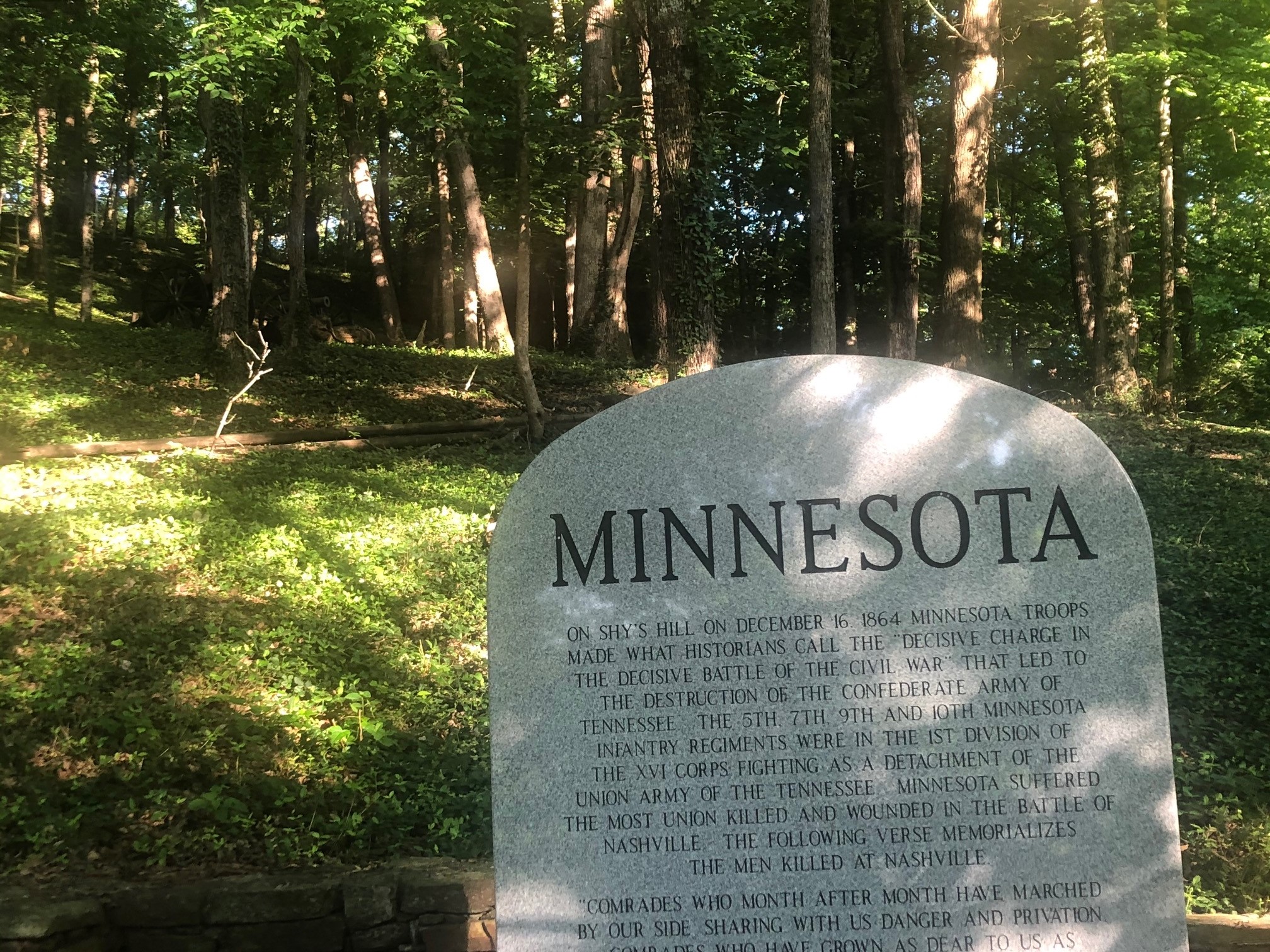
More recently, I read another book titled, Nashville 1864, this time a work of historical fiction that recounted the Battle of Nashville in the American Civil War. The novel was frustrating in its romantic approach to the Antebellum South while helpfully portraying the terrible specter of war, and it simply reinforced in my mind the terribly complicated history of this nation. The novel describes the decisive encounter of the battle that occurred at Shy’s Hill, which happens to be one mile from my house. I finished the book on Memorial Day weekend, and early on Memorial Day itself jogged over to and up on Shy’s Hill to consider all the lives lost. It seemed random to see a marker for Minnesota on Shy’s Hill in Nashville, Tennessee—random until I learned that more Union soldiers from Minnesota died in that battle than from any other state.

And then the despicable murder of George Floyd in Minnesota was televised on the evening news.

Friends, it has been 156 years since a significant number of Minnesotans died in my neighborhood fighting a war that presumably put an end to the notion that Black Americans were less than White Americans. But it is all too clear that all the lives lost and all the efforts made and all the progress achieved has not ultimately prevailed.

For multiple reasons I chose years ago to post less about issues on social media instead of more. Among those reasons was a desire to read and listen more (and talk less), and to focus on things that carry the possibility of creating actual structural changes so that the reality 156 years from now is different—things like using my advantages to instigate conversations that lead to changes in education systems, hiring practices, and ultimately, changes in hearts.

But in times like this I question whether I am doing the right things, or things that really matter, or, maybe most of all, whether I am doing enough.

So today, for what it is worth, I say aloud that I recognize the deep wrongs screaming at us on the evening news—wrongs that exist in a nation where the two people competing to be its CEO are both White men who have independently and recently managed to offend millions of Black Americans. In such a time and place, I simply say that I stand alongside Black Americans and declare their full beauty and worth as human beings. It matters more whether I live it than whether I say it, but in case it helps or matters, I say it.

Manzanar

ManzanarI elbowed my way through afternoon L.A. traffic to begin a four-hour mountain drive that ended in a surprising thunderstorm and finally some peace and quiet. Early the next morning I drove the few remaining miles to my destination: Manzanar.

I forget exactly when I learned about Manzanar, but it should have been sooner.

Asian-Americans endured prejudicial treatment prior to Pearl Harbor in 1941 but that terrible attack brought specific ethnic hostility to those of Japanese ancestry. In early 1942, FDR signed Executive Order 9066 that authorized the military to remove “any or all persons” from the West Coast and ultimately over 110,000 people of Japanese ancestry were incarcerated in ten American concentration camps simply because of their ethnicity. Ten thousand of those Japanese-Americans and Japanese immigrants were incarcerated in California at Manzanar.

My interest in visiting Manzanar intensified a few years ago when I learned that two of the ten wartime camps were located in Arkansas—I grew up in Arkansas and taught history in Arkansas and had never been told that Arkansas incarcerated 17,000 people of Japanese descent from California, half at Camp Jerome and half at Camp Rohwer. I knew then that I needed to visit Manzanar to feel the pain of a camp and ponder this terrible connection between my two “home” states—and my native country.

Manzanar is easy to visit on one hand: It is free, uncrowded, and only takes an hour or two to see everything there is to see. But it is difficult to visit as well. For what it represents, and what it proclaims.

Out of the 110,000+ imprisoned out of fear of espionage or sabotage, exactly zero were convicted of espionage or sabotage. That unwarranted fear destroyed many lives and families and even flirted with destroying a culture. In Hawaii where 158,000 Japanese-Americans faced less prejudice and enjoyed more freedom than those on the mainland, they were still discouraged from speaking the Japanese language and practicing the Buddhist religion. Hawaii’s military governor explained why: “We must remember that this is America and we must do things the American Way.”

And what, pray tell, did this chapter of American history communicate about the American Way?

The barbed wire at Manzanar stands as a reminder of how fear and power work together. But Manzanar also reminds us of the potential resilience of oppressed people and that even when fear and power lace up on the same team that victims can band together and rise above their circumstances. Possibly my favorite poster in the visitor’s center hung outside the theater and featured a quote from Hank Umemoto: “We were screwed, but then we made the most out of it and we turned Manzanar into a community.”

May there be no more Manzanars. But in the meanwhile, may all such peoples find that kind of courage and hope.

These United States

33

The United States of America is 242 years old today. It seems to be in a bit of a cranky stage but those of us who love her hope she will grow out of it someday (soon). It is a spectacular country in about every way you define spectacular. I have now traveled to five continents and have a better frame of reference—enough to recognize that the land of my birth is unique in its global influence.

And I have now spent time in thirty-six of these United States and hope to complete the set someday. I already have remarkable memories.

I stood outside the Dexter Avenue Baptist Church in Alabama and threw snowballs on the Fourth of July in Alaska. I stood at the Grand Canyon in Arizona and called the Hogs in Arkansas. I watched the sunset in California and ran in the snow in Colorado. I saw a rocket launch in Florida and ate peach cobbler in Georgia. I ran along the Snake River in Idaho and sang Take Me Out to the Ballgame at Wrigley Field in Illinois. I shot hoops at Larry Bird’s restaurant in Indiana and drove by corn fields in Iowa.

I saw the wide open horizon in Kansas and watched horses run behind white fences in Kentucky. I ate beignets in Louisiana and crab cakes in Maryland. I toured the Ford Museum in Michigan and the Mall of America in Minnesota. I saw a hurricane in Mississippi and the Gateway Arch in Missouri. I sang in the capitol rotunda in Nebraska and walked the Las Vegas Strip in Nevada. I drove Route 66 across New Mexico and ran Central Park in New York.

I ate banana pudding in North Carolina and had a VIP tour of the Pro Football Hall of Fame in Ohio. I dodged tornadoes in Oklahoma and crossed breathtaking rivers in Pennsylvania. I saw Fort Sumter in South Carolina and the Lorraine Motel in Tennessee. I witnessed Monday Night Football in Texas and the Golden Spike National Monument in Utah. I crossed the Potomac in Virginia and ascended the Space Needle in Washington. I drove up a winding mountain in West Virginia and ate cheese curds in a bar in Wisconsin.

I am ready for more.

This is an incredible country, and I choose to celebrate these United States today. And I choose to do my part in making it better tomorrow.

Waves of Memories

PepperdineUMemSunriseFlags1jpg-3376683_p9Our youngest daughter started middle school when we moved from Mississippi to Malibu in 2008 and needed certain shots to enroll in school, (make up your own jokes friends from Mississippi and California, but be nice!) so we went to a local urgent-care facility and waited. There in the waiting room I met a super-friendly Pepperdine student who was the incoming president of the College Republicans at Seaver College. He excitedly shared with me his plan to place a large American flag on the magnificent front lawn of Pepperdine University for every life lost in the terrorist attacks on September 11, 2001. He said it was going to be awesome. I was impressed by both his initiative and enthusiasm.
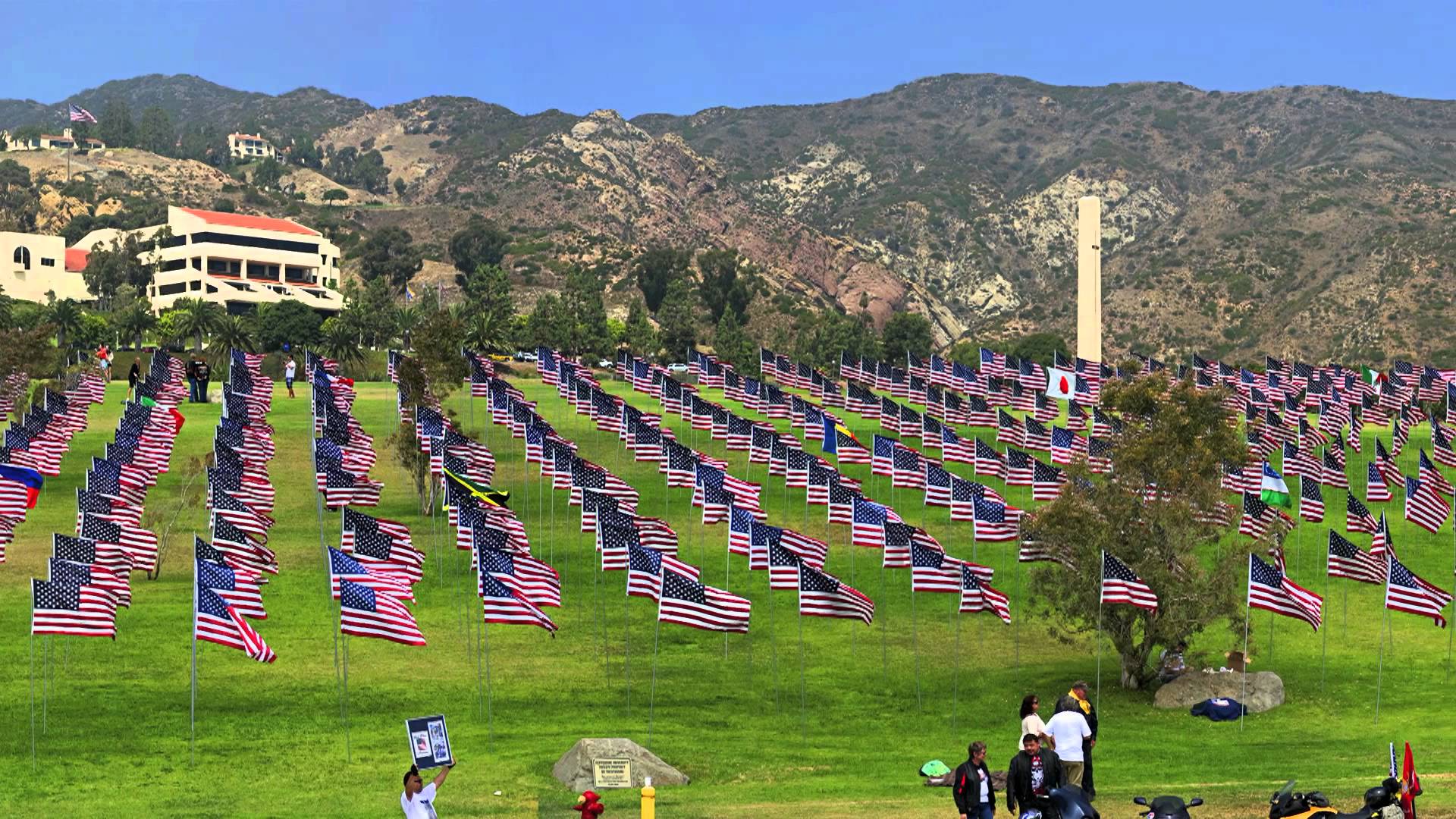
He delivered. The display was such a success that Pepperdine immediately latched on to the idea, and this year marks the tenth consecutive year for the breathtaking “waves of flags” display. 

Walking among the flags is an experience in and of itself, not to mention a photographer’s dream in the Age of Instagram, but my favorite thing to do is to watch the first responders and the veterans park their fire trucks and motorcycles on the iconic Pacific Coast Highway and walk up the hill to take in the experience.  They are far more inspiring to watch than the flags themselves.

In the early years, someone had the proper idea to place flags of other nations among the American flags to represent the correct nationalities of the victims of the attacks on that fateful day. After all, the attacks were acts of aggression against the entire world. International students and guests to campus are happy to find their flag and yet sobered by the reminder of the loss that flag represents. 

We still remember that terrible day. In a year or two, incoming college students will remind us that they were not alive in the fall of 2001, but as of today the flags are still flying and those of us who remember still share our stories. 

President Abraham Lincoln predicted that the world would soon forget what he said that historic Thursday afternoon in Gettysburg, Pennsylvania, but elementary school children still memorize his speech over 150 years later. Some things are simply unforgettable.

maxresdefault

Beneficence

bush-letter

“Our culture has made it harder to be good.” – David Brooks, The Road to Character

With the news that former president George H.W. Bush is in ICU and the worldwide attention on today’s presidential inauguration, I found this worth sharing today.

In one sense, today is simply a Republican president succeeding a Democrat president, something that has occurred three times in my lifetime (and three times vice-versa, too).  But everyone knows that this inauguration is almost indescribably different.  Donald Trump won the presidency by brazenly declaring that he is indescribably different.  And today is the day he moves into the White House.

President Obama will cede center stage today.  I have watched him navigate the post-election drama, and I may not be objective enough to comment, but it seems that he has been consistently gracious in what must be an awkward time.  Today will be particularly scrutinized.

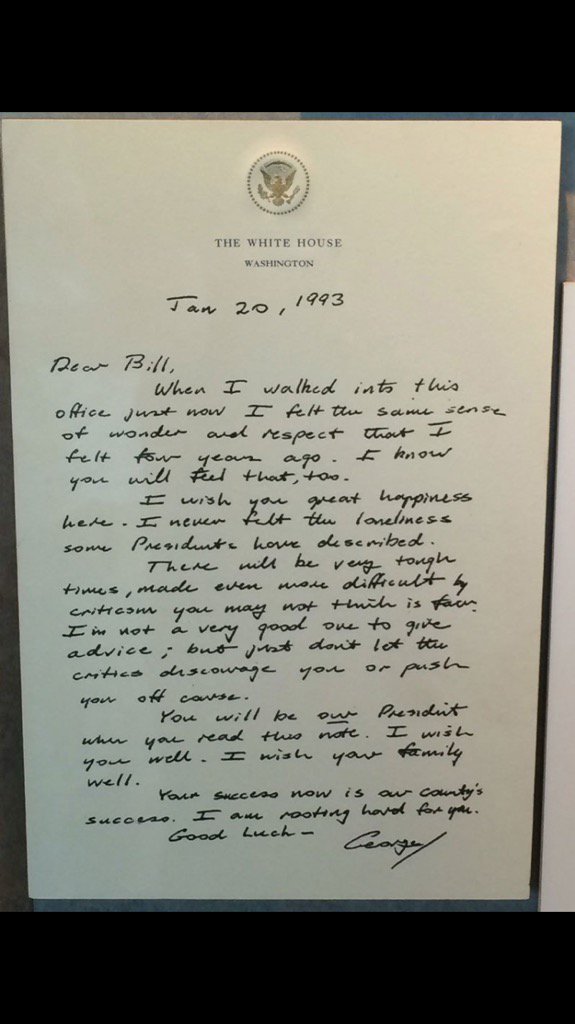
A couple of months ago at the height of the election drama, a handwritten letter that outgoing president George H.W. Bush left in the White House for incoming president Bill Clinton in 1993 made the rounds, and given the campaign histrionics this go around, it was almost shocking to read.

He wrote:

Dear Bill,

When I walked into this office just now I felt the same sense of wonder and respect that I felt four years ago.  I know you will feel that, too.

I wish you great happiness here.  I never felt the loneliness some Presidents have described.

There will be very tough times, made even more difficult by criticism you may not think is fair.  I’m not a very good one to give advice; but just don’t let the critics discourage you or push you off course.

You will be our President when you read this note.  I wish you well.  I wish your family well.

Your success now is our country’s success.  I am rooting hard for you.

Good luck,

George

In President (George H.W.) Bush’s autobiography, he describes that day: “And so time goes on and I’m sitting here now alone, the desk is clear and the pictures are gone.  I leave a note on the desk for Bill Clinton.  It looks a little lonely sitting there.  I don’t want to be overly dramatic, but I did want him to know that I would be rooting for him.”

I don’t want to be overly dramatic either, but the graciousness offered by President (George H.W.) Bush to President Clinton is something that in my opinion does more than transcend politics—it transcends life.  And it displays a depth of character not rewarded in our culture today.

I want to highlight it.  Especially today.

Love Down in Early Trading

11I’m not sure that I met the height requirement for this American roller coaster, but I am apparently strapped in and here we go.

Let me just say that I believe love wins in the end.  But right now love is getting clobbered.  It’s like love is the Cleveland Browns.

The unique American experiment used the language of equality at its inception, which was absurdly false.  With time, various social justice movements emerged that brought differing measures of hope and progress to those beaten down or discredited due to their skin color, religion, gender, sexual orientation, and so on.  Such progress occurred through acts of love by courageous advocates who put their lives on the line for their brothers and sisters.  However, one category was rarely on the list of people to love, and that was a love for the people doing the beating or discrediting (i.e., “the enemy”).

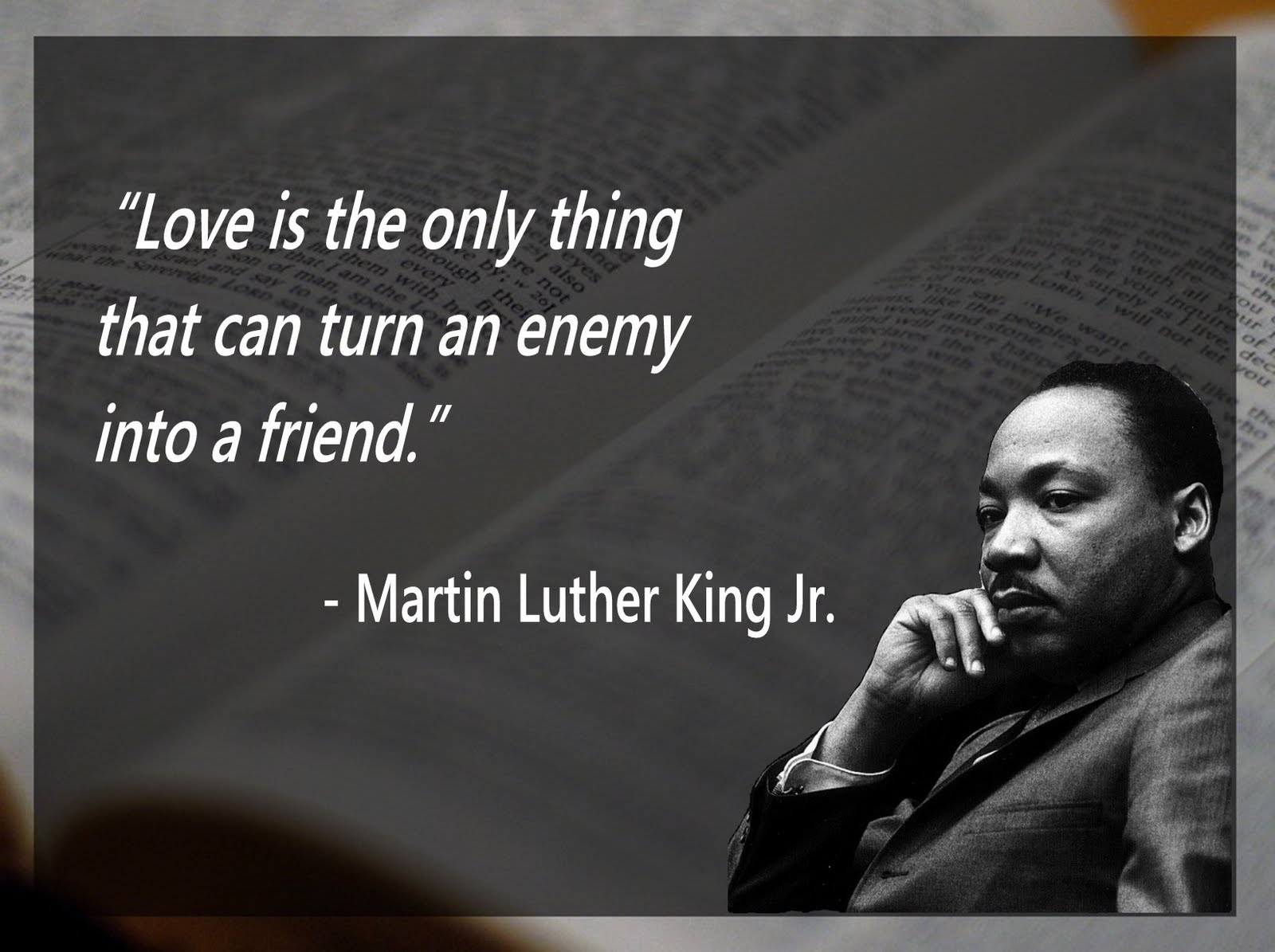
But who in their right mind would propose loving an enemy when it is undeserved, especially when hate, resentment, and rage all feel so darn good?  Well, there was Dr. King, but he was a rare bird.  My Christian faith calls for a love of enemies, but it seems that Harriet Beecher Stowe summed it up in this little exchange in Uncle Tom’s Cabin:

“Don’t the Bible say we must love everybody?”

“Oh, the Bible!  To be sure, it says a great many such things; but then, nobody ever thinks of doing them…”

Regardless, we have spiraled into an awful mess.  “I don’t love you because you are a certain category.”  “Then I don’t love you because you are a terrible person because you don’t love people because they are in a certain category.”  “Well, now I don’t love you either because you say I am a terrible person.”  “Well then…”

It is a spiral leading nowhere good.  Specifically, it led to this presidential election, and from what I see, there is no sign of this train slowing down on either side.

It is telling that this presidential campaign produced two “anyone but” movements (i.e., “anyone but Trump” and “anyone but Hillary”).  Both meant exactly what they said.  Both emerged because our (un)civil war led the two sides to offer candidates representing the ultimate middle finger to their sworn enemy: “We propose the worst person you can imagine to be the most powerful person on the planet.”

One side won.  The other is apoplectic.  It was inevitable either way.

Let me be specific.  First, I am from Arkansas.  Second, I voted for Secretary Clinton.  It stings to hear what some friends say about “anyone who would vote for Hillary.”  It is hard to imagine that someone can say such things and love me at the same time.  Simultaneously, it stings to hear what some friends say about “anyone who would vote for Trump”—e.g., when entire swaths of my friends and family are referred to as uneducated, ignorant, redneck, and so on.  It is hard to imagine that someone can say such things and love those I love at the same time.

Love is just getting trounced.  Who knows, maybe it is game over, and if so, hopefully someone will learn a lesson from us someday after we are finished annihilating ourselves.  But I choose love anyway.  Even when it seems impossible, I continue to believe that love wins in the end.

To my friends on both sides who are understandably afraid, I humbly suggest that your fear may be misplaced.  Instead of being afraid of those you believe look down on you or those you love—and maybe they really do look down on you or those you love—I suggest (to quote a president) that the true enemy is fear itself.  And the antidote is love.  Learning to love an enemy is incredibly difficult, but I believe it is the hope of the world.

So how might one attempt to do such a radical thing as love someone you have good reasons to hate?  Buddhist monk, Thich Nhat Hanh, offers this: “To love our enemy is impossible.  The moment we understand our enemy we feel compassion towards him or her, and he or she is no longer our enemy.”

I say it is worth a shot.  Categorically dismissing others is getting uglier all the time.