Tag Archives: faith

An Historic Election: Looking Backward, Inward, and Forward

I confess a deep sadness following last week’s presidential election. It is a personal sadness, sure, but it is far more on behalf of those from historically-marginalized groups that feel especially vulnerable and afraid due to a resounding national stamp of approval for a candidate famous for hateful rhetoric offered in their specific direction. E.g., Stand back and stand by. Black jobs. Grab them by the ____. Too many direct quotes about specific women’s bodies to list. Mocking a reporter with arthrogryposis. Muslim bans. Shithole countries.

I felt especially sad for my two amazing daughters. Their professional lives and personal hearts are dedicated to teaching children who live in poverty in the urban core and who are now facing a promise of mass deportation that will rip immigrant families apart. It is hard to imagine a fear more fundamental than a powerful government separating you from your family. It was hard enough for me to communicate with my heartbroken daughters as they went to work the morning after the election and know that they love children by name who are facing those fundamental fears.

My sadness expands recognizing that my personal religion, Christianity, generally speaking, is openly and willingly associated with the national stamp of approval for the hateful rhetoric. Although I disagree with their conclusion, I can understand the thought processes of those who saw the election as a “lesser of two evils” vote, but there is never cause for celebration following a lesser-of-two-evils vote. And yet lots of Christians celebrated this one with euphoric joy; saw it as an answered prayer; used words like anointed. I unfortunately opened Facebook the day after the election.

I have been on a thirty-year journey with faith and politics, a journey that began in the early 1990s with me a young, questioning adult and the simultaneous rise of the Religious Right as a political movement. As Evangelical (for lack of a better term) churches gravitated toward the proselytization of a political strategy, I was saved from dismissing Christianity and moving on entirely, in part, by stumbling upon the writings of Will D. Campbell who demonstrated for me that there was a different way to be Christian, and I concluded that for me following Jesus meant that I must love everyone, regardless. Both sides. All humans. Even enemies. Learning to “live reconciled” became an important phrase to me, as did “indiscriminate love.”

But that really messed me up. Loving everyone is a recipe for loneliness in a culture insistent on choosing sides, winners and losers, us and them. On one hand, I could see the pain felt by those that experienced decades of cultural condescension and blindness to class inequality from the Political (and Religious) Left while on the other hand growing increasingly cognizant of the centuries of pain felt by those that experienced the terrible injustice and marginalization perpetuated by the Political (and Religious) Right. So, I eventually learned to bite my tongue a lot, choosing instead to plant seeds, attempting not to alienate either side in an attempt to love and maintain relationships with everyone. I chose to work within a lot, behind the scenes a lot. And I felt guilty a lot for not doing and/or saying more.

My interpretation of Christianity remains, but in time I sought a quiet freedom from a life where I am not allowed to be fully authentic, and I am grateful for the wonderful feeling of liberation that I now experience. But given my own emotional reaction this week, and given numerous private texts and conversations with friends from all over the country that we made on our long journey toward personal liberation, my personal freedom seems self-serving and wholly insufficient.

But what to do?

That question has dominated my thinking, and I am grateful for anything I have heard and read from Dr. Tressie McMillan Cottom in the aftermath of the election (like the full Daily Show interview). Dr. Tressie has helped me tremendously (and I thank my friend, Chalak, for telling me about her in the first place). And I have also benefitted from articles written by both David Brooks and David French after the election, white men from conservative backgrounds who through their columns have assured me that my visceral reactions to the election aren’t simply because I drank Kool-Aid at the Liberal Vacation Bible School.

Collectively, they pulled no punches in saying that chaos is coming but emphasized that despair cannot be allowed to be the mood for long. Dr. Tressie advised, “Don’t cry too long over a sinking ship,” and the subject of David French’s email read, “We don’t have time to waste time in despair.”

French wrote, “There’s a temptation to retreat. If you have a stable job, a good family and good friends, you can check out of politics. After all, politics can be painful. It’s not just the pain of loss, but also the pain of engagement itself. MAGA is extraordinarily cruel to its political opponents. But despair is an elite luxury that vulnerable communities cannot afford. If Trump was telling the truth about his intentions — and there is no good reason to think he wasn’t — then he will attempt a campaign of retribution and mass deportation that will fracture families, create chaos in American communities and potentially even result in active-duty troops being deployed to our cities.”

So, while sad and tempted to quit caring, even that, as depressing as it sounds, is “an elite [and selfish] luxury.” Here are my commitments instead:

#1: See. I choose not to give up on my faith commitment to see all people—i.e., to love neighbors, regardless of anything. David Brooks published an important book last year titled, “How to Know a Person,” and his post-election column explained something Will Campbell helped me see long ago, i.e., a “redistribution of respect” that led to a “vast segregation system” between the Political Left and those that now comprise the base of the MAGA movement. Brooks’s post-election column titled, “Voters to Elites: Do You See Me Now?,” reminds me that condescension creates problems and does not cure them, and I won’t abandon my desire to see all people as human beings equally worthy of sincere love and respect.

#2: Speak. This, I confess, feels like my greatest challenge. One change I must adopt moving forward is a willingness to speak up more, even though that will risk alienation from and dismissal by people that I love on every side. It is tempting to bite my tongue, especially when I want to remain in relationship with everyone, but I think David French is right when he says we are compelled to “speak the truth.” He explained it this way: “Telling the truth means combating deception and misinformation, but it also means publicly defending the dignity and humanity of the people and communities who are the object of Trump’s wrath. It means resisting malice when we encounter it in our churches and communities.” Remaining silent might appear to preserve relationships, but it forecloses all prospects for true justice and real harmony. This blog post is an initial and meager attempt to speak up more.

#3: Act. Finally, as hard as the first two are to do, they are insufficient without action. David French wrote that we must “protect the vulnerable,” but I like how Dr. Tressie said it best: “Don’t cry too long over a sinking ship. Build dinghies.” To continue the nautical metaphor, the Brooks column concluded this way: “[W]e are entering a period of white water. Trump is a sower of chaos, not fascism. Over the next few years, a plague of disorder will descend upon America, and maybe the world, shaking everything loose. If you hate polarization, just wait until we experience global disorder. But in chaos there’s opportunity for a new society and a new response to the Trumpian political, economic and psychological assault. These are the times that try people’s souls, and we’ll see what we are made of.”

I want my soul to pass this test, so with thanks to Dr. Tressie and the two Davids, and after much reflection, I have concluded that it takes all three: See. Speak. Act. Looking backward in despair, looking inward in contemplation, and now looking forward with resolve, that is what I commit to do.
Coming to Terms

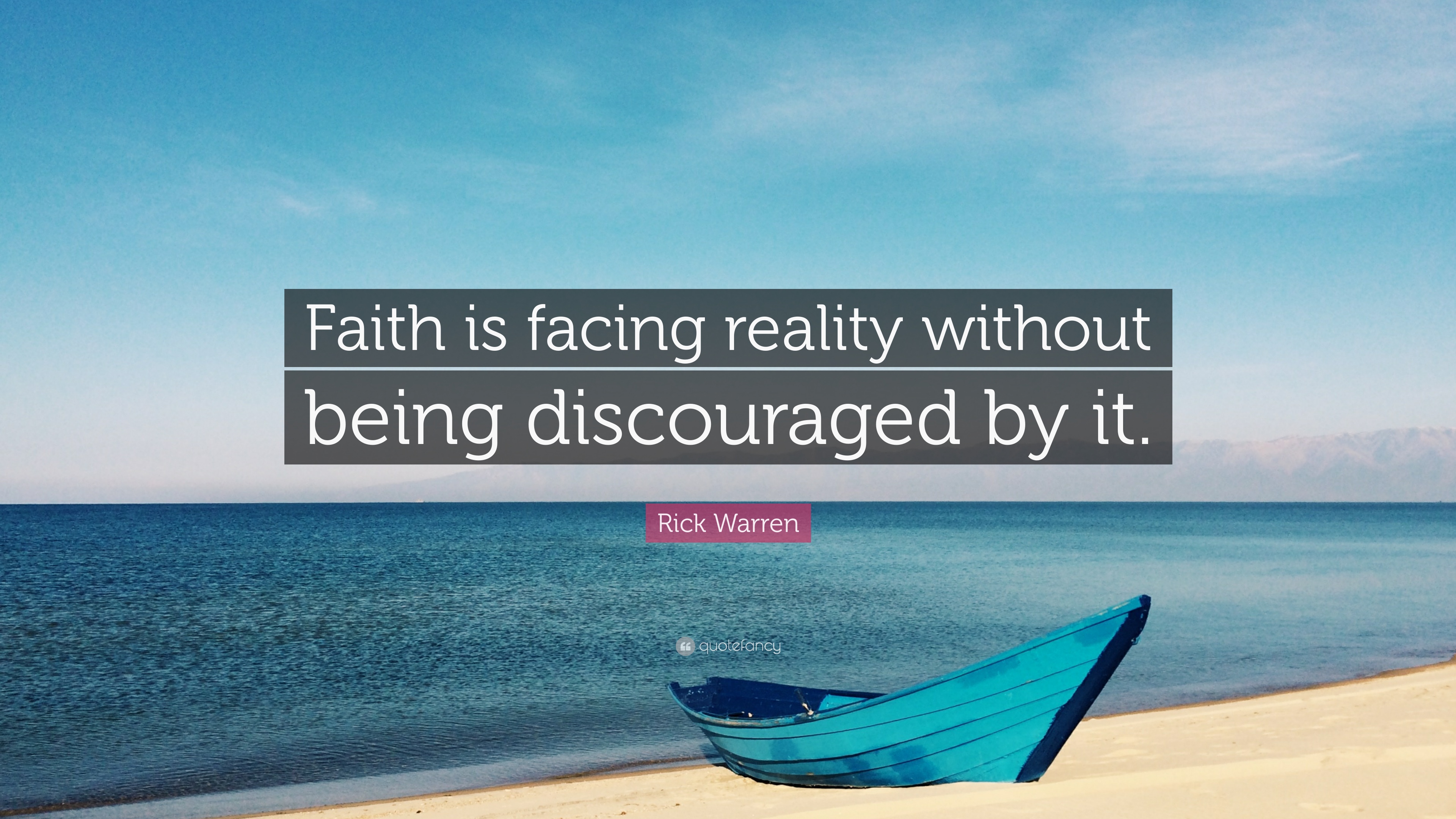
1851074-Rick-Warren-Quote-Faith-is-facing-reality-without-being

“You’re likely to get the coronavirus.”

That was the headline of an article in The Atlantic that caught my eye way back in February before the world entered into an impressive barrel roll. The author, a physician who lectures at Yale School of Public Health, quoted a Harvard epidemiology professor who said, “I think the likely outcome is that it [COVID-19] will ultimately not be containable.” The Harvard prof guessed that “40 to 70 percent of people around the world will be infected with the virus that causes COVID-19.”

Sobering, to say the least. But then there was this:

The emerging consensus among epidemiologists is that the most likely outcome of this outbreak is a new seasonal disease—a fifth “endemic” coronavirus. With the other four, people are not known to develop long-lasting immunity. If this one follows suit, and if the disease continues to be as severe as it is now, “cold and flu season” could become “cold and flu and COVID-19 season.”

I haven’t been able to shake that early prediction.

Of course a couple of weeks later we all learned phrases like “flatten the curve” and “social distancing” and then there was Carole Baskin and Joe Exotic and now a few months later American Idol is broadcasting from living rooms while ESPN featured the 46th Annual Cherry Pit Spitting Championship. So we’re all a little dizzy.

But I keep thinking back to that article from February and wonder if we should consider that COVID-19 might be here to stay.

Another headline recently caught my attention: “Scientists fear the hunt for a coronavirus vaccine will fail and we will all have to live with the ‘constant threat’ of COVID-19.” Consistent with my nagging thoughts, David Nabarro, a professor of global health at Imperial College in London, was quoted as saying, “…for the foreseeable future, we are going to have to find ways to go about our lives with this virus as a constant threat.”

So, how is your day going so far?

I may be unconvincing when I say this, but I’m not writing to depress anyone. Quite the opposite. Instead, I deeply believe that the greatest psychological danger is to ignore reality and that coming to terms with the journey ahead is the healthy approach to life.

In my humble opinion, while continuing to focus unprecedented attention on protecting the vulnerable, we must also determine how to rearrange our lives to carry on with COVID-19 in the neighborhood because, like the common cold, it is possible that it is not going away anytime soon.

The Stockdale Paradox

Good-To-Great-Leadership-Lessons-1024x597

“A key psychology for leading from good to great is the Stockdale Paradox: Retain absolute faith that you can and will prevail in the end, regardless of the difficulties, AND at the same time confront the most brutal facts of your current reality, whatever they might be.” – Jim Collins. Good to Great. Random House, 2001, p. 88.

Anyone stuck listening to me talk about leadership in the last several years has suffered through many references to Jim Collins’s famous book, Good to Great.

Welcome back.

I shared this short three-minute video with my student life team last week prior to our all-staff (virtual) meeting of Collins himself describing one of his key findings. Feel free to tune in, too, but I’m going to talk about it either way.

In the video Collins describes his interactions with Admiral James Stockdale, an American hero who was held and tortured as a POW in Vietnam for over seven years (and if the name sounds familiar, he was later Ross Perot’s running mate and subject of a Phil Hartman parody on SNL). Collins uses Stockdale’s horrific experiences as a POW to ask how one approaches a situation when you aren’t sure if it will ever end, and even if it will, you cannot know when.

This is how Collins describes his memory of Stockdale’s response: “You have to realize I never got depressed because I never ever wavered in my faith that not only I would get out, but I would turn being out of the camp into the defining event of my life, that in retrospect I would not trade.”

Wow. Read that one again for the full impact.

But Collins, ever the researcher, goes on to ask: “Who didn’t make it out as strong as you?”

Stockdale’s response?  “Easy, it was the optimists.”

Collins was quick to point out that Stockdale’s unwavering faith that this would turn out to be the defining event of his life surely sounded optimistic, to which Stockdale emphatically replied that he was most definitely NOT optimistic. While others were sure they would be out by Christmas, then Easter, then Thanksgiving, then Christmas again, ultimately dying, as Collins described, “of a broken heart,” Stockdale never shied away from the reality of his situation.

Are you ready for this?  From Admiral Stockdale, “This is what I learned.  When you are imprisoned by great calamity, by great difficulty, by great uncertainty, you have to on the one hand never confuse the need for unwavering faith that you will find a way to prevail in the end with on the other hand the discipline to confront the most brutal facts we actually face.”

It is a ridiculous stretch to compare most of our situations with a POW camp, but that doesn’t stop the “Stockdale Paradox” from proving most helpful anyway—an unwavering faith that we will ultimately prevail alongside a willingness to face reality.

My boss/friend, Matt, pointed to Scripture to make this even more clear for people who will live by faith:

We are afflicted in every way, but not crushed; perplexed, but not driven to despair; persecuted, but not forsaken; struck down, but not destroyed… So we do not lose heart. Even though our outer nature is wasting away, our inner nature is being renewed day by day. For this slight momentary affliction is preparing us for an eternal weight of glory beyond all measure, because we look not at what can be seen but at what cannot be seen; for what can be seen is temporary, but what cannot be seen is eternal. – Paul, 2nd Corinthians 4: 8-9; 16-18 (NRSV)


Gifts

Ashley Lahey

Ashley Lahey entered the final semester of her senior season as the top-ranked women’s tennis player in the nation (not to mention one of the top students at Pepperdine), but more importantly to me, she ranks among the best human beings.

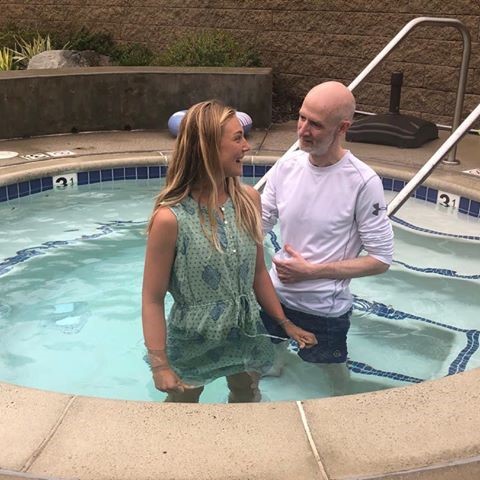
Ashley (reluctantly) came to the church where I preached in Malibu with her boyfriend and my good buddy, Treet, but I had no idea at the time that she was in a season of struggle. She broke down in tears at a tennis match the first time we had a brief conversation, which led to a longer sit-down where I got a glimpse of what was really in her heart. From that time on I simply had the great privilege of watching her immense intellect and strong will in action—just like on the tennis court—as she journeyed to faith. After my last sermon there, Ashley asked if I would baptize her, and I had that opportunity on my very last day living in Malibu. What a tremendous gift.

I am writing about Ashley because last week was a rough one in my world. I lost an old friend and traveled to honor his life, and on the way unexpected chaos broke out among the work I had left behind. It was a hard week. And then Friday night, sitting at home and processing all that had happened, Ashley sent a video of her sharing her faith story that day at Celebration Chapel at Pepperdine where she graciously gave me a prominent place in the story. What a sweet gift on any day, but especially for me on that day.

In the unpredictable messiness of life, the unexpected gifts are extra special.

Ashley Baptism

Finish the Race, Keep the Faith

IMG_1721

Note: I wrote this post before the tragic helicopter crash in Calabasas near one of my old running trails, but the message still somehow applies. RIP to Kobe, his daughter, and all who died in such a terrible accident.

When I was fourteen, Shawn invited me to run a 15k in Memphis at Oktoberfest, and since there was little adventure in our small-town Arkansas life I quickly agreed. I was bright enough to know that fifteen kilometers equaled 9.3 miles but not yet bright enough to prepare by running more than three miles in advance. Coach Watson warned us, but we were invincible junior high schoolers, so we weren’t worried.

We rose in the early morning darkness and rode the hour and a half to Memphis in a custom van with Ethan and Everett. We thought both men were ancient, although I realize now that Ethan was only fifty-three (and Everett sixty-seven). Ethan was a legend in our hometown, completing over forty marathons, including three Bostons, and Everett was a legend in several ways—college football at LSU, one-time world record holder for sit-ups, pole vaulter in the Senior Olympics. We were unable to comprehend our great privilege.

The race was something else. I had only run a couple of local 5ks, so this was the first time I had experienced the exhilaration of a major race with a thousand runners—much less the distance. Filled with adrenaline we started way too fast, and at the second mile marker I could not breathe, where it occurred to me that I still had over seven miles to go. So I let Shawn, the far better runner, go on while I slowed the pace to focus on survival. I never stopped, in spite of the monster incline up Riverside Drive near the end. I may not be a natural runner, but I am naturally stubborn.

Last weekend, thirty-five years later, I remembered that race on a seven-mile run at Percy Warner Park, alone in nature with my memories. The trail is hilly, and the temperature was frigid, and as my aging body huffed and puffed up a small mountain I remembered Shawn’s impression of the whistling sound Ethan made as he inevitably caught and passed us at each race. I had to laugh. At an overlook at the top of a major hill I stopped to gaze at the Tennessee winter forest and realized that I love Ethan and Everett now more than ever. I was in California when each passed and could not pay respects in person, but they helped shape my life. And then I thought of Shawn, killed in that tragic automobile accident so long ago. My very first running buddy.

The cold and the hills and the memories combined to bring tears to my eyes. I realized that I am the only one left from that 1984 Oktoberfest quartet, the only one left even to remember.

I decided to dedicate the run to my old friends (may they be somewhere running in peace), so I turned from the overlook and hit the trail again—alone. Not sure why I am the only one still on the course, but as long as I can I’ll keep running.

What Goes Around…

blog picIn December of 1993, over a quarter century ago now, I was a young high school basketball coach in Arkansas trying to come to terms with what it meant to truly follow Jesus. My struggle pointed toward the margins of society and the conclusion that I should go love people in places that others might not. Specifically, I decided to move to a major city and teach in an inner-city school, and although I had never been further west than Dallas, I chose Los Angeles.

I then went to tell my mother. That was no fun. I told her that I planned to drive (yes, drive) to L.A. on spring break to look for an apartment and return to finish out the school year before moving that summer to begin a new life. She was heartbroken. I, as you can tell, was clueless.

This was pre-Internet, at least for me, so I had no idea how to pull this off. On New Year’s Eve, I mailed a typewritten cover letter and resume to the Los Angeles Unified School District in an envelope with no street address and a zip code I must have found in the reference section of the public library. I somehow expected it would get there—by divine courier if nothing else.

I never made the trip. Instead, while at a high school basketball tournament on New Year’s Day—the same day I had dated the cover letter—a beautiful young woman introduced herself and changed my life forever. That spring break, instead of driving to L.A., I proposed marriage. That summer, instead of moving away, we married.

At some point, my letter to the Los Angeles Unified School District was returned to sender—by divine courier, I suspect, but via the local postal carrier. It remains to this day one of my prized possessions.

Fast forward to last week, and our oldest daughter accepted a job teaching deaf and hard of hearing children at an elementary school in the Los Angeles Unified School District. Same day, our youngest daughter—around the age I was when I sent that letter—began her post-college life using her bilingual skills at a middle school in the San Antonio Independent School District.

I don’t know what to make of any of this. Still, after so many years, I remain clueless.

Clueless, yes, but also amused at the irony of life. And proud of those two young women that I have had the privilege to teach and to love.

In the Spotlight

Bright Lights

“All the world’s a stage…” – Jacques in As You Like It, by William Shakespeare

As I prepared last Friday night to enjoy my first experience with Singarama, a wildly popular campus tradition that showcases large numbers of ultra-gifted Lipscomb University students, I was mesmerized by the stage lights illuminating the auditorium in celestial royal blue. We in the audience instinctively knew that the lights were simply teasing us. Before long, they would disappear completely, only to explode again and dazzle us with the glittering magic of brightly-costumed performers singing and dancing and delivering a delightful evening of entertainment.

It is a different experience for those on stage. Blinded by the light, they must remain focused in ironic, light-flooded darkness, remembering the steps, remembering the lyrics, remembering to smile. It is a rush of a different kind, one that arrives by hard work, nerves, adrenaline, and execution. In the end we are all happy, but none more so than those who stepped up and delivered in the spotlight.

I also considered this earlier in the week sitting in the famed Madison Square Garden, the self-described most famous arena in the world, watching another set of college students put on a show in front of a crowd under the bright lights. This time it was athletic talent and a live national television audience, but it necessarily involved the same light-flooded darkness, the same adrenaline, and the same task to focus on what had been practiced over and over.

It was a pleasure on both occasions to watch students stand and deliver under the bright lights.

Some seem to crave the spotlight, while others avoid it. There are reasons to be wary of the spotlight, but others to embrace it. It is simultaneously compelling and terrifying. And some who crave the spotlight never receive it, and others who avoid it who find it thrust upon them.

It isn’t a bad metaphor for life, as might have occurred to Shakespeare.

So how does one respond to an impending moment on life’s stage under the bright lights? Discipline. Preparation. Courage. Persistence. Hard work. Good habits. Resilience. Endurance.

And maybe most important of all, an active imagination that envisions in faith that glorious and transcendent moment when you have done your part and the curtain falls or the buzzer sounds—in the spotlight.

The Mystery of Life

YA Party

“Mystery is endless knowability.” – Richard Rohr

We hosted our second annual murder mystery dinner party for our church young adult group on Saturday evening. Last year we created an ‘80s prom, but this year’s rendition was superhero-themed so I went to the dark side and attended as Lex Luthor since all I had to do was put on a suit and buy a green (kryptonite) ring pop. We had a blast.

It is odd to host a fun church party around such a dark theme, but we could hardly wait the full year to host another one it is so awesome. (And if you are interested in hosting one yourself I recommend shotinthedarkmysteries.com.)

I don’t think it is the costumes that make a mystery dinner party such fun, although the costumes are pretty great—I think the fun in the whole ballgame is that it is a mystery. We don’t know “whodunit”—and we are on a quest to figure it out. There is a reason we read mystery novels and watch mystery movies and television shows. There is simply something compelling about mystery.

Which is a little misleading because we really want to “know” the answer, right? It wouldn’t have been a great party if at the end of the night we had told everyone, “Sorry, but we don’t want to call anyone an actual murderer, so let’s just forgive and forget and move on with life, okay?” No, the compelling part of a mystery is that there is an ultimate answer.

Richard Rohr is pretty great, and in his writings on faith he teaches that living in mystery is not really a negative because mystery does not mean that you cannot know (how many negatives did I use in that one sentence?).  He writes, “Mystery is endless knowability. Living inside such endless knowability is finally a comfort, a foundation of ultimate support, security, unrestricted love, and eternal care. For all of us, it takes much of our life to get there; it is what we surely mean by ‘growing’ in faith.”

As I grow older I am less drawn toward the need to know everything and more inclined to enjoy the journey inside the ever-evolving mystery of life. Welcome to life—that long mystery dinner party.

Keep Climbing

Pic 1

On a trail last Thursday morning in a neighboring canyon I found myself running alone. I had started with others but when I faced a steep, narrow trail straight up an imposing mountain, unplanned, there seemed to be no one in the whole world but me and the trail to the heavens.

I attacked the hill with every ounce of my strength, arms pumping, calves burning, lungs fighting, and heart firing to conquer the challenge in front of me. I was strong—for a while—and then it was too much. I had to walk, but I refused to give up entirely and kept climbing the mountain step by step. In a few moments it seemed that I could sort of breathe again, so I challenged my legs to run the rest of the way. I thought I could do it, and I did.

At the top, seemingly on cue, I looked out at the crazy view across the morning sky and just at that moment the sun exploded over the mountains and above the clouds that lay across the hills like a cotton blanket. It was spectacular. The picture above is okay but doesn’t do it justice.

I’m not sure I want to run that hill again, and in retrospect, not sure that I really wanted to run it in the first place. But there was a feeling in my soul when I made it to the top and the sun broke through that felt like it was a special gift just for me, just for running, just for not stopping and finishing the climb. Pardon me, but it felt like a holy moment, and I was thankful. I felt a deep gratitude standing there on top of that mountain. The warmth of the sun. The beauty from above. The fullness in my lungs. The unplanned smile on my face.

I have friends on steep mountains today. I will have others. And it will be me again, too. My hope is that we all keep climbing, keep trusting, and keep believing that at the top of the mountain we will discover a spectacular gift. And smile.

We travelers, walking to the sun, can’t see
Ahead, but looking back the very light
That blinded us shows us the way we came,
Along which blessings now appear, risen
As if from sightlessness to sight, and we,
By blessing brightly lit, keep going toward
That blessed light that yet to us is dark.
Wendell Berry

Pic 2

Dreams

18380491_1304245319630140_7970860990956830720_n(1)My sweet wife visited the Field of Dreams Movie Site in Dyersville, Iowa, last week and brought home several souvenirs since she knows Field of Dreams is my favorite movie of all time. And, it seems, because she loved it there.

It still feels strange to say that Field of Dreams is my favorite movie. It has a corny plot–literally–set in that spooky Iowa cornfield complete with ghost baseball players and disembodied voices. It surely wasn’t my favorite movie when I saw it at the theater in 1989. Sure, I enjoyed the baseball history and the touching storyline, but I tend to prefer movies that aren’t set in fantasy world (nothing personal against Iowa).

My mistake was watching it years later. After my father died. That did me in. That famous last scene when a father is reunited with son and they play catch once again and Annie says to Ray, “Introduce him to his granddaughter” . . . 

Okay, I might need to change the subject. These darn allergies.

Mother’s days and father’s days mean something different to those of us on the other side of the great divide called death. It can be quite depressing, but oddly enough, it never has been for me. And I don’t even have to work hard to understand why. 

As fantastic as it sounds, although Field of Dreams is crazy fiction, I believe it touches on something that is actually very real. In my heart, I believe that someday I will once again hold my mother’s hand and play catch with my dad and introduce him to his youngest granddaughter.

The very thought of it nearly makes my heart explode with anticipation.