Tag Archives: california

Oh, the Places to Run!

Submission guidelines:

  1. Email running photographs for consideration to ohtheplacestorun@gmail.com
  2. Include the location of the photo (i.e., city; state; nation)
  3. Share a brief description of the photo (e.g., the place, the run, the people, etc.)
  4. Categories include: nature (beautiful scenery); roadside attractions (interesting things); humor (funny things); friends/people (running buddies); and travel (pics taken on runs while traveling)
  5. You retain all rights to your photograph and will receive photo credit when posted on Oh, the Places to Run! (note: if you want to promote your personal social media account or running club, please share that information)

——————————————————————————————————————–

I wish I could remember.

There are certain things I do recall. Like joining my wife for a super slow 5k jog in Westlake Village way back in 2010 after I had taken a couple of decades off from running. And my subsequent decision to purchase a cheap pair of running shoes and try running again, knowing it wouldn’t last. And my surprise and excitement later that it did.

And I also remember that someone shared the Nike Run Club app with me even though I never used GPS. And then the app itself remembers that it was July 2, 2013, when I first used it, jogging 1.27 miles with my wife on Malibu Road, which led to thousands and thousands of miles shared with that app over the past twelve years.

But what I don’t remember is the first time I decided to add a picture as a memory of one of my runs. I wish I remembered. Because that changed my life.

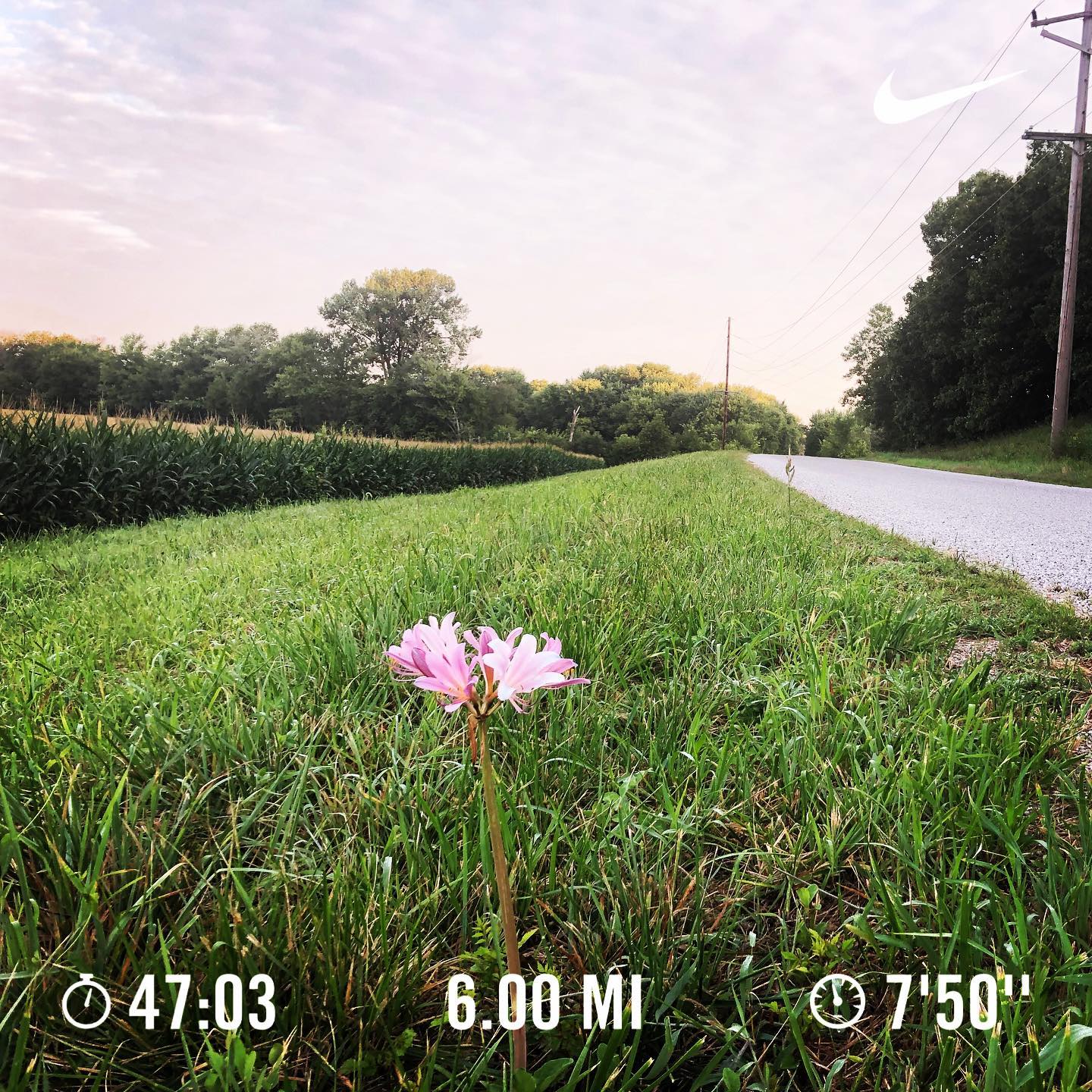
I am not a world-class photographer. And I am not a world-class runner. But what I have become is someone with a habit of going out into the world with open eyes, searching for the beauty that is everywhere once you start looking. I want to capture that beauty when I run. To remember.

I have a lot of running pictures now. A lot. And not to brag, but some of them are actually pretty good (if you take enough pictures, you get lucky every now and then). I have shared many running pictures on my social media accounts over the years, and periodically friends have encouraged me to collect them in a book—and I might do that someday. But today I have a different plan.

Today, I am launching a new Facebook page and an Instagram page titled, “Oh, the Places to Run!” (Imagine Humans of New York but for running places.) It will start small, I’m sure, sort of like my running habit, but I hope that it will grow to change the lives of other people, too.

My habit began in Malibu, California, and many said that I would struggle to find beautiful photo material once I moved away from breathtaking ocean and mountain scenery, and I took that as a personal challenge. I soon discovered that my suspicion was correct: There is beauty to be discovered everywhere. At least that’s what I discovered living in urban Tennessee, and then rural Illinois, and now rural Wisconsin—and actually everywhere I have traveled along the way.

I will keep taking pictures and sharing them on my new pages, and I hope you all will add the new pages to your algorithms and follow, like, share, and comment along the way. But my dream is much bigger. I hope that past, present, and future runners will share their favorite running place photos with me, too, and that these pages become places where everyone can discover that there is beauty everywhere when we have eyes to see.

So please click on the following links and follow along on Facebook and/or Instagram if you would be so kind. And, if you are willing to share some of your own running photos for consideration, submission guidelines are at the top of this blog post.

As Dr. Seuss famously wrote: “You’re off to great places! Today is your day! Your mountain is waiting…so get on your way!”

Let’s go!

Days of Reckoning

With so many statements vying for limited headline space, it seems that President Trump’s audacious assertions about Canada, Greenland, Gulf of Mexico, and the Panama Canal have been characterized by many as mostly “Trump being Trump,” which may very well be true. And I probably would not have given it much more thought had I not at the same time been reading my favorite college professor’s sweeping history of the American West titled, Continental Reckoning. 

For future reference, when you hear that someone has written a “sweeping history,” you can safely assume that it is a big ass book, which this one is. But it is a worthwhile read, especially for Americans to “be closer to understanding ourselves and how we have come to be.” (Prelude, page xxx — that’s Roman numeral thirty, not something dirty!)

I confess an added personal interest in the American West having lived in California for a dozen years in the past, and as I dove into the sweeping history in early January, it seemed all the more relevant when historic wildfires devastated the large numbers of people that have been drawn westward to what has become extremely valuable properties there. But it was reading of historic American expansion (and its consequences) alongside President Trump’s bold expansionist rhetoric that really began to capture my attention. 

A book review is not my intention, but I will explain that the mid-1800s witnessed incredible American expansion and transformation, and while historians typically focus on the violent and fateful American Civil War from that era, Dr. West encourages us to “broaden our view in space and time.” He writes, “The Civil War and the birth of the West . . . should be given something like equal billing in this crucial transition in national life. Each event has its own story and deserves its own narrative, but each was often in conversation with the other, and when each is properly considered in its broadest context, neither can be understood without the other.” (Prelude, page xx)

The extraordinary experience of the American West erupted from the discovery of California gold just as the territory became an American possession in 1848, something Dr. West calls, “The Great Coincidence.” (i.e., “Within two hundred hours of its becoming part of the republic . . . California began to be revealed as the most valuable real estate on the continent.” – page 5) 

It is no surprise that significant expansion is often an economic flex, but the consequences often extend much further.

For example, in the story of the American West, in addition to the vast increase in power, opportunity, and affluence, there were incredible advances in communication, science, technology, and transportation — but the costs were enormous: “hundreds of thousands dead or dispossessed” (454), “land stolen and turned into poisoned grotesqueries” (454), and an appalling racial ordering with devastating effects for Native communities, Black Americans, Hispanic Americans, and Chinese immigrants — Dr. West even shared another historian’s observation that the architects of Nazi Germany admired the United States and “believed they were ‘not so much inventing a race-obsessed state as catching up with one’” based on the U.S. treatment of those considered non-“white.” (453)

I recognize that this is the 2020s and not the 1850s, and that talk of expansion might be the bluster of a negotiator, but my thought for those of us used to a flag with fifty stars is this: Don’t take expansion rhetoric lightly. Be aware. Expansion produces consequences, often significant, and we should not allow our unfamiliarity with it and the possible allure of new acquisitions to prevent us from careful consideration of past experiences in our own days of reckoning, particularly if the proposed expansion is broad and, well, sweeping.

Faulkner’s famous line, “The past is never dead. It’s not even past,” seems apropos. Or, as Dr. West suggests near the end of this volume that he subtitled, The American West in the Age of Expansion: “The consequences remain; yesterday makes today. As for tomorrow and how best to use it, the stories and their voices offer up hints and provocations.” (454)

Learning to Hear Everything

“People notice when he’s imitating a horn or a bass, but he’s also singing like water, like rain, singing like a piece of wood, or like a plate cracking on the floor . . . . These are all available to him. All these sounds, because he’s just always aware . . . . In life, he’s always observing things. [And] he doesn’t just see everything. He hears everything.” – Marcus Miller (on Al Jarreau, in Kurt Dietrich’s “Never Givin’ Up: The Life and Music of Al Jarreau,” p. 321)

When Jody and I moved to Malibu (the first time) in 2008, like countless others before and since, we experienced the welcome embrace of Hung and Corinne Le. We quickly felt like family as we shared many a meal in the Le home alongside so many others that received similar treatment. On one of our initial visits Hung said that when he first heard about this couple, “Al-and-Jody,” what he kept hearing was, “Al Jarreau.” So before long, we became known to the Le family as the Jarreaus, not the Sturgeons. It would crack us up when “the Jarreaus” would be invited over for dinner, or while there, hear Hung ask to get a picture of “the Jarreaus” before the evening ended.

You can imagine my reaction several months ago now when the opportunity to move to Wisconsin to work at Ripon College became a real possibility and I stumbled upon a list of the College’s famous alums and saw the name: Al Jarreau. I just had to laugh.

Everyone in my generation heard of Al Jarreau. Ten Grammy awards, sure, but it seemed like he was constantly on television for something or other during the Eighties: singing the theme song for the hit show, Moonlighting; wedging his contribution to the epic “We Are the World” performance between Willie Nelson and Bruce Springsteen; performing his hit song, “We’re In this Love Together.” Even I, a sports-obsessed teenager that paid little attention to the music industry, knew his name.

In our many moves, I developed a habit of reading some facet of an area’s history once we arrived. I read “The Age of Gold: The California Gold Rush and the New American Dream” by H.W. Brands when we lived in California. In Nashville, it was “The Children” by David Halberstam. In Illinois, it was “Life of Black Hawk” as dictated by the Sauk leader himself. Anticipating Wisconsin, I noticed someone had recently published a biography on Al Jarreau, and I knew that I had to track it down once there.

Well, I didn’t have to try very hard. On one of my first visits to First Congregational Church of Ripon, I happened to sit next to Kurt Dietrich, a retired music professor from Ripon College who decided to become Al Jarreau’s posthumous biographer in his retirement. And I soon learned that Professor Dietrich would give a presentation on his book at the Ripon Public Library. Jody and I not only attended but I also received an autographed copy of the book, which he graciously addressed to his “new friend Al.”

I finished reading it this morning and thoroughly enjoyed every page. Anyone with even a passing interest in Al Jarreau, or music in general, or stories of incredibly gifted human beings with fascinating journeys, will be glad that they tracked down a copy.

I also read Isabel Wilkerson’s “Warmth of Other Suns” recently, a brilliant history of The Great Migration of Black citizens from the American South during Jim Crow, so I recognized that Al Jarreau was yet another example of an enormously influential Black musician from places like Chicago (e.g., Nat King Cole; Sam Cooke; Quincy Jones) and Detroit (e.g., Aretha Franklin; Diana Ross; Stevie Wonder) whose very genius emanated from people having the courage to flee the racial terror of the South in hopes of better lives for their families. Jarreau’s family story included parents that left Alabama for Chicago with subsequent stops in both Flint and Indianapolis before eventually settling in Milwaukee, Wisconsin, where Al was born and raised.

Although my journey is so, so different, there were several personal connections in the book that made me wish that I had paid far more attention to Al Jarreau along the way. For starters of course, we both had unlikely journeys to Ripon College, but we also made major moves to Southern California that transformed our lives. I also smiled when I noticed that a musician named Willie Weeks played bass on Jarreau’s second album, and I remembered that it was Weeks who later in his career gave my childhood friend, Jon Conley, his big break in Nashville. I also learned that Jarreau’s last concert was in Austin, Texas, where my youngest daughter now lives, and sadly learned that when Jarreau went to the hospital with the illness that took his life in early 2017, he did so in Thousand Oaks, California, where our oldest daughter now lives.

But beyond the coincidences that provided small feelings of connection to this musical legend, I experienced a deeper connection that comes from the work of a good biographer like Professor Dietrich.

For as long as I can remember, I have had a million friends while still feeling a strong sense of loneliness that is hard to describe. I suspect that on a much larger level that describes the life of Al Jarreau.

Everyone felt drawn to Al Jarreau, but he never truly fit into a recognized box. He fit in everywhere, and nowhere. He had a smile and positivity that lit up wherever he happened to be, but he defied easy categorization. He was so loved at Ripon College, but he was nowhere near the typical Ripon College student. He was a phenomenal musical talent, but no one could decide if he was a jazz artist, or pop artist, or R&B artist. He was an incredible human being with extraordinary gifts that was one of a kind, which sounds like a compliment but might be easier to admire than to be.

What I learned about Al Jarreau the musician is that he had an incredible gift for live performance in part due to his magnetic personality, but also because of his unique improvisational ability. Professor Dietrich shared a story from tour director Jerry Levin about a concert in St. Louis in 1978: “Halfway through the concert, a severe thunderstorm materialized, and the power in the venue went out. Although crew and concert organizers went out to see about cranking up a generator and salvaging the concert, the power had gone out in that entire part of the city. As the promoters and Levin began negotiating about refunding ticket prices to the audience, Al started singing all alone on the stage. The band’s percussionist passed out instruments to band members. Audience members got out lighters and flashlights from their purses and backpacks, bathing the room with a kind of a warm glow. Al finished the set, singing seven or eight songs a cappella. At one point, he sat on the edge of the stage. Several rows back, there was a couple with a small child. The youngster was brought up to the stage, where he sat on Al’s knee, and Al sang directly to the boy. Levin finished the story by saying, ‘I don’t think anybody that was there will [ever] forget it.'”

I wasn’t there, but just by reading about it I don’t think I will forget it either.

But what showcased his improvisational abilities, as musician Marcus Miller described, was a special voice that could sound like anything and everything, which wowed his concert audiences. The quote from Miller near the end of the biography really struck me: Jarreau could do this especially well because he paid attention to everything. He listened to everything. He was fully and constantly aware.

That’s what was in my mind as I closed the book on the life of Al Jarreau this morning. I, too, would like to be fully aware, having learned the secret of how to listen to everything. I don’t have Al Jarreau’s unique voice, so I’m not referring to recreating actual sounds in a stage performance of course. No, I’m just imagining the magic of the self-aware life. Maybe it’s a foolish wish, but it sounds like it might even help with loneliness.

I’m glad that Hung Le refers to us as the Jarreaus. I’m glad that we moved to Ripon College and met Professor Dietrich so that I can feel a deeper connection to Al Jarreau through reading his life story. But mostly, I’m glad that all of the above has led me to commit to listening to everything better.
Back (Trouble) to Back (At It)

September 23, 2023

Is it fair to say you are a runner if you don’t actually run?

I ran a mile this morning. It has been 262 days since I ran that far, but who’s counting, huh?

On January 4, 2023, while living in Carlinville, Illinois, I went for a run in the early morning darkness. It was a familiar run to the Square, still decorated with festive holiday lights, and I noticed a pain in my left leg different from the typical getting older pains. Instead of making a good decision, I chose to tough it out and finish the three-mile run, but by the time I arrived home I realized that was a mistake.

I did not seek any medical advice, because how silly would that be, right? I chose limping instead. More accurately, I thought “rest” solved everything, so I tried to rest it out. That didn’t work. Eventually, I poorly described how I felt in a casual conversation with my friend, Abby, an athletic trainer, who thought it sort of sounded like IT band trouble. I responded with what seemed smart: a morning stretching routine; working on my core, and doing some cardio on an exercise bike. I truly thought that was going to help. It didn’t.

In mid-April, I secretly flew to L.A. for a job interview and took a redeye home, which led to an uncomfortable night crammed into an airplane seat. Not long afterward, I discovered the worst lower back pain of my life; so painful, in fact, that I actually listened to my wife’s advice to visit a chiropractor, which don’t tell Jody this part, but that was the first good choice I had made in all of this. It turns out that it wasn’t my leg or my IT band at all; instead, I had some spinal issues that desperately needed addressing.

Months later, with the critical help of chiropractors in Illinois and now California, slowly (and with an emphasis on slowly), this morning, I went to Zuma Beach and ran a mile. All to say, I’m happy today. Still a long way to go, like the ancient Lao Tzu quote about a thousand-mile journey starting with an itsy-bitsy step, although I’m not sure Lao Tzu actually said itsy-bitsy, but you get the drift.

Today’s little milestone could have been depressing instead, I guess. My pace was terrible, less Noah Lyles and more Noah shuffling the elephants around the Ark. It actually seems that I am racing faster through my middle-age years than I did at Zuma this morning, and that could be a downer to someone who once did not question whether it was okay to call himself a runner.

But.

I remember a story about the great hall-of-fame baseball catcher, Roy Campanella, after his terrible automobile accident in 1958 that left him paralyzed just before the Dodgers played their first season in Los Angeles. Whoever told the story mentioned seeing a PT nurse toss a little toy ball to Campy and his struggle to catch a ball that a toddler could catch. A hall-of fame catcher struggling to catch a toy. But you know what, Campy kept trying to catch that ball while writing a book that he titled, It’s Good to Be Alive.

So, dadgum it, call me a runner. I am a runner that ran a mile today. And when I did, with plenty of time to think about it, I thought: It’s good to be alive.

January 4, 2023

Take a Hike

My wife and I are proof that opposites attract and can even be happily married forever (twenty-nine years and counting!). Our differences provide some independence, which we count as a strength; however, we battle against being too independent, so we periodically have ideas as to how we might do something together—not something mine or hers, but ours. The latest idea is hiking.

Oh, we have hiked off and on over the years in various parts of these United States, but intentional, regular hiking is a new adventure for us. We plan to target some spectacular part of Southern California once a month, and today was our first.

There’s a joke about camping as rich people pretending to be homeless, which I considered last night as I removed tags from the new hiking apparel we purchased at the super-hip store for outdoors enthusiasts, REI, which I also learned does not technically stand for Really Expensive Items (Recreational Equipment, Incorporated, but who knew?). This morning I slipped on my new forest-green REI hiking pants and my new black Salomon Speedcross 6 trail shoes and off we went to the Santa Ynez Mountains of Santa Barbara.

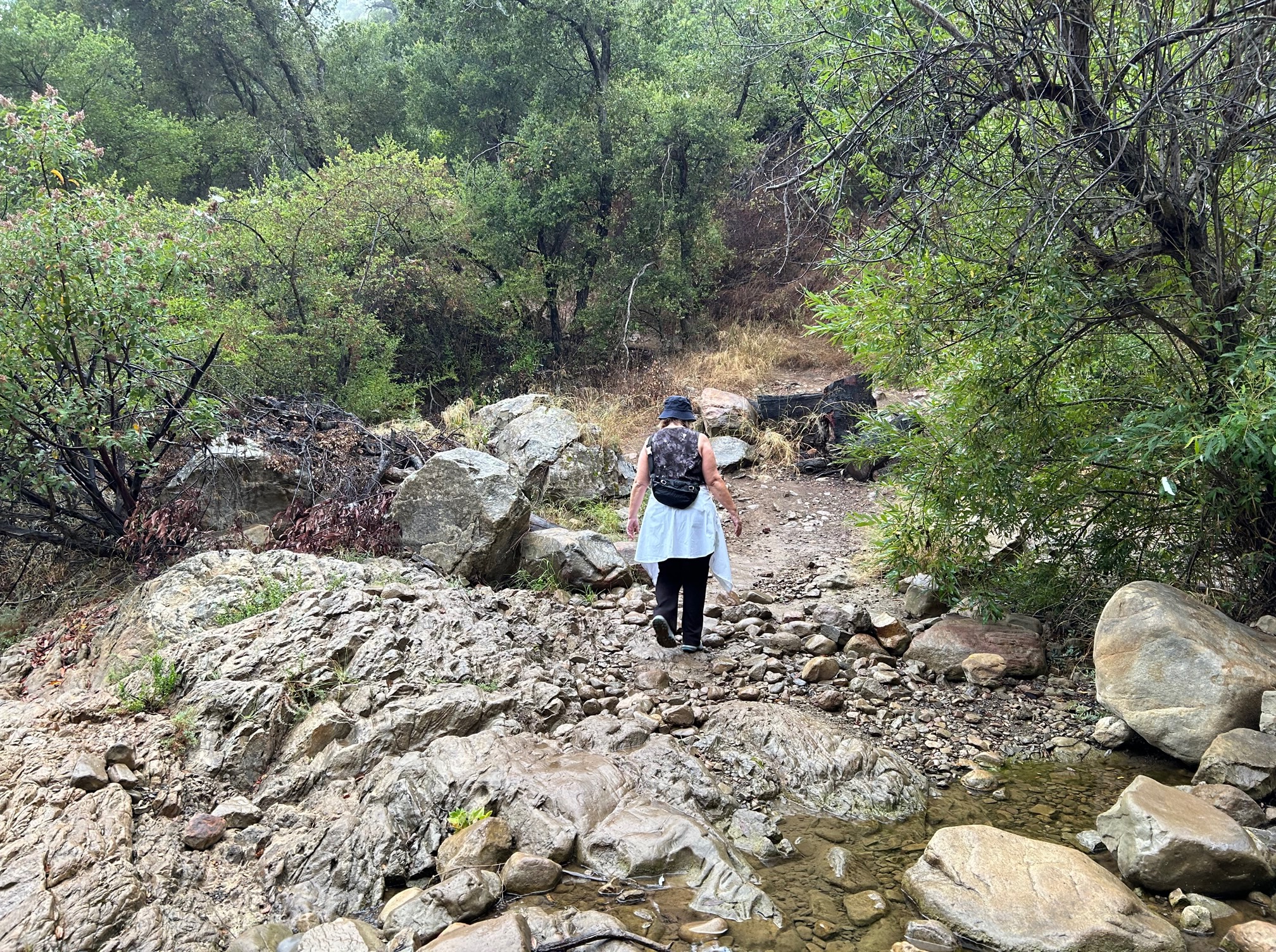
Because we are just getting started and not in great shape, we chose a “moderate” hike, and I’m sure that in some level of hell the four miles and 800-feet of elevation we encountered could be described as moderate, so I won’t quibble. But we struggled. When it comes to sure-footedness, I, for one, have the clumsy coordination of a baby giraffe. We were passed twice by the same young trail runner going up and down the trail we hoped to conquer once and felt a little intimidated by the parents carrying small children on their backs as well as the two guys carrying their mountain bikes up a switchback. We climbed, slowly, toward our destination, Inspiration Point, and I did discover inspiration on the journey: I felt a strong inspiration to curse. I felt inspired to consider a different activity to do together. I often felt inspired to stop.

But my goodness it turned out to be incredible. Somewhere between a heavy mist and a light rain accompanied us as we hiked our way up into the puffy, saturated clouds, and we reveled in the mesmerizing sound of nature, which included the breathtaking sound of silence. Slowly, deliberately, we climbed, and when we finally reached Inspiration Point, we discovered that we had it all to ourselves, which felt appropriate, since our initial inspiration was to do it for ourselves anyway.

I am embarrassed to say that I rarely touch the actual planet that we live on. My feet touch pavement and concrete, carpet and hardwood flooring, tile and vinyl, laminate and linoleum, but how often do I come into contact with Mother Earth? Not often enough. Not. Often. Enough.

But the best part of a remarkable day? Holding hands when the trail was wide enough. Simple conversations. Making each other laugh. Cheering each other on. Sharing spectacular scenes together. Feeling less alone in this world. Feeling more connected to each other, not to mention the universe.

We’ll be doing this again. And again, and again.

Don’t be offended, but if you asked us for a little marital advice, we’d tell you to take a hike.

Back Behind the Wheel

I was born with a lazy eye. It’s the left one if you want to direct your derision at its lethargy appropriately.

“Lazy eye” is officially called amblyopia and afflicts approximately 1-2% of humanity, including celebrities known for their beauty such as Ryan Gosling and Heidi Klum, alongside unfamous people not known for their beauty, like me. Amblyopia can typically be corrected if discovered in small children, which mine was not, meaning that I have been legally blind in my left eye my entire life. If you are curious, it has peripheral vision, but a member of the alphabet would need to be the size of a linebacker for accurate identification.

Not searching for sympathy here: Since it’s a lifelong condition, I only know my way of seeing the world and have gotten along just fine. I was known as a decent outside shooter on the basketball court. I could tell that my wife is really pretty right away. I even once found Waldo. And I had no problem securing driver’s licenses in Arkansas, Mississippi, California, Tennessee, and Illinois—until I moved back to California, that is.

It turns out that the California DMV modified its vision standards since I moved away, and when I visited early last week, I was told to visit an optometrist. (Side note: Driving home after said eye exam through a winding canyon while squinting through a dilated working eye led to some reflection on what I assume was the motivation behind the new standard. But I digress.) Afterward, a return trip to the DMV with the completed form led to the discovery that I had to take a behind-the-wheel driving test for the first time since the mid-1980s. Which happened yesterday.

Let’s begin by saying that, yes, I think I had all the nerves of the teenagers taking the test with me, maybe more. If you fail the test as a teenager, I assume your parents offer comfort and a stop for cheeseburgers. I, on the other hand, might have to sell my car immediately and Uber home.

Well, the time came, and my driving critic was a young man that looked suspiciously like Sal from Impractical Jokers, which did make me wonder about the entire ordeal. It also occurred to me that I was probably teaching people to drive before he was old enough to learn, but since I was actively engaged in combat with militant butterflies, I just focused on the driving.

Me and Sal (not his real name) rode in silence, and I tried to remember all the things: hands at eight and four; constant looking over your shoulder like a bobblehead; using turn signals months before you actually turn; driving faster than the joggers but slower than everyone else; and so on. If you perform what is known as a critical error, you instantly fail; if not, you must have under twenty points to pass. I am pleased to report no critical errors and just five points marked, so I made it. I celebrated by taking my own self to In-N-Out for a cheeseburger.

I am the most defensive driver I know, and believe me I felt a little defensive when required to take a behind-the-wheel test. I guess I could hate on California, or the DMV, or government bureaucracy in general. And, well, yes, and sure. Or I guess I could look for a silver lining like learning something new (very little) or fun conversations with new people (didn’t happen). Instead, I guess that sometimes, when life seems unfair, the only thing you get out of it is some real-life practice in endurance and patience.

I suspect you are facing something much more unfair and challenging, or will. If so, hang in there, do your best, and know that I am rooting for you to pass, too. And when you do, I suggest treating yourself to a double-double combo (protein-style) like I did.

Heading Home

23A52F53-0489-4D6D-85CB-30A31AFF4DF8

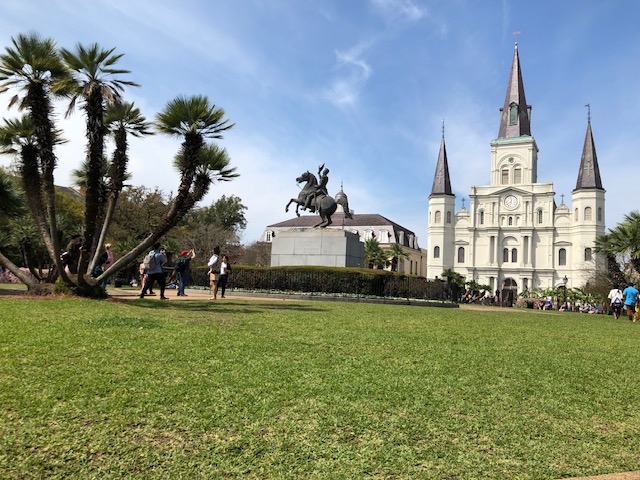
From our seat in Jackson Square

Somewhere in Texas on a flat and lonely stretch of interstate my wife broke the silence to share, “I started to say that we are a long way from home, but I’m not sure where home is right now.” This wasn’t a sad statement, just a true one.

#1: We are forever from Arkansas, and before our trip ended we spent quality time there. Family. Farmland. Razorback license plates. Home.

#2: But we lived a decade of our married life on the Mississippi Gulf Coast, a special place we also visited on our cross-country journey. Live oaks. Shrimp boats. Humidity. Also home.

#3: Our trip originated in California where we lived together the longest. Palm trees. Mountains. Crashing waves. Yet another home.

#4: But we eventually arrived in Nashville, Tennessee. Music. Rolling hills. Hot chicken. Our new home.

So where should we say is home? It is a question far deeper than our uniquely mixed-up situation. “Home” may generate thoughts of a specific residential structure or a group of people or a city/region/state/country, but I think home is more of a sensation. It is a place of belonging. From personal experience it seems to me that there can be more than one, and today, as I start my new job, we are excited to add a new one to our list.

But then again I’m not certain we human beings ever really locate home on this life journey. Our talk of “something more” than this life leads me to wonder if we are all simply on an epic odyssey to find home.  As Sojourner Truth once declared, “I am not going to die. I’m going home like a shooting star.” Maybe we are all headed home?

We took a break in the middle of our cross-country move to enjoy New Orleans, one of our very favorite places. We were sitting in the warm sunshine in Jackson Square, soaking in the day, when my wife raised the question again, “If someone asks us where we are from, what do we say?” I admit that I was stumped. But later, upon reflection, I think I just might say, “’We’re from everywhere, but ultimately we are headed toward home.”

On the Road Again…Seein’ Things That I May Never See Again

IMG_3476“Here I was at the end of America – no more land – and now there was nowhere to go but back.”
― Jack Kerouac, On the Road

We left Malibu before sunrise on Saturday, and if everything is proceeding as planned, we are somewhere in the middle of this great country of ours headed east on an epic road trip—a sort of Route 66 reversal. We do have a definite destination, but we also have our hearts set on enjoying the journey itself. We resisted the urge to stop and see friends along the way and opted instead for one long, amazing date. Just the two of us.

Walt Whitman said, “I take to the open road, healthy, free, the world before me.” That’s the way we feel about it, too. The last few weeks were filled with unforgettable sweetness—meals and moments, coffees and conversations—and we left California filled to the brim with love. Now, we are enjoying the unique solitude married folk can enjoy since they are one person after all. Today, our to-do list consists of a single item called the open road.

A week from now I will officially start a brand new job in a brand new place, and I am very excited about what is to come. But that is next week and beyond. Today is a day to simply sit and watch the world go by. Together.

By Blessing Brightly Lit

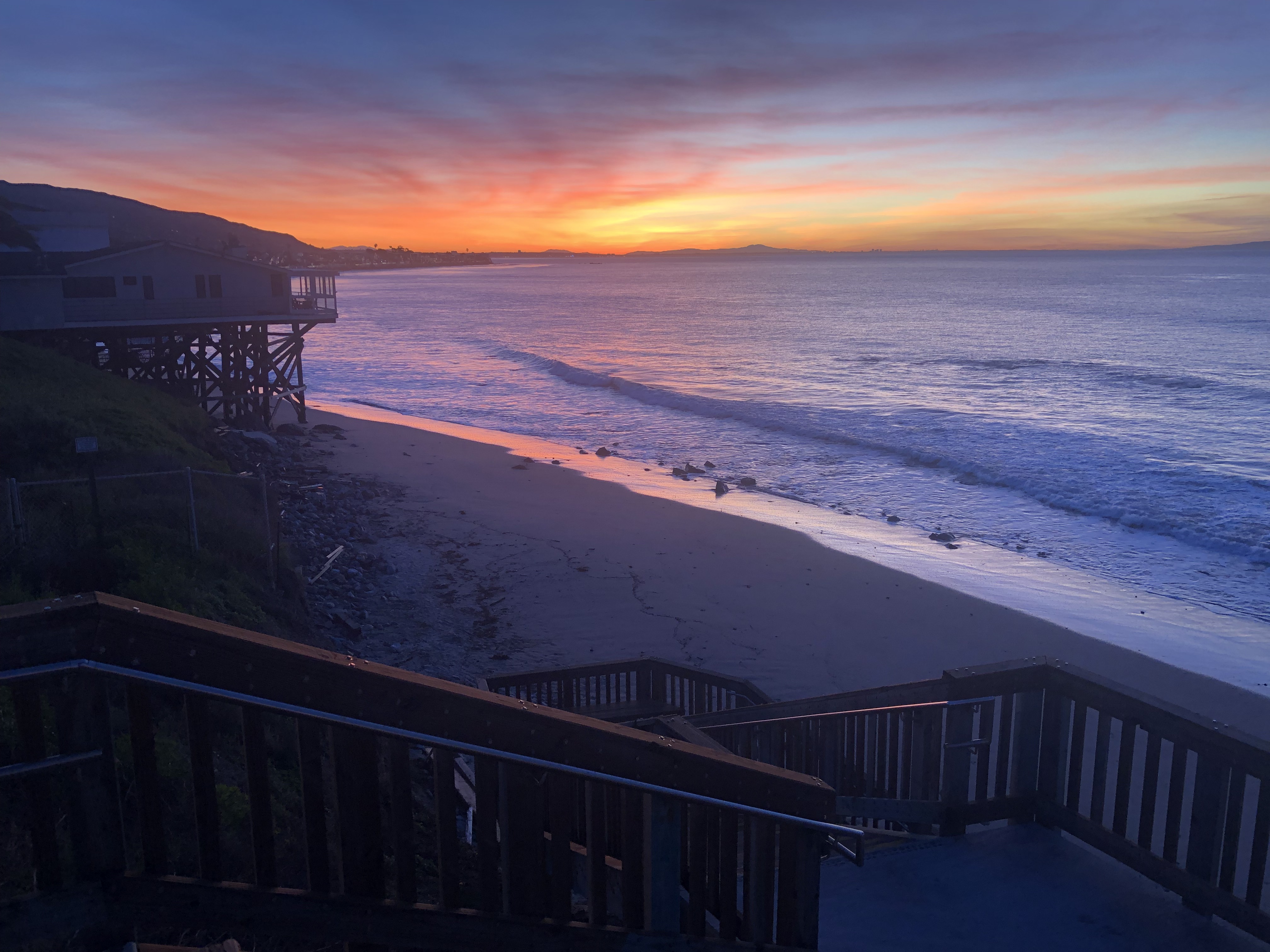
Malibu“Life is all memory except for the one present moment that goes by so quick you can hardly catch it going.” – Tennessee Williams, The Milk Train Doesn’t Stop Here Anymore

To say there is much to do this week is an understatement that borders on absurdity. My farewell sermon yesterday was followed by such a sweet farewell reception—that all four of “us” could be there was very special—but now the rollercoaster whips around an unexpected turn and we will worry about breathing later on. The week ahead is packed floor to ceiling (hey, like that moving metaphor?) as we tie up loose ends and then move to a new stage of life in Tennessee.

A nice and clean reflection has proven impossible. Do I write about the unforgettable people? There are too many. Do I write about stunning California? I wouldn’t know where to start. Do I write about law school or Pepperdine or Malibu or the Labor Exchange or University Church or running or…

I give up.

Maybe I will just say that our time here has transformed our lives in every conceivable way. Physically. Intellectually. Professionally. Emotionally. Spiritually. You name it.

And we are thankful.

I have been told repeatedly that I will miss the views here. With all due respect, I don’t believe it. Those views have been permanently imprinted on my memory and will always be nearby—and I’m not simply referring to the natural scenery. Edgar Allan Poe said, “To observe attentively is to remember distinctly.” If nothing else I was sure to pay attention, so I’m not worried.

I have shared my favorite Wendell Berry Sabbath poem before, but it is most appropriate today:

We travelers, walking to the sun, can’t see
Ahead, but looking back the very light
That blinded us shows us the way we came,
Along which blessings now appear, risen
As if from sightlessness to sight, and we,
By blessing brightly lit, keep going toward
The blessed light that yet to us is dark.

Exactly.

So here we go on these crazy final few days. I will blog from the road next week—Lord willin’ and the creek don’t rise. The South, here we come.

In Good Times and in Bad Times

IMG_2724

A mere fifteen hours after a ruthless gunman opened fire on an innocent crowd in Thousand Oaks, California, the Woolsey Fire ignited about fifteen miles away near Simi Valley. Both apparently man-made events have devastated our community, and the week that followed has somehow been both blurry and unforgettable.

After spending over a week at Pepperdine, however, I finally ventured off campus this past weekend to officiate a wedding ceremony about seventy miles away. Hilary and Tyler had planned to marry in Malibu, but like so many places in our area, their wedding venue burned to the ground. They kept their chins up and scrambled to relocate and successfully secured a gorgeous resort in Newport Beach to exchange their vows.

I was Tyler’s dean of students at Pepperdine Law and was honored to do this for him and his lovely bride, but I confess a bit of mixed emotions when I left campus to drive to the wedding. It was literally a breath of fresh air to drive to Newport Beach and be with this lovely couple on their special day, but it was strange and hard to leave what felt like fellow soldiers battling on in such difficult conditions with so much work to do. It was jarring, and refreshing, and just plain odd to leave.

But I am glad that I was able to go.

I have now officiated eighteen weddings involving someone from Pepperdine Law, and each time I am struck by the great honor of having the best seat in the house. I get to watch the groom lose his breath when he sees his bride enter, and I get to see the bride’s heart melt when she sees the way her groom looks at her. I get to see them stare in each other’s eyes while I rattle on about whatever—and then nearly lose my own breath when I notice them actually listening to what they promise one another at such a holy moment.

And this time I particularly noticed—in good times and in bad times. Wow. For better or worse, and in good times and in bad times. That has surely been on my heart this past week. The good times are easy and not worth the trouble of a vow. It is the bad times that call for a ceremony.

I did not stay for the reception and got an early start on the L.A. traffic to return home. I could hardly wait to get back to everyone. For we have been in the throes of the bad times. When love is challenged to prove itself.