A Conversation Going South

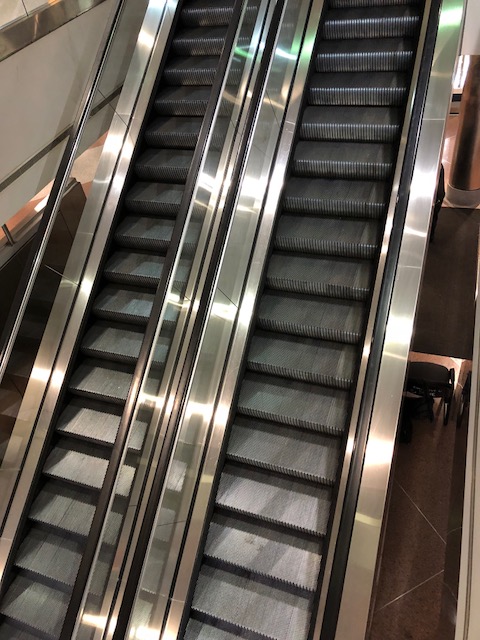
IMG_1946

Is there a term for an escalator that is going down? A de-escalator? Well there should be a term. Anyway, I exited the Denver airport last Friday and stepped on the escalator headed down (sigh) when I heard, “Sir! Sir!”

I turned and saw a blonde woman about my age running and trying to get my attention. “Is this the way to the light rail?” she asked as she stepped on the escalator (?) behind me.

“I think so,” I answered. “That’s where I’m headed.”

“Where are you from?”

“California.”

“Oh,” she replied, obviously disappointed. “I thought I detected an accent.”

“Well, you probably did. I’m originally from Arkansas.”

“Oh,” she replied, suddenly in a better mood. “I would claim Arkansas.”

Well I won’t repeat what came to mind at this juncture of the conversation; instead, I made the difficult choice to smile and simply said, “I like them both.”

I thought that made a nice conversation ender, but she reluctantly replied, “Yes, I guess there are good and bad people wherever you go.” Saying this appeared to disappoint her once again.

There were many things I might have said at that point, but I just agreed and ended the conversation by turning and facing ahead. Which happened to be down. On both literally and metaphorically one of the longest rides I have taken on whatever one should call an escalator going down.

The Labor Party

MCLEOn the big screen Martin Sheen is probably best known for his leading role in Apocalypse Now and on the television screen for his portrayal of President Bartlet on The West Wing.  In Malibu he is known for his generosity.
Several years ago some teenagers from our church were at our local ice cream shop and one of the teens did not have a jacket with him. There was a bit of a chill in the air, and, you know, there was ice cream. One of the group noticed that the teenager was suddenly wearing a sweatshirt or jacket, I forget the specifics, and when asked where he got it he pointed to some random man that gave it to him. He had no idea it was Martin Sheen.

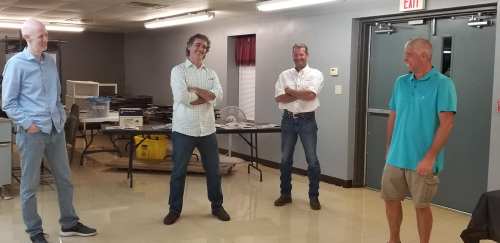
I have been involved in a unique and wonderful day labor hiring site called the Malibu Community Labor Exchange for ten years now and am embarking on my second stint as president of the board of directors. Martin Sheen has been involved since its inception twenty-five years ago, prominently at the beginning, and more behind the scenes in the years that followed, but he is stepping out front to host a major silver anniversary celebration that is open to public this Saturday evening at the Labor Exchange (23595 Civic Center Way – the Malibu Library parking lot).

As we planned the party, I had several opportunities to interact with Martin in person, including interviewing him for a promotional video. The word “celebrity” did not factor into conversation in my Arkansas hometown, so this is a novel experience for me. We were both interviewed by a local newspaper about the event, and one line in the article made me smile: “Sturgeon and Sheen emphasized that the joyful occasion is intended to recognize the Labor Exchange’s contributions to the community and its gratefulness to Malibu.” I know my name is a big draw, but Mr. Sheen’s name should have come first alphabetically.

If you are near Malibu this Saturday, I invite you to drop by the Labor Exchange trailer from 6-9pm to dance to the mariachi band, grab a free taco, and celebrate this local institution. You are welcomed. That’s the thing I love the most about the Labor Exchange. Everyone is always welcomed.

Do Sweat the Big Stuff

IMG_1843

Last October the New York Times published an article now credited with sparking the #MeToo movement that exposed producer Harvey Weinstein’s history and practice of sexual abuse and harassment. The first woman mentioned in the article was actress, Ashley Judd, and the second was a wonderful former student of mine at Pepperdine Law. In less than a month there were scores of other names added to the list.

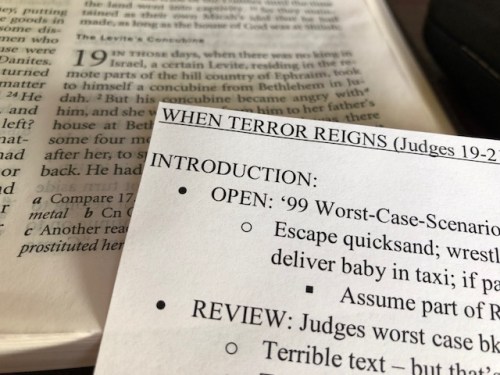
Exactly one week after that landmark article my good friends at Pepperdine Law hosted an important conference titled, “In Search of Sanctuary: Strengthening the Church’s Response to Intimate Partner Violence.” The featured speaker at the conference was Rev. Dr. Marie Fortune, and I was honored to be in attendance to listen and learn from her great wisdom and work. As a preacher now/again I was particularly surprised that when Rev. Fortune asked for a show of hands of all familiar with the story of Vashti only a few of us were. She then asked how many knew the story of the nameless Levite’s concubine (from Judges 19), and there may have been one other person besides me who raised a hand. Dr. Fortune’s point was that texts dealing with intimate partner violence are not popular preaching texts, and as a result, the Church is sadly unfamiliar with and at the very least complicit in sustaining an environment that results in a deafening silence. She told of one particular pastor who simply mentioned his plan to attend a conference on intimate partner violence and was shocked to have multiple victims approach him afterward in their pain—a simple off-handed reference was the most the topic had ever been broached in the congregation. I have been no better.

That conference planted the seed that resulted in my summer sermon series on the Book of Judges at my congregation. I learned that those who faithfully follow the Revised Common Lectionary will only turn to the Book of Judges for one text in their lives (the Song of Deborah) and never face the violent texts, especially not the sickening story of the nameless Levite’s concubine in Judges 19. Yesterday I forced myself to deliver a sermon on that text, which also happened to be the first sermon I had ever heard on that particular text.

I do not write today to redeliver the sermon—I will upload it today to uccmalibu.podbean.com if you are interested in that sort of thing. And I do not write today to congratulate myself. No, my attitude is one of embarrassment for my complicity, and I write in a spirit of confession.

The sermons this summer have been difficult to deliver, but one of the enduring images I will take from it are of those who periodically stopped to say that they sincerely appreciate the effort to confront the difficult texts.

I have often told my daughters that the only things worth doing in life are difficult. I hope to listen to my own advice.

Pay Attention

Writing Books
“He could go anyplace he wanted with a sense of purpose. One of the gifts of being a writer is that it gives you an excuse to do things, to go places and explore. Another is that writing motivates you to look closely at life, at life as it lurches and tramps around. Writing taught my father to pay attention…”
– Anne Lamott, Bird by Bird

I avoided writing whenever possible in high school and celebrated upon testing out of both required English composition courses in college. And now I love to write. For whatever reason I cannot seem to pick up the curveball in this game called life.

When my dad died in 1994 I experienced a strong urge to write—the first time I wanted to write an essay—and the urge returned not long afterward when the moms and dads of my elementary school daughter’s local soccer team acted completely insane and nearly drove me bonkers.  Around then it occurred to me that I should not have prayed so fervently to test out of English composition.  On both occasions writing was my way of processing the confusion of life.

And then, on the eighth day, God created a host of things like home computers and Microsoft Word, grammar check and spell check, print-on-demand publishing and blogs.  I became a writer in spite of poor life decisions.  Sort of like how Donald Trump became the president.

Somewhere along the way I purchased and devoured two wonderful books on the craft of writing: Bird by Bird by Anne Lamott, and On Writing by Stephen King.  Both are chock full of hilarious, practical, and straight-shooting advice on this creative outlet that I now adore.  It was Lamott, however, who zeroed in on what I love the most: Writing teaches me to pay attention.

I shouldn’t need anything to make me pay attention to life, but then again, maybe I do.  Maybe my cousin, Amy, is right when she claims that we all have a creative side that needs exercising, and maybe it is that need to create that leads us to lean into this thing called life, to have a reason to head out into it, to use all of our senses, to take notes on everything that is there.

Maybe.  That’s all I’m saying.  I just know that writing is now a part of who I am—and that I am thankful.

Time Keeps on Slipping

Reunion 1

PC: Kristi May

Time is a sneaky son of a gun.

I recently traveled to my hometown to pull off two reunions in a single day: eight first cousins for a mini-family reunion over an extra-long lunch followed by eight high school classmates for a thirty-year reunion over an extra-long dinner. It was a great day from start to finish.

I am the youngest of fourteen first cousins on my mother’s side of the family, so I missed out on the creation of many of the great memories that were shared over lunch. I do, however, remember assembling on a designated Sunday each summer in tiny towns in the hills of Arkansas for a family reunion that served to bind us together. Jeff brought an old DVD from the reunion the summer I graduated from college way back in 1992. My parents and grandparents were alive then, and the DVD brought them back from the grave and threw my heart for a loop.

I also happened to be the youngest of nineteen members of the Class of ’88 at Crowley’s Ridge Academy due to a late September birthday, but I was most definitely there for all the wonderful memories that we recalled with great laughter over dinner. In fact, I attended that tiny school for twelve years—it is as much a part of me as anything. Joe brought several yearbooks, and those old black-and-white photographs resurrected memories that did their own number on my heart.

It occurred to me at some point that some of the high school teachers we once considered ancient were younger then than we are now. I’m not exactly sure how to describe how that all settled in the old heart, but I wouldn’t use any version of the word comfort.

Steve Miller wrote and released the song Fly Like an Eagle (and immortalized the line that time keeps on slipping into the future) around the time I started making all those memories at home and school. The lyrics seem to say that Miller wanted to spend his time helping the poor and soar to a place of freedom for everyone—but time keeps on slipping away.

Yes, it does. Hashtag agreed and all that.

Looking back, I’m not exactly sure what I would tell myself thirty years ago, or forty, or whatever—and to be honest, I’m not particularly interested since that ship has apparently sailed. What I would rather determine is what I would tell myself right now. I gave that question quite a bit of thought after this little peek in the time capsule, and do you know what I concluded?

Me neither.

I am sure that I, too, want to help the poor and soar to a place of freedom for everyone. But time apparently has a habit of going viral.

Manzanar

ManzanarI elbowed my way through afternoon L.A. traffic to begin a four-hour mountain drive that ended in a surprising thunderstorm and finally some peace and quiet. Early the next morning I drove the few remaining miles to my destination: Manzanar.

I forget exactly when I learned about Manzanar, but it should have been sooner.

Asian-Americans endured prejudicial treatment prior to Pearl Harbor in 1941 but that terrible attack brought specific ethnic hostility to those of Japanese ancestry. In early 1942, FDR signed Executive Order 9066 that authorized the military to remove “any or all persons” from the West Coast and ultimately over 110,000 people of Japanese ancestry were incarcerated in ten American concentration camps simply because of their ethnicity. Ten thousand of those Japanese-Americans and Japanese immigrants were incarcerated in California at Manzanar.

My interest in visiting Manzanar intensified a few years ago when I learned that two of the ten wartime camps were located in Arkansas—I grew up in Arkansas and taught history in Arkansas and had never been told that Arkansas incarcerated 17,000 people of Japanese descent from California, half at Camp Jerome and half at Camp Rohwer. I knew then that I needed to visit Manzanar to feel the pain of a camp and ponder this terrible connection between my two “home” states—and my native country.

Manzanar is easy to visit on one hand: It is free, uncrowded, and only takes an hour or two to see everything there is to see. But it is difficult to visit as well. For what it represents, and what it proclaims.

Out of the 110,000+ imprisoned out of fear of espionage or sabotage, exactly zero were convicted of espionage or sabotage. That unwarranted fear destroyed many lives and families and even flirted with destroying a culture. In Hawaii where 158,000 Japanese-Americans faced less prejudice and enjoyed more freedom than those on the mainland, they were still discouraged from speaking the Japanese language and practicing the Buddhist religion. Hawaii’s military governor explained why: “We must remember that this is America and we must do things the American Way.”

And what, pray tell, did this chapter of American history communicate about the American Way?

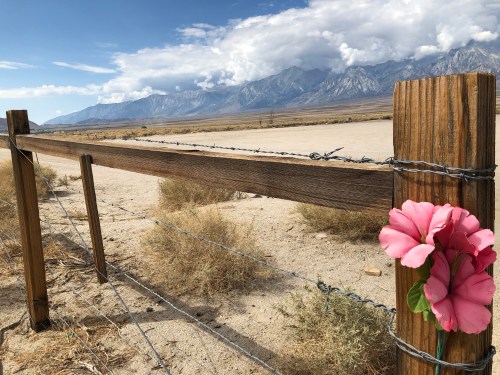
The barbed wire at Manzanar stands as a reminder of how fear and power work together. But Manzanar also reminds us of the potential resilience of oppressed people and that even when fear and power lace up on the same team that victims can band together and rise above their circumstances. Possibly my favorite poster in the visitor’s center hung outside the theater and featured a quote from Hank Umemoto: “We were screwed, but then we made the most out of it and we turned Manzanar into a community.”

May there be no more Manzanars. But in the meanwhile, may all such peoples find that kind of courage and hope.

A Hostel Environment

Hostel 2I spent the night in a hostel in Lone Pine, California, last Thursday. Lone Pine sits on the eastern edge of the Sierra Nevadas and is interesting in its own right, but let’s focus on the first thought: I spent the night in a hostel.

It was my first. I texted my youngest daughter/world traveler in advance for any advice for an old man, and she replied, “Don’t be one of those weird old men who just stays in the hostel all day.” Quality feedback. So I chose to be one of those weird old men who does not stay in the hostel all day. She asked why I was staying in a hostel, and I answered truthfully: Because I am cheap. It is surprising that this personal trait had not led to previous visits. That could be because I am also an introvert, and the prospect of zero privacy may have overcome my cheapskatedness prior to last Thursday.

Well, I arrived at 7pm and was assigned to Bed #4; thankfully, a bottom bunk in the small room outfitted for ten occupants. There were several men there when I arrived, engaged in a natural hiking/climbing conversation given the mountain location of this particular hostel. I, the Introvert, used our one bathroom and then immediately left for dinner.

When I returned a couple hours later, it was a different story: still several men, but zero conversation. I dropped my backpack, laid down, and got my bearings. Six of my new roomies were around—one tall, Danish-looking young man out on the balcony, and five others in their respective beds with the lights on either reading, snoozing, or on cell phones. Two were older than me (although I’m not sure if either spent the day hanging around the hostel!). The room stank, which is unsurprising when several men, most of whom had spent the day backpacking, take off their boots. There was a mini-fridge and a microwave and a television—none of which were in use. The two older men soon fell fast asleep. One immediately started snoring. Great. Otherwise, there was a lot of awkward silence.

There was one very brief conversation that included yours truly. A young man of Asian descent in Bed #1 dropped his metal water bottle with a loud clatter, and I crawled under Bed #2 to retrieve it. He said several things in a language I did not understand until he said clearly and carefully, “Thank you a lot.” Not a problem, my new friend.

Eventually Mr. Great Dane came in and turned off the lights for the seven of us, and the night that followed was eventfully uneventful. One of the older men had a coughing fit that seemed to last for an hour. There was a bit of a snore fest to which I may or may not have contributed. At one point I noticed a stealth Roomie #8 arrive for the night and when morning dawned I was surprised to notice that at some point apparently a Roomie #9 had claimed one of the two remaining top bunks. And with morning this band of hostel brothers arose one at a time and left in silence. Upon reflection I decided that maybe hostels are actually designed for introverts. I was number seven of nine to hit the road, thirty-one bucks poorer and one experience richer.

I have not formed a strong opinion on the hostel experience. My daughter/hostel fan calls it “an underdeveloped industry in the U.S.” and I suspect that is true. At least I now know what to expect. And if I learned anything, maybe it is that I am not yet too old to try something new.

These United States

33

The United States of America is 242 years old today. It seems to be in a bit of a cranky stage but those of us who love her hope she will grow out of it someday (soon). It is a spectacular country in about every way you define spectacular. I have now traveled to five continents and have a better frame of reference—enough to recognize that the land of my birth is unique in its global influence.

And I have now spent time in thirty-six of these United States and hope to complete the set someday. I already have remarkable memories.

I stood outside the Dexter Avenue Baptist Church in Alabama and threw snowballs on the Fourth of July in Alaska. I stood at the Grand Canyon in Arizona and called the Hogs in Arkansas. I watched the sunset in California and ran in the snow in Colorado. I saw a rocket launch in Florida and ate peach cobbler in Georgia. I ran along the Snake River in Idaho and sang Take Me Out to the Ballgame at Wrigley Field in Illinois. I shot hoops at Larry Bird’s restaurant in Indiana and drove by corn fields in Iowa.

I saw the wide open horizon in Kansas and watched horses run behind white fences in Kentucky. I ate beignets in Louisiana and crab cakes in Maryland. I toured the Ford Museum in Michigan and the Mall of America in Minnesota. I saw a hurricane in Mississippi and the Gateway Arch in Missouri. I sang in the capitol rotunda in Nebraska and walked the Las Vegas Strip in Nevada. I drove Route 66 across New Mexico and ran Central Park in New York.

I ate banana pudding in North Carolina and had a VIP tour of the Pro Football Hall of Fame in Ohio. I dodged tornadoes in Oklahoma and crossed breathtaking rivers in Pennsylvania. I saw Fort Sumter in South Carolina and the Lorraine Motel in Tennessee. I witnessed Monday Night Football in Texas and the Golden Spike National Monument in Utah. I crossed the Potomac in Virginia and ascended the Space Needle in Washington. I drove up a winding mountain in West Virginia and ate cheese curds in a bar in Wisconsin.

I am ready for more.

This is an incredible country, and I choose to celebrate these United States today. And I choose to do my part in making it better tomorrow.

Chama Chama


Our eight-person team from the University Church of Christ in Malibu recently spent two weeks in Kenya on a mission trip and experienced the full spectrum of emotions, which most definitely included gut-busting laughter. One of the chief causes of hilarity was a popular Swahili song titled, Chama Chama (translated, Party, Party). It is unbelievably long (fourteen minutes) and the cheesiest kind of romantic, which is even funnier when the sultry voice transitions from Swahili to broken English, e.g., “I can’t get off my eyes from your photos.”

One day we were touring Mathare Valley, a famed slum in Nairobi, and were crammed into a tiny shanty when surprisingly Chama Chama blasted across a neighbor’s radio. Our host was confused by our initial reaction and then burst into laughter when we burst into song.

I took pictures and video clips from our trip and assembled a video to chronicle our trip—the sessions with the graduates, the home and work visits, the safari, and the friendships, both old and new. Of course the video is fourteen minutes long, and of course Chama Chama is the soundtrack. I doubt anyone beyond the eight of us who were there really want to watch, but it might be worth it just to join the Chama Chama phenomenon that is now sweeping Southern California.

Sunset on the Mara

Mara PicMy great privilege occurred to me as we raced along the bumpy roads of the Maasai Mara. The tans, browns, and yellows of the passing landscape waved our direction and the unspoiled breeze blasted our faces as we stood and braced for the ride of a lifetime. There are many in the world whose primary dream is an African safari, and in a moment it occurred to me that I have now been twice. What a humbling thought.

The hunt for rare sightings was exhilarating, and the sensation of racing through the Kenyan wonderland defies description, but the animals themselves are the superstars. Of course I snapped pictures. The lioness and her cubs. The curious giraffe. The lumbering elephant. The lazy leopard. The stalking cheetah. The ridiculous ostrich. The enormous hippopotamus. But every so often I remembered to put the camera away and simply be present in the wild with the magnificent creatures. It was in those moments that I discovered an unforced smile and a childlike sense of joy and wonder.

The sun set on the Mara at the end of our first game drive, and our driver stopped so we could behold the glory. From our vantage point the flaming ball of fire descended through an iconic acacia tree as we furiously snapped pictures as if we could ever forget. Yes, the animals are the stars of the safari, but the sunset stole the show.

Nature. That’s the word we use to describe the indescribable reality of that which is beyond human production. We create platforms to simply to stand as humble spectators and observe the magnificent world that we did nothing to create. Such primal beauty is difficult to see and even more difficult to comprehend immersed in what we call civilization. But I was privileged to catch a glimpse as the sun set on the Mara.