
Tag Archives: democrats

Cultivate the Bright Passions

I find it especially important in dark and troubled times to closely monitor personal emotions, and we seem to live in dark and troubled times. This came to mind as I drove to the office before eight o’clock on this Sunday morning. My wife is out of town, so I felt justified putting in early Sunday work hours, but such behavior indicates that my emotions could get out of whack.

But it was sixty-three degrees on a lovely morning, and I lowered the window to feel the cool breeze while listening to a station that features soothing acoustic music. And as I drove past farmland I was surprised to see several normally-stationary horses galloping together on a gentle morning run. And then I rounded a curve and noticed that the self-serve produce stand is now decorated with pumpkins and flowers on this first day of autumn. And I sensed in a powerful form the intoxicating feeling of peace.

There was more.

A little farther along, I met an older woman riding her bike on the lonely back roads. We have passed one another on several mornings and now wave with smiles as if we are dear friends, which we did with even more enthusiasm this morning. I then turned toward the office and noticed my friend, Kelly, out walking her dog, which led to another wave and another smile. And as if the world was conspiring for my good, I then noticed a wonderful student, Emma, walking across campus on a Sunday morning, and I stuck my arm out the window with another wave and smile.

And for a moment, if I didn’t know better, I sensed every reason in the world to be happy.

David Brooks published a column in The New York Times three days ago titled, “The Era of Dark Passions.” I surely do not agree with David Brooks on many things, but I typically benefit from reading his thoughts, and I especially appreciated that particular opinion piece. Brooks shared his belief that “something awful has been unleashed” in our current times and that “[e]ven before the Charlie Kirk assassination it was obvious that the dark passions now pervade the American psyche, and thus American politics.” Brooks identified dark passions as Anger, Hatred, Resentment, Fear, and the Urge to Dominate, and he distributed blame for stirring dark passions for personal benefit to his own industry, the media, and to both sides of the political aisle. Brooks then posed the question:

Why does politics feel so different now than in times past? My short answer is that over these years, demagogues in politics, in the media and online have exploited common feelings of humiliation to arouse dark passions, and those dark passions are dehumanizing our culture and undermining liberal democracy. My intuition is that we’re only at the beginning of this spiral, and that it will only get worse.

With that cheery outlook, what is there to do? Well, for starters, Brooks begins:

First, let me tell you how not to reverse it. There is a tendency in these circumstances to think that the other side is so awful that we need a monster on our side to beat it. That’s the decision Republicans made in nominating Trump. Democrats are moving in that direction too. Back in 2016 Michelle Obama asserted that Democrats to go high when Republicans go low, but the vibe quickly shifted. As former Attorney General Eric Holder put it in 2018: “When they go low, we kick ’em. That’s what this new Democratic Party is about.” If Republicans soil our democracy with extreme gerrymandering in Texas, Gavin Newsom and the Democrats will soil our democracy in California. The problem with fighting fire with fire is that you’re throwing yourself into the cesspool of dark passions. Do we really think we won’t be corrupted by them? Do we really think the path to victory lies in becoming morally indistinguishable from Trump? Do we really think democracy will survive? Surveys consistently show that most Americans are exhausted by this moral race to the bottom and want an alternative; do we not trust the American people?

Brooks then advises as “the most effective way to fight dark passions”…

History provides clear examples of how to halt the dark passion doom loop. It starts when a leader, or a group of people, who have every right to feel humiliated, who have every right to resort to the dark motivations, decide to interrupt the process. They simply refuse to be swallowed by the bitterness, and they work — laboriously over years or decades — to cultivate the bright passions in themselves — to be motivated by hope, care and some brighter vision of the good, and to show those passions to others, especially their enemies. Vaclav Havel did this. Abraham Lincoln did this in his second Inaugural Address. Alfred Dreyfus did this after his false conviction and Viktor Frankl did this after the Holocaust. You may believe Jesus is the messiah or not, but what gives his life moral grandeur was his ability to meet hatred with love. These leaders displayed astounding forbearance. They did not seek payback and revenge. Obviously, Martin Luther King Jr. comes to mind: “To our most bitter opponents we say: We shall match your capacity to inflict suffering by our capacity to endure suffering. We shall meet your physical force with soul force. Do to us what you will, and we shall continue to love you. We cannot in all good conscience obey your unjust laws, because noncooperation with evil is as much a moral obligation as is cooperation with good. Throw us in jail, and we shall still love you.”

You might not be surprised that this resonates with me given my latest blog post published a few days prior to Brooks’s column. But it especially came to mind this morning on a lovely ride into work. I place no value on being unrealistic or ignoring the obvious, but I place great value on noticing the good and living with hope, for what is the future without hope?

I guess what I’m saying is that I unexpectedly caught a glimpse of the bright passions on a drive to work this morning, and I am now extra inspired to resist the forces that push the dark passions and choose to cultivate the bright passions more and more instead. As David Brooks concluded his recent column:

The dark passions look backward toward some wrong committed in the past and render people hardhearted. The bright passions look forward toward some better life and render people tough-minded but tenderhearted.

May we look forward toward some better life as tough-minded and tenderhearted people.

A House (Still) Divided Against Itself Cannot Stand (Forever)

“A house divided against itself, cannot stand.” – Abraham Lincoln on the campaign trail in Springfield, Illinois, June 16, 1858

Our friend, Flo, graciously gave me a signed copy of Erik Larson’s latest book, “The Demon of Unrest: A Saga of Hubris, Heartbreak, and Heroism at the Dawn of the Civil War,” as a Christmas gift, and I read it with great interest, especially at this particular moment in American history. The book chronicles the few short months between the unlikely election of President Abraham Lincoln in November of 1860 and the outbreak of the American Civil War at Fort Sumter in April of 1861 by venturing beneath the headlines and into the lives of some of the key players in the unfolding tragedy. The stories are captivating, to say the least.

I finished the hefty book amid the rapid-fire headlines currently firing from our nation’s capital, wondering if the combination provided anything for me to say. And I think that I do, have something to say that is.

For starters, to state the obvious, our current political polarization with its cyclical outrage is not new. The American Civil War was deep polarization by definition, in that case producing a macabre debate over exactly how many hundreds of thousands of deaths followed, but I began to wonder if today’s toxic political climate is an instance of history repeating itself—or, is it better understood as an ongoing history?  I suspect the latter.

I have had eleven special opportunities to teach a course built by a fantastic professor named Peter Robinson, titled, “Apology, Forgiveness, and Reconciliation,” and in so doing I stumbled across a December 2019 article in The Atlantic by Adam Serwer with the provocative title, “Civility Is Overrated.” The article’s premise is that the aftermath of the American Civil War—an era popularly called Reconstruction—was not, in fact, a time of healing and reconciliation, but a time that perpetuated the original division through its “false promise of civility” that then evolved into Jim Crow, and a century later, the American Civil Rights Movement of the 1960s. In the final paragraph, Serwer writes: “In the aftermath of a terrible war, Americans once purchased an illusion of reconciliation, peace, and civility through a restoration of white rule. They should never again make such a bargain.”

Well . . .

So I’m just thinking here: President Lincoln’s famous campaign speech in the important prelude to the American Civil War warned of what happens to divided houses, and a century later, Reverend King’s most famous speech continued to lament the maintenance of that divided house (read the first few paragraphs of his speech, at least) and dreamed an inspiring dream of a yet-to-be-realized undivided house. I think that today we’re on the next stanza of the same tragic song.

But if President Lincoln’s famous line (citing Jesus) from his famous speech is correct, the song does not have unlimited stanzas.

President Trump is a fascinating phenomenon. His now larger-than-life persona is venerated by many and reviled by many others—and his flurry of provocative executive actions during his first few weeks back in office naturally produces both reactions. But what I find disturbing is that even many of the Republicans that vehemently oppose President Trump—the RINO (“Republicans in name only” as he calls them)—although in opposition to most of his initial actions, seem to agree with his assault on one thing: DEI (Diversity, Equity, and Inclusion). Instead of multiple nuanced perspectives on the general concept of DEI, there seem to be only two: Good. Or, Bad.

Let me be clear: While money/power always lurks behind the curtain, the American Civil War was fought specifically over DEI. Make no mistake. And the Civil Rights Movement was without question a DEI movement. And amid the sweeping number of issues on the table today, I believe that DEI as a cause or concern, broadly speaking, remains at the center of it all.

One telling example is to recall the home stretch anti-DEI emphasis of the 2024 Trump campaign commercials that helped secure his clear victory at the polls.1 2 And as another specific but dramatic example, you may have seen recently that new Secretary of State Marco Rubio hired an undersecretary for public diplomacy that wrote the following less than four months ago: “Competent white men must be in charge if you want things to work. Unfortunately, our entire national ideology is predicated on coddling the feelings of women and minorities, and demoralizing competent white men.”

My friend, Dr. Richard T. Hughes, published “Myths America Lives By” in 2018, and in discussing various foundational myths identifies white supremacy as “the primal American myth.” One of the blurbs for his book was written by theologian, Dr. James H. Cone, who himself authored one of the most devastating books I have ever read, titled, “The Cross and the Lynching Tree.” For Dr. Hughes’s book, Dr. Cone wrote: “It takes a whole lot of courage for white theologians and scholars to speak the truth about race. If we had more white theologians and religion scholars like Hughes who would break their silence about white supremacy and face it for what it is, we–together–could make a better world.”

I, for one, wish to have more courage, for such a reason.

Now I should state my belief that our nation’s troubling supremacist foundations include more characteristics than simply white, although white is major, and that it is no coincidence that DEI work engages those very conversations. That a visceral response to such conversations comes from many otherwise thoughtful individuals simply reveals to me the depth of the foundations.

So did the Democrats lose the presidential election in large part because their diversity, equity, and inclusion arguments were unpopular? I think so. I know without a doubt that Reverend King and the Civil Rights Movement’s diversity, equity, and inclusion arguments were unpopular. And I know that President Lincoln and the Republicans of the 1860s’ diversity, equity, and inclusion arguments were unpopular, too.

I’m imagining a similar speech to that President Lincoln delivered long ago but in today’s divided land, not that our house/nation “cannot endure, permanently half slave and half free,”3 but that we cannot endure half engaging diversity, equity, and inclusion conversations and half silencing them.

I think there is something demonic in the political unrest today, and I do not think that it has much to do with the typical liberal and conservative approaches to domestic, economic, or foreign policy. Instead, I believe that there is a foundational aspect of American history that has always existed and continues to divide us today, a foundation that seeks to reserve power and privilege for certain “types” of people through misusing words like “meritocracy.” And while this divided house has persisted for a very long time now, I agree with Jesus and Reverend King and President Lincoln and many others who were quoted as saying that divided houses cannot survive forever. But if there truly is this fundamental design feature that continues to divide us, and if we truly “face it for what it is,” as Dr. Cone wrote, I share his hope that “we—together—could make a better world.”

—————————————————————————————————————–

  1. Poltico.com on Election Day: “The border and inflation have been GOP mainstays in advertising all year. But there was one other late entry into the Republican onslaught against Harris: More than a quarter of GOP spots that have aired in battleground states since Oct. 1 mentioned transgender issues in some way — most seeking to tie Harris to the concept of prison inmates, including immigrants, receiving gender-affirming surgery. It’s not a new playbook for Republicans, who leaned into transgender issues in key races in the 2022 midterms with little electoral success. It represented a shift in the presidential race: The first TV ad mentioning the issue did not air until mid-September. Still, it became one of the top issues in Republican presidential ads in the final stretch, though the economy and immigration still loomed larger. ↩︎
  2. See also, The Democrats Show Why They Lost. ↩︎
  3. https://www.nps.gov/liho/learn/historyculture/housedivided.htm ↩︎

Roses Are Red, Violets Are Blue, but Wisconsin Is Actually Purple

Purple haze all in my brain / Lately, things just don’t seem the same / Actin’ funny but I don’t know why / Scuse me while I kiss the sky.” – Jimi Hendrix

I stopped using social media to discuss politics a long time ago, mostly because I just didn’t love the desire to claw out my eyeballs. The following represents only a minor shift in personal policy, I hope.

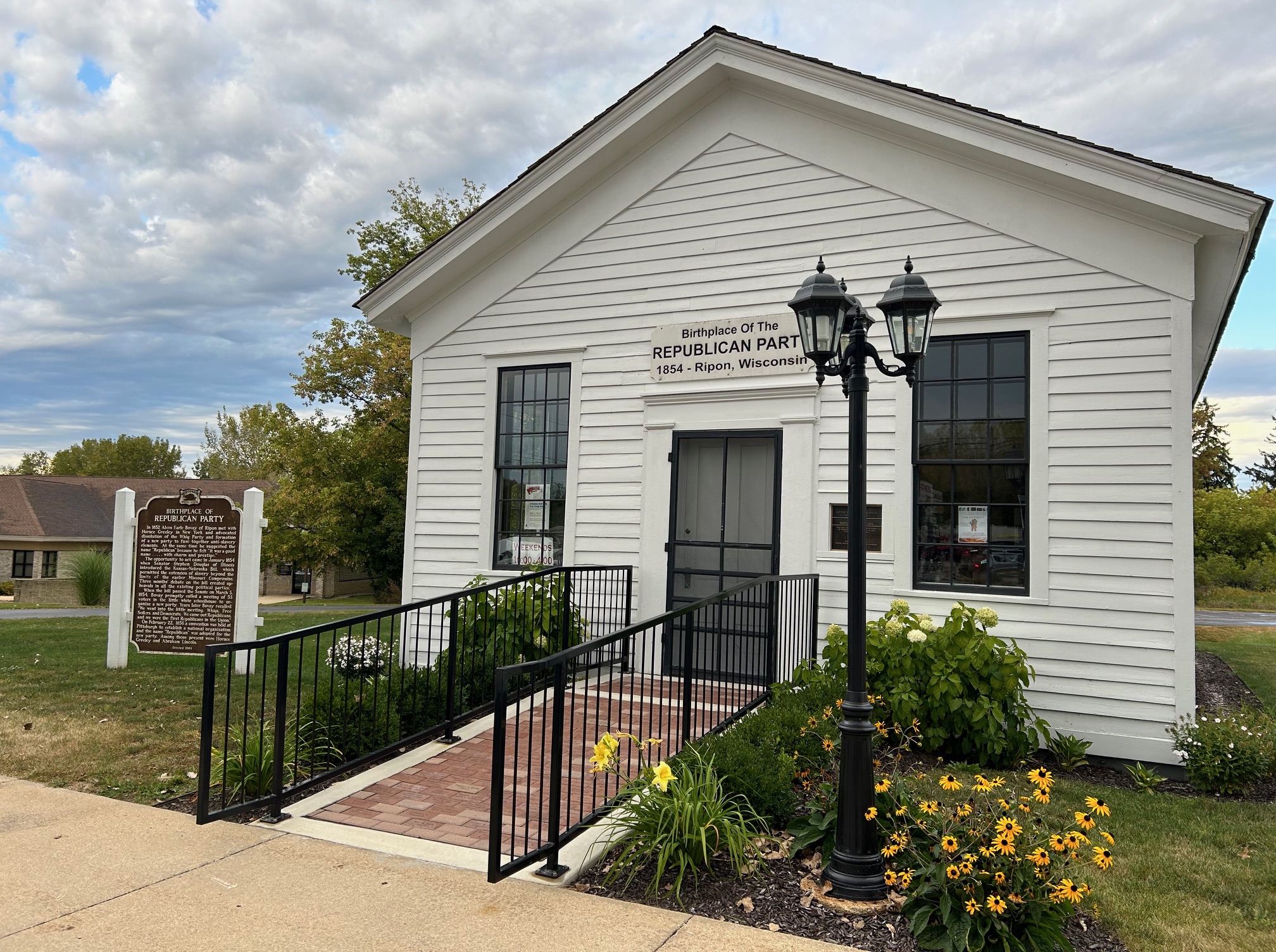
My new hometown is the birthplace of the Republican Party. Alvan Bovay, a lawyer and mathematician from New York City, moved to Ripon, Wisconsin, in 1850, one year after the city was founded, and in 1854, frustrated by the potential spread of slavery in the proposed Kansas-Nebraska Act, called a meeting at the First Congregational Church and proposed forming a new political party to oppose slavery if the bill passed. Well, the bill passed, and Bovay hosted a follow-up meeting at what is now known as the Little White Schoolhouse, a meeting that led to the establishment of the Republican Party. Six years later, the United States elected its first Republican president, Abraham Lincoln, and all hell broke loose soon thereafter.

As you might suspect, when I pass by the Little White Schoolhouse in my new hometown, I often see travelers there taking pictures from their respective pilgrimages. Ironically, I think supporters of both major political parties should take pilgrimages here, albeit for different reasons: Republicans, for obvious reasons, being the birthplace of their party, but Democrats, on the other hand, for historic reasons, too, i.e., to honor an early political movement that stood up for basic civil rights for Black citizens and then held the nation together during the bloodbath that ensued when Southern states seceded to preserve white supremacy. There’s much there for both to celebrate if they so choose.

In a way, I guess my new hometown serves as a nice microcosm of life in a purple state, having something that both Democrats and Republicans can honor.

With the 2024 presidential election on its final approach, Wisconsin, my new home state, is receiving a lot of attention as a “battleground” state. (My new academic department chair was quoted in Newsweek just last week.) Wisconsin is one of only five states (along with Arizona, Georgia, Michigan, and Pennsylvania) that voted for Trump in 2016 and Biden in 2020, displaying the capacity to vote for a presidential candidate from different parties. In addition, officially, and this may change following the next election, Wisconsin is one of only three states (along with Montana and Ohio) that has one United States Senator from the Democratic Party and one United States Senator from the Republican Party—down dramatically from twenty-seven split delegations in 1980.[1] Wisconsin is apparently the prototype of a “purple” state, a mixture of red and blue—even though when it comes to colors, this football-crazed state prefers the green and the gold to that associated with one of its historic rivals, the Minnesota Vikings.

I happen to like purple—when it comes to politics.

I’m actually quite blue, to be sure, when it comes to the political team I typically root for, and I have strong feelings along those lines about this particular presidential election, but as one who cares deeply about words like diversity, equity, inclusion, and belonging, and very much dislikes words like echo chamber, groupthink, and homogeneity, I am fond of what are now extraordinary places where people from different perspectives live in community and everyone has the chance to speak up and be heard. So, I like living in a place that is currently known as a purple state.

However, refusing to put my head in the sand, I’m well aware that these rarities are headed toward extinction, and I’m not sure that will change anytime soon.

I sort of like the idea of a purple party. (This is where my wife, a major Prince fan, perks up, and I confess that going back to (political) parties like its 1999 seems surprisingly nice given today’s crazy town carnival, but that’s not where I’m headed with this little essay.)

I sort of like the idea of a purple party, but I’m not going to call a meeting at the Little White Schoolhouse and try to start one, mostly because I only sort of like the idea and think it would turn out poorly. The idea of a purple party would probably end up as a gathering of all the moderates, those tired of the extremists on both sides—almost a call back to the political establishment once upon a time. Make America Moderate Again, if you will. I can see the purple MAMA hats already.

But actually, sometimes, I like extremes. Like, a lot. For example, all things considered, pretty much any landmark movement for human rights was a radical movement once upon a time, and I want to be on those teams.  

No, instead of a party for “those in the middle,” though an understandable wish for many, what I wish for instead is not even a party, just a place in this world where people from very different backgrounds with very different characteristics and very different perspectives can be in the same place and learn from each other and refuse to hate each other (which is where the train consistently derails) and choose to respect each other as human beings. Places where Justice Ginsburg and Justice Scalia go to the opera together, and where George W. Bush and Michelle Obama exchange hugs and cough drops, and where friendships develop like Snoop Dogg and Martha Stewart; Ella Fitzgerald and Marilyn Monroe; Sherlock Holmes and Dr. Watson; Harry and Sally; Bert and Ernie; Woody and Buzz.

Wishful thinking, I know, this notion of radical respect and radical friendship across dividing social lines. Who could really imagine that happening anywhere? But if anyone ever calls a meeting at a little schoolhouse somewhere with that in mind, please pass along the invitation.


[1] Sure, Maine and West Virginia also have split delegations, but theirs are Independent and Republican, not Democrat and Republican. And don’t even try with Vermont: nothing split about that delegation!

See. Respect. Listen. Love.

2

When Hurricane Katrina flooded our one-story house in 2005, it claimed treasured and irreplaceable items such as our wedding album and family videos while graciously sparing the crap in the attic that was there because we didn’t want it in the first place.  Gee, thanks.  My revenge came from unwittingly sparing a few boxes of personal mementos in my apparently waterproof office simply because we didn’t have room in the house.  I do my best work by accident.

Included in those mementos, believe it or not, was a college research paper that is now a quarter-century old, presented to Dr. Willard Gatewood at the University of Arkansas in 1991 and titled, “Arkansas Democrats in the Presidential Election of 1928.”  That paper was painstakingly typed on an actual typewriter (yes, boys and girls, a typewriter) and placed in a transparent plastic sleeve with a white binder with my social security number (ID number at the time!) emblazoned under my name on the cover page.  I kept the paper because I was proud of it and have a tiny problem throwing things away.

I remembered that paper last week and had to go for a trip down memory lane.

I don’t think I’m to blame for watching CNN last Thursday when I saw Hillary Clinton and Donald Trump laugh at each other’s jokes the day after trading verbal sucker punches and refusing to shake hands in their final debate.  Curiosity got the best of me.  It turned out that our nation’s top presidential candidates were at the Al Smith Dinner, an annual event hosted by the Archbishop of New York to raise money for needy children, and traditionally the last time presidential candidates share a stage prior to the election every four years.

It was the reference to Al Smith that led me to turn a closet upside down to find that old research paper.

Governor Al Smith of New York was the first Catholic to lead a major party ticket in a presidential election when nominated by the Democratic Party in 1928.  Smith chose Senator Joe T. Robinson of Arkansas as his running mate, the first southerner for a major party in that role since the Civil War, and Arkansas faced a dilemma: The heavily Democratic state had one of its own on the ticket, but Smith’s Catholicism was wildly unpopular across the state.  As a result, Protestant ministers in particular led anti-Smith campaigns that allowed the small contingent of Arkansas Republicans to pull up an easy chair while the Democrats worked both sides of the campaign.

In the end, the Smith-Robinson ticket still carried Arkansas and a handful of other states in the Solid South, but Herbert Hoover won the election in a landslide.  And then the stock market crashed, followed by a great depression and second world war and so on and so forth until I wrote a research paper that I can’t seem to throw away.

Today, it is hard to imagine passionate opposition to a presidential candidate simply because s/he is Catholic.  But it happened.  I wonder what research papers will be written by twenty-year-old students about the Election of 2016 decades down the road?

As Hillary Clinton closed her speech at the Al Smith Dinner, she reflected:

And when I think about what Al Smith went through it’s important to just reflect how groundbreaking it was for him, a Catholic, to be my party’s nominee for president.  Don’t forget – school boards sent home letters with children saying that if Al Smith is elected president you will not be allowed to have or read a Bible.  Voters were told that he would annul Protestant marriages.  And I saw a story recently that said people even claimed the Holland Tunnel was a secret passageway to connect Rome and America, to help the Pope rule our country. Those appeals, appeals to fear and division, can cause us to treat each other as the Other.  Rhetoric like that makes it harder for us to see each other, to respect each other, to listen to each other. And certainly a lot harder to love our neighbor as ourselves.