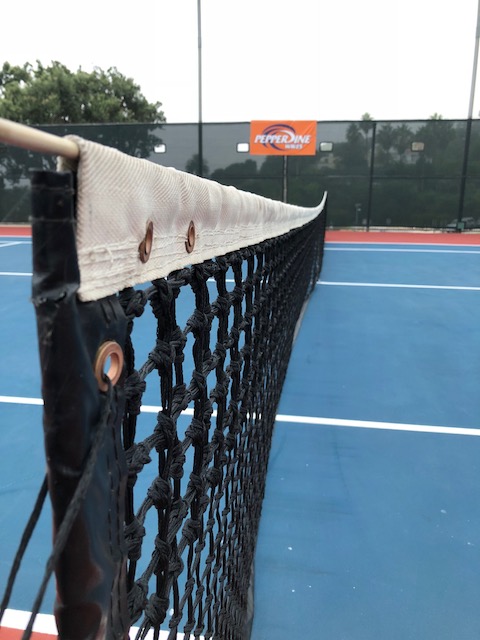
My oldest sister had a tennis class in college and seven-year-old, sports-infatuated me was a convenient choice for a practice partner. That was my introduction to tennis. We played on an elementary-school playground that had a metal chain-link “net” bisecting a concrete basketball court. Not ideal conditions, but I loved every minute of it. I followed professional tennis a little back then, and my childhood was a fun time for it. As a good American I cheered for Chris over Martina but could not get into the screaming antics of Connors and McEnroe, so when it came to international options I opted for Lendl over Borg because Lendl looked cool with those huge white sweatbands. But tennis never made it to center court in my life, other than as a diversion on long summer days when I took a break from shooting hoops to hit tennis balls against a brick wall.
Last year I decided to be a Pepperdine Waves fan across all sports, and as the calendar played out, I had many opportunities to watch our ultra-talented women’s tennis team in action and got a little hooked. What a terrific sport! In fact, one afternoon when I was nursing a nagging running injury I mentioned my interest in playing tennis to my friend and neighbor, Mike, and before I knew it we were playing each Friday morning. My wife bought me a brand new racket, and I bought some cool Waves-colored tennis shoes. You might think that I am a serious tennis player—until you see me play. What a terrific and difficult sport!
Andre Agassi noted that “Tennis uses the language of life. Advantage, service, break, fault, love, the basic elements of tennis are those of everyday existence, because every match is a life in miniature.” Last week I watched a tennis match following such a tumultuous week in our national politics, and as I watched two warriors on a tennis court playing their violent game of chess with the ball sailing back and forth, back and forth, back and forth, I considered the adversarial nature of life. Maybe Agassi was on to something. It does seem to be the nature of things that we face one another across a dividing line and take our best shots.
At the end of the match, however, I watched the two warriors shake hands across the net out of respect for one another. That doesn’t seem to resemble life at all right now.
 We signed our youngest daughter up for TIME magazine her senior year of high school when she indicated an interest in international affairs, but when she took off to Seattle for college I became the beneficiary of knowing what’s up in the world. As time flies and all that, that daughter is about to begin her senior year of college, and I thought I would sneak up to see her for a couple of days last week before the entire college experience slips away. As fate would have it I was reading TIME just before the trip and stumbled across the magazine’s inaugural run at identifying the “World’s Greatest Places.” The list contained one-hundred places from forty-eight countries on six continents and was chosen using factors such as “quality, originality, innovation, sustainability, and influence.” One of those one-hundred places is in Seattle, a restaurant featuring Southern food named JuneBaby.



 On the big screen Martin Sheen is probably best known for his leading role in Apocalypse Now and on the television screen for his portrayal of President Bartlet on The West Wing. In Malibu he is known for his generosity.



 Starting to Look Up