Tag Archives: trump

A Line in the Sand

Confession: I struggle to keep up.

The well-orchestrated and rapid-fire actions of the second Trump administration are dizzying, and while I have many opinions on many issues, I just can’t seem to keep up. I have a job (that I love) that consumes a significant amount of time, and by the time I attempt to be informed enough to formulate thoughts potentially worth sharing, those issues are old news.  

And to be honest, part of me wants to remain silent, partly from the dizziness of it all, but also because I recognize that President Trump and his party won the election and have a relatively short amount of time to make their case for remaining in power before the American people render a verdict at the midterm elections. But another part of me wants to speak out constantly, not only because I care about so many of the issues, but also because I recognize that silence contributes to a gaslighting effect for those that suffer from certain words or actions, including many friends from historically-marginalized groups that wonder if anyone sees their pain.

Despite the tennis match going on in my mind, I have something to say today that I hope will be heard.

I’ll probably lose some of you at the start when I reference Erwin Chemerinsky. Erwin Chemerinsky is dean of the law school at UC-Berkeley, and just the mention of Berkeley will lead some to tune out, but I beg you to stay with me anyway. Chemerinsky is a constitutional law scholar, on the liberal side as you might suspect, but if one can recall such a time, he was also a good friend of the late Ken Starr, a constitutional law scholar on the conservative side who was dean at the law school I chose to attend in 2008. Chemerinsky and Starr rarely arrived at the same interpretive conclusions, but they shared a love and respect both for each other and the United States Constitution.

The New York Times published a guest essay from Chemerinsky two days ago titled, “The One Question That Really Matters: If Trump Defies the Courts, Then What?” Please recognize this title question is neither liberal nor conservative but a question of constitutional structure that is simultaneously an existential question for the American form of government.

It is a short essay that I suggest you read, but I will share the highlights. Chemerinsky writes:

“It is not hyperbole to say that the future of American constitutional democracy now rests on a single question: Will President Trump and his administration defy court orders? . . . [T]he Constitution gives judges no power to compel compliance with their rulings — it is the executive branch that ultimately enforces judicial orders. If a president decides to ignore a judicial ruling, the courts are likely rendered impotent . . .. It is unsettling even to be asking whether the president would defy a court order. Throughout American history, presidents have complied with mandates from the courts, even when they disagree . . .. [T]here are no definitive instances of presidents disobeying court orders. The line attributed to Andrew Jackson about the chief justice, that “John Marshall has made his decision, now let him enforce it,” is likely apocryphal . . .. In addition, modern scholarship has undermined the story that Abraham Lincoln defied an order from the chief justice invalidating a suspension of habeas corpus during the early days of the Civil War . . .. Thus far, the Trump administration has given conflicting signals as to whether it will defy court orders. On Feb. 11, Mr. Trump said, “I always abide by the courts, and then I’ll have to appeal it.” . . .But just one day prior, Mr. Trump posted on social media, “He who saves his Country does not violate any Law.” . . . The reality — and Mr. Trump and those around him know it — is that he could get away with defying court orders should he, ultimately, choose to do so. Because of Supreme Court decisions, Mr. Trump cannot be held civilly or criminally liable for any official acts he takes to carry out his constitutional powers. Those in the Trump administration who carry out his policies and violate court orders could be held in contempt. But if it is criminal contempt, Mr. Trump can issue them pardons . . .. Defiance of court orders could be the basis for impeachment and removal. But with his party in control of Congress, Mr. Trump knows that is highly unlikely to happen. If the Trump administration chooses to defy court orders, we will have a constitutional crisis not seen before. Perhaps public opinion will turn against the president and he will back down and comply. Or perhaps, after 238 years, we will see the end of government under the rule of law.”

I have repeatedly emphasized Chemerinsky’s question in private conversations for weeks now, and I wish I could elevate it above all the noise. It is an existential question for American democracy, and I want to have done my part at least to try to place it in the spotlight it deserves.

Let me be blunt: Presidents and parties come and go, but if any American president, ever, adopts an approach that defies the decisions of the courts, then we no longer have “the rule of law,” which has been the central feature of the United States government since the Constitution was adopted in 1787.

President Trump has famously said many things, including:

  • “I can find a cure to the most devastating disease . . . or announce the answers to the greatest economy in history or the stoppage of crime to the lowest levels ever recorded and these people sitting right here [Democrats in Congress] will not clap, will not stand, and certainly will not cheer for these astronomical achievements.”
  • “I could stand in the middle of Fifth Avenue and shoot somebody and I wouldn’t lose [MAGA] voters.”

Unfortunately, I think that for many he is correct on both counts. But I hope not for everyone.

I know full well that for many the support of a political party or a specific political leader is unwavering. But I hope that is not true for all. I hope that for many there are certain lines that cannot be crossed. And for anyone that values democracy as a form of government, this question regarding a respect for the “rule of law” has to be at the top of the list.

A House (Still) Divided Against Itself Cannot Stand (Forever)

“A house divided against itself, cannot stand.” – Abraham Lincoln on the campaign trail in Springfield, Illinois, June 16, 1858

Our friend, Flo, graciously gave me a signed copy of Erik Larson’s latest book, “The Demon of Unrest: A Saga of Hubris, Heartbreak, and Heroism at the Dawn of the Civil War,” as a Christmas gift, and I read it with great interest, especially at this particular moment in American history. The book chronicles the few short months between the unlikely election of President Abraham Lincoln in November of 1860 and the outbreak of the American Civil War at Fort Sumter in April of 1861 by venturing beneath the headlines and into the lives of some of the key players in the unfolding tragedy. The stories are captivating, to say the least.

I finished the hefty book amid the rapid-fire headlines currently firing from our nation’s capital, wondering if the combination provided anything for me to say. And I think that I do, have something to say that is.

For starters, to state the obvious, our current political polarization with its cyclical outrage is not new. The American Civil War was deep polarization by definition, in that case producing a macabre debate over exactly how many hundreds of thousands of deaths followed, but I began to wonder if today’s toxic political climate is an instance of history repeating itself—or, is it better understood as an ongoing history?  I suspect the latter.

I have had eleven special opportunities to teach a course built by a fantastic professor named Peter Robinson, titled, “Apology, Forgiveness, and Reconciliation,” and in so doing I stumbled across a December 2019 article in The Atlantic by Adam Serwer with the provocative title, “Civility Is Overrated.” The article’s premise is that the aftermath of the American Civil War—an era popularly called Reconstruction—was not, in fact, a time of healing and reconciliation, but a time that perpetuated the original division through its “false promise of civility” that then evolved into Jim Crow, and a century later, the American Civil Rights Movement of the 1960s. In the final paragraph, Serwer writes: “In the aftermath of a terrible war, Americans once purchased an illusion of reconciliation, peace, and civility through a restoration of white rule. They should never again make such a bargain.”

Well . . .

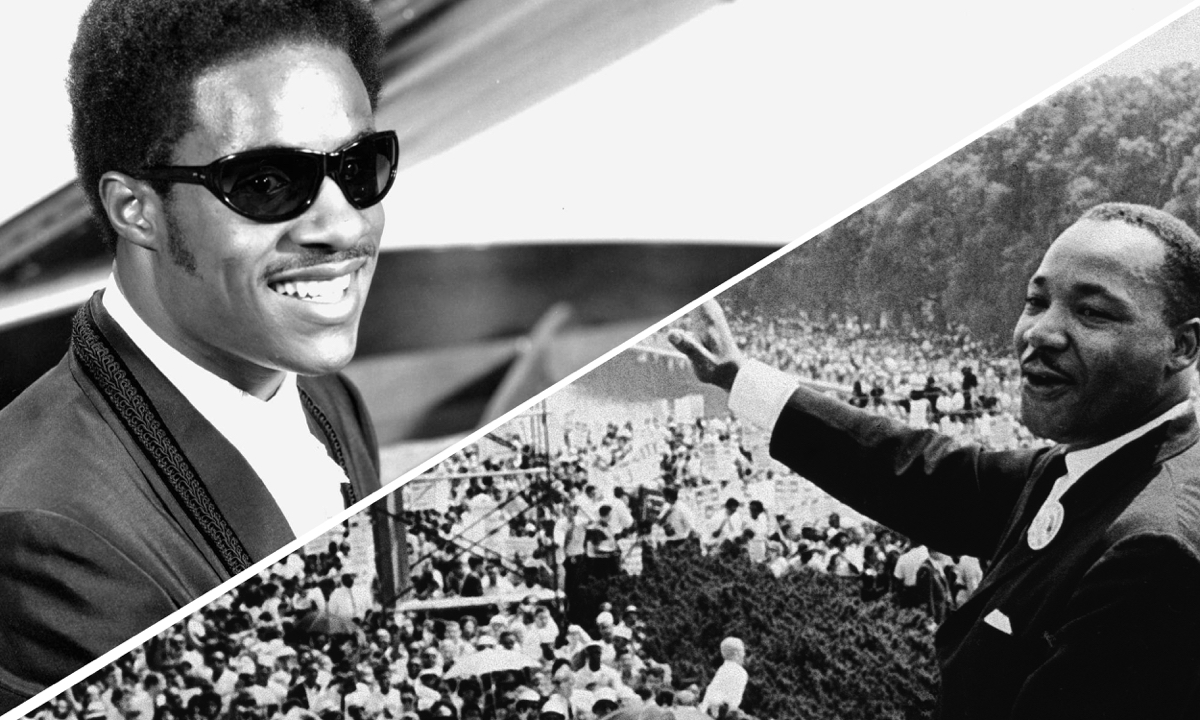
So I’m just thinking here: President Lincoln’s famous campaign speech in the important prelude to the American Civil War warned of what happens to divided houses, and a century later, Reverend King’s most famous speech continued to lament the maintenance of that divided house (read the first few paragraphs of his speech, at least) and dreamed an inspiring dream of a yet-to-be-realized undivided house. I think that today we’re on the next stanza of the same tragic song.

But if President Lincoln’s famous line (citing Jesus) from his famous speech is correct, the song does not have unlimited stanzas.

President Trump is a fascinating phenomenon. His now larger-than-life persona is venerated by many and reviled by many others—and his flurry of provocative executive actions during his first few weeks back in office naturally produces both reactions. But what I find disturbing is that even many of the Republicans that vehemently oppose President Trump—the RINO (“Republicans in name only” as he calls them)—although in opposition to most of his initial actions, seem to agree with his assault on one thing: DEI (Diversity, Equity, and Inclusion). Instead of multiple nuanced perspectives on the general concept of DEI, there seem to be only two: Good. Or, Bad.

Let me be clear: While money/power always lurks behind the curtain, the American Civil War was fought specifically over DEI. Make no mistake. And the Civil Rights Movement was without question a DEI movement. And amid the sweeping number of issues on the table today, I believe that DEI as a cause or concern, broadly speaking, remains at the center of it all.

One telling example is to recall the home stretch anti-DEI emphasis of the 2024 Trump campaign commercials that helped secure his clear victory at the polls.1 2 And as another specific but dramatic example, you may have seen recently that new Secretary of State Marco Rubio hired an undersecretary for public diplomacy that wrote the following less than four months ago: “Competent white men must be in charge if you want things to work. Unfortunately, our entire national ideology is predicated on coddling the feelings of women and minorities, and demoralizing competent white men.”

My friend, Dr. Richard T. Hughes, published “Myths America Lives By” in 2018, and in discussing various foundational myths identifies white supremacy as “the primal American myth.” One of the blurbs for his book was written by theologian, Dr. James H. Cone, who himself authored one of the most devastating books I have ever read, titled, “The Cross and the Lynching Tree.” For Dr. Hughes’s book, Dr. Cone wrote: “It takes a whole lot of courage for white theologians and scholars to speak the truth about race. If we had more white theologians and religion scholars like Hughes who would break their silence about white supremacy and face it for what it is, we–together–could make a better world.”

I, for one, wish to have more courage, for such a reason.

Now I should state my belief that our nation’s troubling supremacist foundations include more characteristics than simply white, although white is major, and that it is no coincidence that DEI work engages those very conversations. That a visceral response to such conversations comes from many otherwise thoughtful individuals simply reveals to me the depth of the foundations.

So did the Democrats lose the presidential election in large part because their diversity, equity, and inclusion arguments were unpopular? I think so. I know without a doubt that Reverend King and the Civil Rights Movement’s diversity, equity, and inclusion arguments were unpopular. And I know that President Lincoln and the Republicans of the 1860s’ diversity, equity, and inclusion arguments were unpopular, too.

I’m imagining a similar speech to that President Lincoln delivered long ago but in today’s divided land, not that our house/nation “cannot endure, permanently half slave and half free,”3 but that we cannot endure half engaging diversity, equity, and inclusion conversations and half silencing them.

I think there is something demonic in the political unrest today, and I do not think that it has much to do with the typical liberal and conservative approaches to domestic, economic, or foreign policy. Instead, I believe that there is a foundational aspect of American history that has always existed and continues to divide us today, a foundation that seeks to reserve power and privilege for certain “types” of people through misusing words like “meritocracy.” And while this divided house has persisted for a very long time now, I agree with Jesus and Reverend King and President Lincoln and many others who were quoted as saying that divided houses cannot survive forever. But if there truly is this fundamental design feature that continues to divide us, and if we truly “face it for what it is,” as Dr. Cone wrote, I share his hope that “we—together—could make a better world.”

—————————————————————————————————————–

  1. Poltico.com on Election Day: “The border and inflation have been GOP mainstays in advertising all year. But there was one other late entry into the Republican onslaught against Harris: More than a quarter of GOP spots that have aired in battleground states since Oct. 1 mentioned transgender issues in some way — most seeking to tie Harris to the concept of prison inmates, including immigrants, receiving gender-affirming surgery. It’s not a new playbook for Republicans, who leaned into transgender issues in key races in the 2022 midterms with little electoral success. It represented a shift in the presidential race: The first TV ad mentioning the issue did not air until mid-September. Still, it became one of the top issues in Republican presidential ads in the final stretch, though the economy and immigration still loomed larger. ↩︎
  2. See also, The Democrats Show Why They Lost. ↩︎
  3. https://www.nps.gov/liho/learn/historyculture/housedivided.htm ↩︎

Days of Reckoning

With so many statements vying for limited headline space, it seems that President Trump’s audacious assertions about Canada, Greenland, Gulf of Mexico, and the Panama Canal have been characterized by many as mostly “Trump being Trump,” which may very well be true. And I probably would not have given it much more thought had I not at the same time been reading my favorite college professor’s sweeping history of the American West titled, Continental Reckoning. 

For future reference, when you hear that someone has written a “sweeping history,” you can safely assume that it is a big ass book, which this one is. But it is a worthwhile read, especially for Americans to “be closer to understanding ourselves and how we have come to be.” (Prelude, page xxx — that’s Roman numeral thirty, not something dirty!)

I confess an added personal interest in the American West having lived in California for a dozen years in the past, and as I dove into the sweeping history in early January, it seemed all the more relevant when historic wildfires devastated the large numbers of people that have been drawn westward to what has become extremely valuable properties there. But it was reading of historic American expansion (and its consequences) alongside President Trump’s bold expansionist rhetoric that really began to capture my attention. 

A book review is not my intention, but I will explain that the mid-1800s witnessed incredible American expansion and transformation, and while historians typically focus on the violent and fateful American Civil War from that era, Dr. West encourages us to “broaden our view in space and time.” He writes, “The Civil War and the birth of the West . . . should be given something like equal billing in this crucial transition in national life. Each event has its own story and deserves its own narrative, but each was often in conversation with the other, and when each is properly considered in its broadest context, neither can be understood without the other.” (Prelude, page xx)

The extraordinary experience of the American West erupted from the discovery of California gold just as the territory became an American possession in 1848, something Dr. West calls, “The Great Coincidence.” (i.e., “Within two hundred hours of its becoming part of the republic . . . California began to be revealed as the most valuable real estate on the continent.” – page 5) 

It is no surprise that significant expansion is often an economic flex, but the consequences often extend much further.

For example, in the story of the American West, in addition to the vast increase in power, opportunity, and affluence, there were incredible advances in communication, science, technology, and transportation — but the costs were enormous: “hundreds of thousands dead or dispossessed” (454), “land stolen and turned into poisoned grotesqueries” (454), and an appalling racial ordering with devastating effects for Native communities, Black Americans, Hispanic Americans, and Chinese immigrants — Dr. West even shared another historian’s observation that the architects of Nazi Germany admired the United States and “believed they were ‘not so much inventing a race-obsessed state as catching up with one’” based on the U.S. treatment of those considered non-“white.” (453)

I recognize that this is the 2020s and not the 1850s, and that talk of expansion might be the bluster of a negotiator, but my thought for those of us used to a flag with fifty stars is this: Don’t take expansion rhetoric lightly. Be aware. Expansion produces consequences, often significant, and we should not allow our unfamiliarity with it and the possible allure of new acquisitions to prevent us from careful consideration of past experiences in our own days of reckoning, particularly if the proposed expansion is broad and, well, sweeping.

Faulkner’s famous line, “The past is never dead. It’s not even past,” seems apropos. Or, as Dr. West suggests near the end of this volume that he subtitled, The American West in the Age of Expansion: “The consequences remain; yesterday makes today. As for tomorrow and how best to use it, the stories and their voices offer up hints and provocations.” (454)

Chaos or Community?

It seems to me that a debate over where a nation’s flags should be positioned today should be about the national holiday’s namesake rather than two others who are not, the national holiday’s namesake that is.

To be fair, one of the two obviously did not invite the debate. In fact, just over forty-six years ago (January 14, 1979) President Jimmy Carter became the first president to propose a national holiday honoring Reverend King even though thirty such bills had been proposed and defeated in Congress in the decade following the assassination, with the first proposal coming just a few days after the national tragedy in 1968.

President Carter’s proposal was unsuccessful, too. There were repeated financial arguments against the holiday over the years (e.g., President Ronald Reagan cited cost concerns; i.e., it will cost too much money to give federal workers another day off), and there were repeated personal attacks (e.g., Senator Jesse Helms called Reverend King a “Marxist” — and even President Reagan, again, who eventually signed the 1983 national holiday bill that finally made it through Congress into law, dodged a question about Senator Helms’s accusations with a thinly-veiled slap, “We’ll know in thirty-five years, won’t we,” referring to the scheduled release of FBI surveillance recordings). Today’s youth are presumably ignorant of the long road to the national celebration of the life of Martin Luther King, Jr.

Key to generating the public pressure necessary to turn the tide on a national holiday, including a petition with an incredible six million signatures, was the extraordinary effort of musical legend, Stevie Wonder, who wrote and released his MLK-holiday-inspired version of the song, “Happy Birthday,” in 1981. “Happy Birthday” became one of his signature songs and has endured in beautiful ways. At the first official national MLK Day celebration in 1986, Stevie was the headline performer.

Still, even with the eventual declaration of a federal holiday, many states were reluctant to participate. It wasn’t until the year 2000 that every state officially came on board, although I am sad to report that both Alabama and Mississippi, in a breathtaking and ongoing insult, still combine the holiday to recognize both Martin Luther King, Jr. and Robert E. Lee, the Civil War general that led the fight to preserve Black slavery.

And if the fight for a day to recognize Reverend King wasn’t hard enough, we add a presidential inauguration today. Given the Twentieth Amendment to the United States Constitution’s specification for presidential inaugurations (January 20) and the designated date for MLK Day (third Monday in January, instead of his actual birthday, January 15), this will happen periodically. It happened with both President Bill Clinton’s second inauguration in 1997 and President Barack Obama’s second inauguration in 2013, and it won’t happen again until 2053, but it is happening today.

I listened to Stevie Wonder’s signature song, and given the persistent reluctance to fully celebrate the holiday and the bitter divisions in our nation, certain of his lyrics struck me with special force:

  • “the way to truth is love and unity to all God’s children”
  • “the whole day should be spent in full remembrance of those who lived and died for the oneness of all people”
  • “we know that love can win”
  • “the key to unity of all people is in the dream that you had so long ago that lives in all of the hearts of people that believe in unity”

I wish that those sentiments — sentiments that happen to reflect Reverend King’s understanding of Christian values — could be the full focus of a day like today.

Today, I do get to be a part of a lengthy reading to commemorate the holiday. We will gather in the “MLK Room” on the Ripon College campus and read aloud sections of the last book that Reverend King published prior to his assassination, titled, “Where Do We Go from Here: Chaos or Community?” That question — Reverend King’s question — reverberates today. Which will we choose?

Sometime between today’s presidential inauguration and tonight’s college football championship, I propose finding a few minutes to reflect on Stevie Wonder’s lyrical call to the world as set forth in his birthday song for Reverend King and truly consider the question: Where will we go from here — chaos, or the beloved community of which Reverend King so famously dreamed?

An Historic Election: Looking Backward, Inward, and Forward

I confess a deep sadness following last week’s presidential election. It is a personal sadness, sure, but it is far more on behalf of those from historically-marginalized groups that feel especially vulnerable and afraid due to a resounding national stamp of approval for a candidate famous for hateful rhetoric offered in their specific direction. E.g., Stand back and stand by. Black jobs. Grab them by the ____. Too many direct quotes about specific women’s bodies to list. Mocking a reporter with arthrogryposis. Muslim bans. Shithole countries.

I felt especially sad for my two amazing daughters. Their professional lives and personal hearts are dedicated to teaching children who live in poverty in the urban core and who are now facing a promise of mass deportation that will rip immigrant families apart. It is hard to imagine a fear more fundamental than a powerful government separating you from your family. It was hard enough for me to communicate with my heartbroken daughters as they went to work the morning after the election and know that they love children by name who are facing those fundamental fears.

My sadness expands recognizing that my personal religion, Christianity, generally speaking, is openly and willingly associated with the national stamp of approval for the hateful rhetoric. Although I disagree with their conclusion, I can understand the thought processes of those who saw the election as a “lesser of two evils” vote, but there is never cause for celebration following a lesser-of-two-evils vote. And yet lots of Christians celebrated this one with euphoric joy; saw it as an answered prayer; used words like anointed. I unfortunately opened Facebook the day after the election.

I have been on a thirty-year journey with faith and politics, a journey that began in the early 1990s with me a young, questioning adult and the simultaneous rise of the Religious Right as a political movement. As Evangelical (for lack of a better term) churches gravitated toward the proselytization of a political strategy, I was saved from dismissing Christianity and moving on entirely, in part, by stumbling upon the writings of Will D. Campbell who demonstrated for me that there was a different way to be Christian, and I concluded that for me following Jesus meant that I must love everyone, regardless. Both sides. All humans. Even enemies. Learning to “live reconciled” became an important phrase to me, as did “indiscriminate love.”

But that really messed me up. Loving everyone is a recipe for loneliness in a culture insistent on choosing sides, winners and losers, us and them. On one hand, I could see the pain felt by those that experienced decades of cultural condescension and blindness to class inequality from the Political (and Religious) Left while on the other hand growing increasingly cognizant of the centuries of pain felt by those that experienced the terrible injustice and marginalization perpetuated by the Political (and Religious) Right. So, I eventually learned to bite my tongue a lot, choosing instead to plant seeds, attempting not to alienate either side in an attempt to love and maintain relationships with everyone. I chose to work within a lot, behind the scenes a lot. And I felt guilty a lot for not doing and/or saying more.

My interpretation of Christianity remains, but in time I sought a quiet freedom from a life where I am not allowed to be fully authentic, and I am grateful for the wonderful feeling of liberation that I now experience. But given my own emotional reaction this week, and given numerous private texts and conversations with friends from all over the country that we made on our long journey toward personal liberation, my personal freedom seems self-serving and wholly insufficient.

But what to do?

That question has dominated my thinking, and I am grateful for anything I have heard and read from Dr. Tressie McMillan Cottom in the aftermath of the election (like the full Daily Show interview). Dr. Tressie has helped me tremendously (and I thank my friend, Chalak, for telling me about her in the first place). And I have also benefitted from articles written by both David Brooks and David French after the election, white men from conservative backgrounds who through their columns have assured me that my visceral reactions to the election aren’t simply because I drank Kool-Aid at the Liberal Vacation Bible School.

Collectively, they pulled no punches in saying that chaos is coming but emphasized that despair cannot be allowed to be the mood for long. Dr. Tressie advised, “Don’t cry too long over a sinking ship,” and the subject of David French’s email read, “We don’t have time to waste time in despair.”

French wrote, “There’s a temptation to retreat. If you have a stable job, a good family and good friends, you can check out of politics. After all, politics can be painful. It’s not just the pain of loss, but also the pain of engagement itself. MAGA is extraordinarily cruel to its political opponents. But despair is an elite luxury that vulnerable communities cannot afford. If Trump was telling the truth about his intentions — and there is no good reason to think he wasn’t — then he will attempt a campaign of retribution and mass deportation that will fracture families, create chaos in American communities and potentially even result in active-duty troops being deployed to our cities.”

So, while sad and tempted to quit caring, even that, as depressing as it sounds, is “an elite [and selfish] luxury.” Here are my commitments instead:

#1: See. I choose not to give up on my faith commitment to see all people—i.e., to love neighbors, regardless of anything. David Brooks published an important book last year titled, “How to Know a Person,” and his post-election column explained something Will Campbell helped me see long ago, i.e., a “redistribution of respect” that led to a “vast segregation system” between the Political Left and those that now comprise the base of the MAGA movement. Brooks’s post-election column titled, “Voters to Elites: Do You See Me Now?,” reminds me that condescension creates problems and does not cure them, and I won’t abandon my desire to see all people as human beings equally worthy of sincere love and respect.

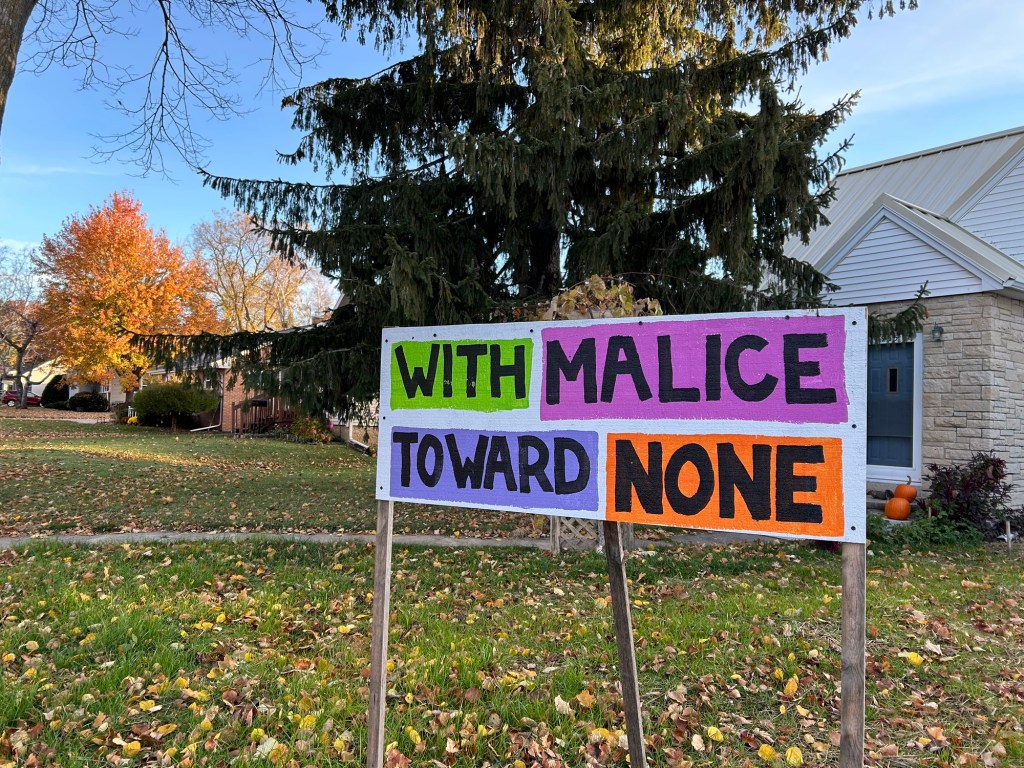
#2: Speak. This, I confess, feels like my greatest challenge. One change I must adopt moving forward is a willingness to speak up more, even though that will risk alienation from and dismissal by people that I love on every side. It is tempting to bite my tongue, especially when I want to remain in relationship with everyone, but I think David French is right when he says we are compelled to “speak the truth.” He explained it this way: “Telling the truth means combating deception and misinformation, but it also means publicly defending the dignity and humanity of the people and communities who are the object of Trump’s wrath. It means resisting malice when we encounter it in our churches and communities.” Remaining silent might appear to preserve relationships, but it forecloses all prospects for true justice and real harmony. This blog post is an initial and meager attempt to speak up more.

#3: Act. Finally, as hard as the first two are to do, they are insufficient without action. David French wrote that we must “protect the vulnerable,” but I like how Dr. Tressie said it best: “Don’t cry too long over a sinking ship. Build dinghies.” To continue the nautical metaphor, the Brooks column concluded this way: “[W]e are entering a period of white water. Trump is a sower of chaos, not fascism. Over the next few years, a plague of disorder will descend upon America, and maybe the world, shaking everything loose. If you hate polarization, just wait until we experience global disorder. But in chaos there’s opportunity for a new society and a new response to the Trumpian political, economic and psychological assault. These are the times that try people’s souls, and we’ll see what we are made of.”

I want my soul to pass this test, so with thanks to Dr. Tressie and the two Davids, and after much reflection, I have concluded that it takes all three: See. Speak. Act. Looking backward in despair, looking inward in contemplation, and now looking forward with resolve, that is what I commit to do.

On the Eve of an Historic Election

As my limited gambling history demonstrates, my best guesses are nowhere close to reliable. But on the eve of what promises to be an historic presidential election, I have what I can only describe as a sense of foreboding. Things could get ugly, as if the campaign wasn’t ugly enough.

If the election is as close as it appears, we may not know the outcome anytime soon, but that doesn’t prevent a little personal nostalgia. I recall a sense of foreboding the day before an unprecedented hurricane crashed through my community, and on that occasion I sent a mass email to let everyone know our plans in case things went badly. Apples and oranges, I know, but a similar feeling resurfaces today, as silly as that sounds.

I anticipate significant acts of violence should Donald Trump “not” be elected president again. I hope that such violence does not occur, but, you know, history. And I anticipate a very different but even greater set of dire consequences if he wins. That’s because, among other things, many of his former military commanders have spoken in no uncertain terms.

So again, pardon the PTSD, but I feel this strange desire to board up some windows and prepare for dangerous winds and waves.

While I have leaned Left for many years now, my concern regards Donald Trump the candidate and not the Political Right. I used to say that the winner of the presidential election didn’t matter nearly as much as we are expected to believe because winners tended to “govern toward the middle” in our clunky two-party system, but I don’t say that this time.

And my thoughts are further complicated because I understand a portion of the Trump appeal to those who for decades of their lives felt the sting of disdain from various types of “elite.” I don’t want to dismiss painful emotions and experiences.

But that we have come to the absurdity of yet another Donald Trump candidacy mostly makes me sad. As just one dramatic example, while Sean “Diddy” Combs understandably sits in prison as evidence of sexual assault mounts against him, Donald Trump expects to be the next president of the United States despite, well, everything. And if I had to bet a nickel, I’d bet that he wins.

I attended a panel discussion recently on the impending election, and one of the panelists said that the outcome of the election will say more about the American people than about the campaigns themselves. That seems about right, and I think that may do more to describe my sense of foreboding than anything else. 

Vote bravely and wisely, everyone, and then batten down the hatches. 

Roses Are Red, Violets Are Blue, but Wisconsin Is Actually Purple

Purple haze all in my brain / Lately, things just don’t seem the same / Actin’ funny but I don’t know why / Scuse me while I kiss the sky.” – Jimi Hendrix

I stopped using social media to discuss politics a long time ago, mostly because I just didn’t love the desire to claw out my eyeballs. The following represents only a minor shift in personal policy, I hope.

My new hometown is the birthplace of the Republican Party. Alvan Bovay, a lawyer and mathematician from New York City, moved to Ripon, Wisconsin, in 1850, one year after the city was founded, and in 1854, frustrated by the potential spread of slavery in the proposed Kansas-Nebraska Act, called a meeting at the First Congregational Church and proposed forming a new political party to oppose slavery if the bill passed. Well, the bill passed, and Bovay hosted a follow-up meeting at what is now known as the Little White Schoolhouse, a meeting that led to the establishment of the Republican Party. Six years later, the United States elected its first Republican president, Abraham Lincoln, and all hell broke loose soon thereafter.

As you might suspect, when I pass by the Little White Schoolhouse in my new hometown, I often see travelers there taking pictures from their respective pilgrimages. Ironically, I think supporters of both major political parties should take pilgrimages here, albeit for different reasons: Republicans, for obvious reasons, being the birthplace of their party, but Democrats, on the other hand, for historic reasons, too, i.e., to honor an early political movement that stood up for basic civil rights for Black citizens and then held the nation together during the bloodbath that ensued when Southern states seceded to preserve white supremacy. There’s much there for both to celebrate if they so choose.

In a way, I guess my new hometown serves as a nice microcosm of life in a purple state, having something that both Democrats and Republicans can honor.

With the 2024 presidential election on its final approach, Wisconsin, my new home state, is receiving a lot of attention as a “battleground” state. (My new academic department chair was quoted in Newsweek just last week.) Wisconsin is one of only five states (along with Arizona, Georgia, Michigan, and Pennsylvania) that voted for Trump in 2016 and Biden in 2020, displaying the capacity to vote for a presidential candidate from different parties. In addition, officially, and this may change following the next election, Wisconsin is one of only three states (along with Montana and Ohio) that has one United States Senator from the Democratic Party and one United States Senator from the Republican Party—down dramatically from twenty-seven split delegations in 1980.[1] Wisconsin is apparently the prototype of a “purple” state, a mixture of red and blue—even though when it comes to colors, this football-crazed state prefers the green and the gold to that associated with one of its historic rivals, the Minnesota Vikings.

I happen to like purple—when it comes to politics.

I’m actually quite blue, to be sure, when it comes to the political team I typically root for, and I have strong feelings along those lines about this particular presidential election, but as one who cares deeply about words like diversity, equity, inclusion, and belonging, and very much dislikes words like echo chamber, groupthink, and homogeneity, I am fond of what are now extraordinary places where people from different perspectives live in community and everyone has the chance to speak up and be heard. So, I like living in a place that is currently known as a purple state.

However, refusing to put my head in the sand, I’m well aware that these rarities are headed toward extinction, and I’m not sure that will change anytime soon.

I sort of like the idea of a purple party. (This is where my wife, a major Prince fan, perks up, and I confess that going back to (political) parties like its 1999 seems surprisingly nice given today’s crazy town carnival, but that’s not where I’m headed with this little essay.)

I sort of like the idea of a purple party, but I’m not going to call a meeting at the Little White Schoolhouse and try to start one, mostly because I only sort of like the idea and think it would turn out poorly. The idea of a purple party would probably end up as a gathering of all the moderates, those tired of the extremists on both sides—almost a call back to the political establishment once upon a time. Make America Moderate Again, if you will. I can see the purple MAMA hats already.

But actually, sometimes, I like extremes. Like, a lot. For example, all things considered, pretty much any landmark movement for human rights was a radical movement once upon a time, and I want to be on those teams.  

No, instead of a party for “those in the middle,” though an understandable wish for many, what I wish for instead is not even a party, just a place in this world where people from very different backgrounds with very different characteristics and very different perspectives can be in the same place and learn from each other and refuse to hate each other (which is where the train consistently derails) and choose to respect each other as human beings. Places where Justice Ginsburg and Justice Scalia go to the opera together, and where George W. Bush and Michelle Obama exchange hugs and cough drops, and where friendships develop like Snoop Dogg and Martha Stewart; Ella Fitzgerald and Marilyn Monroe; Sherlock Holmes and Dr. Watson; Harry and Sally; Bert and Ernie; Woody and Buzz.

Wishful thinking, I know, this notion of radical respect and radical friendship across dividing social lines. Who could really imagine that happening anywhere? But if anyone ever calls a meeting at a little schoolhouse somewhere with that in mind, please pass along the invitation.


[1] Sure, Maine and West Virginia also have split delegations, but theirs are Independent and Republican, not Democrat and Republican. And don’t even try with Vermont: nothing split about that delegation!

What Gives Me Hope

interfaith-group-2017As nostalgia sets in at the prospect of leaving the law school, the privileges I enjoy become more pronounced.  One of my favorites has been hosting the Interfaith Student Council.

Early this week, sixteen wonderful people—fourteen law students, one undergraduate student, and one lawyer—showed up for an evening of discussion (the lawyer took the picture above!).  This fine group represented various flavors of Christianity, Islam, Judaism, and Atheism.

The leaders offered two potential topics for the evening: a heavy discussion about the controversial Trump immigration executive order, and a lighter discussion of dating practices in various faith traditions.  The group decided to do both and briefly discuss the heavy topic before moving to the lighter topic.  It may be unsurprising in the rear view mirror, but we never made it past the first.

Early in the conversation, one of the kindest people I have ever known shared a personal story that involved a close acquaintance sharing things that characterized this person’s entire religion in a terrible light.  I don’t think this kind soul has the capacity for anger, but there was definite hurt.  And confusion.  I mean, what do you do when someone you know portrays you and everyone in your faith as evil?

Everyone tried to help, and a good conversation ensued.

Later on, after the conversation took several twists and turns, a different student spoke up—one who comes from the faith that was used to characterize the other student as evil—and directed remarks back to that tough situation.  And she apologized.  She apologized on behalf of her entire faith.  And then she started crying, which made the other student start crying, and if we weren’t careful it was going to get all of us but they hugged it out and gave us a fighting chance.

If I am honest, as I sit here and type away, you know how your tears like to hang out in your upper cheekbones watching television and how they stand up and put their shoes on when you start thinking about touching moments like this one?  Well, maybe that is happening right now, but you’ll never know.

At the end of the evening, I asked everyone what gives them hope when times seem dark.  Folks shared some great answers, but I have to tell you that what gives me hope is an evening like that one and an encounter like the one between those two wonderful students.

Some may look at the world right now and just see stormy weather, but in that one embrace I believe I saw a break in the clouds.

Beneficence

bush-letter

“Our culture has made it harder to be good.” – David Brooks, The Road to Character

With the news that former president George H.W. Bush is in ICU and the worldwide attention on today’s presidential inauguration, I found this worth sharing today.

In one sense, today is simply a Republican president succeeding a Democrat president, something that has occurred three times in my lifetime (and three times vice-versa, too).  But everyone knows that this inauguration is almost indescribably different.  Donald Trump won the presidency by brazenly declaring that he is indescribably different.  And today is the day he moves into the White House.

President Obama will cede center stage today.  I have watched him navigate the post-election drama, and I may not be objective enough to comment, but it seems that he has been consistently gracious in what must be an awkward time.  Today will be particularly scrutinized.

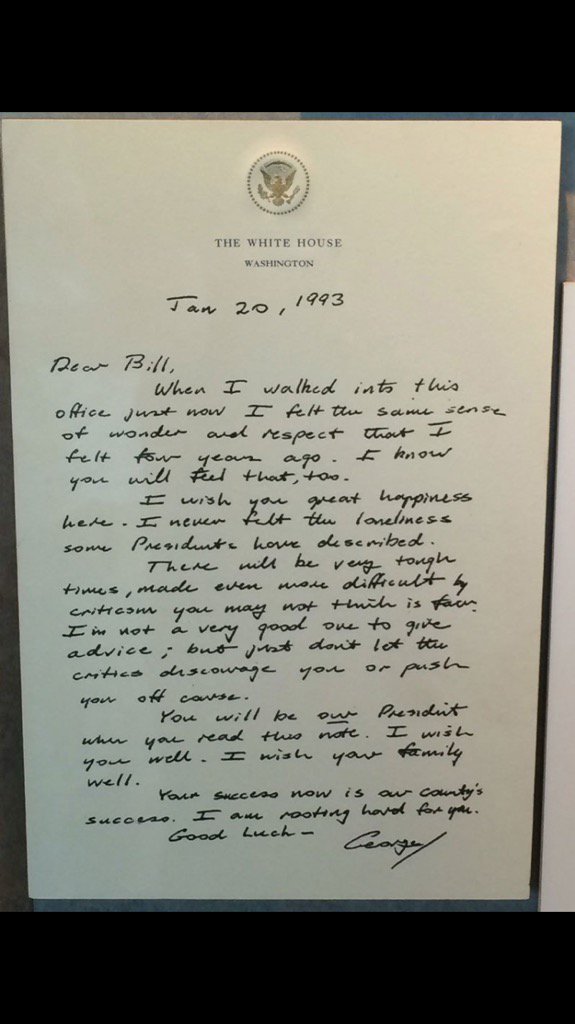
A couple of months ago at the height of the election drama, a handwritten letter that outgoing president George H.W. Bush left in the White House for incoming president Bill Clinton in 1993 made the rounds, and given the campaign histrionics this go around, it was almost shocking to read.

He wrote:

Dear Bill,

When I walked into this office just now I felt the same sense of wonder and respect that I felt four years ago.  I know you will feel that, too.

I wish you great happiness here.  I never felt the loneliness some Presidents have described.

There will be very tough times, made even more difficult by criticism you may not think is fair.  I’m not a very good one to give advice; but just don’t let the critics discourage you or push you off course.

You will be our President when you read this note.  I wish you well.  I wish your family well.

Your success now is our country’s success.  I am rooting hard for you.

Good luck,

George

In President (George H.W.) Bush’s autobiography, he describes that day: “And so time goes on and I’m sitting here now alone, the desk is clear and the pictures are gone.  I leave a note on the desk for Bill Clinton.  It looks a little lonely sitting there.  I don’t want to be overly dramatic, but I did want him to know that I would be rooting for him.”

I don’t want to be overly dramatic either, but the graciousness offered by President (George H.W.) Bush to President Clinton is something that in my opinion does more than transcend politics—it transcends life.  And it displays a depth of character not rewarded in our culture today.

I want to highlight it.  Especially today.

#winning

foam-finger-11-e1395603815168

We live in a world of competition.

This weekend, a mind-boggling number of people will tune in to see who wins and loses when Jimmy Fallon hosts the Golden Globes a few miles down the road at the Beverly Hilton.  Since I watch more football than movies, I will be more interested in the winners and losers of the College Football Championship and the wildcard round of the NFL playoffs.  Whatever your fancy, there is a competition for it—just look at the ridiculous number of reality competition shows on seemingly every network, e.g., Cupcake Wars; America’s Next Top Model; Last Comic Standing; The Bachelor/ette; Whisker Wars (yes, that was a real show).

And why should it surprise us that a former reality show celebrity emphasized “winning” so much in his shockingly successful presidential campaign?

Our entire social order is based on competition.  Our justice system is adversarial with the thought that the fight to win will produce just results.  Our economic system is designed to pit businesses against one another so that prices are lowered and products are improved.  Our political system sets parties against one another to determine the will of the majority and promote compromise.  And sports and entertainment?  Well, again, just turn on your television.

We live in a world of competition.

Even if I thought competition was a bad idea, any attempt to speak against it would be a losing battle (Ha!).  Competition is apparently inherent to human existence, but it sure makes it hard to promote love for and cooperation with others in a world that teaches us to see each other as competitors.  What’s a blogger to do?

In 2011, actor Charlie Sheen had a public meltdown and in a series of bizarre statements famously declared that he was “winning” and created one of the more popular Twitter hashtags to date.  Unwittingly, he also may have solved my dilemma.  You can apparently redefine what it means to win!

So here’s my proposal: Be a winner, sure, but first pick a battle that is worth the struggle and then carefully consider how to calculate true success.