Tag Archives: rest

Good Night, and Good Luck

“Sleep is the single most effective thing we can do to reset our brain and body health each day.” – Dr. Matthew Walker, Ph.D.

In early 2015, I asked the following question to Pepperdine’s law students: In comparison to when you first entered Pepperdine School of Law, how would you now describe your practice of rest (e.g., time off, relaxing, Sabbath)? The results: 40% indicated no change; 19% answered stronger; but 41% said weaker. When disaggregated, 52% of first-year students said their practice of rest was poorer than when they started law school. I was not even close to surprised. As the Australians taught us children of the Eighties to say: Been there, done that.

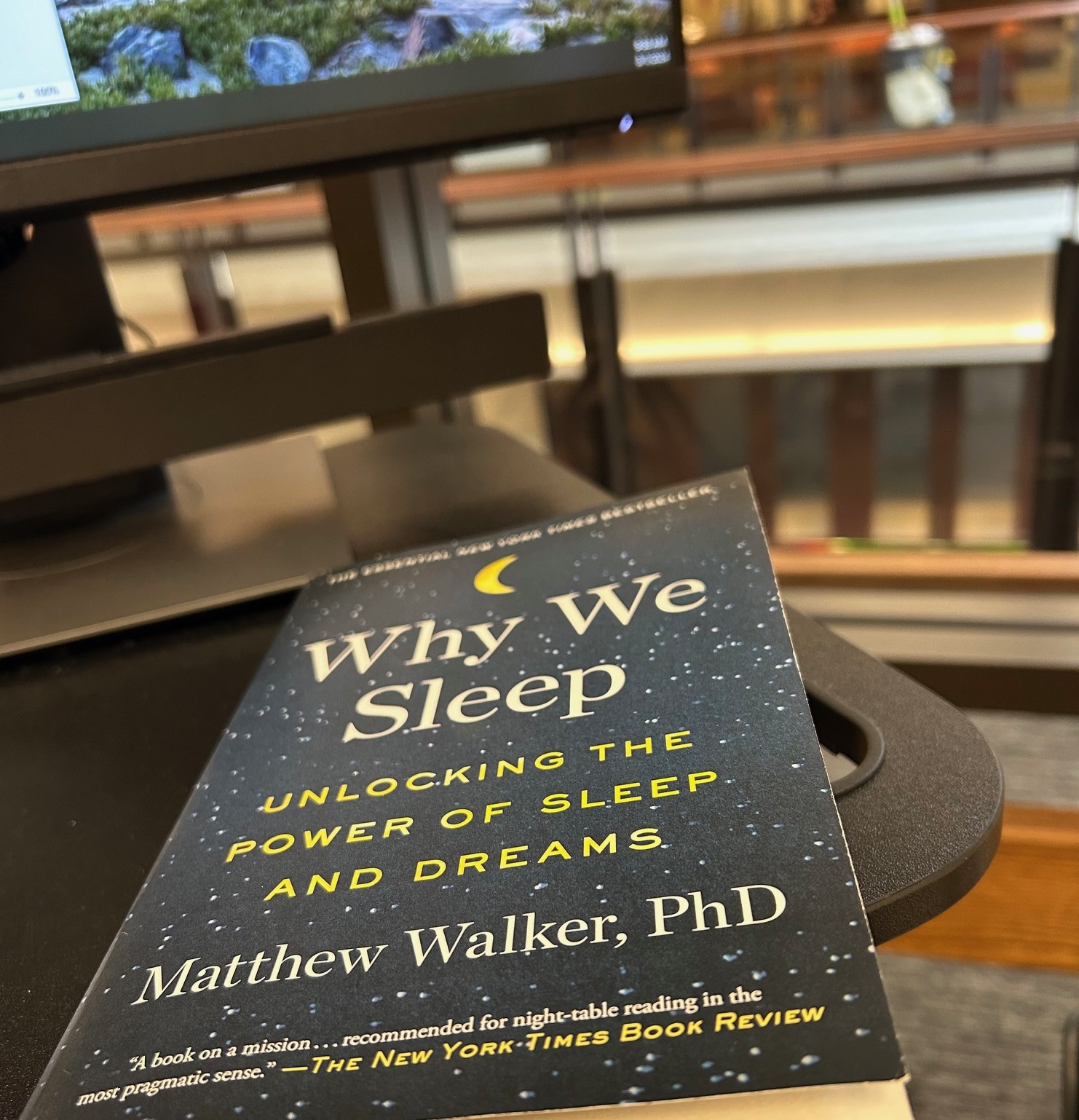
But I was never happy about it. Last semester, nearly a decade later, after discussing sleep troubles with a new law student, I decided that I should at least try to learn something about sleep, so I tracked down a book: Why We Sleep: Unlocking the Power of Sleep at Dreams, by Matthew Walker, Ph.D. I don’t know enough about science to confirm its veracity (there have been critics and controversy), but I do know that after reading it, now I’m having trouble sleeping. But because I don’t want to leave you out of the misery, let me share some of the disturbing (though sometimes cool) information that I read with you. You’re welcome in advance.

For starters, and on a positive note, all animal species seem to sleep, and part of why we humans are awesome may be because of our unique and natural sleep patterns. Specifically, compared to other primates, we sleep in a bed or on the ground instead of perched on tree branches, which allows us a disproportionate amount of REM sleep (the sleep when we dream) because the body is completely paralyzed during REM sleep, which isn’t a terrific idea if you are perched on a tree branch. And while in the cool facts portion of my essay, Walker claimed that the reason we are completely paralyzed during REM sleep is so that we won’t act out our dreams!

Our inordinate amount of REM sleep seems to set us apart in a couple of major ways: First, it heals and helps our mental and emotional health; and second, it enhances our creative and problem-solving abilities. Remember being told to “sleep on it?” Actually, great advice! Although in fact, all sleep phases are beneficial, and messing with any of them causes actual brain impairment.

The human body is fascinating. Just before a baby is born, its amount of REM-sleep is at an all-time high, approximately twelve hours a day. In year one, that declines while deep NREM sleep begins to increase, peaking just before puberty before retreating. The deep NREM sleep during childhood is sculpting the brain, but we all probably remember that it seems like construction halts during the teenage years when all sorts of irrational silliness ensued. Actually, the brain is still maturing then, but rationality is the last to arrive on the scene. Sleep then naturally settles into a predictable pattern in early adulthood. When left to our natural tendencies, human sleep is apparently “biphasic”—about seven actual hours of sleep at night, followed by an hour nap in the early afternoon—but that train apparently left our sociocultural station a long time ago.

In all our societal advancement, however, we have apparently created ways to screw up everything. Have you ever wondered why American life expectancy sucks relative to our immense economic and medical resources? The myriad ways we have created to destroy natural, human sleep patterns and a fingers-stuck-in-the-ears-while-bellowing-la-la-la-la-la-in-the-face-of-research posture toward the importance of sleep may be teensy reasons worthy of consideration.

O sleep, how do I screweth-uppeth thee? Let me count a couple of ways: Darn Thomas Edison for saying let there be light when there shouldn’t be light, and darn alarm clocks (and especially snooze buttons) for daily shocks to our hearts and nervous systems, sometimes multiple times a morning, telling us to get up when we aren’t done sleeping. And since REM sleep is disproportionate toward the end of the seven-to-nine hours of daily sleep we reportedly should be experiencing, about half of all adults in developing countries may be missing out on the unique human benefits that purportedly helped us develop in the first place.

And the consequences are tragic: Weakened immune systems, including an increased risk for certain cancers. Contributions to depression, anxiety, and suicidality. Impaired memory (and while I’m on memory, sleep aids memory both before and after learning, so all-nighters for work or school may be completely counterproductive). Cardiovascular disease. Increased propensity for weight gain, obesity, and developing type 2 diabetes. Drowsy driving—a driver that got up at 7am and heads home from the club at 2am without a single drink is reportedly just as impaired as a legally-drunk driver.

The result? As Dr. Walker wrote, “Relative to the recommended seven to nine hours, the shorter your sleep, the shorter your life span.”

Now we aren’t completely oblivious to our sleeping problems, but it seems that we are unfortunately ignorant to both the extent of the problems and the actual solutions. We typically mitigate with substances, including sleeping pills and/or alcohol and/or caffeine, that can actually do real harm instead of help.

So, what can I do about this to help our law students? I’ll have to get back to you on that one. This seems to be a larger problem than my present work environment, so that’s a major challenge to undertake. But I like major challenges. And it seems far too important to ignore.

What I will do is share with you my summation of the twelve tips for healthy sleep that Dr. Walker shared from the National Institute of Health at the end of his book and hope that someone finds them helpful:

  • Go to bed and wake up at the same time every single day.
  • Exercise, but not too late in the day.
  • Avoid nicotine (period) and caffeine in the afternoon/evening.
  • Avoid alcohol before bedtime.
  • Don’t got to bed too full or too hungry, and avoid beverages late at night.
  • Avoid medicines that disrupt sleep as much as possible.
  • Don’t nap after 3pm.
  • Do something relaxing before bed (not on a phone or computer).
  • Take a hot bath before bed.
  • Make your bedroom dark, cool (e.g., 65 degrees), and gadget-free.
  • Get at least 30 minutes of natural sunlight each day (ideally, an hour each morning).
  • If still awake in bed after 20 minutes, get up and do something relaxing until you are sleepy.

To quote the late, great Edward R. Murrow, “Good night, and good luck.”

Settling In

blog pic

The last four months flitted away like a Tennessee dragonfly and left us a little dizzy, but we are finally beginning to settle in.

Our move happened quickly, and we knew on arrival in March that our landing place was only temporary as we searched for a permanent home in a bustling Nashville housing market. Meanwhile, my entire office suite underwent a much-needed facelift that left us working out of boxes, too. The smell of cardboard, the sight of clutter, and the sound of packing tape have been part and parcel to life this summer—not my very first choices for sensory experiences.

But we moved back into our freshly carpeted, lighted, and painted office space recently. And then thanks to Jody and a fantastic realtor, we found the perfect place for us and just last week moved into a condo in Green Hills.

Priceless. Metaphorically speaking (unfortunately).

My wife would say that I prefer my world to be neatly ordered. Well, specifically, she would say—and I may paraphrase a little—that I am the type of nutjob who has to unpack immediately after a trip regardless of the time of night because no one can sleep if my stuff isn’t all in its OCD-inspired place.

So I may have been a bit difficult to live with for the last few months.

But now we are in. Homeowners again. Settled.

The word “settle” is apparently one of the more versatile words in the English language. One might settle a stomach or a lawsuit, one’s affairs or an account. People might settle their differences or a distant colony or on a new plan. A cold might even settle in one’s chest. I know that my current settling is that of finding a location to stay, but today I prefer the intransitive verb version: “to come to rest.”

After an unsettled summer, I like the sound of that very much.

Evening Sky in Summer

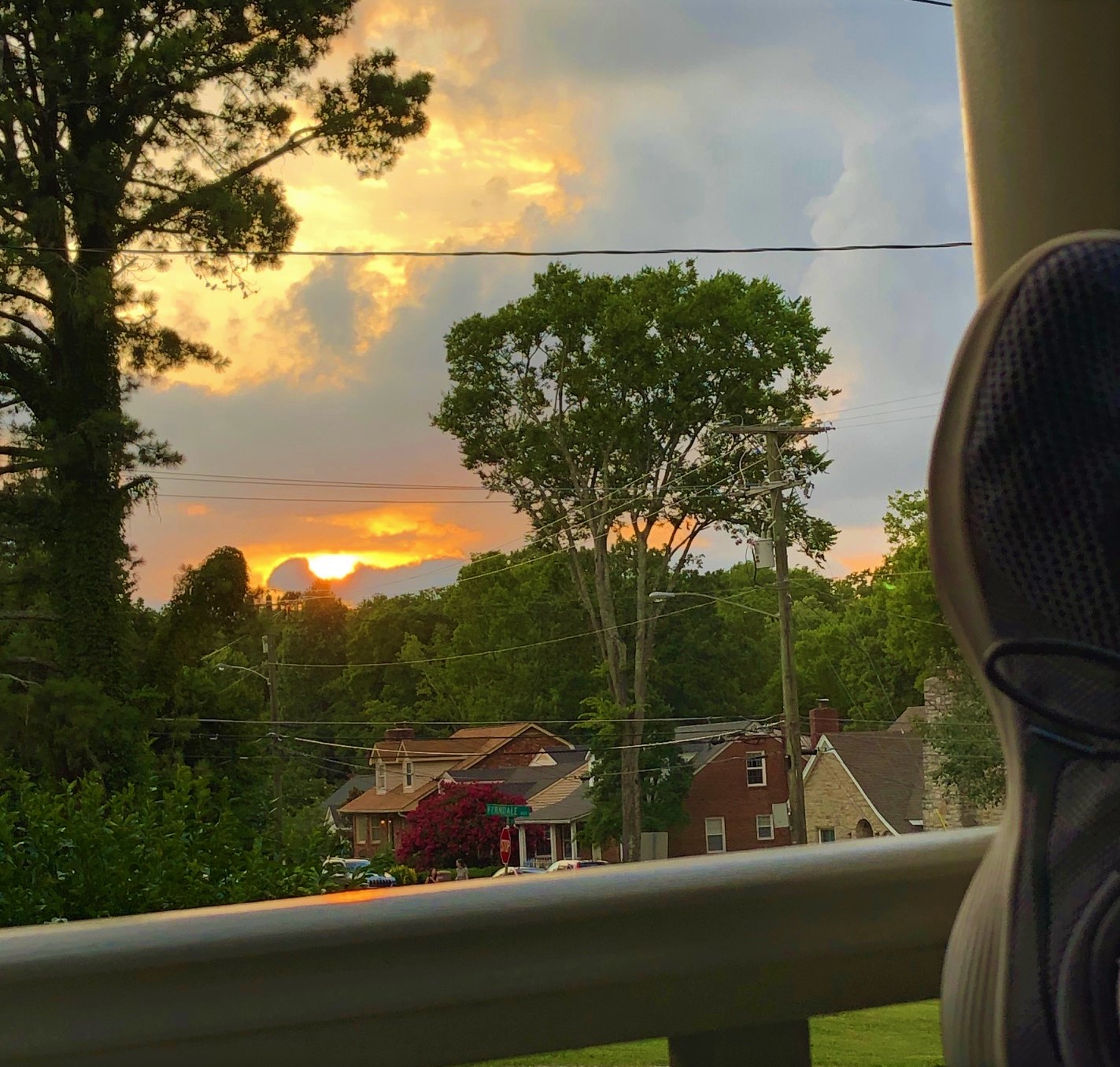
IMG_0751I sat in the rocking chair on our front porch to finish Joyce’s Dubliners and propped a foot up on the post, a picture of serenity on a late and sticky Tennessee summer evening. But I confess that the picture was deceiving.

I love to work, which has been a good thing lately because there has been a lot of it. There is the normal (abnormal) load associated with my role on campus, and then there is the typical added challenge when moving to an entirely new environment. But add to that the departmental reorganization that we are walking out and then the fact that my wife has been gone for the past couple of weeks moving our youngest daughter across the country so that nothing has prevented my working around the clock—the result is a level of intensity that is abnormal even for me.

It is obvious that this pace is unsustainable and even unhealthy. One of my role models in the profession recently shared an Instagram meme that said, “Almost everything will work again if you unplug it for a few minutes. Even you.”

Thanks, Connie. I will get there soon.

But on that evening, sitting in that rocking chair after another exhausting day, I tried to slow my mind and escape to a Christmas soirée in Dublin over a hundred years ago. And once there I looked up and noticed the loveliest evening sky. And smiled.

Just Stop

94e502a4dd7fa63ab887bc0660d35988

The classic Christian hymn, Dear Lord and Father of Mankind, contains the line, Drop Thy still dews of quietness / Till all our strivings cease.  That last part just sounds terrible.  You see, I’m a striver.  Striving’s my thing.  I like accomplishment.  Give me a problem to solve, yours or mine, and I will strive all day and night to solve it.  One of my latest projects is striving to learn how to take a break from striving, which it turns out is just as complicated as it sounds.

Last week Pepperdine hosted theologian, Miroslav Volf, who in his final lecture extolled the Jewish practice of Sabbath as a weekly event where one stops striving.  I have long agreed with that concept but am just terrible at it.  Since my new preaching gig sees Sunday as work day, I approach Friday-Saturday as weekend and Friday in particular as a personal sabbath.  Well, that’s the idea at least.  It hasn’t gone well so far.

For starters, I don’t want to stop striving for a day.  I prefer catching up on unfinished striving and go a little bonkers ignoring things that need attention when I actually have time set aside to do them!  But even when I try, presumably non-striving activities morph into things to accomplish.  A nature walk becomes the quest of the perfect picture or story.  A novel becomes a mission that needs to be completed in a certain time frame.  A sport becomes a personal competition.

I am more than a little nutty.  How exactly do I not strive?  I could say that I will work on it, but that is exactly the problem.

John Greenleaf Whittier wrote that 19th century poem-turned-hymn that imagined the cessation of strivings.  Ironically, he hated the very idea of singing in church and wrote the poem to promote silent meditation in contrast to musical worship, but his poem became a tool of the thing he despised.  Life is funny.  He was also an abolitionist, who in his lifetime saw the passage of the Thirteenth Amendment abolishing the practice of slavery in the United States.  So he was a striver, too! 

Well, obviously striving and Sabbath are teammates, not opponents.

Breaks are important for any endeavor, which obviously includes life itself.  This may not come naturally to me, but the secret just may be when it no longer feels like something to accomplish.  Stopping is the opposite of accomplishment.  It is a gift.

Emancipation

An article in the online edition of the Harvard Business Review caught my attention: “A Modest Proposal: Eliminate Email: Reasonable Attempts to Tame It Are Doomed to Fail.”  Ironically, or maybe appropriately, the article arrived via email.

The author (Cal Newport, Georgetown professor) is apparently serious, and as one of the “inbox-enslaved individuals” he describes, I appreciate his attempt at a Technological Emancipation Proclamation.  He accurately portrays my people’s need “to constantly check their inbox and feel great guilt or unease about the possibility of unanswered communication awaiting attention” and that “the inbox-bound lifestyle created by an unstructured workflow is exhausting and anxiety-provoking.”

So, he suggests chunking it.  He writes, “The concept is simple. Employees no longer have personalized email addresses.”

I think he is crazy.  Which is partly why I love it.  But more importantly, and I’m speaking as one highly skilled in email management, I think the day is coming when the email problem has to be addressed.  As Professor Newport concludes, “if workplace trends continue as they are, [his crazy/stupid/fruitcake idea] might one day soon seem less less like an interesting thought experiment and more like a necessary call to action.”

Email allows us to be so stinking available, efficient, and responsive that we no longer have time to work (in fact, that becomes our work)–or, tragically, to live.  In his delirious alternate universe, Professor Newport envisions: “[W]hen you’re home in the evening or on vacation, the fact that there is no inbox slowly filling up with urgent obligations allows a degree of rest and recharge that’s all but lost from the lives of most knowledge workers today.”

Can you imagine such a thing?  I can imagine.  In fact, I can almost even remember.

Recurring Fluctuation

Rhythm: (noun) [ri-thəm] 3a: movement, fluctuation, or variation marked by the regular recurrence or natural flow of related elements.¹

You say routine, and I hear same. That’s boring. You say rhythm, and I hear flow. That’s magic. Routine is my middle name (or possibly Andrew), but I want to live with rhythm.

The end of the calendar year brings a holiday break to most people, and it arrived yesterday with much rejoicing for the students in my world. I like the rhythm of the academic calendar, the dependable circuit of fresh beginnings building toward grand crescendos and coveted breaks. Nothing lasts long enough for monotony to set in, but the variety is familiar. It is rhythm, that lovely idea with the oxymoronic definition of recurring fluctuation.

Our particular culture may be rhythm-impaired.

The American notion of work is hard to identify. From one angle it looks all workaholic with a capitalism-infused insatiable desire for more and a technological revolution that never really allows us to go home or on vacation, but from another it looks a little like laziness expecting two full days off a week and only eight hours of work the other days carefully divided by breaks and lunch hours and creative approaches to what counts as being on the clock (not to mention vacations, sick days, and other assorted flavors of leave).

So which is it? Do we work like crazy fifty weeks of the year and then take two weeks to run like crazy on vacation and never really rest? Or, do we never really get around to work?

Can it be both? I answer both because I think we lack rhythm.

The planner in me says that rhythm demands excellent time management skills, and it does, but the rhythmic life demands the creative side of the brain, too. Do not settle for a bland, routinized life. Do not settle for a rudderless, pinball life either.

Seek a life with beautiful recurring fluctuation, and then—and only then—go with the flow.

——————————————————————————————-

¹ Merriam-Webster.com. Merriam-Webster, n.d. Web. 14 Dec. 2015.