Tag Archives: reconciliation

A House (Still) Divided Against Itself Cannot Stand (Forever)

“A house divided against itself, cannot stand.” – Abraham Lincoln on the campaign trail in Springfield, Illinois, June 16, 1858

Our friend, Flo, graciously gave me a signed copy of Erik Larson’s latest book, “The Demon of Unrest: A Saga of Hubris, Heartbreak, and Heroism at the Dawn of the Civil War,” as a Christmas gift, and I read it with great interest, especially at this particular moment in American history. The book chronicles the few short months between the unlikely election of President Abraham Lincoln in November of 1860 and the outbreak of the American Civil War at Fort Sumter in April of 1861 by venturing beneath the headlines and into the lives of some of the key players in the unfolding tragedy. The stories are captivating, to say the least.

I finished the hefty book amid the rapid-fire headlines currently firing from our nation’s capital, wondering if the combination provided anything for me to say. And I think that I do, have something to say that is.

For starters, to state the obvious, our current political polarization with its cyclical outrage is not new. The American Civil War was deep polarization by definition, in that case producing a macabre debate over exactly how many hundreds of thousands of deaths followed, but I began to wonder if today’s toxic political climate is an instance of history repeating itself—or, is it better understood as an ongoing history?  I suspect the latter.

I have had eleven special opportunities to teach a course built by a fantastic professor named Peter Robinson, titled, “Apology, Forgiveness, and Reconciliation,” and in so doing I stumbled across a December 2019 article in The Atlantic by Adam Serwer with the provocative title, “Civility Is Overrated.” The article’s premise is that the aftermath of the American Civil War—an era popularly called Reconstruction—was not, in fact, a time of healing and reconciliation, but a time that perpetuated the original division through its “false promise of civility” that then evolved into Jim Crow, and a century later, the American Civil Rights Movement of the 1960s. In the final paragraph, Serwer writes: “In the aftermath of a terrible war, Americans once purchased an illusion of reconciliation, peace, and civility through a restoration of white rule. They should never again make such a bargain.”

Well . . .

So I’m just thinking here: President Lincoln’s famous campaign speech in the important prelude to the American Civil War warned of what happens to divided houses, and a century later, Reverend King’s most famous speech continued to lament the maintenance of that divided house (read the first few paragraphs of his speech, at least) and dreamed an inspiring dream of a yet-to-be-realized undivided house. I think that today we’re on the next stanza of the same tragic song.

But if President Lincoln’s famous line (citing Jesus) from his famous speech is correct, the song does not have unlimited stanzas.

President Trump is a fascinating phenomenon. His now larger-than-life persona is venerated by many and reviled by many others—and his flurry of provocative executive actions during his first few weeks back in office naturally produces both reactions. But what I find disturbing is that even many of the Republicans that vehemently oppose President Trump—the RINO (“Republicans in name only” as he calls them)—although in opposition to most of his initial actions, seem to agree with his assault on one thing: DEI (Diversity, Equity, and Inclusion). Instead of multiple nuanced perspectives on the general concept of DEI, there seem to be only two: Good. Or, Bad.

Let me be clear: While money/power always lurks behind the curtain, the American Civil War was fought specifically over DEI. Make no mistake. And the Civil Rights Movement was without question a DEI movement. And amid the sweeping number of issues on the table today, I believe that DEI as a cause or concern, broadly speaking, remains at the center of it all.

One telling example is to recall the home stretch anti-DEI emphasis of the 2024 Trump campaign commercials that helped secure his clear victory at the polls.1 2 And as another specific but dramatic example, you may have seen recently that new Secretary of State Marco Rubio hired an undersecretary for public diplomacy that wrote the following less than four months ago: “Competent white men must be in charge if you want things to work. Unfortunately, our entire national ideology is predicated on coddling the feelings of women and minorities, and demoralizing competent white men.”

My friend, Dr. Richard T. Hughes, published “Myths America Lives By” in 2018, and in discussing various foundational myths identifies white supremacy as “the primal American myth.” One of the blurbs for his book was written by theologian, Dr. James H. Cone, who himself authored one of the most devastating books I have ever read, titled, “The Cross and the Lynching Tree.” For Dr. Hughes’s book, Dr. Cone wrote: “It takes a whole lot of courage for white theologians and scholars to speak the truth about race. If we had more white theologians and religion scholars like Hughes who would break their silence about white supremacy and face it for what it is, we–together–could make a better world.”

I, for one, wish to have more courage, for such a reason.

Now I should state my belief that our nation’s troubling supremacist foundations include more characteristics than simply white, although white is major, and that it is no coincidence that DEI work engages those very conversations. That a visceral response to such conversations comes from many otherwise thoughtful individuals simply reveals to me the depth of the foundations.

So did the Democrats lose the presidential election in large part because their diversity, equity, and inclusion arguments were unpopular? I think so. I know without a doubt that Reverend King and the Civil Rights Movement’s diversity, equity, and inclusion arguments were unpopular. And I know that President Lincoln and the Republicans of the 1860s’ diversity, equity, and inclusion arguments were unpopular, too.

I’m imagining a similar speech to that President Lincoln delivered long ago but in today’s divided land, not that our house/nation “cannot endure, permanently half slave and half free,”3 but that we cannot endure half engaging diversity, equity, and inclusion conversations and half silencing them.

I think there is something demonic in the political unrest today, and I do not think that it has much to do with the typical liberal and conservative approaches to domestic, economic, or foreign policy. Instead, I believe that there is a foundational aspect of American history that has always existed and continues to divide us today, a foundation that seeks to reserve power and privilege for certain “types” of people through misusing words like “meritocracy.” And while this divided house has persisted for a very long time now, I agree with Jesus and Reverend King and President Lincoln and many others who were quoted as saying that divided houses cannot survive forever. But if there truly is this fundamental design feature that continues to divide us, and if we truly “face it for what it is,” as Dr. Cone wrote, I share his hope that “we—together—could make a better world.”

—————————————————————————————————————–

  1. Poltico.com on Election Day: “The border and inflation have been GOP mainstays in advertising all year. But there was one other late entry into the Republican onslaught against Harris: More than a quarter of GOP spots that have aired in battleground states since Oct. 1 mentioned transgender issues in some way — most seeking to tie Harris to the concept of prison inmates, including immigrants, receiving gender-affirming surgery. It’s not a new playbook for Republicans, who leaned into transgender issues in key races in the 2022 midterms with little electoral success. It represented a shift in the presidential race: The first TV ad mentioning the issue did not air until mid-September. Still, it became one of the top issues in Republican presidential ads in the final stretch, though the economy and immigration still loomed larger. ↩︎
  2. See also, The Democrats Show Why They Lost. ↩︎
  3. https://www.nps.gov/liho/learn/historyculture/housedivided.htm ↩︎

Telling the Truth in America

CV02b_1U4AEbWtj

“I think we do need truth and reconciliation in America. But truth and reconciliation are sequential. You can’t get to reconciliation until you first tell the truth.” – Bryan Stevenson

My dad was born and raised in Kennett, Missouri, the largest town in the Missouri Bootheel located just across the Arkansas border and not far from the Mississippi River. He was born in 1920, over four decades before singer-songwriter, Sheryl Crow, Kennett’s most famous native.

I don’t know much about my dad’s childhood years but have never forgotten a haunting story he told of witnessing the lynching of a black man on the courthouse lawn for allegedly raping a white woman. Children were not supposed to be there, but my dad wiggled his way to the front while the crowd was shamefully mesmerized by the spectacle of a human being with a noose around his neck being asked if he had any final words. The man answered, “Well, I didn’t do it, but I know that doesn’t make any difference to you all.” And then he was killed.

I don’t remember my dad telling the story with any particular emotion so I’m not sure why he shared it with his young son over fifty years after the fact, but it was obvious that it had made an impression. And here I am almost another fifty years later telling it again. If you wonder how far we have to go back to find race-motivated lynchings on a courthouse lawn, for me it is one generation.

I think Bryan Stevenson is a remarkable human being and encourage you to read/watch/listen to him in any way that you can. Stevenson is the founder and Executive Director of the Equal Justice Initiative (“EJI”) in Montgomery, Alabama, and among many wonderful projects had the idea of telling the truth about lynchings in the United States.  EJI published a report titled, Lynching in America: Confronting the Legacy of Racial Terror, which documented over 4,000 lynchings between 1877-1950—a period of time after, of course, the Civil War, the abolition of slavery, and the other Reconstruction Amendments to the Constitution. I looked at the map and noted zero lynchings identified in Dunklin County, Missouri, where Kennett is the county seat. I know a man who witnessed one, so I can only imagine how many race-motivated lynchings actually occurred.

Stevenson’s message is that we must tell the truth before we get anywhere on racial reconciliation, so on a day set aside to remember Dr. Martin Luther King, Jr., I will use my small platform to say that my personal heritage includes a history and ongoing legacy of things we can be proud of alongside things for which we should be deeply ashamed. We cannot honestly claim one without the other. And among those things that require deep shame is nothing less than domestic terrorism that targeted a particular race of people motivated by white supremacy.

May we tell the truth. May we lay markers so that we never forget. And may we recommit to the pursuit of Dr. King’s not-yet-realized dream.

“I have a dream that one day every valley shall be exalted and every hill and mountain shall be made low; the rough places will be made plain, and the crooked places will be made straight; and the glory of the Lord shall be revealed, and all flesh shall see it together.” – Dr. Martin Luther King, Jr. (Washington, D.C., August 28, 1963)

Come Together

1853

“A few found what they came for, filling their pockets easily and heading home convinced that California was God’s apology for ousting Adam and Eve from the Garden. But the many more toiled in a decidedly post-Edenic state, with uncertain and often diminishing success.”

– H.W. Brands, The Age of Gold (Anchor Books, 2002) 194.

I’ve been reading a lot more since my latest career switcheroo, which has been a welcome change. One of the books in the feeding frenzy was a history book by H.W. Brands titled, The Age of Gold: The California Gold Rush and the New American Dream. For a transplanted Californian and former history teacher, it was a natural choice.

It was fascinating to read selected accounts of those intrepid souls who set off on terrifying journeys from all over the nation and all over the planet, all with their sights set on the part of the world that I now call home. Reading about the experiences on those seemingly interminable voyages and dangerous journeys…  I really can’t imagine, but Dr. Brands’s book helped me try. And certain facts about California that should have been obvious before—like the reason San Francisco is such a diverse city—make so much sense to me now.

But of course one of the transformative events in the history of this nation and one of the most astonishing accomplishments in American history emerged from these dangerous pilgrimages, and that was the completion of the transcontinental railroad.

On my recent travels I drove out to the historic location where the golden spike was driven that completed the grand project. Almost unbelievably, that epic dream began in 1863 when the nation was right in the middle of trying to kill itself by self-war. Two companies, the Central Pacific led by Leland Stanford and the Union Pacific led by Dr. Thomas Durant set out from Sacramento and Omaha respectively building track in the general direction of the other in a race for economic victory. The Central Pacific effort had to traverse the treacherous and snowy Sierra Madres—at time digging through solid granite at a pace of eight inches of progress a day—while the Union Pacific had its own challenges crossing the Great Plains while encountering the desperate Sioux and Cheyenne only to run into the Rocky Mountains.

Somehow, almost miraculously, these two companies met up north of Ogden, Utah, in just six years and had a little ceremony that rocked the world.

It was a lonely weekday morning at the Golden Spike National Historic Site when I visited, and it was quite surreal to be the only person standing at such an historic spot.

And, of course, I was filled with conflicting emotions about it all, given the materialistic fervor that produced the initial desire and drove the work along with the terrible treatment of particular peoples, including the very destruction of the ways of life of nations that were here first.  Still, it was impossible not to find some measure of respect in the simple fact that it was dreamed and accomplished.

But I think my favorite part is the metaphor of the very project that seems so foreign to our world today.  Imagine a world where competitors are positioned so that their very task is to see how fast they can come together as one.

That’s worth celebrating.


Warm (-ing up to) Embrace

9486

“Loving your enemies . . . Far from being the pious injunction of a utopian dreamer, this demand is an absolute necessity for the survival of our civilization. Yes it is love that will save our world and civilization; love even for our enemies.” – Martin Luther King, Jr.

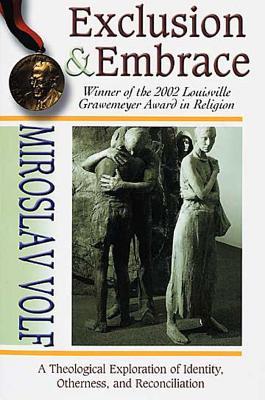
I war privileged to hear Yale professor and prominent theologian, Miroslav Volf, speak in March, and although late to the party I just finished his most famous book, Exclusion & Embrace.  It was in a sense required reading since I teach a course in the Straus Institute for Dispute Resolution at Pepperdine University School of Law titled, Apology, Forgiveness, and Reconciliation—topics that are at the heart of his book.

Full disclosure: I am not an idiot—unless you are simply comparing me and Mirsolav Volf that is.  I understood a good number of the words he used in the book but most of the time was intellectually flailing and gasping for air.  He is brilliant.  Which is why I was particularly intrigued to read such a brilliant mind analyze the components of a hug.

Exclusion & Embrace addresses our fractured “us vs. them” world where exclusion is coin of the realm and presents the image of embrace as a theological counter—almost literally.  Volf properly discloses that an embrace is too intimate for some cultures and not intimate enough for others but that he is interested in the metaphor more than the actual practice.  And then he breaks a hug down into four distinct parts that led me to imagine a Sesame Street song: First, you open your arms; then, you wait; then, you close your arms; then, you open your arms again.

You may not have analyzed the components of a hug before, but stick with me here…

To open the arms indicates a desire for the other and an invitation to come into personal space that I have created for you.  To wait is an act of vulnerability that refuses the path of force and respects the autonomy of the other.  To close the arms—the actual embrace—is a tender and reciprocal act of shared space.  And to open the arms again is a sign of release and respect that provides both the freedom and independence to leave—and to return again.

Okay, this is great for your spouse or kids or friends.  For them, I’m a hugger.  But what about the people you despise (unfairly assuming that the latter isn’t your spouse or kids or friends)?

To put down the weapon and open-armed invite those you despise into your intimate space is almost unthinkable.

To go one further and silently, vulnerably, allow your enemy the choice to either accept or attack—both choices are hard to stomach.

To then actually and tenderly embrace the despicable is a simply nauseating thought.

And then to release the enemy as friend?

I’m glad that Volf is super smart because he would be up a creek if he needed to raise a following or lead a team or run for office.  Nobody is going to want to do this.  Being right and feeling proud and getting even are going to be way more popular than seeking reconciliation.

But being right and feeling proud and getting even sure produce an enormous supply of ugly.  I, for one, am interested in any alternative that leads to a true and lasting peace—even if it does sound like awfully hard work and more than a little loony tunes.

One Big Family

wbcDodger Stadium hosted the World Baseball Classic championship game last week, and I was honored to be in attendance as the United States claimed the title with an 8-0 win over Puerto Rico.  Like the Olympic Games, the WBC takes the field every four years, and it seemed appropriate that the USA finally won a title in its fourth try seeing as how we invited the sport and all.
My youngest daughter was home for spring break and agreed to hang out with old dad for the evening, and we knew it would be fun before we made it through the gate as the Puerto Rican fans made themselves known honking and cheering their way into the parking lot.  It just got better throughout the evening as fans of both nations/teams made their patriotism clear.  Our personal favorite was a gentleman who never stopped banging on a wok with a ladle throughout the marathon four-hour game.

At one point, the national cheers even melded into an antiphonal chant that resembled the cadence of the goofy (and potentially culturally-insensitive) Three Wandering Jews song from my childhood Vacation Bible School days.  “Puerto Rico!” “U.S.A.!”  “Puerto Rico!” “U.S.A.”

The game was sort of terrible.  United States’ pitcher, Marcus Stroman, mystified the Puerto Rican bats while the American hitters scored early and often.  There was some excitement when Stroman carried a no-no into the seventh inning, but Angel Pagan’s base hit took away that fun and the victorious American squad anticlimactically went on to complete the blowout.

Most headed for the exits after the fireworks and confetti declared the world champions, but we stuck around for the trophy presentation.  So did the Puerto Rican team.  At one point, probably predetermined, after the victors paraded around the stadium and the runners-up watched in silence, the two teams met and hugged that from our vantage point beyond the left field foul pole looked like two sets of interlocking fingers.

And there was applause.  

After hours of two competitors cheering, chanting, and heckling one another out of love of country, the two sides came together, and this apparently made everyone happy.

There is much contempt in this old world.  But the applause at Dodger Stadium last Wednesday evening reminded me that respect still has a chance.

The Party Spirit – Not Necessarily as Fun as It Sounds

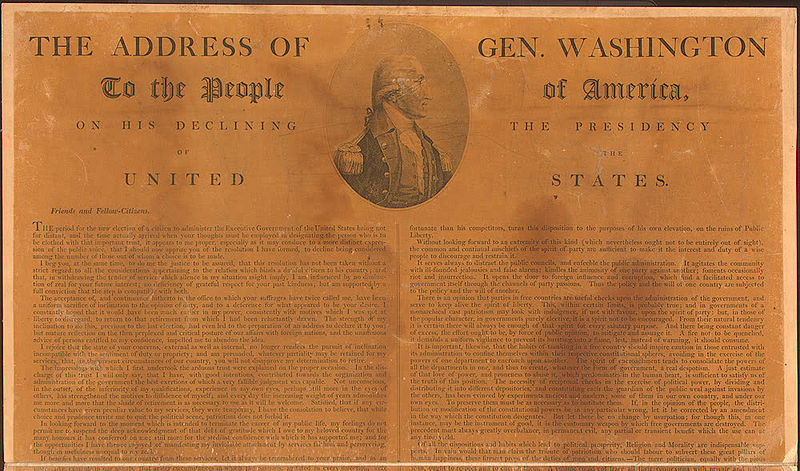
george-washingtons-farewell-addressGeorge Washington’s 285th birthday is two days away, my how the time flies, but today marks the federal holiday in his honor.  Close to half of these United States extends the holiday to all presidents, but I live in one of the many states that sticks with the federal designation of “Washington’s Birthday” in honor of the man known as the father of this country.

Washington served as commander-in-chief of the Continental Army, a position he notably resigned after its stunning victory to retire to his farm in Virginia, but public service called again when he was elected as the new nation’s first president.  Washington never joined a particular political party, however, and warned against “the spirit of party” in his famous Farewell Address—an interesting admonition given today’s polarized society.

Washington argued that the party spirit is natural and pervasive and produces desires for (and acts of) revenge that lead a nation away from liberty and eventually toward despotism.  As a result, Washington argued that it is the “duty of a wise people to discourage and restrain” the party spirit.

“It serves always to distract the public councils and enfeeble the public administration. It agitates the community with ill-founded jealousies and false alarms, kindles the animosity of one part against another, foments occasionally riot and insurrection. It opens the door to foreign influence and corruption, which finds a facilitated access to the government itself through the channels of party passions. Thus the policy and the will of one country are subjected to the policy and will of another.”

Now it’s funny, I can picture readers from various political viewpoints reading much more into this than I intend.  My critique is of all and my point is simple: Encourage coming together, and discourage choosing up sides.  Unity good.  Polarization bad.  That would be my party platform should I have one, but ironically, a Unity Party is a contradiction in terms.

President Washington concluded his remarks on the party spirit with the following dire warning: “A fire not to be quenched, it demands a uniform vigilance to prevent its bursting into a flame, lest, instead of warming, it should consume.”

Thanks for the heads-up, Mr. General President Washington.  And happy birthday.

What Gives Me Hope

interfaith-group-2017As nostalgia sets in at the prospect of leaving the law school, the privileges I enjoy become more pronounced.  One of my favorites has been hosting the Interfaith Student Council.
Early this week, sixteen wonderful people—fourteen law students, one undergraduate student, and one lawyer—showed up for an evening of discussion (the lawyer took the picture above!).  This fine group represented various flavors of Christianity, Islam, Judaism, and Atheism.

The leaders offered two potential topics for the evening: a heavy discussion about the controversial Trump immigration executive order, and a lighter discussion of dating practices in various faith traditions.  The group decided to do both and briefly discuss the heavy topic before moving to the lighter topic.  It may be unsurprising in the rear view mirror, but we never made it past the first.

Early in the conversation, one of the kindest people I have ever known shared a personal story that involved a close acquaintance sharing things that characterized this person’s entire religion in a terrible light.  I don’t think this kind soul has the capacity for anger, but there was definite hurt.  And confusion.  I mean, what do you do when someone you know portrays you and everyone in your faith as evil?

Everyone tried to help, and a good conversation ensued.

Later on, after the conversation took several twists and turns, a different student spoke up—one who comes from the faith that was used to characterize the other student as evil—and directed remarks back to that tough situation.  And she apologized.  She apologized on behalf of her entire faith.  And then she started crying, which made the other student start crying, and if we weren’t careful it was going to get all of us but they hugged it out and gave us a fighting chance.

If I am honest, as I sit here and type away, you know how your tears like to hang out in your upper cheekbones watching television and how they stand up and put their shoes on when you start thinking about touching moments like this one?  Well, maybe that is happening right now, but you’ll never know.

At the end of the evening, I asked everyone what gives them hope when times seem dark.  Folks shared some great answers, but I have to tell you that what gives me hope is an evening like that one and an encounter like the one between those two wonderful students.

Some may look at the world right now and just see stormy weather, but in that one embrace I believe I saw a break in the clouds.

On Exploiting Hopelessness

In addition to the steep learning curve associated with a new position at work, I have been preparing to teach a course titled, “Apology, Forgiveness, and Reconciliation,” for the Master of Dispute Resolution program at our West Los Angeles campus.  It is a fascinating and ever-timely topic in this world of ours with no shortage of moving literature, including the book I saved for last, The Sunflower: On the Possibilities and Limits of Forgiveness, by Simon Weisenthal.

Weisenthal survived the Holocaust and gained fame as a “Nazi hunter.”  The Sunflower tells of his being summoned to the bedside of a dying Nazi soldier while a prisoner in a concentration camp where the soldier confessed his deeds and asked for forgiveness.  Weisenthal offered only silence.  Soon afterward, he questioned his response, and in fact, ends his section of the book by placing the reader in his place and posing the heart-wrenching question, “What would I have done?”  The rest of the book shares answers to the penetrating question from fifty-three people around the world, from the Dalai Lama to Desmond Tutu.

Two days after finishing the book, I finally visited the Museum of Tolerance in L.A. and didn’t know whether to be amazed or embarrassed to notice that it was described as “A Simon Weisenthal Center Museum.”  Um, perfect timing?  Although it addresses a variety of topics, the heart of the Museum is the Holocaust Exhibit that guides visitors through the development of Nazi Germany and the terrible atrocities that followed.  It was sadly fascinating to learn that the Nazis began as a few guys sharing burgers in a beer joint, but what struck me most was the statement that this humble beginning grew to such perplexing power to influence fellow citizens to carry out unspeakable acts because they “exploited hopelessness.”

Well, my first inclination was far too easy: Write a blog lamenting how terrible it is to exploit hopelessness and title it, Exude Hopefulness.  But there’s a problem.  Exuding hopefulness is exactly how you exploit hopelessness.  Promise hopeless folks better days ahead.  That’s exactly what the Democrats, Republicans, Libertarians, Greens, and lots of other folks are doing at this very moment.

Hopeless people have to be wary, I guess, but I suspect that wariness is not high on the to-do list of hopeless people.

So, for the sake of the world, I have two thoughts to offer instead.

First, remain hopeful.  You.  Don’t tell others to be hopeful.  You remain hopeful yourself.  Losing hope is too dangerous, and we are susceptible to such terrible things.

Second, remove the reasons others are hopeless.  Actions over words.  Hopelessness is not to be used.  It is to be subverted.  Love people.  Seek justice.  Feed hungry folks.  Give someone a job.  Volunteer your time and your money.

Humanity is both capable of and susceptible to terrible things.  But wow, the possibilities for good are limitless.

Race

DCF 1.0

Go see “Race.” The critics apparently do not think it is the greatest movie in the history of movies, but the story of Jesse Owens is one of the greatest stories in the history of stories, so there. But be prepared. American race relations in the 1930s is not fun to watch, and then you encounter Nazi Germany. It is a tough, hard, heroic story well worth the price of admission, not to mention the attention of your heart.

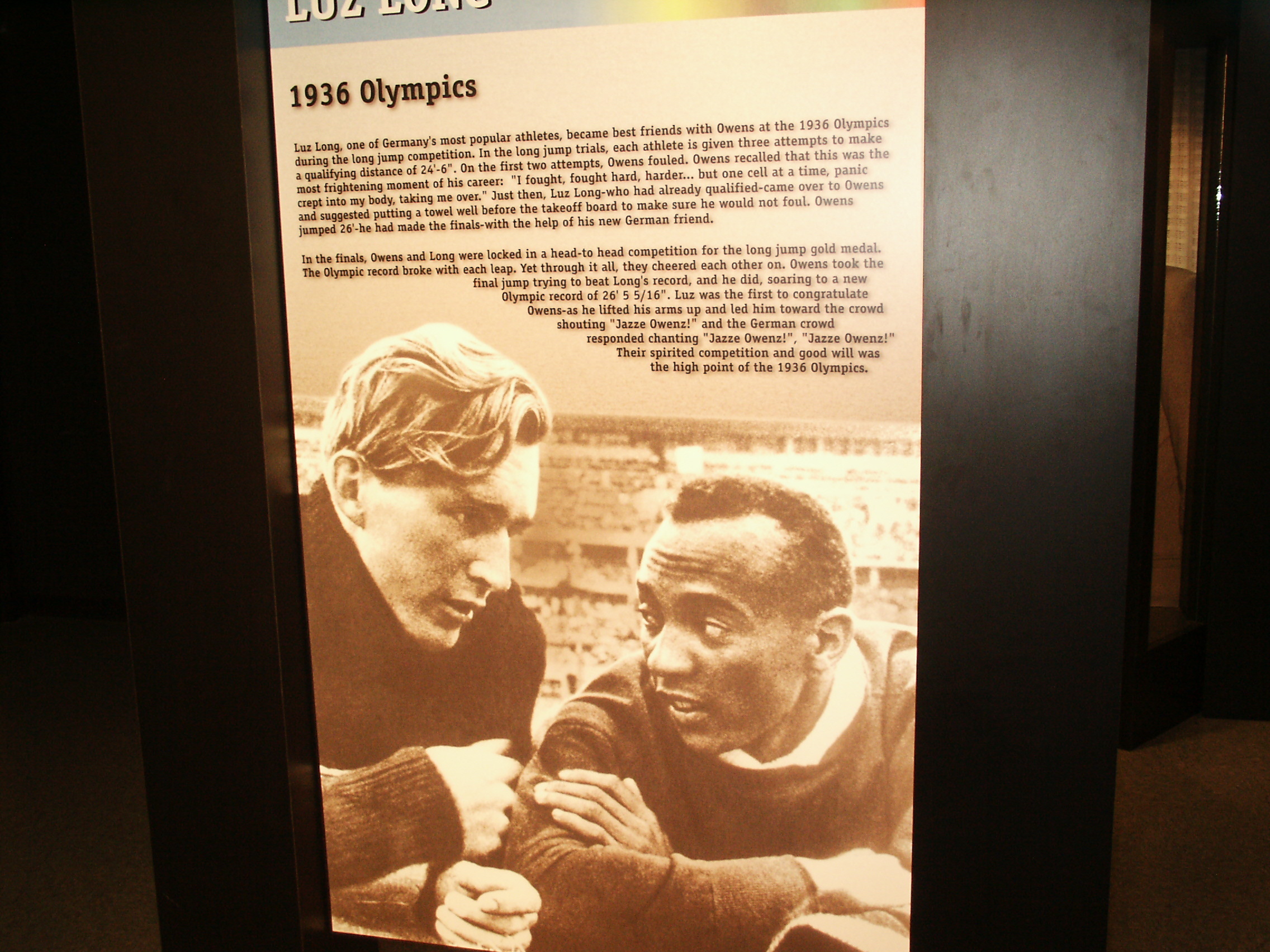
I traveled to northern Alabama in June 2007 to speak at a church that had supported our church during Hurricane Katrina, and while there, noticed that the Jesse Owens Memorial Park & Museum was nearby. I had to go. Jesse, a grandson of slaves, was born into a family of sharecroppers in tiny Oakville, Alabama, and the museum grounds contains a replica of his childhood home. Mr. & Mrs. Owens had nine children in that tiny house, and the children had no beds. Eventually, the family relocated to Cleveland, Ohio, where life was bad, but better, and it was there that Jesse’s spectacular high school track and field performances catapulted him on to the world stage where he forever defied Hitler’s claim of Aryan supremacy.

This picture is my personal favorite from the museum (and my favorite scene in the movie):

DCF 1.0

The friendship that formed between blond-haired, blue-eyed Luz Long from Nazi Germany and African-American, Jesse Owens, from the United States in the long jump competition at the Olympic Games stands as a testament of hope for the world.

An article on ESPN.com shared the following quote from Owens: “It took a lot of courage for him to befriend me in front of Hitler. You can melt down all the medals and cups I have and they wouldn’t be a plating on the 24-karat friendship I felt for Luz Long at that moment. Hitler must have gone crazy watching us embrace. The sad part of the story is I never saw Long again. He was killed in World War II.”

Eighty years after the 1936 Olympic Games, the world sure seems to remain a mess. But there is hope. There is always hope. And it begins when people defy social expectations and form the most unlikely friendships.

2

1

Love Your Neighbor

If the world had a Facebook account, its relationship status would read, “It’s Complicated.” Unfortunately, my contribution to the dizzying conversation will not magically clear things up.

Mourning is the appropriate response to tragedy, but the proud defiance by ISIS in the most recent attacks in Paris does not allow the world to sit beyond a moment of silence before responding to the ongoing threat. I was traveling when the attacks occurred, and best I could tell, the talking heads apparently agree that the real ISIS threat is its ability to recruit homegrown terrorists everywhere. They emphasized everywhere.

Who is attracted to such a thing? It is far too convenient to ascribe the attraction to abstract “evil.” Evil is easy to condemn and easy to hate, but this is no DC comic book. Further, even calling the tragedies “senseless” is far too easy. The acts, unfortunately, make all too much sense to those who carry them out, and any hope of prevention requires us to seek first to understand. I propose that those attracted to ISIS across the world are people who feel deeply marginalized, outside, silenced, and unimportant in their respective communities, and that any hope of removing the threat at the critical grassroots level requires us to love and respect everyone.

I’m a pretty hopeful guy in general, but this one has me less than chipper.

It is a catch-22 at the top. The powers that be must condemn and respond to terrorist attacks and have a specific responsibility to stop those already plotting violence. That response, however, inevitably fuels those who already feel marginalized by those very powers. ISIS thrives on the strong response its actions generate. We should remember that the next time we celebrate a necessary response.

So, surprisingly, the real, long-term hope for the world is in the hands of its regular citizens. If you want to make the world a safe place beyond a temporary Facebook profile picture, the answer lies not in forming camps by religion, race, sexual orientation, age, or God forbid, political party. In fact, I suggest the exact opposite—that the answer lies in breaking down the social walls that divide us in Everyday World and caring for those who live on the other side.

Division fuels hatred. Reconciliation generates hope. My advice is to seek out the outsiders in your community, including those who may already be angry, bitter souls. Befriend them. Walk beside them. Listen. Care about their cares. That, my friends, is where you and I can make a real difference in this complicated world.