Tag Archives: pepperdine

Transcendent Experiences

1

Famed journalist, David Brooks, was the featured speaker at a recent conference at Pepperdine, and much of the conversation focused on an op-ed he wrote a year ago in The New York Times titled, “The Big University.”  The thought behind the article is summed up in a single sentence/paragraph:

In short, for the past many decades colleges narrowed down to focus on professional academic disciplines, but now there are a series of forces leading them to widen out so that they leave a mark on the full human being.

Brooks applauded this development and prescribed four tasks for colleges and universities:

  1. Reveal moral options.
  2. Foster transcendent experiences.
  3. Investigate current loves and teach new things to love.
  4. Apply the humanities.

While all four are worthy of reflective conversation, I am particularly drawn to the call to foster transcendent experiences.  Brooks wrote:

If a student spends four years in regular and concentrated contact with beauty—with poetry or music, extended time in a cathedral, serving a child with Down syndrome, waking up with loving friends on a mountain—there’s a good chance something transcendent and imagination-altering will happen.

Yeah, I dig it.

Last week, I was thousands of miles from home in Akron, Ohio, with a couple of unexpected hours and zero plans and somehow ended up hiking through a beautiful park amid the blazing colors of autumn.  The very next day, even farther from home in the heart of Manhattan in New York City, I had more unexpected time to spend while awaiting a meeting in a Fifth Avenue skyscraper and wandered into iconic St. Patrick’s Cathedral to experience an early afternoon Mass in that stunning venue.

A peaceful forest.  A majestic cathedral.  Two good choices.  And why did I have to travel so far to make such choices?

Brooks’s encouragement may have simply been intended for college students, but seeing that I feel a little thirsty for transcendence myself, my choices in those two moments make me wonder what might happen if I altered my routines to create “regular and concentrated contact with beauty.”

I just might do it.  And if nothing else, fostering transcendent experiences in my own life might make me more effective in fostering such moments for others.
What Is Your Potential, and How Do You Get There?

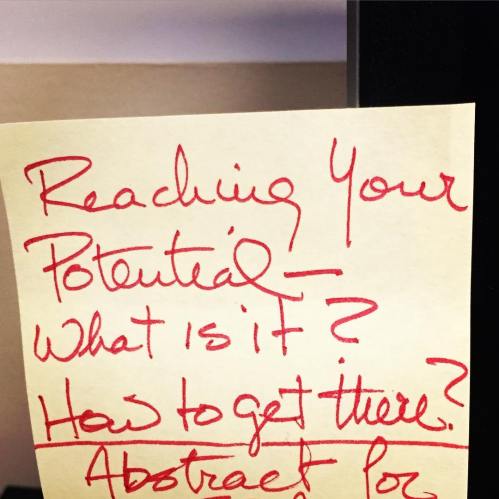
14561809_1566746046684481_2882562503231930368_n1

My second post comes early this week because my friend, Tim, died, and I am heartbroken.  His sweet wife, Peggy, called with the tragic news this morning.  It is such a sad day.

Tim and I were close and shared many deep conversations.  For me, this made him special, but from Tim’s perspective, it made me one of hundreds if not thousands of people who felt close to him.  Tim had a way of creating space for deep, meaningful conversations, and all who responded to his invitation to “pull up a chair” helplessly found themselves baring their souls to this kind, sweet man.

Tim’s favorite part of his job was counseling people, mostly students, and I was privileged to be his office neighbor for the past four months.  Today, several grieving souls made a pilgrimage to the place where they shared their deepest fears and greatest dreams to a man full of wisdom and love.

Last week, Tim popped his head in my office with a new idea.  He shared that his typical approach to counseling students had always been to ask about their goals and dreams, which led to all sorts of meaningful moments.  But he had a new idea.  He asked what I thought about a new approach that asks students about their potential instead of their dreams.  He thought that just might be the better approach.

I’m not sure what I loved more, the idea itself, or the fact that this counseling maestro never stopped refining his craft.  Well, what I loved more was him.

Today, after absorbing the shocking phone call and then sharing the news with his loving colleagues, I walked into Tim’s office just to feel his presence.  I breathed in the spirit of the room and silently took in the sights of the pictures and books and stacks of work waiting for him this Monday morning.  And in that moment I noticed a little sticky note on the side of his computer monitor with the following notes: Reaching your potential – What is it?  How to get there?

I am sad that Tim won’t be able to work this new approach like a street magician, but from this day forward I will use these questions with students to tap into the magic that was Tim Pownall.  I am honored that he left me this final gift to use for good before moving on.


Future Friends

hk1

hk4I fiercely disagree with Donald Trump’s assertion that the firestorm surrounding his 2005 remarks “is nothing more than a distraction” and strongly believe that the resulting conversations on misogyny and sexual assault (not to mention presidential choices) are significant and important.

Same time, somewhere in the neighborhood of a thousand people are dead in the wake of Hurricane Matthew, and as a survivor/veteran/victim of Hurricane Katrina who was a beneficiary of intense public attention and the resulting flood of love and support, my thoughts are especially with those grieving families and all who have suffered from the storm.

Last week, as Matthew grew in intensity, our good friend, Hung, shared a sweet Facebook post that featured a picture from 2005 of cute kiddos working a lemonade stand at Pepperdine University for the victims of Hurricane Katrina.  It touched my heart since the cute kiddos in that picture eventually became friends, classmates, and youth group buddies of our youngest daughter who lost the only house she had ever known in that storm two thousand miles away.  Who could have imagined that years later those same kids would be fast friends?  I am certain that the money collected that day did not specifically rescue us from our homelessness, but as I looked at that picture, in my mind it was as direct a connection as if they had hand-delivered the cash seen sitting in that Tupperware container.

Sometimes I feel overwhelmed by the great needs in this world and the inability to address them all.  As a recovered victim with the luxury of looking back, I can say that the sentiment expressed in both the Quran and the Talmud that whoever saves one life saves them all rings true.  And if we ever need extra motivation to take action, imagining that your pocket change will directly benefit someone you will come to know and love just might do the trick—even more so if you can sense how it will touch the heart of your Future Friend.

hk2

For Leaders and Followers

ant_leadership

“I really knew I wanted to be Adam, because Adam was the first man. Ant I chose because, if there’s a nuclear explosion, the ants will survive.” – Adam Ant

It is my great honor to hang out with Pepperdine’s men’s and women’s cross country teams once a week and share a short spiritual message at one of their early morning practices.  Go Waves!  The team boasts impressive athletes, students, and people, and as college students listening to me at half past six in the a.m., they are also generous in not telling me to take a hike.

This year I am generally sharing some message from the Book of Proverbs, which is straight out cheating since I am teaching Proverbs to a class of graduate students in our condo each Sunday morning.  I think even Proverbs would applaud my resourcefulness.  Proverbs often uses observations from the natural world to encourage wisdom, and this week I used its lessons learned from watching ants.  Not the DreamWorks movie.  Actual ants.

Brief interlude for an ant joke: What do you call an ant from overseas?  (Pause for effect…)

Important.

Ha!  That’s okay, college students don’t think I am funny either.

So Proverbs chapter six uses the ant to teach initiative, i.e., it looks like no one is telling an ant to get to work, but it gets to work anyway.  (Translation to athletes: Do what is right without waiting for your coach to tell you what to do.)  And Proverbs chapter six uses the ant to teach against procrastination, i.e., an ant collects food in the summer so that it has something to eat in the winter.  (Translation to athletes: Don’t wait until race day to train!)

But in the spirit of Proverbs, I kept observing the ant to see what other lessons might be hiding there.  Well, actually I googled “lessons from ants” and let someone else do the heavy lifting for me.  Again, resourcefulness!

Researchers at the University of Bristol observed that when an ant discovered a new food source it went back to the colony to show everyone the way.  As it led the others back, there was a predictable gap between leader and follower, but when the leader was too far in front of the pack, the leader ant would slow down to make sure the follower stayed engaged.  And when the gap closed completely, the follower ant would metaphorically give the leader a kick in the butt to widen the gap again.

I think this is important for everyone.  For those times in your life when you are the leader, don’t get so far in front that you lose touch with those coming along behind.  Your job is to bring others along with you, not set a land speed record.  And for those times in your life when you are the follower, encourage your leader to stay out in front.  Your job is not just to follow—your responsibility also includes spurring the leader on toward the destination.

Either way, leading or following, you have good work to do.

Great Big Beautiful World

1

Photo Credit, Jeff Baker

In this great big beautiful world of ours, I come from a place called Paragould, a small city in the northeastern corner of Arkansas right next to the Missouri border.  We called it The Friendly City, and maybe that is still its nickname.  Paragould is primarily a factory town sitting on a geographic anomaly called Crowley’s Ridge just east of “the hills” and just north of Mississippi Delta farmland.  It experiences all four seasons each year, from the searing heat of summer to the crisp fall air to bitter winter weather to the liveliness of spring—sometimes all in the same week—and is home to mosquitoes large enough to pull a truck out of the mud should they ever decide to be helpful.

In Paragould, I have fond memories of loving family and friends, listening to Cardinal Baseball on the radio, cruising Kingshighway as a teenager, eating “baby burgers” at Dairy Queen, and high school basketball straight out of the Hoosiers movie set.  In Paragould, I am not glad to remember a sordid past in race relations and am amazed that an almost unbelievable lack of racial diversity persists even to today.  But all of this, the good and the not good, is part of my hometown.  It’s where I come from.

This week is Diversity Week at Pepperdine Law, my California home for the past eight years, and it kicked off with the second annual Global Village Day, a day that celebrates the national, regional, and ethnic cultures found within the Pepperdine Law community.  It has become my favorite day of the entire year.  I suspect I enjoy it so much because of my insular experience growing up in Paragould.  To wander around a single law school atrium and experience cultures including Armenia, China, East Africa, France, Germany, India, Iran, Israel, Italy, Korea, Moldova, Philippines, Russia, Saudi Arabia, Scandinavia, Spain, Uzbekistan, and Vietnam—and regions of the United States including California, New England, and Texas—is just too cool to describe.  But from a somewhat less selfish perspective, it is even more fun watching students (and faculty and staff) take such pride in sharing their culture with others.  We are all from somewhere, and all of those somewheres are worth sharing.

So on Global Village Day I joined my friends Jeff, Margaret, Brittany, and Sarah for a pretty awesome table that shared the American South with the law school community.  I wore my Arkansas Razorback necktie and poured gallons (four!) of my wife’s sweet tea to those who wandered by, and Jeff shared his amazing (ten-hour!) playlist of Southern music alongside his homemade biscuits and pimento cheese, and Margaret, Brittany, and Sarah shared scrumptious cheese grits, macaroni and cheese, and Butterfinger cake, respectively.  We were a hit, but we were a hit in a room full of hits.

We are all from somewhere.  I have no intention of forgetting that.  But I sure love learning more about this great big beautiful world of ours.

Work Ethic

Remember Haydn’s 104 symphonies.  Not all of them
were great.  But there were 104 of them.
– Raymond Carver¹

Americans have a reputation for being workaholics.  This makes me feel patriotic.  It is Labor Day, presumably a day off from work in honor of work, yet I am eager to get some work completed today free from meetings and the steady onslaught of email.  I may have a problem.

The term “work ethic” implies that there is some moral element to work, a right and a wrong if you will, and I’m not exactly sure who has cornered the market on figuring that out.  I’m pretty sure that it isn’t me.

A couple years back Pepperdine Law hosted a lunchtime presentation featuring Lieutenant General Flora D. Darpino, the thirty-ninth Judge Advocate General (“JAG”) of the United States Army, and the first female to hold that prestigious post.  From her impressive presentation, what stuck with me most was her dislike for the phrase “work-life balance”—an implication that (a) work and life are mutually exclusive; and (b) navigating the two involves walking a precarious tightrope.  Lt. Gen. Darpino argued that we just have “life” and that work is simply one of its many components.  I liked that a lot.

I like work.  So much that I do too much of it sometimes.  The idea of retirement, with no disrespect for those who enjoy it nor to those who long for it, never has appealed to me.  I want to keep contributing to this old world as long as possible.  To be productive.  To create.

I’ll write about the need to rest on some other day, but today, in honor of Labor Day, I celebrate work.  May those of us blessed to have it do it well.


¹ Excerpted from His Bathrobe Pockets Stuffed with Notes by Raymond Carver, in A New Path to the Waterfall (1989).

The Problem with Judgment

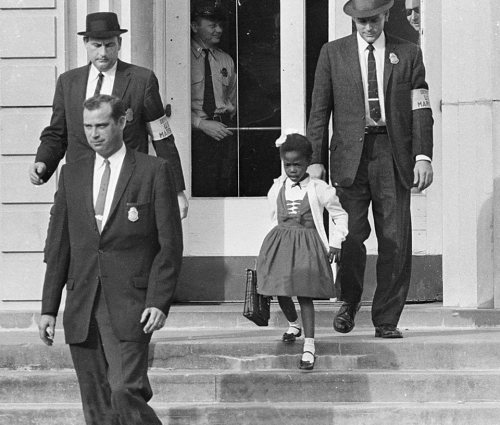
rubybridges

Norman Rockwell’s historic 1964 painting, The Problem We All Live With, serves as an important-yet-disturbing reminder of the enduring legacy of Ruby Bridges.  At age six, Ruby integrated an elementary school in New Orleans, although calling it integration is a little misleading since white parents pulled their children from class and white teachers refused to teach little Ruby.  Thankfully, one brave teacher from Boston agreed to step up, and for a full year Ruby experienced the ultimate in student-teacher ratio.

She also experienced pure hatred.  Rockwell captures the hatred in his painting, but Ruby experienced it firsthand.  The screams, threats, and nastiness came hot and heavy, directed at a sweet little girl simply trying to go to school.

At her mother’s suggestion, Ruby did something special as federal marshals escorted her to and from school each day: little Ruby prayed for forgiveness for the people screaming at her.

Remind me, what is it that I have to be upset about today?

I can think of two things that I have in common with Ruby Bridges: first, both she and I lost our homes in Hurricane Katrina; and second, we were both at the Pepperdine Bible Lectures on Wednesday evening this week, although I was a bald head in a vast crowd while she shared her captivating story from center stage.

Ms. Bridges said that she loved the first grade because of her wonderful teacher.  She said that her teacher looked like the screaming crowd—but she was different—and that the lesson she learned that historic first-grade year is that you cannot simply look at a person and make a right judgment.

Embracing that lesson is the third thing I want to have in common with Ruby Bridges.

ruby-bridges2

First Day, Fresh Start

After four wonderful years as Dean of Students at Pepperdine School of Law, I am transitioning to a completely new position as Dean of Graduate Programs.  I am still at the law school, same wonderful people, but new office, new role, and new adventures.  My new job involves joining forces with the amazing team at the world-renowned Straus Institute for Dispute Resolution as we design, market, and deliver new non-JD programs while continuing to expand the reach of the Institute’s world class dispute resolution program.

Any sadness over leaving such a great job is relieved because my friend, Steve Schultz, will be a rock star successor and allow me to focus on the excitement of the new opportunity.  (I just hope that the students wait to dance until my back is turned!)  I am particularly excited by my new role because the Straus Institute drew me to Pepperdine in the first place, and the opportunity to join the day-to-day work of the Straus family is really a dream come true.  Blessed are the peacemakers.

In the dizzying swirl of activity as I attempt to absorb massive information for the new role and hand off the responsibilities of the fading role, I can test an old trick that I have recommended to many along the way.  Here’s the trick: When cynicism starts to settle in at work and you start to think snippy thoughts about everyone and everything… (Wait, I’m not alone here, right?  This has happened to me once or twice in the past quarter century.)  Anyway, when you notice that teensy bit of bitterness about your work, that why-try-because-who-really-cares-and-I-sure-don’t-anymore sort of fun mood that your colleagues find so endearing, my trick is to imagine that it is suddenly your first day on the job.

Go ahead.  Give it a shot.  Imagine it is your first day.

What do you do?

What you don’t do on your first day is think “well that will never work because so-and-so, blah, blah, blah…”  No, on your first day you have no idea what will work.  Instead, what you do is take a good look around and size up your new colleagues, resources, and surroundings and imagine the possibilities before you.  It is a somewhat scary but always exhilarating time.  Who knows what might come?

I am once again embarking on a fresh start, and just as I remembered, it is a pretty great/queasy feeling, so I think my old trick is still a good one.  If you are in a rut in your present circumstances, you don’t have to quit an old job and start a new one to get the benefit of a fresh start.  Starting to look up simply requires an active imagination.

Your Time Will Come

A friend introduced me to the music of Johnny Clegg several years ago, and I am eternally grateful.  Clegg’s official website describes him as a “dancer, anthropologist, singer, songwriter, academic, activist and French knight” and that he “campaigned against the injustice of apartheid South Africa and been instrumental in putting the new South Africa on the map as a cultural ambassador.”  Pretty cool, right?

Clegg performed at Pepperdine last weekend, and one of my favorite moments in the concert came when Clegg referred to Nelson Mandela’s world-changing endurance to introduce the song “Your Time Will Come.”  Clegg said Mandela taught us that to live with such patience you must believe that everything will be alright in the end, and if it isn’t, then it isn’t the end.

The lyrics to “Your Time Will Come” are mostly in Zulu with an English ending.  Since my Zulu is a little rusty, here are the lyrics fully translated into English:

You were lying, do not tell lies.
You told lies, trying to mislead me,
so that I would give up my faith and hope.
That is what you said — you said that our future is hopeless,
our tomorrow is bleak, you were lying,
trying to mislead us.
No can do! We will never relinquish our faith.

Chorus:
Everything will be all right —
It’s just when this will be, we cannot know.
Everything will come right, I tell you friend.
Do not throw away your hope.
Me holding on one side, you holding on the other side
together we will pull through,
you and me, you and me.

My spirits are down,
I say to you child of my aunt, you have caused me great fear.
You told lies, trying to mislead me,
so that I would give up my faith and hope.
That is what you said — you said that our future is hopeless,
our tomorrow is bleak, you were lying,
trying to mislead us.
No can do! We will never relinquish our faith.

Chorus:

Everything will be all right —
It’s just when this will be, we cannot know.
Everything will come right, I tell you friend.

It will be all right my friend, I’m telling you.
Come true courage, for it is you who gives
life and takes it away,
me on this side, you on the other,
we will hold it together.
Don’t listen to the lies of my compatriot.
We will be victorious in the end, just you and me,
just you and me.

I saw the Berlin Wall fall
I saw Mandela walk free
I saw a dream whose time has come
Change my history — so keep on dreaming.

Dream on dreamer, dreamer.

In the best of times and in the worst of times
gotta keep looking at the skyline
not at a hole in the road
Your time will come, sister, your time will come
nobody’s gonna rush history, we have to ease it along
— just ease it along.

One at a Time

Today marks the end of this semester’s last full week of classes at Pepperdine School of Law.  Two more days next week, several “dead” days, and a couple of weeks of final exams remain so we surely aren’t done, but today feels significant because this academic year is almost, pardon the pun, in the books.  The 1Ls will soon be rising 2Ls, the 2Ls will soon be rising 3Ls, the 3Ls will soon be law school graduates, and the faculty and staff will still be faculty and staff.

So most of us are in a mood.

I like to think of it as an antsy-yet-over-it, needy-but-don’t-touch-me, slightly nauseous, hyperactive zombie sort of mood.

There is something terrible about being so close in time to a finish line while remaining so far away in the amount of work.  All you can think about is being finished with it all, but that simply distracts you from making any progress on the pile of whatever that stands before you.  It is as if the nightmare where you are trying to run to safety but for some reason cannot get your legs to work came true.

One of my favorite books on writing (and just, ever) is Anne Lamott’s Bird by Bird: Some Instructions on Writing and Life.  She describes the book’s title this way:

“Thirty years ago my older brother, who was ten years old at the time, was trying to get a report written on birds that he’d had three months to write, which was due the next day. We were out at our family cabin in Bolinas, and he was at the kitchen table close to tears, surrounded by binder paper and pencils and unopened books about birds, immobilized by the hugeness of the task ahead. Then my father sat down beside him put his arm around my brother’s shoulder, and said, “Bird by bird, buddy. Just take it bird by bird.”

That is my advice to law students as well as life students when the sheer amount of what lies ahead seems a bit daunting.  Just take it one step/day/hour/bird/whatever at a time.