Tag Archives: peace

Cultivate the Bright Passions

I find it especially important in dark and troubled times to closely monitor personal emotions, and we seem to live in dark and troubled times. This came to mind as I drove to the office before eight o’clock on this Sunday morning. My wife is out of town, so I felt justified putting in early Sunday work hours, but such behavior indicates that my emotions could get out of whack.

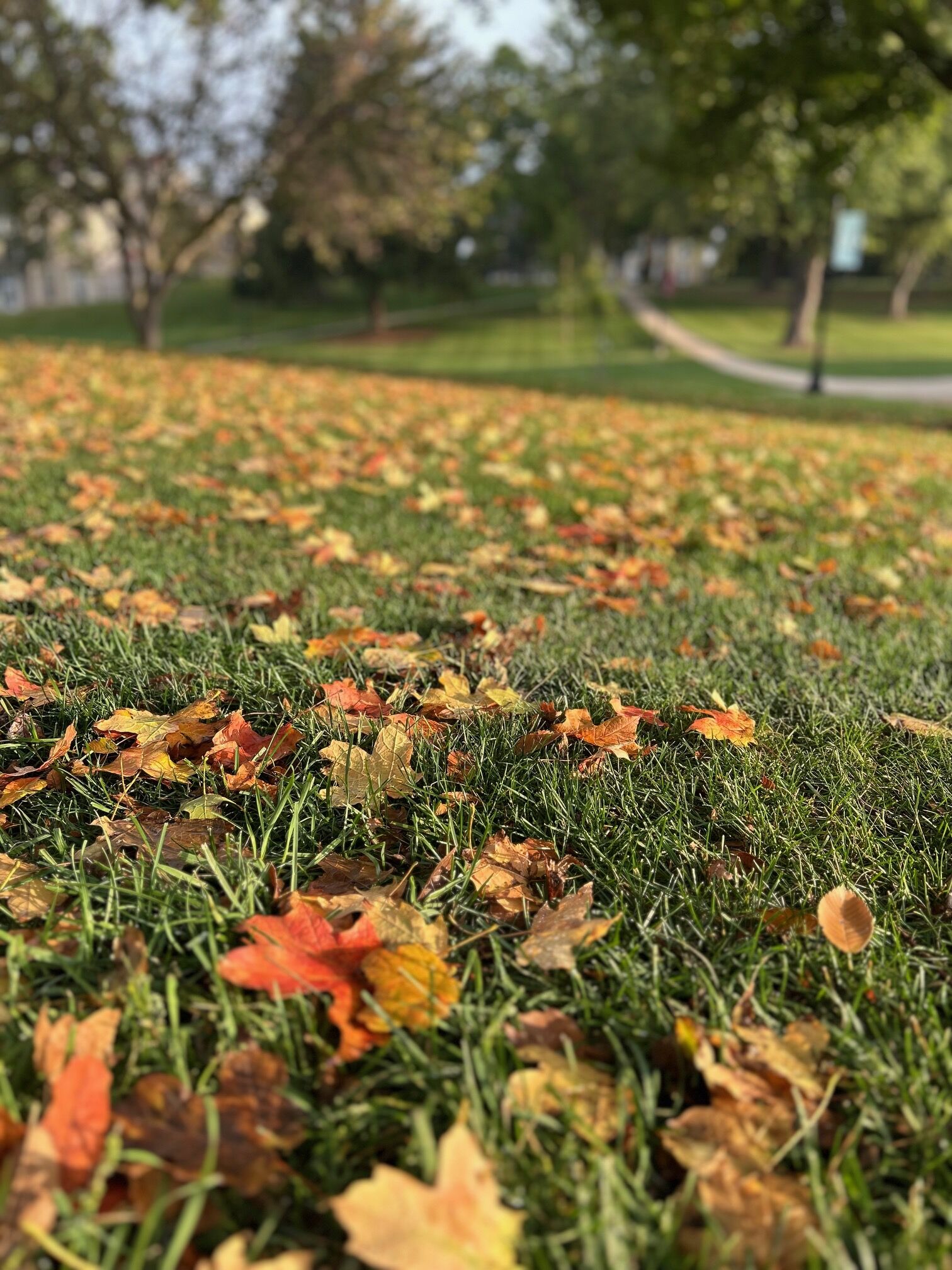
But it was sixty-three degrees on a lovely morning, and I lowered the window to feel the cool breeze while listening to a station that features soothing acoustic music. And as I drove past farmland I was surprised to see several normally-stationary horses galloping together on a gentle morning run. And then I rounded a curve and noticed that the self-serve produce stand is now decorated with pumpkins and flowers on this first day of autumn. And I sensed in a powerful form the intoxicating feeling of peace.

There was more.

A little farther along, I met an older woman riding her bike on the lonely back roads. We have passed one another on several mornings and now wave with smiles as if we are dear friends, which we did with even more enthusiasm this morning. I then turned toward the office and noticed my friend, Kelly, out walking her dog, which led to another wave and another smile. And as if the world was conspiring for my good, I then noticed a wonderful student, Emma, walking across campus on a Sunday morning, and I stuck my arm out the window with another wave and smile.

And for a moment, if I didn’t know better, I sensed every reason in the world to be happy.

David Brooks published a column in The New York Times three days ago titled, “The Era of Dark Passions.” I surely do not agree with David Brooks on many things, but I typically benefit from reading his thoughts, and I especially appreciated that particular opinion piece. Brooks shared his belief that “something awful has been unleashed” in our current times and that “[e]ven before the Charlie Kirk assassination it was obvious that the dark passions now pervade the American psyche, and thus American politics.” Brooks identified dark passions as Anger, Hatred, Resentment, Fear, and the Urge to Dominate, and he distributed blame for stirring dark passions for personal benefit to his own industry, the media, and to both sides of the political aisle. Brooks then posed the question:

Why does politics feel so different now than in times past? My short answer is that over these years, demagogues in politics, in the media and online have exploited common feelings of humiliation to arouse dark passions, and those dark passions are dehumanizing our culture and undermining liberal democracy. My intuition is that we’re only at the beginning of this spiral, and that it will only get worse.

With that cheery outlook, what is there to do? Well, for starters, Brooks begins:

First, let me tell you how not to reverse it. There is a tendency in these circumstances to think that the other side is so awful that we need a monster on our side to beat it. That’s the decision Republicans made in nominating Trump. Democrats are moving in that direction too. Back in 2016 Michelle Obama asserted that Democrats to go high when Republicans go low, but the vibe quickly shifted. As former Attorney General Eric Holder put it in 2018: “When they go low, we kick ’em. That’s what this new Democratic Party is about.” If Republicans soil our democracy with extreme gerrymandering in Texas, Gavin Newsom and the Democrats will soil our democracy in California. The problem with fighting fire with fire is that you’re throwing yourself into the cesspool of dark passions. Do we really think we won’t be corrupted by them? Do we really think the path to victory lies in becoming morally indistinguishable from Trump? Do we really think democracy will survive? Surveys consistently show that most Americans are exhausted by this moral race to the bottom and want an alternative; do we not trust the American people?

Brooks then advises as “the most effective way to fight dark passions”…

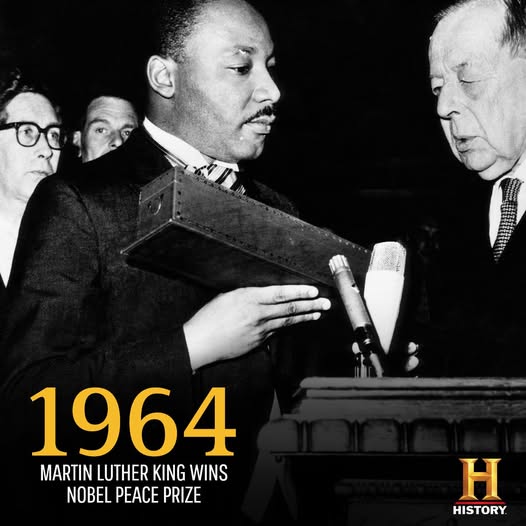
History provides clear examples of how to halt the dark passion doom loop. It starts when a leader, or a group of people, who have every right to feel humiliated, who have every right to resort to the dark motivations, decide to interrupt the process. They simply refuse to be swallowed by the bitterness, and they work — laboriously over years or decades — to cultivate the bright passions in themselves — to be motivated by hope, care and some brighter vision of the good, and to show those passions to others, especially their enemies. Vaclav Havel did this. Abraham Lincoln did this in his second Inaugural Address. Alfred Dreyfus did this after his false conviction and Viktor Frankl did this after the Holocaust. You may believe Jesus is the messiah or not, but what gives his life moral grandeur was his ability to meet hatred with love. These leaders displayed astounding forbearance. They did not seek payback and revenge. Obviously, Martin Luther King Jr. comes to mind: “To our most bitter opponents we say: We shall match your capacity to inflict suffering by our capacity to endure suffering. We shall meet your physical force with soul force. Do to us what you will, and we shall continue to love you. We cannot in all good conscience obey your unjust laws, because noncooperation with evil is as much a moral obligation as is cooperation with good. Throw us in jail, and we shall still love you.”

You might not be surprised that this resonates with me given my latest blog post published a few days prior to Brooks’s column. But it especially came to mind this morning on a lovely ride into work. I place no value on being unrealistic or ignoring the obvious, but I place great value on noticing the good and living with hope, for what is the future without hope?

I guess what I’m saying is that I unexpectedly caught a glimpse of the bright passions on a drive to work this morning, and I am now extra inspired to resist the forces that push the dark passions and choose to cultivate the bright passions more and more instead. As David Brooks concluded his recent column:

The dark passions look backward toward some wrong committed in the past and render people hardhearted. The bright passions look forward toward some better life and render people tough-minded but tenderhearted.

May we look forward toward some better life as tough-minded and tenderhearted people.

The Presence of Still Water

When despair for the world grows in me / and I wake in the night at the least sound / in fear of what my life and my children’s lives may be, / I go and lie down where the wood drake / rests in his beauty on the water, and the great heron feeds. / I come into the peace of wild things / who do not tax their lives with forethought / of grief. I come into the presence of still water. / And I feel above me the day-blind stars / waiting with their light. For a time / I rest in the grace of the world, and am free. – Wendell Berry, The Peace of Wild Things And Other Poems (Penguin, 2018).

I read Tom Lake. I should see Swan Lake. I have seen the Great Salt Lake. I remember Ricki Lake. There’s a British steeplechaser named Iona Lake (what a terrific name). For a few more days, I live in a town named Green Lake. It is my favorite lake so far.

Green Lake is a cool little place. It is four miles from Ripon, which is where I work and will live, and it boasts a population of 1,001. (I like to think the 1 is just for me.) But, in the summer, the population of Green Lake explodes. The “Travel Wisconsin” website explains why:

Visit the deepest lake in Wisconsin and the welcoming city on its shore. Located in the central region of the state, the outdoor recreational opportunities here are endless. Fish for trout and walleye, paddle, hike or bike the 27 miles of pristine shoreline, and stay a while with your crew to experience all the area has to offer. Relax after a long day of adventures at one of the resorts and spas and be sure to take a swing at one of the four scenic golf courses.

Not your typical tiny town. Bottom line: I’m not roughing it.

Growing up poor, we never went to “the lake” like many of our more affluent friends, but growing up in deep church culture, I recall the tsk-tsking of church members who I understood needed to spend less time at “the lake” and pay more attention to regular church attendance. Who knew that poverty could actually be a built-in advantage in the eyes of the Lord? I’m quickly learning now what I was missing then.

I have enjoyed several early morning runs along the lake here, listening to its gentle gurgle, the yawning chirps from the trees, and the occasional splash somewhere nearby, while seeing lazy birds glide by alone, an occasional squawking duck, and the wild turkeys trot clumsily across the road. And I have enjoyed a lovely meal with friends at a popular restaurant here, relaxing at the fire pit together while waiting for a table, watching dark clouds roll across the sky. And I have enjoyed watching the day end at Sunset Park here with a boater returning to shore for the evening, the sun painting the horizon with lavender and salamander brushes, and an elderly couple joining me in awe.

I hear that the winter is a little different, with an average high of 26 degrees and the activities transformed into ice fishing and ice skating, snowmobiling and snowshoeing, skiing and sledding. I may be crazy, but I think that sounds lovely, too.

Why is life at the lake so special? The word peaceful comes to mind. And Wendell Berry’s poem seems to capture it best: somehow, mystical though it may be, it is a magical place of still water that moves you from disturbed despair to rest, grace, and freedom.

I’m just thinking about it all today. And the thought occurred to me: When you sense despair someday, and odds are that it could happen, you might remember to visit a lake. Even if it is on a Sunday.

‘Tis the Season

IMG_1518

I love this time of year but am also the sort of person who sees the glass as half empty and half full all at the same time—a realist, if you will. So I realize that this time of year is all mixed up with positives and negatives. Merry Christmas to all, with some Bah, Humbug, too.

I love the giving. We share gifts at this time of year with family and friends, colleagues and strangers, even faceless people whose names we learn from angel trees.  We give a lot, and as we do we celebrate words like Believe. Hope. Joy. Peace.

And then we go and buy more and more stuff like it’s going out of style, which it is, but we can’t seem to help ourselves. I hate that part. The commercialism, the consumerism, and lots of other –isms that are better described as Greed. We crave More and can’t find Enough.

All that jumbled together in one season.

And then there are the people. Those merrily singing that it’s the hap-happiest time of the year, and those mired in depression. Those lavishly decorating cozy houses, and those sleeping outside in the dark and cold.

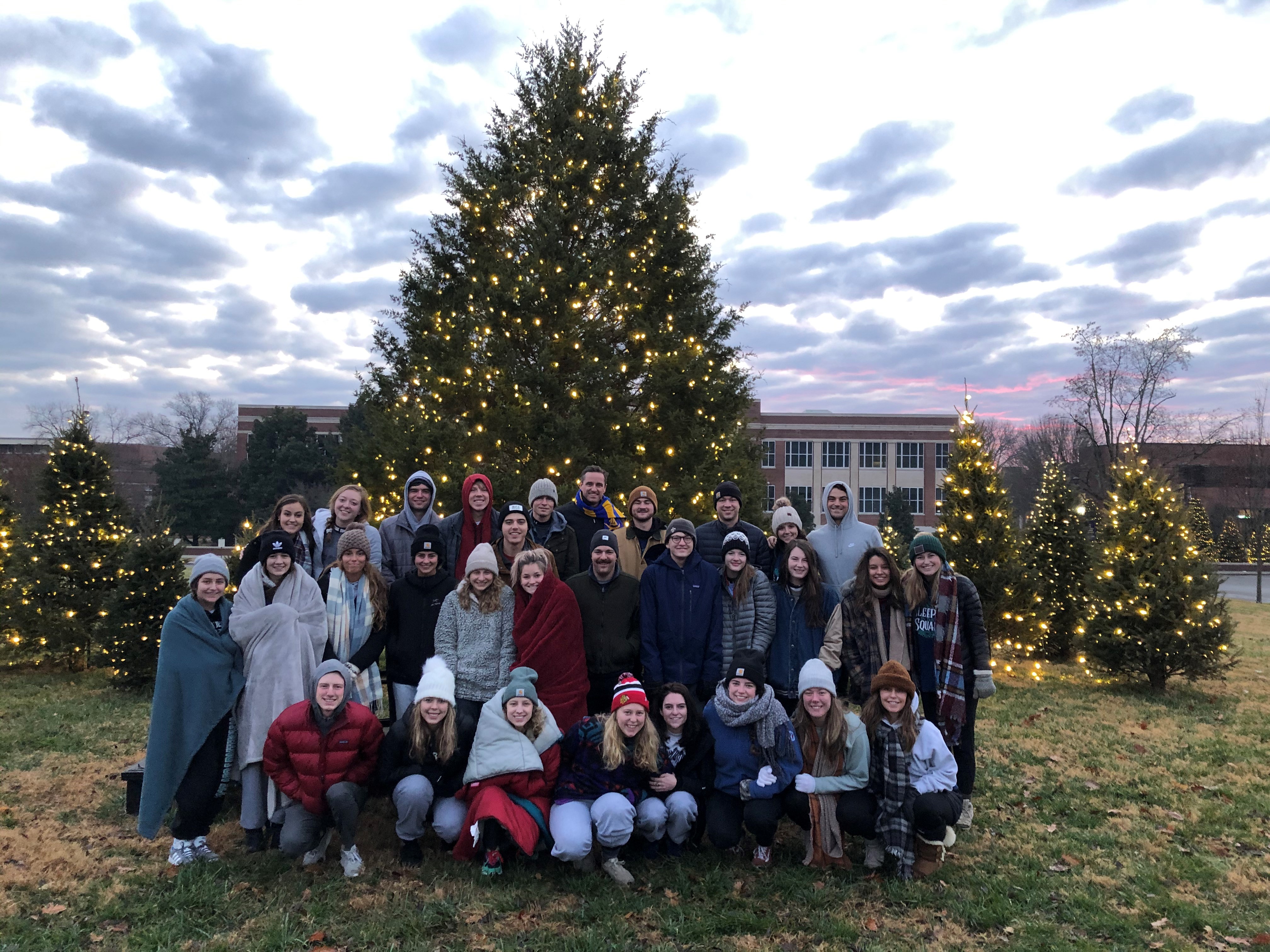
This entire semester, one of our amazing students planned an event she called, Sleep in the Square, that occurred this past weekend. The entire point was to raise awareness regarding homelessness in our local community. As she so eloquently put it, “A night for friends and strangers alike to gather and hear stories of those who have experienced homelessness, attempt to sleep while exposed to the elements of the outdoors, and encounter an evening filled with transparent cross-cultural conversations.”

We did all of that—we gathered, heard, attempted, and encountered. I was amazed by our students and their friends who slept out in the cold (pictured above the next morning), although I went home and slept in a warm bed for a few hours before returning for the closing liturgy of repentance and joy (there’s that dichotomy again!). The experience left me mixed-up just like the season, filled with love and hope, right alongside a sobering realization of my undeserved privileges and weakness.

Sometimes I feel that I should apologize for pointing out the dueling natures at this time of year—until I remember that the Christ-ian story underlying Christ-mas is exactly that kind of story.

‘Tis a mixed up season, one that reminds us that It’s a Wonderful-but-Messy Life.

The Fan

IMG_0521

THE FAN (a free verse poem by Al Sturgeon)

The memory arrived unprompted as a tender gift.

I had been sunburned yet again.

It was night as I lay in bed, miserable,

motionless, and cursing myself

for an apparent inability to learn a lesson.


I was a teenager, alone in that tiny bedroom,

alone with my restless imagination, naked

as a modest kid in a modest family could get

to ease the pain, limbs sprayed like a

hopeless summer attempt at a snow angel.


My mother had tried her best to provide

some lotion as a remedy but to no avail.

I would simply be miserable until I wasn’t;

there was nothing more to do but listen to

the silent sound of time passing.


But squeezed into the corner was an oscillating fan.

It stood watch through the night, keeping me company,

marking time with its fluttering whir, rhythmically sending

a breeze both soothing and not across my blistered skin—

a welcomed sensation in solitary confinement.


The rhythm led to a mindless world of nothingness.

No thought of the terrible fate of dressing in the morning.

No self-loathing. Just staring into dark eyelids with

my sweet parents next door; at peace, listening, awaiting

the consistent and predictable relief from the oscillating fan.


The memory arrived out of nowhere.

For a brief moment I was a kid again

with a mom and a dad who would answer

if I simply called their names. It was so real

that I could hear the whirring fan and feel the gentle breeze.


Home Run

25010686_659397667781726_6878480645274730496_nWe crossed the Mississippi River bridge in Memphis in the rental car, ironically a Malibu, and remembered what the Arkansas Delta looks like in early winter. Many of the trees had long ago shed their leaves leaving cold bare branches that reach toward the sky, and those still holding leaves that had only recently been brilliant reds, yellows, and oranges had faded to the color of rust and stood clustered together for warmth next to the brown dirt of the silent farmland. The winter sun was setting, and it looked as if someone had plastic-wrapped the entire pastel sky. It isn’t your typical picture of natural beauty, but I now find it strangely wonderful.

It was good to spend time in my hometown. Seeing family and old friends was special as expected, but there was something special about just being there, too. I don’t miss temperatures in the upper twenties even a little bit, but it was even refreshing to remember what home felt like on my skin once upon a time. I went for a seven-mile run one morning that gave me a good long time to remember.

My wife and I went for a drive one afternoon to remember more. We drove by her first workplace and the places we lived together and even Joel and Alicia’s apartment where we spent many an evening in the early days of our relationship sitting on the couch and talking and falling in love.

And then we drove to the grave sites of my sweet parents. I used to make a point to do this alone on each visit home to talk to them; first, my dad, who died so long ago, and then more recently to both of them, sort of like I would go to their bedroom seeking comfort following a childhood nightmare in the middle of the night—comforting even when I couldn’t see their faces. But this time I went with my beautiful wife. We walked across the crunchy leaves under a cold sun and stood there as a couple — as my parents were a couple once upon a memory. There was nothing really to do other than stare at the flowers and the name plates and silently wonder where the years go and what to think about it. It was good to stand there together, like my parents who also made the choice in life to stand together. And who now Rest In Peace together.

I developed a strong sense that someone has pressed pretty hard on life’s accelerator and that the years are really starting to fly by now. It may sound a little spooky to say such a thing, but strangely enough I find it to be a most peaceful feeling. Life is quite the ride, and fear now seems like such a waste of precious time.

I think my parents are telling me this as I still stand by their bedside in the darkness.

Off & Running

Running Forest FallsIt is a big day. My office sits in the heart of Pepperdine University’s main campus in Malibu, and today is the first day of classes for undergraduate students. Next door to my office is Pepperdine’s high-tech, newly-renovated Payson Library complete with a full-functioning Starbucks, and you can feel the highly-caffeinated energy in the air.
My youngest daughter attends a different university that runs on a different calendar, but because she is studying abroad in Spain this semester and her plane is scheduled to touch down right about now it feels like the first day for her, too. It simply feels like a big day at every turn in my world.

Last week had a different feel. I was honored to be invited to attend a retreat high in the San Bernardino Mountains with fifty or sixty rising Pepperdine sophomores as they prepared for a brand new year. It was such a tranquil setting. The view by day featured a beautiful lake and stunning views of the surrounding mountains, and the night featured actual bear sightings and a sky so full of stars that I had to remind myself that it was real.

But I decided to go for a run one afternoon because that is the sort of thing I do, and though stunning, I wouldn’t snag the word “tranquil” to describe it. For one, we were a mile above sea level, and let’s just say that my lungs noticed. For two, although the temperature was nowhere near extreme, maybe it seemed so hot because we were that much closer to the sun. And for three, there was nothing flat in sight. It surely wasn’t my easiest rave run.

We went on this retreat to get away and find focus for the year to come. Peace and tranquility are good for such things, but on reflection I think that difficult run was pretty good preparation, too. In fact, my major take-away on the retreat was that I need to remember how to choose to do without. And that run surely reminded me what it felt like to do without, oh, let’s say, air.

So here we go. The year ahead looks full and awesome and slightly terrifying, but good. I’m ready for it. Let’s run this race.

Warm (-ing up to) Embrace

9486

“Loving your enemies . . . Far from being the pious injunction of a utopian dreamer, this demand is an absolute necessity for the survival of our civilization. Yes it is love that will save our world and civilization; love even for our enemies.” – Martin Luther King, Jr.

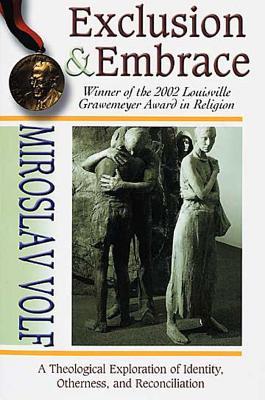
I war privileged to hear Yale professor and prominent theologian, Miroslav Volf, speak in March, and although late to the party I just finished his most famous book, Exclusion & Embrace.  It was in a sense required reading since I teach a course in the Straus Institute for Dispute Resolution at Pepperdine University School of Law titled, Apology, Forgiveness, and Reconciliation—topics that are at the heart of his book.

Full disclosure: I am not an idiot—unless you are simply comparing me and Mirsolav Volf that is.  I understood a good number of the words he used in the book but most of the time was intellectually flailing and gasping for air.  He is brilliant.  Which is why I was particularly intrigued to read such a brilliant mind analyze the components of a hug.

Exclusion & Embrace addresses our fractured “us vs. them” world where exclusion is coin of the realm and presents the image of embrace as a theological counter—almost literally.  Volf properly discloses that an embrace is too intimate for some cultures and not intimate enough for others but that he is interested in the metaphor more than the actual practice.  And then he breaks a hug down into four distinct parts that led me to imagine a Sesame Street song: First, you open your arms; then, you wait; then, you close your arms; then, you open your arms again.

You may not have analyzed the components of a hug before, but stick with me here…

To open the arms indicates a desire for the other and an invitation to come into personal space that I have created for you.  To wait is an act of vulnerability that refuses the path of force and respects the autonomy of the other.  To close the arms—the actual embrace—is a tender and reciprocal act of shared space.  And to open the arms again is a sign of release and respect that provides both the freedom and independence to leave—and to return again.

Okay, this is great for your spouse or kids or friends.  For them, I’m a hugger.  But what about the people you despise (unfairly assuming that the latter isn’t your spouse or kids or friends)?

To put down the weapon and open-armed invite those you despise into your intimate space is almost unthinkable.

To go one further and silently, vulnerably, allow your enemy the choice to either accept or attack—both choices are hard to stomach.

To then actually and tenderly embrace the despicable is a simply nauseating thought.

And then to release the enemy as friend?

I’m glad that Volf is super smart because he would be up a creek if he needed to raise a following or lead a team or run for office.  Nobody is going to want to do this.  Being right and feeling proud and getting even are going to be way more popular than seeking reconciliation.

But being right and feeling proud and getting even sure produce an enormous supply of ugly.  I, for one, am interested in any alternative that leads to a true and lasting peace—even if it does sound like awfully hard work and more than a little loony tunes.

One Big Family

wbcDodger Stadium hosted the World Baseball Classic championship game last week, and I was honored to be in attendance as the United States claimed the title with an 8-0 win over Puerto Rico.  Like the Olympic Games, the WBC takes the field every four years, and it seemed appropriate that the USA finally won a title in its fourth try seeing as how we invited the sport and all.

My youngest daughter was home for spring break and agreed to hang out with old dad for the evening, and we knew it would be fun before we made it through the gate as the Puerto Rican fans made themselves known honking and cheering their way into the parking lot.  It just got better throughout the evening as fans of both nations/teams made their patriotism clear.  Our personal favorite was a gentleman who never stopped banging on a wok with a ladle throughout the marathon four-hour game.

At one point, the national cheers even melded into an antiphonal chant that resembled the cadence of the goofy (and potentially culturally-insensitive) Three Wandering Jews song from my childhood Vacation Bible School days.  “Puerto Rico!” “U.S.A.!”  “Puerto Rico!” “U.S.A.”

The game was sort of terrible.  United States’ pitcher, Marcus Stroman, mystified the Puerto Rican bats while the American hitters scored early and often.  There was some excitement when Stroman carried a no-no into the seventh inning, but Angel Pagan’s base hit took away that fun and the victorious American squad anticlimactically went on to complete the blowout.

Most headed for the exits after the fireworks and confetti declared the world champions, but we stuck around for the trophy presentation.  So did the Puerto Rican team.  At one point, probably predetermined, after the victors paraded around the stadium and the runners-up watched in silence, the two teams met and hugged that from our vantage point beyond the left field foul pole looked like two sets of interlocking fingers.

And there was applause.  

After hours of two competitors cheering, chanting, and heckling one another out of love of country, the two sides came together, and this apparently made everyone happy.

There is much contempt in this old world.  But the applause at Dodger Stadium last Wednesday evening reminded me that respect still has a chance.

Alone but Not Lonely on Valentine’s Day

1“Love cares more for others than for self.” – Paul (1st Corinthians 13, MSG)

Tomorrow, on Valentine’s Day, my beautiful wife will be relaxing in a luxury hotel in Maui, which sounds fabulously romantic except for the fact that I will be at work 2500 miles away.

Sigh…

To explain, our oldest daughter teaches at a school that hosts a major fundraising event each year, and last year’s event included a trip for two to Maui as a raffle prize.  Guess who won?!  Somewhat surprisingly, she chose to take her mother along as her plus one, which I think is fantastic on multiple levels.  My wife thinks it may primarily be so that mom will pay for the non-free portions of the trip, but even if so, it is what we call a “win-win” in the negotiation business.

Except for me, that is, who will be home alone enjoying a meal prepared by my favorite Italian chef, Mr. Chef Boyardee.

In the spirit of planning ahead, my wife and I created another daughter a couple of decades ago on the off-chance that our oldest daughter won a trip for two to Maui and invited her mother along on Valentine’s Day so that I would have another beautiful person to spend time with on such a special holiday.  But that kiddo is 1100 miles away at college in Seattle.

Despite the three beautiful women in my life, I guess that I am destined to be alone this Valentine’s Day.

And yet I am genuinely happy.  Seriously.  No, I like those three human beings as much as you can like anyone ever and would love to spend time with them all, but it is so fun to stop and imagine the memories Jody and Erica will make together in Maui this week as well as how much Hillary enjoys being in Seattle.  Love does that sort of thing to you.  It produces genuine feelings of peace and joy when the objects of your love are blissfully happy without a second thought about what that means for you.

It doesn’t always look so great on paper, but I’m telling you that love is where it’s at.

Avoiding a Repeat of History

charleston-picI set my alarm for 5:30am most every morning, but when I did so on Tuesday in Charleston, South Carolina, it was actually 2:30am for the old California-tuned biological clock.  But I got up anyway and met a new friend in the hotel lobby for an early morning run.  We ran four miles through that beautiful city with its gas lamps, stately mansions, cobblestone streets, peaceful waterfront, and general gorgeous-ness before the sun really even thought about making an appearance.  It was great—the run, the conversation, the city, the sights, and the weather.

When we first located the ocean on our run (fyi, those oceans aren’t always as easy to find as you might think), my new friend pointed toward a gleaming set of lights in the distance and said casually, “Oh, there’s Fort Sumter.”

I nearly had to stop running.  Fort Sumter.  Where the American Civil War began, a fact I taught an unknown number of teenaged history students a few decades and careers ago.  I knew Fort Sumter was in Charleston but hadn’t thought about it in the days leading up to this hastily-planned business trip and surely didn’t expect to see it pointed out in casual conversation.

That location, sitting silent in the darkness, is where the citizens of my country chose up sides and literally started killing each other.

Times are a little crazy right now, and I don’t wish to sound overly dramatic, but a professor friend of mine who is an expert on Lincoln has pointed out more than once recently that our current political climate reminds him of the decade leading up to the American Civil War.  Surely such a thing couldn’t happen again?  Could it?

Not if I have anything to do about it.  And I do.  We all do.

While Fort Sumter sat silently in the distance, I considered the contrasting metaphor of our morning run where two American brothers ran side by side in the same direction sharing deep thoughts and good stories.  That was nice.  We did, however, meet people traveling different directions than us, and as we tend to do in the South (and as this Southern boy does wherever I happen to be), we said hello in warm greetings to those traveling in the exact opposite direction.  That was nice, too.

Now don’t get me wrong: There is a time and a place to stand in opposition to others.  And we should.  But there is also a way to treat your brothers and your sisters when you stand in opposition, and when the collective decision concludes that the best way to do so is to pick up weapons and start shooting each other, then something went horribly wrong a long time ago.

Something may have already gone wrong in this country of ours a long time ago.  If so, I suggest that we find a way to reverse course before some random runner a couple of centuries from now is jarred by the sight of the place where we once again chose a violent answer.