
Tag Archives: church

Big Love

Imagine stargazing alone on the darkest night and witnessing a glorious cluster of shooting stars hurtling across the sky with such beauty and brilliance that you are forever changed, and then imagine the sadness that comes later when you recognize that you experienced something both powerful and personal that can never be recaptured. That is the sadness and the void in the universe that I feel today.

I met Kimberly Hebert eight years ago by email – at 8:31pm PST on October 23, 2017, to be exact. It was a rough start for me. I had preached a sermon that morning at the University Church of Christ in Malibu, California, on the campus of Pepperdine University titled, “On Behalf of Another.” I opened with the YouTube video “Oh Freedom!” that featured powerful images from the Civil Rights Movement—marches, sit-ins, legislation, Reverend King, Rosa Parks—all set to the haunting lyrics, Before I’ll be a slave / I’ll be buried in my grave / And go home to my Lord / And be free.

I followed what I considered to be a powerful opening with my own story of growing up in a Southern sundown town, and with my preaching foot on the accelerator then told of Oscar Romero giving his life for those being raped and murdered in El Salvador. All that led to the sermon text in Exodus 33 where Moses stood up to God on behalf of his people, and my message was that being “the Church” means standing up on behalf of others. There was even a photo of a sign from a Civil Rights march in the opening video that read “Where is the Church?” that in many ways characterized my sermon’s thesis.

I was sort of proud of it, but Kimberly wasn’t buying it at all. I had no idea who Kimberly Hebert was at the time, but she was in the audience that morning and shared her impressions with me that night in an email that she titled, Where IS the Church? She said the sermon felt “emotionally manipulative.” She said “[t]he church is still silent on issues of race” and that in my sermon the “silence was deafening” and that such silence “is one of the many reasons that the church is impotent in this area and does not show up.” She challenged me to have the “courage to tell the whole story in truth and love” and characterized sermons like mine as “tepid” before closing with the hope that I could receive her message “with the love in which it is being shared.”

It was hard for me to read. It was hard for me to read in part because there was not a doubt in my mind that she was right, and because the message that I had delivered, which was strong for me, failed to address the present nature of American racial politics and had had its true measure revealed: Tepid. Weak.

I wrote back that night – at 10:16pm PST to be exact (I have kept and treasured much of our correspondence). I expressed both apologies and gratitude. I said that she was right and that I had much to learn. I shared my hope that we could visit so that I could learn and grow. I had no idea what I was asking for, but as I have often said, I do my very best work by accident, because from such an inauspicious start that initial email exchange in the space of two evening hours produced for me a brief and beautiful friendship that changed my life for good. Kimberly became my teacher, my consultant, my advisor, and my friend.

In the following months we exchanged emails where I asked ignorant questions and she shared brilliant answers Then we became book partners in a campus ministry effort that worked through the book, Welcoming Justice, by Charles Marsh and John Perkins. I found the book insightful and helpful. Kimberly didn’t care for it. We met for lunch at Le Pain Quotidien, a French bakery-restaurant in Calabasas, on multiple occasions in early 2018 where I slowly caught on to how Kimberly received the book from her lived experience. Each time we met someone would recognize her and sometimes ask for a picture.

Did I mention that Kimberly was also a movie star? I had no idea when we first interacted, but this later discovery made this special human being even more fascinating. 

I’m sure it was our good friend, Google, that shared the news with me when I first wondered about this person that called my sermon on the carpet. At our first Calabasas lunch she was so embarrassed when I told her that my wife was a major fan of her portrayal of Dr. Belinda Brown when she starred alongside Walton Goggins and Danny McBride on the somewhat (okay, more than somewhat) raunchy HBO comedy, Vice Principals. But she was so much more than a brilliant actor. There was a depth and a breadth to her life and an enormous intellect that I was privileged to access. Kimberly grew up in Houston and later received a bachelor’s degree in psychology from Mount Holyoke College in Massachusetts and then an MSW from the University of Chicago before launching a successful career on stage and screen. In my eyes she was larger than life.

I sense a mischievous smile when I remember that I eventually got to turn the mirror around and invite Kimberly to face challenges, too. I invited Kimberly to lead an adult Bible class in beautiful Stauffer Chapel in the summer of 2018 in a series on our personal “cloud of witnesses,” and the thought of bucking the restrictive male-only posture of our shared faith tradition forced her to reach for some courage of her own. But she did it, and the stories of those that shaped her life trajectory were incredible. I even convinced her to share her story in front of the whole church in a worship gathering that September, which just about blew her mind but gave me the greatest joy!

I learned that Kimberly died on Friday. I do not know the details, but I am heartbroken.

I will never forget the awkward nature of our initial contact, but more importantly, I will never forget the deep friendship that developed in such a short time. Kimberly welcomed me into her story and shared physical health challenges that she battled for decades. She invited me to sit with her mother at Cedars Sinai just one year after our initial emails during a concerning procedure that turned out well, just as we had prayed, which proved that we had traveled a long way from suffering through an emotionally manipulative and tepid sermon. Prior to the procedure, Kimberly wrote to me of her gratitude “that God knitted this relationship for such a time as this” and that, “I didn’t see it coming, but God knew I would need a community.” When I announced my move to Nashville a few months later in the spring of 2019, it is crazy to sift through our email correspondence to see how our awkward initial exchange had grown so that we felt such deep loss for miles to separate our friendship.

Just prior to our move to Nashville, Kimberly starred in a play at the Geffen Playhouse in Los Angeles titled, Black Super Hero Magic Mama. Appropriate, of course. Kimberly secured two premium tickets, and Jody and I felt so special to sit in the audience and watch our new friend, the star of the show. The movie premiere for Five Feet Apart, which Kimberly starred in as well, also occurred that night, and since she couldn’t be in two places at the same time, a limo was arranged to whisk her to the premiere afterparty at a Hollywood club after the play, and she invited us along for the experience. I hope you can picture my wife and I, a couple of actual Beverly Hillbillies, stepping out of the limo to the flashing cameras and entering the strobe-lit club where Kimberly introduced us to celebrities such as Cole Sprouse, a co-star, and Justin Baldoni, the director.

I think of that night in March of 2019, the last time I saw her in person and “hugged her neck” (as she would say), as I might think of an appropriately spectacular ending of a fireworks display. I knew that we were moving away from one another quite literally, but I had no hint of finality.

Our email correspondence soon became fewer and farther between, but a couple of years later we had one brief opportunity to reconnect. By that time we had all encountered the murder of George Floyd and the Covid pandemic, and I had moved from Nashville to work at a small college in Illinois. When our volleyball coach at the college planned a fundraiser for cystic fibrosis, I remembered Kimberly’s movie, Five Feet Apart, which was a beautiful love story of two young people with cystic fibrosis who were not allowed to be within five feet of one another (ironically, a movie released a couple of years before “six feet apart” became a part of our national experience), and I reached out to see if Kimberly would meet our students in rural Illinois via Zoom. To which, as you might guess, she graciously agreed. We not only invited our volleyball student-athletes to hear Kimberly share what she learned about cystic fibrosis from her movie role, but also our theater students to hear of her acting career, and also our Black students to learn of her thoughts in the aftermath of the murder of George Floyd and her experiences as a Black woman navigating a career in the United States. As expected, Kimberly was gracious with her time, and profound, and hilarious, and inspiring, and unforgettable.

Jody and I stayed afterward, and that post-Zoom conversation was the last time we spoke and shared the love of our friendship.

In the summer of 2023, Jody and I unexpectedly moved back to Malibu. We thought we might be back in California forever, and Kimberly was one of the first that I emailed. Not long after we arrived, she responded that “[y]ou know I’ll make some time to see you” and that she looked forward to reconnecting. I responded with my new cell number, and that turned out to be our final exchange. We both got busy, and California turned out to be just a bonus year for us that led to a move to our new home in Wisconsin, and my regrets are now deep. I knew that Kimberly’s life remained full without regular installations of our friendship, but it never occurred to me that she might move on from this life so soon. And I wish I had been there for her in the end.

I have been too rattled to think clearly, but I have been trying to think clearly so that I can do honor to the lessons I learned from Kimberly Hebert. I kept our correspondence, and I have been sifting through it since I learned such sad news this weekend, and one lesson I have remembered is found within these words that she shared when we were praying for her health seven years ago: “Again, despite what we are going through, God has not abandoned us. He is always right there with us, even unto the end of the ages.” There is comfort in those words, and my hope remains that her words are true. 

Further, as I reread the challenges in her initial outreach to a preacher she did not know, I am emboldened to remember the challenge to my humanity and my personal courage in a culture that seems hell-bent on regressing instead of progressing. She wrote, “A revisionist approach to history is dangerous, particularly when inserted into our religious arena. If you want to challenge the body to be self-reflective in this area, there has to be courage to tell the whole story in truth and love.” Now, more than ever, I want to do better. I want to tell the whole story. I want to tell the truth. I want to tell it in love.

Kimberly’s salutations in our friendship correspondence were the words: Big Love, Kimberly. That is how I remember her today. A special person who loved big.

It was an incredible honor that she loved me in spite of everything that conspired against it, and it is intimidating as hell to remember the courage she challenged me to live with from the very start. May she rest in peace and power, and may I live with greater “courage to tell the whole story in truth and love.”

Farewell, my friend. As the curtain falls and the credits roll, know that I am moved to stand and applaud your extraordinary performance.
Social Distancing as an Act of Love — A Sermon in Absentia

Blog Pic 2

PC: Lipscomb University (Kristi Jones)

I spent a significant number of years delivering Sunday morning sermons, but that is no longer part of my life. Even if it was, our local churches are canceling services due to the pandemic, so where would I deliver a sermon anyway? But a sermon came to me nonetheless, so I will just deliver it right here. I have titled it: Social Distancing as an Act of Love—A Sermon in Absentia.

“And the Word became flesh and lived among us, and we have seen his glory, the glory as of a father’s only son, full of grace and truth.” – John 1:14 (NRSV)

Good morning, and welcome to Virtual Church. Members and guests, please fill out an attendance card and place it in the comment box below.

The Incarnation serves as the foundation of the Gospel. God came and “lived among us”—or as Eugene Peterson put it, “moved into the neighborhood.” God’s love is such that God simply could not stand to be at a distance. God came near.

GOD with us. God WITH us.  God with US.

God did this in the humanity of Jesus, and in Jesus we see “the image of the invisible God.” We see what a walking-talking-breathing God looks like, and in Jesus we encounter one who notices the unnoticeable, one who touches the untouchable.

So we aren’t even surprised when we hear Jesus tell a story in Luke 15 about a shepherd who leaves the ninety-nine safe sheep and goes traipsing all over the countryside to find the goofy one who wandered off. And how he is giddy with joy as he carries it home draped across his shoulders. Of course he does. That’s God. So we are even less surprised at the follow-up story about a woman who still has nine coins but turns the house upside down looking for the one that is MIA. And how she throws a party like she won the lottery when she found that crazy coin of hers. Of course she did. That’s God.

But Jesus can be a little hard to figure at times.

That same Jesus, the one who moved into the neighborhood, that God-image who chases after lost folks and embraces them in bear hugs says nutty stuff like, “It’s better for you that I leave.” Um, what? He was apparently serious. (If you don’t believe me, check out John 16:7, MSG.) And back in Luke 15, right after those stories that picture God on a search and rescue, Jesus offers a third story where God is a dad who loses a son—and just lets him walk away. Doesn’t even follow him down the driveway.

That’s what has me thinking today. Love typically seeks people out, brings people close with hugs and high fives and holy smooches. But maybe sometimes love allows for distance.

In this time of pandemic, we are advised that the way to love your neighbor is to keep them at a distance. That feels so counterintuitive because, well, it typically is. But maybe not always.

My wife and I live in Nashville, Tennessee. Our oldest daughter lives in Los Angeles. Our youngest daughter lives in San Antonio. Our family practices social distancing all the time now. How did we let all that happen? Every once in a while it dawns on me how wrong that seems, and every once in a while it really hits me hard how much better it would be to be in close proximity to both of our sweet daughters. But more often I remember that it isn’t always right or better simply to be in the same zip code.

Love might can be gauged, but I don’t recommend a tape measure. Sometimes love draws near. Sometime love stands at a distance.

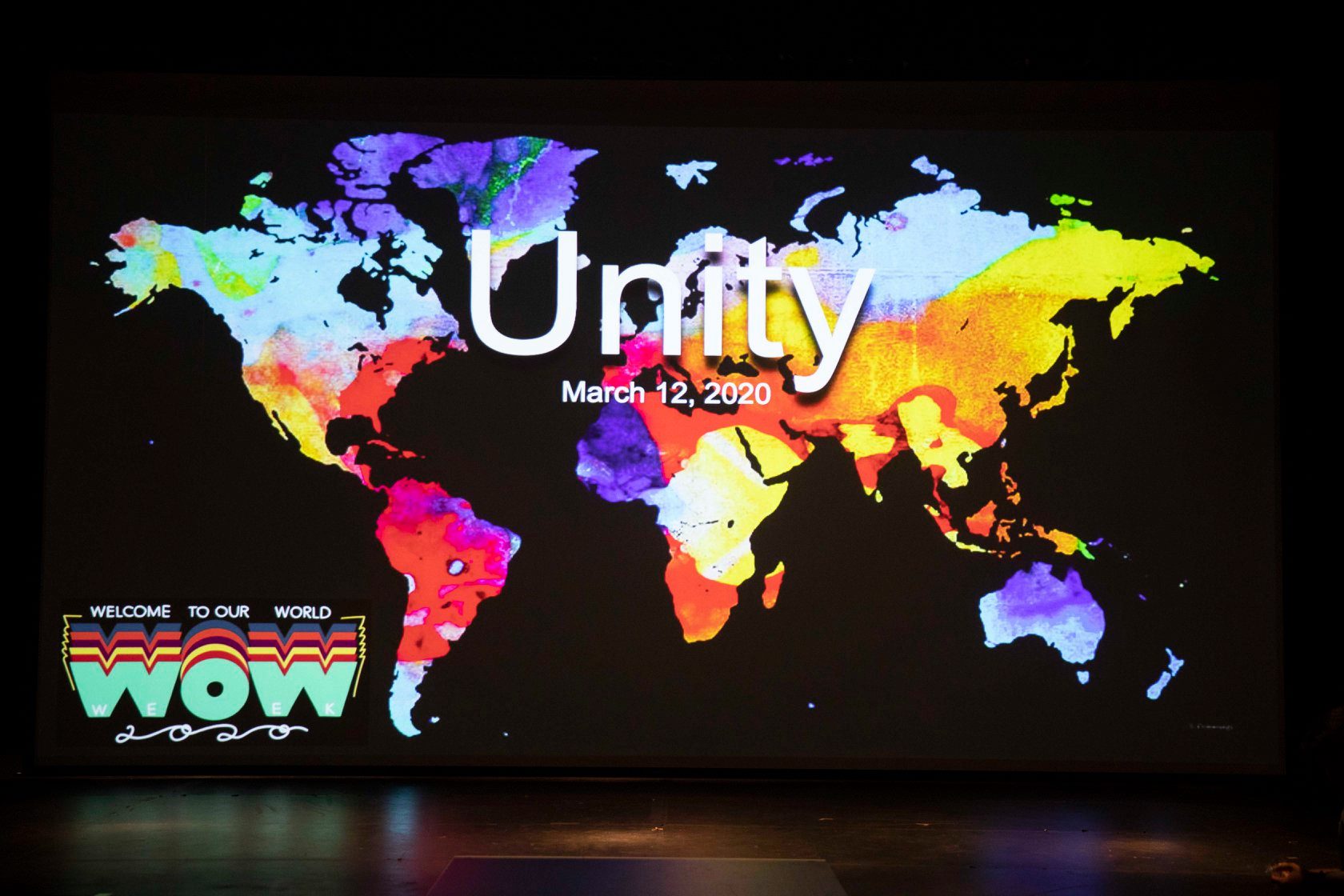
The last official event before spring break at Lipscomb University as announcements were made about an extended break and online classes was the Welcome to Our World Fashion Show, hosted by our Office of Intercultural Development. It was as beautiful as I anticipated. In a time of global pandemic, it felt so appropriate to recognize that our world is bound together in important ways. The closing line of the show reminded us that there is UNITY in DIVERSITY. That there can be a oneness in our many-ness.

I guess what I am saying is that from time to time there can also be a knitting together of hearts in a period of social distancing, as strange as that may seem.

Love never gives up.
Love cares more for others than for self.
Love doesn’t want what it doesn’t have.
Love doesn’t strut,
Doesn’t have a swelled head,
Doesn’t force itself on others,
Isn’t always ‘me first,’
Doesn’t fly off the handle,
Doesn’t keep score of the sins of others,
Doesn’t revel when others grovel,
Takes pleasure in the flowering of truth,
Puts up with anything,
Trusts God always,
Always looks for the best,
Never looks back,
But keeps going to the end.
 – 1st Corinthians 13: 4-7 (MSG)

The Sky’s the Limit

20478813_400498847013419_4964910068790198272_n(1)Few states are known for a single thing more than Utah. Okay, maybe none are. The Mormon Church is Utah, or so it seemed before I made my first trip there last week. And sure, there were lots of LDS church structures — the unique temple architecture was even utilized to design local high school buildings.  And there were lots of families with the stereotypical brood of children. But there was far more than the Mormon Church in my brief hibernation-style visit to Utah. “Pioneer Days” in Ogden had just ended but the town and the festival aftermath displayed a fondness for cowboys, rodeos, railroads, and all things western. And a quick walk down Historic 25th Street in Ogden did not feel very Utah-like with its quirky shops and colorful artwork alongside historical descriptions of the street’s seedy beginnings. 

[Note: Not sure where to file this one, but the state troopers had electronic signage on the interstate that read, “If yer eyes are saggin’ pull over yer wagon.” That’s a new one for me, but you know, safety first.]

And although I was not on a nature vacation (and far from what I understand to be the most breathtaking scenery in Utah), I saw enough to know that Utah is majestic.  The huge sky, puffy white clouds, and towering mountains were unavoidable, and although I spent the majority of my time alone and in a library, I did dedicate enough time for a run along a river trail and a hike to the “big fill” near the Golden Spike National Historic Site. Out in the open spaces, the quiet was practically deafening.  And the great expanse of the never-ending sky found me impersonating Tom Petty: Into the great wide open / Under the skies so blue. 

It is hard to describe the magical sensation that comes with that combination of shocking silence and wide open vistas, but if forced to choose a word, the one that comes to mind is “possibilities.” With the bright sun shining down and the wind in your face and that great big sky, it seemed like anything was possible.

If you ever feel trapped in this old world, I suggest a trip to Utah.  Heh, come to think of it, maybe old Brigham Young had that very idea.  

The Secrets of a Sacred Space

Stauffer“Let the site tell you its secrets.” — Christopher Alexander
I joke that my propensity to arrive early for absolutely everything is a sickness, but in reality it is a treasured quality since it reminds me of mom and dad.  Being early is my heritage.  With age, it seems that I am less impressed with my unique qualities and particularly value those characteristics that connect me to a larger story.

I arrive very early for work on Sunday mornings to prepare for our church’s collective time together, a couple of hours early in fact—and love it.  We decided to meet in stunning Stauffer Chapel this summer thanks to a brilliant suggestion from my friend, Sara, and the setting has made the early morning solitude particularly delightful.

I like the strange sensation of opening the door to discover that no one else is there and being the first to step inside.  I like turning on the lights and straightening the hymnals and removing the leftover trash from the pew racks.  I like arranging the podium and communion table just right and reviewing the sermon, imagining the congregation at breakfast preparing to join with me and with others.  I like propping open the doors and hearing the gurgling fountain outside and then returning to the deafening quiet inside and the intense feeling of anticipation. I like to notice the sun pierce through the massive stained glass spraying psychedelic graffiti all over the quiet sanctuary.

Famed architect, Christopher Alexander, argued that users of a space know more about their needs than the architect and wrote, “Let the site tell you its secrets.”  In my sacred Sunday solitude, I don’t seem to be able to articulate my needs, but it sure seems that the space has secrets to tell.  I listen each week and can almost hear them.  Maybe if I listen long enough?

In reality, I’m not sure that sacred spaces have actual secrets to tell.  But maybe the wonder that is found in showing up early to listen is secret enough.

Hold on to Joy

1
Loving Joan was not optional. She was eminently lovable. I preached in Ocean Springs, Mississippi, for a decade and could count on Joan and Joel (or, “Joe,” as she called him) to be sitting up front cheering me on every time the doors opened. Joan cheered everybody on.

It was sad to hear that Joan died last week at eighty years young after a heck of a fight with cancer. But it would be a discredit to her memory to linger in sadness.

Joan was no stranger to challenges. Before my time in Mississippi, she lost her son in a tragic car accident. During my time in Mississippi, she encountered the American law of eminent domain when the government decided to put a highway through the house she and Joel intended to inhabit for the rest of their retirement years. After my time in Mississippi, her “Joe” contracted Parkinson’s Disease. And then there was the cancer.

But Joan never let a challenge dampen her positive attitude. She often quoted a line from an old sermon that she accepted as a life approach: Don’t let anyone steal your joy. Joan spent her life giving to others, but she jealously guarded her joy like she was Ebenezer Scrooge.

It has been years since I saw her in person, but Facebook worked its magic to keep us in distant contact. Joan “liked” lots of things on Facebook. That fit her well. Joan was a really good liker of things. She would have made it just fine without the frowny-face option.

One of my favorite memories came as a result of one of Joan’s worst days. Joan had two children, the son whose life was tragically cut short, and a daughter who was her pride and joy. Joan’s daughter pursued a successful career and chose to marry later in life. Joan was ecstatic about the wedding and could not wait to travel to the ceremony. But one afternoon, while shooing blackbirds away from the back porch, Joan fell and broke both ankles, landing her in a rehabilitation hospital and threatening her ability to make it to the wedding.

True to form, Joan kept her joy and started to work. She soon knew everyone in the hospital and worked hard at physical therapy with that beautiful wedding ceremony as her inspiration. The fateful day came when the doctors would decide whether she was fit to travel, and despite her very best efforts, Joan was not cleared for takeoff. I’m not exactly sure how devastated she was, but the rest of us were heartbroken.

In those days before Skype and FaceTime, we tried to invent things like Skype and FaceTime just for Joan, but alas, we were in over our heads. Joel traveled to the wedding alone, and the family had the clever idea to use a cell phone during the ceremony so that Joan could listen in. A group of us from church went to her hospital room that day to share the occasion with a corsage, wedding cake, and being good Southern church folk, sparkling cider. It was a party, but it was no pity party. I will never forget Joan trying to hand the cell phone to the rest of us during the ceremony so that we could listen and our laughing and frustrated refusals — This is for you, Joan!

It remains one of my best days. A terrible day somehow turned into joy.

That was Joan. And today, in her honor, and while mourning her loss, I will hold on even tighter to my joy.

DCF 1.0

Tell Them the Truth

17075864_1838189199788768_4657554125959987200_n1I’m hoping that preaching every Sunday is like riding a bicycle because it has been nine years since I broke the habit.  We’ll find out soon.  Come see for yourself if you are near Malibu starting this weekend (10:15am, Elkins Auditorium, Pepperdine University).

I have known several impressive teachers and scholars who regularly communicate complicated material to large groups of people and yet are totally freaked out by the prospect of delivering a twenty-five minute sermon.  At first I thought they were crazy, but it actually does make some sense.  Preaching is its own animal.

When I moved to Malibu for law school in 2008 after a decade of preaching, I had the pleasure of listening to Ken Durham preach each Sunday.  After my first year here, Ken asked me to fill in for him one Sunday.  I accepted and on that Sunday in the summer of 2009 read a classic selection from Frederick Buechner that is my all-time favorite description of the preaching moment.  As I mentally prepare to climb back on the proverbial horse, here it is once again:

“So the sermon hymn comes to a close with a somewhat unsteady amen, and the organist gestures the choir to sit down.  Fresh from breakfast with his wife and children and a quick runthrough of the Sunday papers, the preacher climbs the steps to the pulpit with his sermon in his hand.  He hikes his black robe up at the knee so he will not trip over it on the way up.  His mouth is a little dry.  He has cut himself shaving.  He feels as if he has swallowed an anchor.  If it weren’t for the honor of the thing, he would just as soon be somewhere else.  In the front pews the old ladies turn up their hearing aids, and a young lady slips her six year old a Lifesaver and a Magic Marker.  A college sophomore home for vacation, who is there because he was dragged there, slumps forward with his chin in his hand.  The vice-president of a bank who twice that week has seriously contemplated suicide places his hymnal in the rack.  A pregnant girl feels the life stir inside her.  A high-school math teacher, who for twenty years has managed to keep his homosexuality a secret for the most part even from himself, creases his order of service down the center with his thumbnail and tucks it under his knee . . . . The preacher pulls the little cord that turns on the lectern light and deals out his note cards like a riverboat gambler.  The stakes have never been higher.  Two minutes from now he may have lost his listeners completely to their own thoughts, but at this minute he has them in the palm of his hand.  The silence in the shabby church is deafening because everybody is listening to it.  Everybody is listening including even himself.  Everybody knows the kind of things he has told them before and not told them, but who knows what this time, out of the silence, he will tell them?  Let him tell them the truth.”

A Personal Update

pic3

Those who know me well might want to sit down for this one.

The co-chairs of the preacher search committee at our church announced this morning that my name has been proposed as the church’s new full-time preaching minister.  This is most definitely not a done deal since I (and the rest of the elders) insisted on feedback from the congregation this week.  If the proposal proceeds, however, I am willing to transition into that full-time role in March.

(Pause for friends and family who didn’t listen to the suggestion to sit down.)

Both my current work (law school administration) and my church find themselves in important times of transition, and I have struggled for the past several years with serving in effectively pastoral roles in both places and the accompanying feeling that I am unable to do justice to either one.  And I care a lot about doing justice.  At one point during the past year I tried to step back from church leadership but circumstances simply would not allow that to occur.  Maybe that was a sign.  Now, through lots of late-night talks and prayers with my sweet wife, it seems right that I focus full attention on church.

Those who don’t know me well may not know that I served as full-time preaching minister for a wonderful group of people on the Mississippi Gulf Coast for nearly a decade (early 1999 to late 2008).  Some preachers take a sabbatical after such a run.  Apparently, I went to law school for nine years instead.

This is a big week for me and for us.  My law school years have been fantastic, but this may be a time for transition.  I do hope that the congregation will share their thoughts with the church leadership so that the proper decision is clear.  If the time isn’t right, then, well, who would want that?  But if it is, I am ready to dive in.

My blog is titled, Starting to Look Up.  Looking up is surely how I will spend this week.

A False Sense of Security

Rolling Stone did a great piece on why the NFL sacked Roman numerals for Super Bowl 50, and if your team ended up with the L yesterday, you can just think of it as a big old Roman numeral instead. (Too soon?)

Super Bowl 50 mostly made me feel old since I remember most of them. I was a football fan and a churchgoing kid in the 1970s-1980s, which was a terrible combination on Super Bowl Sunday.¹ Our church had Bible classes at 5:15 p.m. on Sunday afternoons, followed by a 6:00 p.m. worship assembly, and it was clear that we would go straight to hell for missing either. I lived in a house directly across the street from the church building, so my friend Jamey and I would run across the street² in between class/worship to get a Super Bowl update from my non-churchgoing dad. It was torture at the time, but it makes me smile to remember me/Jamey/Dad and the breathless fun of being a kid.

My dad played football in the 1930s when players wore leather helmets with no facemask. Crazy, right? Recently, I heard some lawyers discussing football’s concussion scandal and someone suggested returning to those days. Super crazy, right? This deranged lawyer tossed in some actual facts (sneaky!) that contact sports like rugby (sans helmets) have a much lower incidence of brain injuries, which if not concussed, takes about half a second to understand: A false sense of security is a dangerous thing.

Well, going helmet-less should never happen to American football, but that’s not where my brain is at today.³ I’m thinking about the other equipment we wear to protect our minds and our hearts that unconsciously liberates us to act in ways that damage us even more.

Like, I won’t let anyone know my weaknesses, so I drive myself harder and harder (you can’t hurt me!) until, well, my weaknesses are pretty undeniable.

And, I won’t let anyone know my failures, so I set out to prove how successful I can be at everything (you can’t beat me!) until, well, I fail in spectacular fashion.

And, I won’t let anyone know my loneliness, so I endear myself to so many people (you can’t ignore me!) that I end up not connecting to anyone.

Among others.

Maybe I should take off the old football helmet. That may force me to consider how my daily actions truly impact my tender mind and heart.

—————————————————————————————-

¹ Arguably a terrible combination period, although I have stubbornly held on to both.

² I never was clear on the state of our eternal souls if we were hit by a car while crossing the street running away from the church on Super Bowl Sunday. Post-law school, I think our mens rea would have protected us, but then again, who would have been out driving on Super Bowl Sunday anyway?

³ Pun? Irony? Terrible writing? All three?