Time to Learn

I have a recurring dream where I am in a school hallway searching for my locker. Everyone else is safely scurrying into the proper classroom, and the air is thick with anticipation for the tardy bell, but I cannot find my locker. My mind is racing to remember the number while my eyes fly back and forth across the expanse of puke green metal rectangles as if watching a world-class table tennis match, hoping that something will trigger which one is my locker, but all hope is apparently lost. I suddenly remember that there was a locker assignment list posted on a bulletin board on the first day of classes, so I race to the wrong bulletin board a time or two or five or at least to one where the anxious search through names and numbers reveals no clues as to the location of the lost locker. The tardy bell is simply taunting me now, threatening to pierce the silence of the hallway at any moment and ruin me.

It is a terrible dream.

Sometimes I find my locker, or maybe I do. At least I am at a locker, fumbling with a combination, clearly not remembering anything helpful. Or maybe God likes me after all and I both find and open my locker but then cannot remember my class schedule and/or which books to take to class and/or if I even have the right books and/or what day it is in the first place.

Welcome back to school, boys and girls. May it haunt you for as long as it has haunted me.

Ha!

Other than the occasional traumatic nightmare, I am generally a happy person who likes school so much that it is now my place of employment. If you count about a decade when my first day of school role was simply as dad, I have now participated in a first day of school since 1975; in fact, I cannot remember a year without one, and there is no end in sight. At my place of work, today is the 2015 version of that tradition. It is going to be awesome.

We call it Launch Week now, and we are going to blow the minds of these students and not just because we will assign them lockers today. They are in for a life-changing week (and year), and I could not be more excited.

That recurring nightmare reminds me on a semi-regular basis that formal education has the potential to be a teensy bit psychologically disturbing what with teaching us how it feels to be last or late or lost. But, my oh my, the potential upside is so fantastic that even if I could find the words I’d be afraid to write them because their intense goodness might just explode and leave an awful mess.

Welcome back to school everyone, and in particular welcome to the Pepperdine University School of Law you budding lawyers. Together, we will laugh and cry and question and dream and love and argue and struggle and hope and disagree and grow and encounter new people and ideas and friends and challenges and be better from the experience.

Today is one of my happiest days. May you, too, regardless of your station in life this fine day, seek the opportunity to learn in community.
A Call to Leadership

9976bdf06545b2be4163f5675247be16

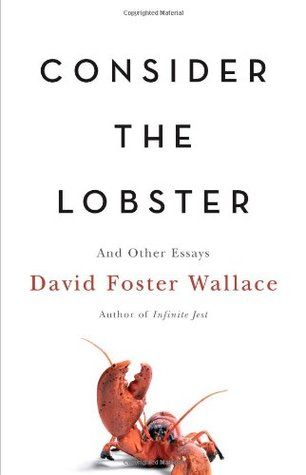
I trust my friend, Mikey, for all things writing-related and recalled his deep admiration for David Foster Wallace when “Consider the Lobster: And Other Essays” was sitting by a trash receptacle when Pepperdine students moved out in May. So I snagged it. Mikey was right, of course. Wallace was a genius.¹

(Note: If you accidentally left your copy of “Consider the Lobster: And Other Essays” by David Foster Wallace by a trash receptacle last May, I lacked the requisite intent to be charged with larceny.)²

For instance of said genius, check out this magnificent description of a New York Times journalist Wallace penned from the McCain 2000 presidential campaign trail in “Up Simba” (an article he wrote for Rolling Stone): “…a slim calm kindly lady of maybe 45 who wears dark tights, pointy boots, a black sweater that looks home-crocheted, and a perpetual look of concerned puzzlement, as if life were one long request for clarification.”

I read that last phrase a hundred times it is so awesome.

So, I was called on to fill-in preach at church this past Sunday morning, which I am reluctant to do anymore but did for some reason this time, and that afternoon I was finishing “Up Simba” when I stumbled across a paragraph that perfectly illustrated the point of my entire sermon. The sermon offered the distinction between self-interest and true love of others as the language of my faith, but Wallace described the same dichotomy as salesmanship versus leadership. So, you take your pick today—politics, religion, or leadership—and reach your own conclusions. Here is Wallace:

Now you have to pay close attention to something that’s going to seem obvious at first. There is a difference between a great leader and a great salesman. There are also similarities, of course. A great salesman is usually charismatic and likable, and he can often get us to do things (buy things, agree to things) that we might not go for on our own, and to feel good about it. Plus a lot of salesmen are basically decent people with plenty about them to admire. But even a truly great salesman isn’t a leader. This is because a salesman’s ultimate, overriding motivation is self-interest—if you buy what he’s selling, the salesman profits. So even though the salesman may have a very powerful, charismatic, admirable personality, and might even persuade you that buying is in your interests (and it really might be) – still, a little part of you always knows that what the salesman’s ultimately after is something for himself. And this awareness is painful . . . although admittedly it’s a tiny pain, more like a twinge, and often unconscious. But if you’re subjected to great salesmen and sales pitches and marketing concepts for long enough—like from your earliest Saturday-morning cartoons, let’s say—it’s only a matter of time before you start believing deep down that everything is sales and marketing, and that whenever somebody seems like they care about you or about some noble idea or cause, that person is a salesman and really ultimately doesn’t give a sh*t about you or some cause but really just wants something for himself.

——————————————————————————————————————

¹ I happily discovered when about two-thirds of the way through the book that there is a movie out about Wallace right now called “End of the Tour.” So I had to see that, too. It is a touching film about this talented, fascinating, tragic life that I highly recommend.

² Wallace used lots of footnotes.  I am so easily influenced.

Rest in Peace

Shawn

Shawn was so easy to like, which makes the news of his tragic death especially painful. He had an enormous smile, an infectious spirit, and a cruel demon that he didn’t hide from those who loved him, which was a lot of people in a lot of places.

Shawn was officially a member of our church family with his name and number nestled comfortably in the membership directory between two sets of Bairds. He had an interesting spot in the family: Reverend James Forbes once said that nobody gets into heaven without a letter of reference from someone who is living without, and for many in our congregation Shawn was the first person known well enough to approach for a recommendation.

Shawn’s struggles left him without a home, something he openly shared on stage via microphone, but he destroyed the homeless stereotype. He didn’t look/smell/act/speak like anything in the brochures.¹ Shawn hugged us, swapped stories with us, handed us bulletins at the front door, shared his life with us, and knew and remembered us by name.

The news of Shawn’s death took some wind out of me. I have experienced the loss of many people and as a former professional minister had a front row seat to the terrible specter of death on far too many occasions, but to me there is something different about losing Shawn. The loss is not inexplicable or particularly unusual, but it is its own special kind of sad.

In one way, the sadness is reminiscent of the world losing a John Belushi or Robin Williams, who brought such joy and laughter to the world that the exchange felt a little lopsided given their personal demons. Similarly, Shawn’s charm was a great gift to many, but I wish we could have returned the favor in the ways that he needed most.

Shawn will be remembered in good and right ways of course, and his spirit will live on and make us better. My hope is that we will honor him by continuing the quest for ways to help one another as we struggle through life together.² My religious conviction is to follow after Jesus of Nazareth who was known as a healer, but I have yet to get the hang of it.

My prayer for Shawn today is that he receives the mercy that he believed in and a nice warm bed so that he can finally rest in peace. And when I get to the other side, I hope he is handing out the bulletins at the door.

——————————————————————————————————

¹ In case you didn’t know, the brochures are all wrong.

² The timing is particularly ominous.  We came to know Shawn in Malibu through the S.O.S. (Standing on Stone) ministry, the Artifac Tree thrift store, and the Malibu Community Labor Exchange–the first two organizations are now homeless themselves, and the third just received its own eviction notice.  It is sadly becoming easier to envision a scenario where we would never have met Shawn.

Some Things Are Never Easy

Hell and hill are remarkably similar words, or at least that is my recurring thought as I run what I call “the hill” two mornings a week. To call it a hill is an insult to Drescher Mountain. It is a monster.

From my house, the run begins with a 350’ drop in elevation over a winding two-thirds of a mile, which is a perfectly fine way to begin a 5k run. The kicker, of course, is that it ends with a grueling two-thirds of a mile climb up same mountain.

It was three summers ago when I decided that this hill/mountain/monster must be conquered. I’m not sure why. Temporary insanity leads the polls. But decide I did, and after it I went—slowly. I counted nine fire hydrants along the path, so the strategic plan was to conquer the mountain one fire hydrant at a time.

The first fire hydrant was okay because a person could reach it with a good spit from somewhat level ground. The second wasn’t too bad, but the third made me cry. Four, five, and six required therapy, and I cannot even begin to describe seven and eight—those fire hydrants worship Satan. Fire hydrant number nine and the final stretch run to my house were bad only in the sense that after fire hydrant eight I displayed a remarkable resemblance to a Will Ferrell crying scene.

But I did it. Conquered the mountain.

I’m leaving out an important part of the story. All along, my plan was to do more than conquer the mountain, presuming that continuing to conquer the mountain would lead to some beautiful day when running up that blasted hill would be easy. I thought that was rational.

Rational or not, it was wrong. It has been years since that first glorious victory and it is not even close to easy. It is hard, every single time.

After reflecting on this somewhat depressing reality on yet another morning run, a new thought arrived: Maybe some things aren’t meant to be easy. And maybe that’s okay.

Getting up early for a difficult job, battling a chronic illness, losing loved ones, or even running up a mountain—maybe it would be an insult to the thing itself if it ever became easy.

I’m going to mention my friend, Stephanie, again because she told me about a line in the play Rabbit Hole that compared grief to a brick that you carry around in your pocket: The brick never leaves, but you get to where you don’t notice it so much and, in fact, when you do notice you realize that you don’t want it to go away.

Maybe that is what I am learning today. Some things aren’t meant to be easy, but that’s okay. If they were easy, you might forget to appreciate something worthwhile.

The thought arrived somewhere around infernal fire hydrant eight this week that maybe perseverance is not sticking with something until you conquer it. Maybe perseverance is better understood as sticking with something even when you never conquer it.

There is a famous chapter in the Christian Bible all about people who did that very thing, and they called it “faith.”

Maybe I could rename my morning nemesis Faith Hill, but that would just sound silly.

Personal Humility + Professional Will

photo_l5l1

My least impressive resolution for 2015 was to finally read the ESPN history book that had collected dust on my nightstand for longer than I care to guess. Mission accomplished. Once I dove in, the 832 pages didn’t take long to complete.

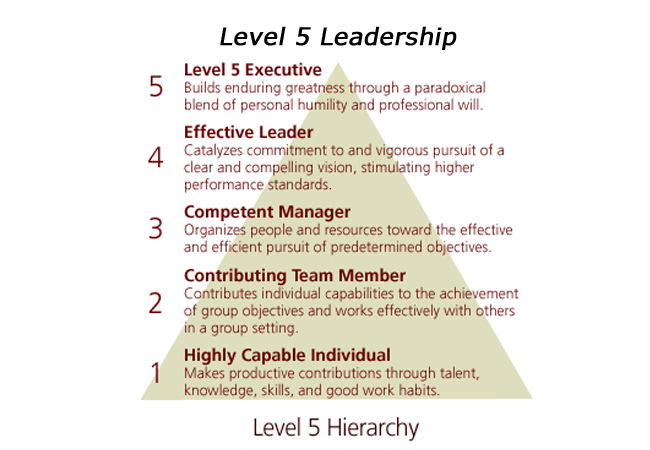
The story that stuck out to me was that of George Bodenheimer, who started out in the mailroom at ESPN and ended up its president. I had never heard of him. Bodenheimer is the perfect example of what Jim Collins would call a “Level 5” leader (see above). Look no further than his tiny Wikipedia page for example.

Those Guys Have All the Fun: Inside the World of ESPN utilized an interview approach in its historical account of the wildly successful sports television network. Today, I simply want to share my favorite entry that describes Bodenheimer. It is from John Skipper, who came to ESPN after senior roles with companies like Disney and Rolling Stone, and who has since publication of the book succeeded Bodenheimer as ESPN president. Read it, and form your own conclusions.

George defines the culture now. Steve Bornstein [former ESPN president] was respected, admired, followed—and feared. George Bodenheimer is respected, admired, followed—and loved. George has been at his job since 1998. At some point, 1999 or 2000, he created this once-a-year strategy meeting. He gathers the top people, and what does he do? He says we as a group are going to decide our priorities as a company. And we now have this annual thing we do about shared success—it’s team-team-team. By nature, I’m a cynic and even a slight elitist—I moved to New York, I studied satire. That’s what I was studying at Columbia—eighteenth-century satire—so I’m of a sardonic turn, and I can tell you that this culture is not cynical. It’s “team.” It’s complete enthusiasm, Moonie-ism in a positive sense. People believe in it. And that priorities thing, which you can make fun of—it’s a little goofy, a little corny—we go together, we say the following four, five things are our priority. One year our priority is “Make ratings go up.” One year it was “we have to make dot com work.” So the whole company has been told, you might work in event production and operating camera and traveling around the country, but we’re also looking to you to help us figure out how to make ESPN.com work.

You get a little card. We print card with the priorities on them. You carry your card around. On the back is the mission and the company values. Really simple stuff, easy for a smarty-pants cynic who likes living in New York. But you can’t make fun of it, because it works.

There is a cult of George in our company. George would hate that. George is the most influential person in sports; he actually doesn’t care and actually doesn’t like it—he’d be happy if it went away. To the rank and file, George walks on water.

Be the Best You Can

blog pic

Stephanie Brown is the type of person who gives you a gift for her graduation. She did some great cyber-sleuthing and discovered a blog that I had for many years titled, “Minutes to Memories,” from one of my all-time favorite songs and gave me the beautiful artwork pictured above with the lyrics from the chorus.  This is now the first thing people see when they enter our home.

Minutes to Memories was not one of John Mellencamp’s greatest hits, so I considered it a long shot this week when I attended my first Mellencamp concert. But the universe smiled my direction, and the third song in the set was Minutes to Memories, the song that for nearly three decades has pulled me out of many a pity party.

Mellencamp is a terrific artist and storyteller, and this song in particular draws me into a world where I can imagine having a talk with my dad. Having missed that opportunity for over two decades now, I love the song even more.

Here are the lyrics. I hope you enjoy it, too.

Minutes to Memories (John Mellencamp)

On a Greyhound thirty miles beyond Jamestown
He saw the sun set on the Tennessee line
Looked at the young man who was riding beside him
He said I’m old, kind of worn out inside

I worked my whole life in the steel mills near Gary
My father before me, I helped build this land
Now I’m seventy-seven and with God as my witness
I earned every dollar that passed through my hands

My family and friends are the best things I’ve known
Through the eye of the needle I’ll carry them home

Rain hit the old dog in the twilight’s last gleaming
He said, “Son it sounds like rattling old bones”
This highway is long but I know some that are longer
By sun up tomorrow I guess I’ll be home

Through the hills of Kentucky across the Ohio River
The old man kept talking ’bout his life and his times
He fell asleep with his head against the window
He said an honest man’s pillow is his peace of mind

This world offers riches and riches grow wings
I don’t take stock in those unsettled things

Days turn to minutes and minutes to memories
Life sweeps away the dreams we have planned
You are young and you are the future
So suck it up and tough it out, and be the best you can

The old man had a vision, it was hard for me to follow
I do things my way, and I pay a high price
When I think back now on the old man and the bus ride
Now that I’m older I can see he was right

Another hot one out on highway eleven
This is my life, it’s what I chose to do
There’s no free rides. No one said it’d be easy
The old man told me this my son I’m telling it to you

Days turn to minutes and minutes to memories
Life sweeps away the dreams we have planned
You are young and you are the future
So suck it up and tough it out, and be the best you can.

Bar Eve. Or, Don’t Shrink from a Challenge.

We always opened presents on Christmas Eve. I like Christmas Eve. New Year’s Eve ends with confetti-drenched smooching, and who can argue with that? But Bar Eve—the night before the bar exam—is more of a pain in the hind quarters.

I was abnormally slow to matriculate to law school so the bar exam remains a somewhat fresh wound. I sat for the California version, statistically the hardest in the country, an eighteen-hour torture device spread out over three days that begins tomorrow for many of my good friends.

Truth be told, the exam is the easy part. It is the anticipation, the fear-filled, guilt-infested, never-ending dread that drives a person to inquire about openings with the circus. So Bar Eve is significant, the pinnacle of the real challenge. When the exam begins tomorrow morning, life will actually begin to improve. And when the exam ends on Thursday afternoon, delirious excitement abounds, although the emphasis is on delirious.

To riff the old Tony Campolo sermon, it’s Bar Eve, but Thursday’s a-comin’.

Accounting for the delirium, I prize two important memories from that Thursday afternoon when I emerged from the Pasadena Convention Center (sidebar: we pronounce it PASS-adena for the good vibes; thankfully, we didn’t sit for the exam in FAIL-adelphia).

Memory #1: I sincerely thought there should have been a parade for us. I mean it. It was a strong feeling that, regardless of how we did on the exam, the simple fact that we endured that hell of a summer and survived the three-day exam called for a parade. We were heroes.

Memory #2: Driving home, stuck in traffic on the 101 and not caring about traffic for the first time ever, I knew what I wanted to say when I arrived home. My youngest daughter was in eighth grade at the time and had declared to my hearty approval while observing the bar summer that she would never go to law school. But on the drive home, I knew what I had to tell her. When I made it, after the hugs and kisses, I mustered all the seriousness in me to communicate what I hoped she would receive as one of those few life lessons that you just cannot miss: Never run away from a challenge simply because it looks daunting.

I could not say such a thing until that Thursday afternoon, but I never felt any life lesson more strongly than I did at that moment. On this Bar Eve, I hope my hero friends will finish strong and experience that same sense of accomplishment.

Go Big or Go Home

“Make no little plans; they have no magic to stir men’s blood . . . . Make big plans, aim high in hope and work . . . .” – Daniel Burnham

As luck would have it, I needed a big hairy audacious goal in life and learned that that’s a thing at a higher education conference in Phoenix.

The weather was scorching hot in Phoenix, but since it was a dry heat, I believe it was technically chilly. I may be a bit fuzzy on the science. The conference was held at the swanky Arizona Biltmore where the Reagans honeymooned, Marilyn Monroe lounged by the pool, and Irving Berlin dreamed of a white Christmas, but at times I felt surrounded by my kind of people (who were taking care of the lawn). The Biltmore is also where John McCain conceded that Sarah Palin would not be the new Vice President of the United States, and that is an historic event regardless of your leanings.

Hands down, the most stimulating plenary at the conference was delivered by Jim Collins, the famed business consultant and author of classic books such as Built to Last and Good to Great. His lecture was worth even more than the two nights at the Biltmore.

Instead of recounting the twelve points of his great lecture, I will simply mention that Collins coined the acronym BHAG (bee-hag), which stands for Big Hairy Audacious Goal. True story. There is actually a Wikipedia entry for this concept that will save me the trouble—it lists examples such as Microsoft’s “A computer on every desk and in every home,” and Google’s “Organize the world’s information and make it universally accessible and useful.”

It is a goal that is huge and bold and captivating but not impossible.

I need one of those. I seem to have lost all of mine sometime back.

Seven years ago, I started having chest pains. Scary. Instead of sudden death, I got a new diet, a daily purple pill, and an epiphany, which is not a bad deal given the choices. The epiphany was that if my life had ended in my late thirties—halftime from the perspective of an odds maker—there was no reason to complain. It had been a good run and anything more would just be bonus.

That was a nice thought for a while, but it is mathematically ridiculous and I am just now figuring that out. You see, the odds makers would now have my life a good chunk of the way into the third quarter. Are you following me here sports fans? So I had a great first half, but either the game ended at halftime or it didn’t, and looking at the rest of my life as the bonus round is goofy math. And it is no way to play.

I have a tendency to be either the tiniest bit existentially-angsty or maybe a whole lot. When Collins made it to point number ten or so in Phoenix and declared that a BHAG was a cure for existential angst, he had my attention.

I need a big hairy audacious goal to propel me forward because coasting is, well, anticlimactic, and to risk sounding whiny, increasingly boring. And if I’m being candid and I am so there, coasting has almost proven to be depressing.

No more, I declare. The game isn’t over. I am officially back in the game, and the second half is instantly better.

Things are really starting to look up.

Seek Extraordinary

“If you aren’t living on the edge, you are taking up too much space.” – Jim Whittaker

Reincarnation is a cool concept, but I can only locate the receipt for this one particular life so I would like to get some good use of it since it is all I’ve got and already pretty stained up and, presumably, nonreturnable.

It is not my style to tell people how to use theirs. I hate to appear presumptuous. Best I can tell, it is your prerogative to be extraordinary or ordinary or wasteful or a downright jerk with “your one wild and precious life” to borrow Mary Oliver’s poetic phrase. I can still make suggestions.

I suggest taking aim at extraordinary.

I live and work on a university campus. Admittedly, this particular campus is disgustingly awesome, but I think all college campuses are pretty fantastic because they are places where big dreamers and big ideas fall in love and produce miracles.

This is on my mind because we just returned from “Summer in Seattle” at Seattle University, a pre-orientation program for new freshmen and their families, including mine. In the closing session, a vice president shared the quote used as the epigraph for this little essay from an alum of Seattle U who also happened to be the first American to reach the summit of Mount Everest. It is a great bumper sticker quote that I loved at first, hated at second, didn’t know what to do with at third, but by the time it reached home I liked it pretty much a whole lot. Hence, my presumptuous suggestion for your life’s consideration:

You can’t be extraordinary playing it safe all the time.¹

I am a fan of safe. I’m a lawyer after all. But playing it safe is only useful if it keeps you safe for something, not just from something.

And I am not a fan of stereotypical thrill-seeking. Those thrills are cheap. But you should seek something that will ultimately be thrilling—just don’t settle for cheap.

I suggest that you seek an extraordinary life. But you get to choose. I hate to appear presumptuous.

—————————————————————————————————-

¹ See the Parable of the Talents (Matthew 25: 14-30).

Scene (or, Seen) at a Stoplight

Favela

He couldn’t have been more than ten years old. It was our last night in Rio, and we had just begun one final terrifying taxi ride to Santa Teresa when I saw him. We were stopped at a light just off Copacabana Beach with the typical zillion cars zigged and zagged together in automotive contortion and this young boy weaved in between to wash windshields. He wielded a spray bottle and a brush and used his shirt for a towel—a typical Friday night it seemed for this ten-year-old. He took pride in his work with great attention to detail, finished and collected the change from the disembodied arm of the driver and glided with a swagger between the bumpers to the shoulder of the road exactly on cue as the light turned from Flamengo red to Brazilian green.

He made a strong impression on me, although I suspect the dirty little kid from the favela would prefer R$5 than an essay from an American about an impression he made in the span of a traffic signal.

I am officially a lawyer and live in a land and work at a school that celebrates and promotes the rule of law. I am not ashamed of this in the least. And I do not prefer to live in a world where ten-year-old boys have to work in the middle of a dangerous road in a dangerous city for loose change on a Friday night for God knows what purpose. Hopefully it was for his personal needs, although that alone would be tragic.

And yet . . .

That ten-year-old boy appeared in that brief scene to be more of a man than I am right now what with my petty fears and complaints and indulgences. I cannot say that I wanted to exchange places with him in that instant, but I did consider that I might hope to be like him when I grow up.

Fearless.
Industrious.
Skilled.
Swagger.
No excuses and no complaints.

I hope people will look through those spotless windshields and see that incredible kid.