I’d Like to Teach the World to Sing

Well, I did it. On Saturday night, I sang a solo in public for the very first time. This caught me up to most of the world, so no grand accomplishment, but it sure was for me. Our church hosted a low- and at times off-key talent show to raise money for those of us traveling to Kenya this summer and somewhere between the expansive definition of “talent” and guilt for not doing much for the trip so far I decided that this was a fine time to break my forty-five year silence. I chose “Forever and Ever Amen” by Randy Travis, partly because I will love my wife forever and ever (amen) and partly because I have a bass voice and thought this song choice reduced the risk of total humiliation. My kind friend, Shelby, graciously agreed to accompany on guitar, and had she not, I totally would have chickened out.

My problem began in church at age six. I was sitting by my mother and belting out the chorus of a favorite song when a couple in the pew in front of us turned and gave me a dirty look as if to say, “Let us put this nicely—you are annoying the hell out of us, so shut up.” Setting aside the fact that annoying the hell out of someone is arguably a net spiritual benefit to the annoyed, I shut up. I shut up for a decade.

Fast forward to sophomore year of high school. While sitting in “chapel” at my small, Christian high school, I accidentally broke my sincere vow never to let anyone hear me sing and my friend, John Mark, said, “You have a good voice: Why don’t you sing more?” That one comment changed my world. Okay, I didn’t start a band or anything, but that one comment returned my voice, just like a single criticism took it away, and I started singing again, allowing my voice to blend into the music of the world.

It took another thirty years (I may be a slow learner), but two days ago, John Mark’s encouragement even allowed me to offer the world a song on my own.

You should never underestimate the power of a single act of criticism or encouragement.

The More Things Change…

A fun video of contemporary kiddos attempting to use an old computer with the Windows 95 operating system made the Internet rounds recently, and by “fun” I mean it is now either time for me to die or move into the retirement village.

We bought our first home computer in 1995 just as the Windows 95 revolution launched, and when the gazillion black-and-white spotted boxes from Gateway 2000 (“Computers from Iowa?”) arrived and I successfully operated the crane to extract the computer from said boxes, it came with Windows 3.1 pre-loaded and a Windows 95 upgrade disk. We were cutting edge. We were also semi-stupid, having invested a full month’s pre-tax salary (my wife and I combined) on this contraption: three thousand bucks, which included three-hundred bucks for a (prepare yourself) “color” printer.

Windows 95 was supposedly the best thing ever for humanity although my lack of attention to computer technology pre-1995 made me less than an expert. Windows 95 (I was told) unveiled a revolutionary “Start” button in the lower left-hand corner of the screen, enabling morons like me to just point and click pretty things with advanced terms like “Start.” Sadly, it took me awhile to catch on.

But I did. And it was awesome watching Weezer perform “Buddy Holly” over and over again from the Windows 95 upgrade CD. Although the video quality was less impressive than the television across the room, it was glorious that Weezer performed “Buddy Holly” when I wanted and not at the unpredictable whim of MTV. And Encarta was SO cool. Who cares that I could have bought ten encyclopedia sets for that amount of money—Encarta offered zero paper cuts and (some) actual videos on interesting topics!

Watching today’s teenagers fumble around Windows 95 resurrected words like Netscape and Prodigy from my long-term memory and brought back the image of a telephone cord strung dangerously across our dining room so that we could count down our ten free hours on Compuserve (and not receive any phone calls, which was a service we were actually paying for).

The world has changed significantly in the past two decades, although I’m not entirely sure it has been for better or worse.

What I do know is that has changed, is changing, and will change, and in another couple of decades teenagers will still be laughing about it. So if it’s all the same to you, I suggest that we take ourselves a little less seriously.

Life-Changing Moments

I often say that I do my best work by accident, which is true, and there is no better example than the afternoon I as a young high school basketball coach said hello to the most adorable six-year-old little girl. We were standing in the gym, she in an after-school program and I awaiting the bus to take the team to a road game, and unaware of the massive implications for my life initiated the following conversation:

“What’s your name?”

“Erica.”

“What grade are you in?”

“First grade.”

“Oh, do you know my nephew, Josh?”

“Yes!”

“Is he your boyfriend?”

“No.”

“Do you have a boyfriend?”

“Yes”

“Who is your boyfriend?”

(Without pause) “Aaron Farley.”

Note: This was particularly interesting since Aaron was one of my junior high basketball players.

My life was forever changed. Erica and I soon became buddies. She brought me Christmas candy. I met her mother. In less than five months, I married her mother. A couple of decades later, I am the luckiest man on the planet and owe it all to that innocent conversation with a cute little girl in a smelly high school gymnasium.

Erica is a beautiful woman now who teaches/loves adorable little children as a career, and even though birthdays have come and gone (and another of hers will come and go tomorrow), to me she will always be that adorable little girl who changed my life for good.

Be careful out there today. It is entirely possible that an innocent conversation can change your life for good, too.
Erica 1


Emancipation

An article in the online edition of the Harvard Business Review caught my attention: “A Modest Proposal: Eliminate Email: Reasonable Attempts to Tame It Are Doomed to Fail.”  Ironically, or maybe appropriately, the article arrived via email.

The author (Cal Newport, Georgetown professor) is apparently serious, and as one of the “inbox-enslaved individuals” he describes, I appreciate his attempt at a Technological Emancipation Proclamation.  He accurately portrays my people’s need “to constantly check their inbox and feel great guilt or unease about the possibility of unanswered communication awaiting attention” and that “the inbox-bound lifestyle created by an unstructured workflow is exhausting and anxiety-provoking.”

So, he suggests chunking it.  He writes, “The concept is simple. Employees no longer have personalized email addresses.”

I think he is crazy.  Which is partly why I love it.  But more importantly, and I’m speaking as one highly skilled in email management, I think the day is coming when the email problem has to be addressed.  As Professor Newport concludes, “if workplace trends continue as they are, [his crazy/stupid/fruitcake idea] might one day soon seem less less like an interesting thought experiment and more like a necessary call to action.”

Email allows us to be so stinking available, efficient, and responsive that we no longer have time to work (in fact, that becomes our work)–or, tragically, to live.  In his delirious alternate universe, Professor Newport envisions: “[W]hen you’re home in the evening or on vacation, the fact that there is no inbox slowly filling up with urgent obligations allows a degree of rest and recharge that’s all but lost from the lives of most knowledge workers today.”

Can you imagine such a thing?  I can imagine.  In fact, I can almost even remember.

Freeday

So we wait four whole years to get an entire extra day again and it turns out to be a Monday. Darn the luck. Rumor has it that Leap Day will be on a Saturday in 2020—as it should be—but this go around . . . Monday.

So what will you do with this rare gift of an entire day? My guess is go to work, so on, so forth. Just another Monday.

But, what if. What if you really did have a free day, twenty-four hours with no responsibilities, what would you do? And while we’re in make-believe world, what if it didn’t have a name like Monday (work) or Saturday (take the kids to soccer) or Sunday (go to church)? What if we made up a cool name like Freeday so that there was no lurking guilt as to what you should be doing that day instead? How would you spend Freeday?

And what’s stopping you?

My good friend, Wikipedia, told me that Leap Day occurs in most years divisible by four but not years divisible by 100 unless divisible by 400. I’m not making this up. Some cat named Pope Gregory XIII did make this up 400+ years ago, so I’m asking, why can’t you make up some math and declare a day all for you?

I say pick a day and go for it. Time is a precious gift, and observation tells me that it eventually runs out on all of us, so why not resist the forces working against you and seize a (Free)day.

The Judeo-Christian heritage calls such craziness “Sabbath” with a recommended dosage of once a week. But once every four years is better than never.

Race

DCF 1.0

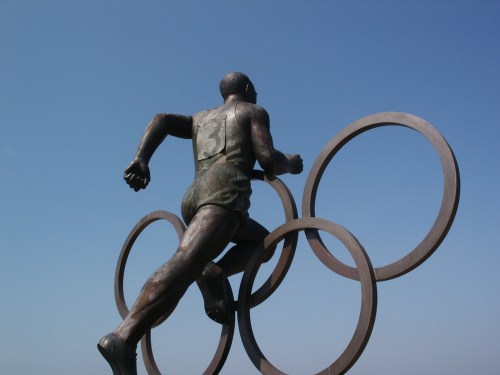
Go see “Race.” The critics apparently do not think it is the greatest movie in the history of movies, but the story of Jesse Owens is one of the greatest stories in the history of stories, so there. But be prepared. American race relations in the 1930s is not fun to watch, and then you encounter Nazi Germany. It is a tough, hard, heroic story well worth the price of admission, not to mention the attention of your heart.

I traveled to northern Alabama in June 2007 to speak at a church that had supported our church during Hurricane Katrina, and while there, noticed that the Jesse Owens Memorial Park & Museum was nearby. I had to go. Jesse, a grandson of slaves, was born into a family of sharecroppers in tiny Oakville, Alabama, and the museum grounds contains a replica of his childhood home. Mr. & Mrs. Owens had nine children in that tiny house, and the children had no beds. Eventually, the family relocated to Cleveland, Ohio, where life was bad, but better, and it was there that Jesse’s spectacular high school track and field performances catapulted him on to the world stage where he forever defied Hitler’s claim of Aryan supremacy.

This picture is my personal favorite from the museum (and my favorite scene in the movie):

DCF 1.0

The friendship that formed between blond-haired, blue-eyed Luz Long from Nazi Germany and African-American, Jesse Owens, from the United States in the long jump competition at the Olympic Games stands as a testament of hope for the world.

An article on ESPN.com shared the following quote from Owens: “It took a lot of courage for him to befriend me in front of Hitler. You can melt down all the medals and cups I have and they wouldn’t be a plating on the 24-karat friendship I felt for Luz Long at that moment. Hitler must have gone crazy watching us embrace. The sad part of the story is I never saw Long again. He was killed in World War II.”

Eighty years after the 1936 Olympic Games, the world sure seems to remain a mess. But there is hope. There is always hope. And it begins when people defy social expectations and form the most unlikely friendships.

2

1

It Will Be Alright

SCENE 1: It was August 2012 and the worst moment of my life. My mother was dying more rapidly than I and my sisters imagined, and I had spent the last hour holding her hand while she dozed in a special lift chair. The clock taunted me like an executioner. I knew that I had to fly back to California and leave her for the final time, and eventually, that time arrived. I went to grab my bag, but when I returned to say goodbye it was obvious that this would not go well. I stepped into another room to gain composure but failed, so I simply collapsed in loud tears into her shallow, yellowed chest, and through my sobs could hear her raspy, comforting, motherly voice whisper, “It’s going to be alright.” It sure didn’t seem so. When I stood to leave, I strode quickly out the door knowing that I would never leave if I looked back. A man should never have to turn his back on his dying mother, but I did.

SCENE 2: Three weeks later, I am on an afternoon flight from Los Angeles to Memphis. That night, through the miracle of air travel, I would sleep in the bed my mother died in that morning, two thousand miles from where my fateful day began. I reviewed the eulogy fortunately written the day before and fought off tears on what otherwise appeared to be a normal flight. Troubled and weary, I put away the notes and plugged in earbuds in a futile attempt at distraction and scrolled through the flight’s music offerings. For some reason, I selected Three Little Birds by Bob Marley and soon heard his hopeful, comforting, spiritual voice say, “Don’t worry about a thing, cause every little thing gonna be alright.” The tears flowed easily now, and if anyone noticed, I didn’t give a fill-in-the-blank.

SCENE 3: It is February 2016 in Malibu, California, and I am driving down the Pacific Coast Highway for a lunch appointment with a good friend. It is sunny, blue skies, seventy degrees, and heavenly. Lunch will be served by the Pacific Ocean with surfers bobbing in the waves. It has been a bit of a rough month personally, physically, and professionally, but I am recently feeling better on all fronts. Per usual, my Legend CD by Bob Marley & the Wailers is playing, and my old friend is reassuring me once again that every little thing is gonna be alright. Mom was right. Of course. She always seemed to be.

More vs. Enough

In the mid-1980s, despite pedagogical intentions, Coach Watson’s “Global Studies” course introduced me to The Far Side. We checked in on Gary Larson’s strange mind each day as we perused the newspaper for world events (and/or, read the sports page).

Although impossible to pick an all-time favorite, the cartoon featuring a courthouse broadcast where the reporter said something like, “Dramatic testimony against Mr. Pumpkineater was given today by his sister, Jeannie Jeannie Eatszucchini,” always makes me fall on the floor.

But today, for some reason, one of Larson’s anthropomorphic classics came to mind. Mr. and Mrs. Cow are in the living room, and Mr. Cow is in the easy chair with a beer in front of the television. Mrs. Cow is standing in front of the picture window, a fruit platter by her side, a string of pearls around her neck, and bracelets dangling from an arm holding a glass of wine. She looks over her shoulder and says to Mr. Cow, “Wendell…I’m not content.”

Hee-larious. The drawing itself, the absurdity of the scene, and maybe most especially something about a cow named Wendell is so outlandishly clever.

The disturbing part is when I identify with Mrs. Cow.

Once upon a time in a law school paper on Greed titled, “Enough Already,” I shared Dr. Stanley Hauerwas’s one-word definition of the deadly sin of greed—“more”—and juxtaposed that insatiable desire with the idea of “enough.” “More” vs. “Enough.” I’ll give you one guess which one characterizes my mind most often.

“Enough” is elusive, in part because death comes quickly if taken too far, i.e., life demands more air to breathe; more food to eat; more exercise to stay healthy; more money to pay bills; more goals to achieve; and so on and so forth, but the ability to be satisfied, in a given day or a given moment, is important for mental health if nothing else.

And when you are a cow with a glass of wine and a fruit platter, anything less is just ungrateful.

Hope for the World

As Valentine’s Day bled into Presidents’ Day, I decided to give up any love of politics for Lent. This may be the perfect year for such a sacrifice.

The tragic loss of Justice Scalia over the weekend was quickly followed by the tragic politicization of his passing.  There is political work to do, of course, but it was sad, though not surprising, that a presidential candidate had tweeted an opening shot before the Supreme Court had even published an official statement on the loss of their colleague.

This presidential campaign cycle? Wow.

Best I can tell, nine viable candidates remain—two Democrats (Clinton; Sanders), six Republicans (Bush; Carson; Cruz; Kasich; Rubio; Trump), and one lurking independent (Bloomberg). It is possible that Batman or a Muppet or One Direction (campaign slogan alert?) may enter the field, too, given this unpredictable election cycle.

If the presidential field took the field as a baseball team, I’d put Sanders in left (of course), Bloomberg in center (of course), and Cruz in right (of course). Trump would have to play first because it has a #1 in it. Bush and Kasich would necessarily be the (Republican Establishment’s) double-play combination, and Clinton would be a natural at the hot corner given her experience with controversy. I’d put Carson behind the plate (i.e., coming from behind now anyway), and Rubio could take the mound since he is the youngest candidate and may have the most lively arm.

American presidential politics is both fascinating and disturbing, sort of like a roadside accident elicits a peek. Although I vote and appreciate our system, my personal philosophy is best summed up by the late Will D. Campbell (and speaking of baseball): “I watch the political process pretty much as I watch baseball. I have a favorite team, but I know that ultimately it makes no difference who wins. I gave up on politics offering any hope for the world’s problems a long time ago.”

There is a complex thought system that underlies the quote. Just so you know.

Well, I’ll risk oversimplification and explain it this way: I stand with Will D. Campbell and Dr. King in believing that the hope for the world lies in our ability to see one another as brothers and sisters.

Watching our prospective leaders in a democracy speak as they do is a direct reflection of our own hearts, and it seems that we hate each other. Well, maybe not hate (yes, I do mean hate), but at least we resent or despise or fear each other. Surely not family.

I am happy that the inspiring friendship between Justice Scalia and Justice Ginsburg has received some attention this weekend.  It is unfortunate that it appears to have zero effect on the presidential campaign.

My best bet as to who will win in November? Nobody. Oh, someone will be elected president of these United States, but in this political climate, I’m not predicting any real winners. I am predicting a lot of angry people. (I’m also predicting a large number of folks will renege on their pledge to move to Canada if ________ is elected.)

It is personally comforting that I do not believe the “hope for the world’s problems” lies in a presidential election, but at the same time, it is troubling that the hope I believe in appears to have zero traction, Scalia/Ginsburg notwithstanding.

I’m going to see everyone as brothers and sisters anyway.

Permanence

Nothing says next stage of life quite like receiving a text/picture of/from your youngest child in her Seattle tattoo parlor of choice. It is a real attention-grabber. The gentleman/artist in the photograph with her did appear to be wearing surgical gloves, which felt like a win all things considered.

She may or may not be my child; I am without tattoo, at least none that I have discovered, and I have been with me at almost all times. My tattoo-less status is not a moral stand, however; instead, my particular phobias include in no particular order: fear of physical pain, fear of permanent markers, and fear of misspelled words. If the tattoo artist was an actual boa constrictor, it would be my worst nightmare.

My dad had a large, prominent tattoo of a battleship on his bicep, which made perfect sense for a WWII sailor, but I am embarrassed to say that it took me a couple of decades to realize that “Ruby” was probably not the name of the battleship. The lack of texting technology during the Second World War worked in favor of the emotional state of my grandmother.

But our daughter is so cool. She carefully chose her tattoo, a Swahili phrase, and described it this way:

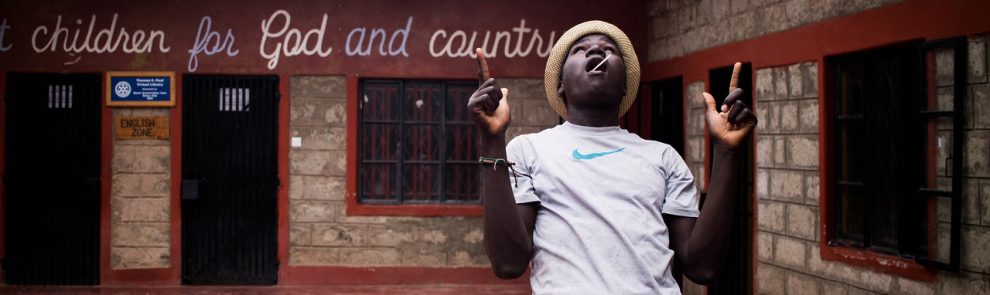
Nakupenda was the first Swahili phrase I learned on my first trip to Kenya back in 2012. It means “I love you” and is a constant reminder of my love for Kenya, for the students at MITS, for travel, for education, and for doing all I can to help bring more love to the world. This phrase has meant so much to me for the past 4 years and now, in the handwriting of my Kenyan brother, Paul, it will always be a part of me.

I love it. And her. But I confess that my first thought upon hearing that she was actually going through with it was, “Are you sure that’s a good idea?” Which, actually, was not a conscious thought, but a deeply-repressed and possibly unspoken lesson from childhood that said, “No, that is not a good idea.” Why not? The voices in my head said something about permanence. This youngest child of ours now has a message permanently imprinted on her body (laser removal technology notwithstanding).

Here’s the funny thing: She chose it because of its permanence. That’s the point.

“…it will always be a part of me.”

Yes, it will, sweetheart, and that makes me smile. You know, come to think of it, ink or no ink, all of us are tatted up by our life experiences and the deep values that shape who we are and what we hope to become.

Permanence has a negative side, but it has a glorious side, too.