Category Archives: Original Essays

Recurring Fluctuation

Rhythm: (noun) [ri-thəm] 3a: movement, fluctuation, or variation marked by the regular recurrence or natural flow of related elements.¹

You say routine, and I hear same. That’s boring. You say rhythm, and I hear flow. That’s magic. Routine is my middle name (or possibly Andrew), but I want to live with rhythm.

The end of the calendar year brings a holiday break to most people, and it arrived yesterday with much rejoicing for the students in my world. I like the rhythm of the academic calendar, the dependable circuit of fresh beginnings building toward grand crescendos and coveted breaks. Nothing lasts long enough for monotony to set in, but the variety is familiar. It is rhythm, that lovely idea with the oxymoronic definition of recurring fluctuation.

Our particular culture may be rhythm-impaired.

The American notion of work is hard to identify. From one angle it looks all workaholic with a capitalism-infused insatiable desire for more and a technological revolution that never really allows us to go home or on vacation, but from another it looks a little like laziness expecting two full days off a week and only eight hours of work the other days carefully divided by breaks and lunch hours and creative approaches to what counts as being on the clock (not to mention vacations, sick days, and other assorted flavors of leave).

So which is it? Do we work like crazy fifty weeks of the year and then take two weeks to run like crazy on vacation and never really rest? Or, do we never really get around to work?

Can it be both? I answer both because I think we lack rhythm.

The planner in me says that rhythm demands excellent time management skills, and it does, but the rhythmic life demands the creative side of the brain, too. Do not settle for a bland, routinized life. Do not settle for a rudderless, pinball life either.

Seek a life with beautiful recurring fluctuation, and then—and only then—go with the flow.

——————————————————————————————-

¹ Merriam-Webster.com. Merriam-Webster, n.d. Web. 14 Dec. 2015.

Choose a Place

3

The world is apparently falling apart, but don’t give up on it. This thought occurred to me last Saturday over a wonderful meal.

The best meal in Malibu last Saturday was served at the Malibu Community Labor Exchange Holiday Party. I know from firsthand eating. The buffet included tamales, ham, turkey, chicken, enchiladas, sweet potatoes, corn casserole, salads, muffins, and on and on and on. It was like Thanksgiving and Christmas dinners made sweet love one to another and out popped Heaven.

This is the fifth consecutive year that my wife led the party preparations—and she is awesome—but many people prepared, cooked, cleaned, gave, and otherwise pitched in to pull it off, which reminds me of the Labor Exchange itself.

Though not in the travel guides, the Labor Exchange is one cool place. It was created by the Malibu community over two decades ago as a safe and organized (and free) place to hire day laborers. It is a place where everyone is welcome, which attracts men and women from all over the world with impressive skills, interesting life stories, and colorful personalities. Oscar Mondragon is the legendary Center Director and one of my personal heroes. Oscar worked closely with Cesar Chavez prior to joining the Labor Exchange in 1993, and for twenty-two years, six days a week, he has served countless individuals by enforcing community standards, sharing wisdom, and simply caring for all who show up.

Author, Shane Claiborne, once was asked by several enamored college students to identify the greatest cause of their time. Claiborne told them not to choose a cause but to choose people and that the causes will choose themselves. I like that so much I have repeated it a hundred times, although it isn’t exactly how I discovered the Labor Exchange. There have been several “causes” in my life such as children’s issues and housing/homelessness, but instead of choosing a cause or people, I have typically been drawn toward what was happening in my backyard—“local justice” as my friend, Jeff, calls it.

Enter the Labor Exchange. It wasn’t the plight of day laborers that initially drew us in; instead, some folks were taking sack lunches each month and we just joined the crew. Before long, however, through getting to know Oscar and meeting the fascinating workers, we became part of the family.

What I like most about the Labor Exchange is that it is a place. There are lots of terrific causes in this world that deserve attention, but there are far too few places to go in a community where everyone is welcome regardless of, well, anything. See if you can find one where you live, and if you do, don’t be a stranger.

I guess that’s my humble modification to Claiborne’s good advice: Choose a place outside of your particular box, meet the people there, and the causes will choose themselves.

Your Very Best

It is final exam season at Pepperdine University School of Law, and you can cut the tension with a knife (except we are a weapons-free campus, so I suggest doing your best with a spork). I am almost embarrassed to admit that I kind of like the feeling of stress in the air because it reminds me of the fluttery feelings associated with the big game or big performance, but there is a particular weirdness to law school final exam stress brought on by a forced curve, a brilliant set of students, and a solitary grade for an entire course. Admittedly, that kind of stress feels more like an unexpected phone call from your doctor than a piano recital.

As a law student, I discovered that worrying about finals was not particularly helpful, although I sure gave it a good try. The better approach consists of a good strategy, discipline, and the many hours that follow.

My law school days came later than most and happened to coincide with my youngest daughter’s matriculation to middle school. It was nice to go school shopping for pencils together. I remember a day when my daughter received an uncharacteristic poor grade on a school assignment, and in my best attempt at being “dad,” I asked if she had truly done her best. When she said that she had, I told her not to worry about it: that her very best was all anyone could expect, and that’s all she has to give anyway. I was proud of my good advice—and then went back to sulking about my prospects of doing poorly in law school.

Thankfully, two seconds later, it occurred to me that I should heed my own advice: Give it my very best, and be satisfied. For the most part, I did, and I was.

Fear is the enemy of life, and fear of failure is troublesome because popular definitions of success are such that so much is out of our control. But what if success and failure were based on doing your very best with what you have been given?

I’m spreading that word in a law school, on social media, and in my own little brain: Reach for the stars. Take what you get. Learn from it. Reach for the stars again.

Joy to the World

My family traditionally opened presents on Christmas Eve, so the Twelve Days of Christmas confused me. Heck, we barely did one. But I never found leaping lords and diverse birdlife, i.e., laying geese, swimming swans, turtle doves, calling birds, partridges housed in pear trees, and hens of French origin all that appealing in the first place.

But I get it now. No, not the lords and birds. I get the Twelve Days of Christmas because I counted and my calendar contains at least twelve holiday-themed events before we even make it to family on Christmas Day.

This observation comes with zero complaints, but it does feel a little disjointed with all the violence and fears and anger and arguments in the world right now—especially since the most recent tragedy occurred at a holiday party. Peace on Earth seems a little, well, laughable, if it wasn’t so sad.

The feeling is familiar. When Hurricane Katrina devastated our community in 2005, it seemed a little odd to have a holiday party that year, too. (We may have worn ugly sweaters, but mostly because that’s what arrived on the relief truck!) But I concluded then that we needed to celebrate even more. After all, given my particular faith tradition, the story of the season revolved around a family with nowhere to sleep.

Maybe that works this year, too. (There was after all a violent infanticide in the Christmas story.) I’m not thinking that “Peace on Earth” is such a terrific phrase right now, at least not if we expect signs of that coming true anytime soon. But, any celebration that talks about Hope seems timely. And anything at all that produces a measure of Joy sounds pretty good, too. As many songs and gifts and love and light as we can muster is a pretty fantastic idea when it’s dark outside.

If it takes twelve-plus days and parties to make a little dent in the darkness, then bring on the egg nog!

Exquisite

[Note: I used to write a lot until, well, law school.  But, one year ago tonight, at the end of a long day, a moment happened in the law school that unleashed an intense desire to write about that particular moment.  That impromptu essay opened the door in my heart that with time became “Starting to Look Up.”  So, in honor of that moment, here is my essay from one year ago.]

The word exquisite doesn’t come to my mind very often.

It has been a long day, at the end of a long week. Our students are in final exams, and I feel about that weary, too. I made it to work around half past seven this morning and walked out around half past nine this evening. That isn’t normal, but it isn’t abnormal. Another long day.

But there were some great moments. I served on an important panel judging a Christmas cookie contest for our staff: public service at its most delicious. And tonight, I attended a swearing-in ceremony for our graduates who passed the bar exam. There may not be a happier occasion, and the celebratory hugs and high fives from such special people made my heart happy.

So it was a good, solid, long day.

But it came time to go home. I closed down my office, grabbed my work bags, and headed toward the exit with a weariness that comes with a fourteen-hour work day.

There was music as I walked toward the door.

The law school received a piano as a gift last year, and we have several talented pianists in our community who put it to good use, so this was not surprising. I noticed three first-year students standing on the second floor near the law school entrance, weary from a never-ending battle to learn the Federal Rules of Civil Procedure, still at school at half past nine on a Friday evening. They were listening to the music that filled the three-story building emanating from the back corner of the first floor.

I joined their group to listen, too.

I am embarrassed not to know piano tunes. This one was lively and reminded me of a Scott Joplin sort of song. But I don’t know. I do know that the young pianist was into it, and soon, we were too.

Two other law students came out of the library, pulled to the railing by the music.

And we just listened. We all stood quietly, mesmerized, weary, but captivated, and listening.

It was really just a moment. The impromptu performance couldn’t have lasted more than a couple of minutes, but there was a moment somewhere therein, somewhere before the song’s rousing conclusion and the surprising ovation from the six-person audience up in the balcony. It may not have made an impression on anyone else, but it is now well after ten o’clock, and although I am still tired, I had to write about this moment because I don’t want to forget it.

It was exquisite.

Some moments are worth the trouble of life. And the one tonight, when the intense and elegant music of an artist captivated a group of stranded travelers on a Friday evening, qualifies in my book.

Freedom Road

480x480xa_glitter_1.jpg.pagespeed.ic.gTwfajW_UJ

Random Glitter Beard Guy (Not Me. Yet.)

My inaugural participation in No Shave November would have ended today were it not for (a) my wife’s shocking declaration that she likes the beard; and (b) an entrepreneurial law student convincing me to wear a “glitter beard” for a full day if he raised a thousand dollars for the law school’s public interest student organization. He created a GoFundMe page for this effort, and as disturbing as a glitter beard on my face is to consider, last I checked he had raised ten bucks. You could change that, of course, with your donations (click HERE), but this is a classic win-win situation for me.

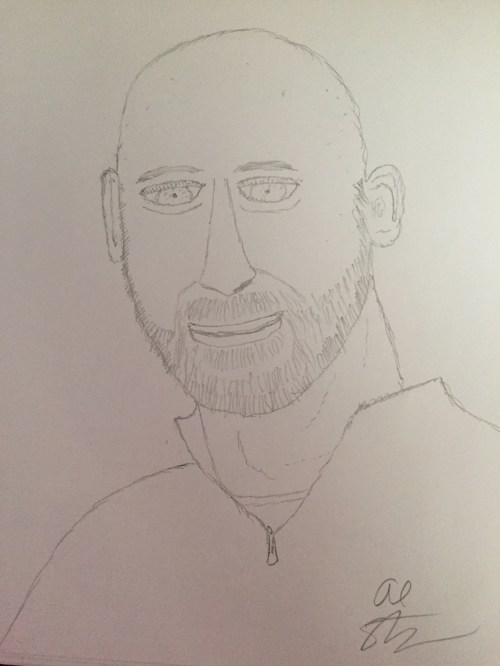
Glitter beard aside, my life is actually one long story of self-consciousness about physical appearance, but there has been great progress over the decades, and my path to baldness is particularly instructive.

My hair embarrassed me from the moment I realized people judged your appearance. I don’t know exactly how to describe my hair, other than terrible. It was thin, light brown, oily, and curled in all the wrong places with length, with a cowlick smack in the middle of my forehead. I hated it. I tried, without talent mind you, to make it look okay, hoping not to draw attention to it—ever—and in that effort spent more time than I care to know in front of a mirror. In effect, I was a butcher with a comb attempting brain surgery.

Worse, any time the wind blew or rain fell it somehow got worse, and both happened in my hometown on a regular basis. Wearing a hat was okay if it was stapled to my head and never came off in public. I wore out untold back pockets on blue jeans because I carried a comb everywhere I went. Everywhere. I guess I was vain in reverse, not consumed with looking good, just desperate not to be the object of laughter.

This went on for a few decades or so, give or take, and then I started going bald on top, too, as if being pale/skinny/freckly with bad hair wasn’t enough self-esteem for an American male.

And then one glorious day I was reading lovely Anne Lamott talk about her lifelong obsession with bad hair (although her particular malady was frizzy-ness). She mentioned that as an adult a friend with dreadlocks encouraged her to follow suit, but the idea of a middle-aged white woman in dreadlocks took some time to consider. Then, one day, while watching the climactic scene in The Shawshank Redemption when Andy Dufresne tunnels through sewage to escape from prison and stands in the pouring rain with his arms to the sky in glorious freedom, Lamott thought, “I could never do that. My hair would look terrible.” At that moment Lamott decided to go with dreadlocks. You laugh, but I had to catch my breath. It was me. In effect, it was that story that led me to shave my head.

Here is the kicker: It was so difficult to actually follow through with it because my entire life had been one long attempt to avoid calling attention to my personal appearance. (And let me tell you, shaving your head is one surefire way to draw attention to your personal appearance.) But I did it. Our friend, Devon, did the honors, and as expected, everyone had to comment. (My favorite was when meeting those who hadn’t seen me for some time. They were oddly quiet, and I am sure that my bald/pale/skinny self had them wondering if it was cancer or AIDS. I just let them wonder.) After some time, the comments went away, and all these years later, I could not be happier.

What I learned is that the path to freedom requires the courage to face your greatest fears. And that the freedom is worth it.

It is still difficult to say, but—look at me. I’m up to sporting a glitter beard now if the price is right.

Thankful

PICT0001.12[Note: I took the picture above and wrote the essay below nine years ago on the Mississippi Gulf Coast. It is worth sharing again this Thanksgiving season.]

I discreetly pulled out my camera after climbing in my car, turned off the flash, and snapped a picture of Carolyn as she went back to her daily work without her knowing. I did not want her to think she was some sort of display, but after our conversation, I also did not want to forget.

I go to Biloxi every couple of weeks to visit my friend, Hezekiah, in the nursing home. Hezekiah is a disabled man in his late 60s – disabled both mentally and physically – and Hezekiah is a hoot. He spends his days coloring in magazines and listening to his radio, with occasional interruptions for his harmonica and smoking breaks. He generally cheers me up when I visit, and today was no exception. We talked about Christmas approaching, and he renewed his constant desire for a “jew harp.” I have no idea what he is talking about. Oh, I know what a “Jew’s harp” is – actually bought one once upon a time for Hezekiah, but when he saw it he didn’t have a clue what I had given him. So who knows… In addition, he’s interested in a football this year, too. One he could kick. The nurses will love that…

I also visited with Mr. Flowers on the way in and on the way out. He cheers me up, too. He also sits in a wheelchair, but he has a lot more going on upstairs than Hezekiah. He always wants me to say a prayer for him, something I’m glad to do. Today was no exception.

When I made it back to my car today, there was a lady working hard in the nursing home yard, picking up trash, and piling up pinecones. As is normal for me, I said something to catch her attention – “You’ve got a never-ending job, don’t you?” I said as I began to step into my car. She responded as I put one foot in, and this unleashed a 20-minute conversation in that position.

I learned a lot about Carolyn while I stood there, and I’m glad I did. She walks around with her body a bit hunched and noticeably leaning to one side. This was explained when she informed me that her ex-husband had taken out a lot of life insurance on her and then threw her out of a moving pickup truck. She lost one of her ears on the fall.

But she thanks God that she’s alive today.

Carolyn has five children, all adults now. They come and visit her every now and then at the nursing home, and she loves them dearly. If she could have one wish, she told me she’d live somewhere where she could see them every day.

But she thanks God that she was able to raise them.

Carolyn spends her days picking up trash and pinecones from the front yard of the nursing home. It is a never-ending job, but it is one she takes pride in. Her bedroom window faces this yard, and though Atkinson Road is a popular road for litter it seems, and although the trees continually shed themselves in this yard, it makes her feel so good to be able to clean it up enough to look out each morning and see it looking clean.

She thanks God that her health is such that she can spend her day picking up the trash.

And what was it again that I have to complain about?

I told Carolyn not to work too hard, and she told me she wouldn’t. She was about to take a break for a while, but when I left she took her bucket and went after a few more pieces of trash before sitting for a spell.

Carolyn is quite the metaphor for life I believe. All of us damaged creatures get up to face the world as seen through our bedroom window every morning. And if we could just have the blessing of being able to pick up the trash we see cluttering up our part of the world, and if we could just have enough breath and life to make it through that day, and if we have been able to touch a few lives along the way…

Then we have a lot to be thankful for.

Not Yet

“Success is not final, failure is not fatal: it is the courage to continue that counts.”
– Winston Churchill

The State Bar of California released its July 2015 bar exam results over the weekend, which impacted the lives of a large number of people that I know and love. California is famously the last state to release results and the one with the lowest passing statistics (and this year’s was the lowest July pass rate in three decades). This combination produces enhanced euphoria for some and a particularly hard punch in the gut to others. It is a weekend of tremendous highs and tremendous lows, and with friends in both places, I never know exactly how to feel. It is easy to celebrate the good news, but it is those who are hurting who maintain center stage in my mind.

I try to do all the right things: Give time, then reach out, then wait patiently, and then, when engaged, try to be helpful. As a former pastor, grief counseling is familiar territory.

Truth be told, the answer in the end is simple and involves climbing back on to the bicycle or horse or whatever metaphor you prefer to have fallen from and go at it again. “If at once you don’t succeed…” is technical truth, but it takes time to hear it without punching someone.

There is more. Success after failure is even sweeter. I recall an old article that identified resilience as a key characteristic of the most spectacular figures in history who overcame great challenges and failures on their unforgettable journeys. Of course failure can destroy a person, too. But it doesn’t have to.

Dr. Carol Dweck of Stanford University tells of a high school in Chicago that gives the grade Not Yet as opposed to Fail. I know this makes some people scream, “Kids need to learn how to fail!” Exactly, and then they need to learn how to get back up again. That is the genius of Dr. Dweck’s groundbreaking research on the importance of mindset when facing failure, which she describes as having a “growth” mindset instead of a “fixed” mindset.

How do you respond to failure? Those with a fixed mindset typically take it personally (e.g., “I’m a failure.”) or blame some external factor (e.g., “It’s your fault that I failed.”). Those with a growth mindset respond with “Not Yet” and determine how to improve to reach the goal.

Finish Strong

My childhood included an unhealthy obsession with sports and since my high school offered only two sports for male students it went without saying that I would participate in both. High school basketball ruled our corner of Arkansas, not unlike the movie Hoosiers, so my standard year consisted of ten months basketball and two months track and field.

Track and field created a personal dilemma. First, I was slow. That turned out to be unhelpful in a footrace. Second, I could not jump, which ruled out the high jump, long jump, pole vault, and hurdle races. Third, I was weak. No discus or shot put for me. One option remained for actual participation on the team: running for long periods of time. That was my in. It was convenient that no one with actual athletic ability wanted to do this at the time.

Distance running engaged two personal strengths: physical and mental endurance. A bonus was the ability to tolerate boredom; my years of playing games alone in the backyard proved advantageous. In the end, given the small schools we competed against and the fact that most real athletes played baseball instead, I was pretty good. I won races at several meets and held my own as a general rule.

But all good things must come to an end. My high school athletic career had to come to an end, too. As fate and the calendar would have it, it would not end on a basketball court but at a state track meet shortly before graduation. I qualified to run the mile and quickly realized that all of my blood, sweat, and tears would end with four laps around a track. I pondered this deeply and decided that I would go out leaving everything on the track that day—energy, effort, lunch, whatever else—and that surely there would be a movie made about my gutsy performance. Tom Cruise was probably too short to take the part, but someone equally awesome would.

Here is what actually happened: I ran hard for three and a half of the four laps and was comfortably in sixth place (which would earn a ribbon and one point for my team), and I was hurting. As I approached the final turn, a sneak peek over my shoulder revealed that seventh place was hopelessly behind me and a look ahead revealed that fifth place was unattainable. So, I abandoned my last, gutsy, movie-invoking performance and coasted to the finish line.

It is a disappointing story. Three decades later, I am not sure what happened to my ribbon, but I do remember that I am disappointed in myself for not finishing strong.

There is a time to coast and for everything else under the sun, but the time to coast is not when you have your heart set on finishing strong. Once you set your heart and the race is on, don’t look behind, don’t look ahead, and don’t focus on the difficulty of the task; instead, look in your heart and look to the sky and find the strength to give it your all to the very end.

There may not be a movie, but you will know that there ought to be, and that is enough.

Love Your Neighbor

If the world had a Facebook account, its relationship status would read, “It’s Complicated.” Unfortunately, my contribution to the dizzying conversation will not magically clear things up.

Mourning is the appropriate response to tragedy, but the proud defiance by ISIS in the most recent attacks in Paris does not allow the world to sit beyond a moment of silence before responding to the ongoing threat. I was traveling when the attacks occurred, and best I could tell, the talking heads apparently agree that the real ISIS threat is its ability to recruit homegrown terrorists everywhere. They emphasized everywhere.

Who is attracted to such a thing? It is far too convenient to ascribe the attraction to abstract “evil.” Evil is easy to condemn and easy to hate, but this is no DC comic book. Further, even calling the tragedies “senseless” is far too easy. The acts, unfortunately, make all too much sense to those who carry them out, and any hope of prevention requires us to seek first to understand. I propose that those attracted to ISIS across the world are people who feel deeply marginalized, outside, silenced, and unimportant in their respective communities, and that any hope of removing the threat at the critical grassroots level requires us to love and respect everyone.

I’m a pretty hopeful guy in general, but this one has me less than chipper.

It is a catch-22 at the top. The powers that be must condemn and respond to terrorist attacks and have a specific responsibility to stop those already plotting violence. That response, however, inevitably fuels those who already feel marginalized by those very powers. ISIS thrives on the strong response its actions generate. We should remember that the next time we celebrate a necessary response.

So, surprisingly, the real, long-term hope for the world is in the hands of its regular citizens. If you want to make the world a safe place beyond a temporary Facebook profile picture, the answer lies not in forming camps by religion, race, sexual orientation, age, or God forbid, political party. In fact, I suggest the exact opposite—that the answer lies in breaking down the social walls that divide us in Everyday World and caring for those who live on the other side.

Division fuels hatred. Reconciliation generates hope. My advice is to seek out the outsiders in your community, including those who may already be angry, bitter souls. Befriend them. Walk beside them. Listen. Care about their cares. That, my friends, is where you and I can make a real difference in this complicated world.