Category Archives: Original Essays

Lunch in Bismarck, North Dakota

Sitting on a cliffside bench on the Maah Daah Hey Trail overlooking the Little Missouri River and the North Dakota Badlands

I am never short on plans and ideas, so when my wife mentioned that our youngest daughter invited her to fly to Europe to hike the last seventy miles of the famed Camino de Santiago with her this summer, I considered various options for my own solo vacation. Several came to mind, and when I asked my wife which sounded least interesting to her, she chose the road trip through North Dakota and into Eastern Montana. So that became my summer vacation. Jody wasn’t sad to miss out.

If you wonder, a road trip across North Dakota and into Eastern Montana allowed me to cover states number forty-four and forty-five on my bingo card, and it also provided the opportunity to add a few epic runs (and photos) to my growing collection, which included the Lake Wobegon Trail (Minnesota), Maah Daah Hey Trail (North Dakota), and Makoshika State Park (Montana). Adding states and running trails were the reasons I had the trip in the hopper.

But it turned out to provide much more.

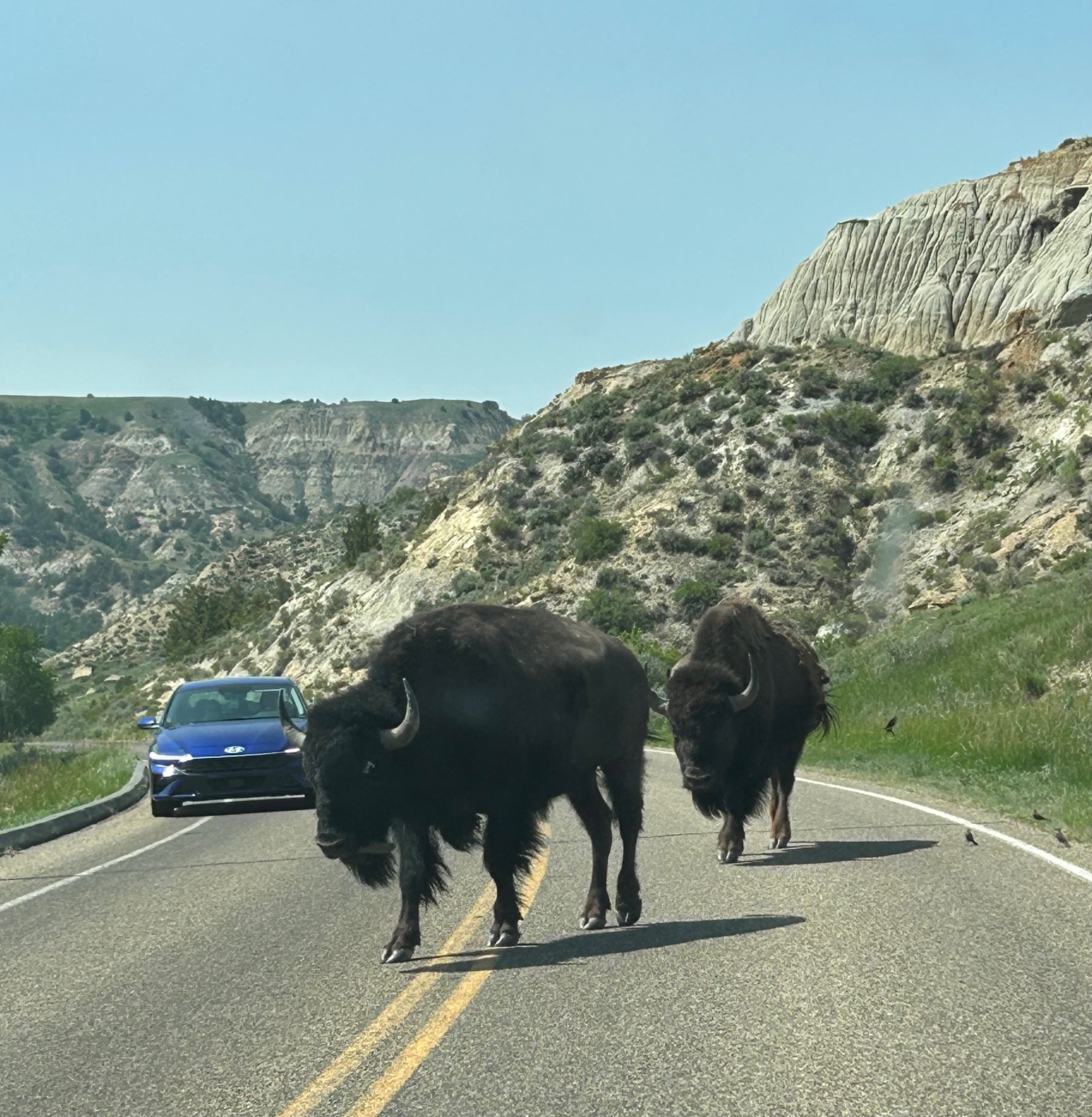
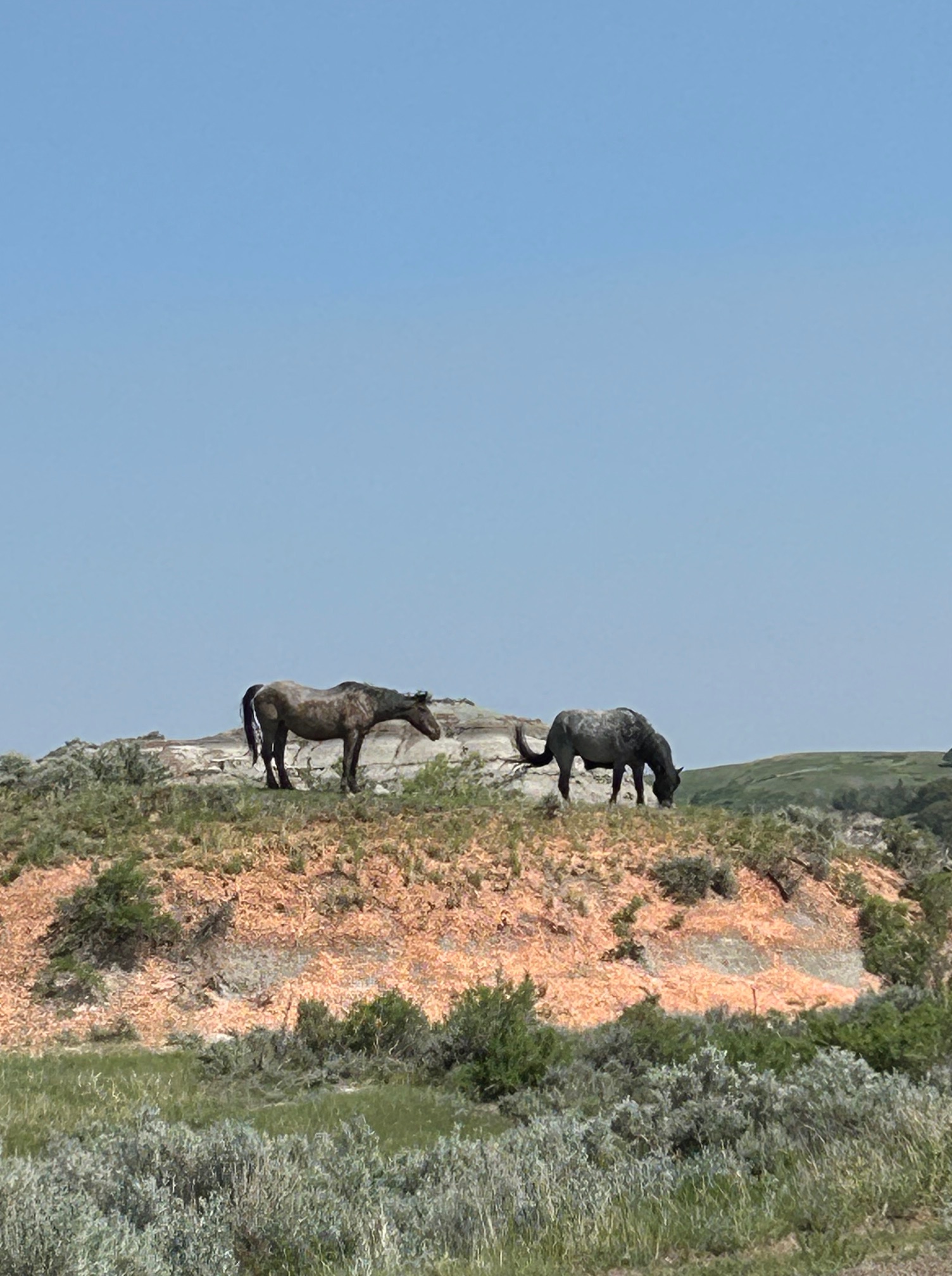
It also introduced me to the North Dakota Badlands, which is a giant miss for globetrotters unaware of such a breathtaking place. And I discovered the Medora Musical, an outdoor production that is both fun (e.g., wonderfully talented performers in a spectacular setting) and strange (e.g., cheesy mascots and regular voice-overs from the deceased creators of the show sixty years ago) and simply too much to truly put into words. And it led me through the Theodore Roosevelt National Park where I encountered majestic bison wandering down the highway, a zillion adorable (maybe?) little chirping prairie dogs, and stunning wild horses posing on hillside pedestals.

I crossed the Mississippi River, the Missouri River, and the Yellowstone River. And I stayed in sketchy hotels and dined in country restaurants and ate raspberry sorbet in front of a tiny new ice cream place that can never make enough money to survive even though I tipped well. It was my own version of a special two-thousand mile roundtrip.

It also provided a moment far less magnificent but much more meaningful.

On the first leg of my journey home, I stopped for lunch at a Chick-fil-A in Bismarck, North Dakota. Other than the chicken, of course, there is nothing very special about stopping for lunch at a Chick-fil-A in Bismarck, North Dakota. But as I sat there alone in a crowded restaurant, I had an unexpected personal moment. For some reason, I thought of little me growing up in Arkansas, who even with quite the imagination never pictured that I would someday be eating a fast food lunch in Bismarck, North Dakota. I’m not sure I can adequately describe how that realization struck me.

I get that you might find it sad, this man in his mid-fifties eating his grilled chicken tenders alone. Others there probably felt that way about it, too. I, on the other hand, found it deeply satisfying. Of all my own personal critiques of my life, one of my favorite parts is the large number of unexpected places that my journey has led. That was the sweet thought that occurred to me there: Who would have thought that I would ever be in that place at that moment? I know that I didn’t, and that is exactly what made it special.

I don’t know, maybe that’s just a definition of wanderlust. Regardless, that moment made the entire trip worthwhile.

Portfolio in Pictures

I saw Doc Hollywood in the movie theater way back in 1991, but it stuck with me over the years. In fact, I have repeated its storyline many times now, but it wasn’t until a year or so ago that my Malibu buddy, Dillon, recognized that it is basically the same storyline as the 2006 Disney Pixar movie, Cars. Must be a pretty good yarn to generate two popular movies.

I share that storyline often because a particular scene generated a personal tradition that I maintain on the back of my office door. In the original movie, the young arrogant doctor arrived at the embarrassing epiphany that the old crotchety doctor knows much more than he suspected. It was a hard and surprising lesson. Later, after learning that truth, the wise old doctor opens an antique armoire in his office to show pictures of the hundreds of babies that he had delivered over the years in that small town that were pasted inside that piece of furniture. The old doctor explained, “Well, this is my portfolio.”

For good reason, although I don’t remember the specific occasion, I remembered that scene during the 2012-2013 academic year, my second working in higher education, and my first in a major administrative role. It occurred to me then that my personal portfolio — what truly matters — would be comprised of each student that I have the honor to serve and see grow into their respective futures.

At the end of that academic year, I made a poster of a collage of pictures taken with students over the course of that year together. And in a sort of homage to Dr. Aurelius Hogue in Doc Hollywood, in place of an antique armoire, I taped my poster to the back of my office door. I told myself that I would look at it from time to time and remember what truly mattered.

I have looked at it more times than I can count, and I now have eleven additional posters taped to the back of my office door for each of the years that followed. Twelve posters for twelve years at three institutions, all filled with precious people and special memories. And I just received my thirteenth in the mail from my first year at Ripon College. If all goes as planned, there are many more to come.

Old Dr. Hogue told young Dr. Stone (aka Doc Hollywood) during his shameful epiphany, “I doubt you’d know crap from Crisco.” But later, discovering a suddenly willing protégé, he taught him gently that it is the people that matter more than anything. The people — “. . . this is my portfolio.”

That’s what the back of my office door says to me.

Oh, the Places to Run!

Submission guidelines:

  1. Email running photographs for consideration to ohtheplacestorun@gmail.com
  2. Include the location of the photo (i.e., city; state; nation)
  3. Share a brief description of the photo (e.g., the place, the run, the people, etc.)
  4. Categories include: nature (beautiful scenery); roadside attractions (interesting things); humor (funny things); friends/people (running buddies); and travel (pics taken on runs while traveling)
  5. You retain all rights to your photograph and will receive photo credit when posted on Oh, the Places to Run! (note: if you want to promote your personal social media account or running club, please share that information)

——————————————————————————————————————–

I wish I could remember.

There are certain things I do recall. Like joining my wife for a super slow 5k jog in Westlake Village way back in 2010 after I had taken a couple of decades off from running. And my subsequent decision to purchase a cheap pair of running shoes and try running again, knowing it wouldn’t last. And my surprise and excitement later that it did.

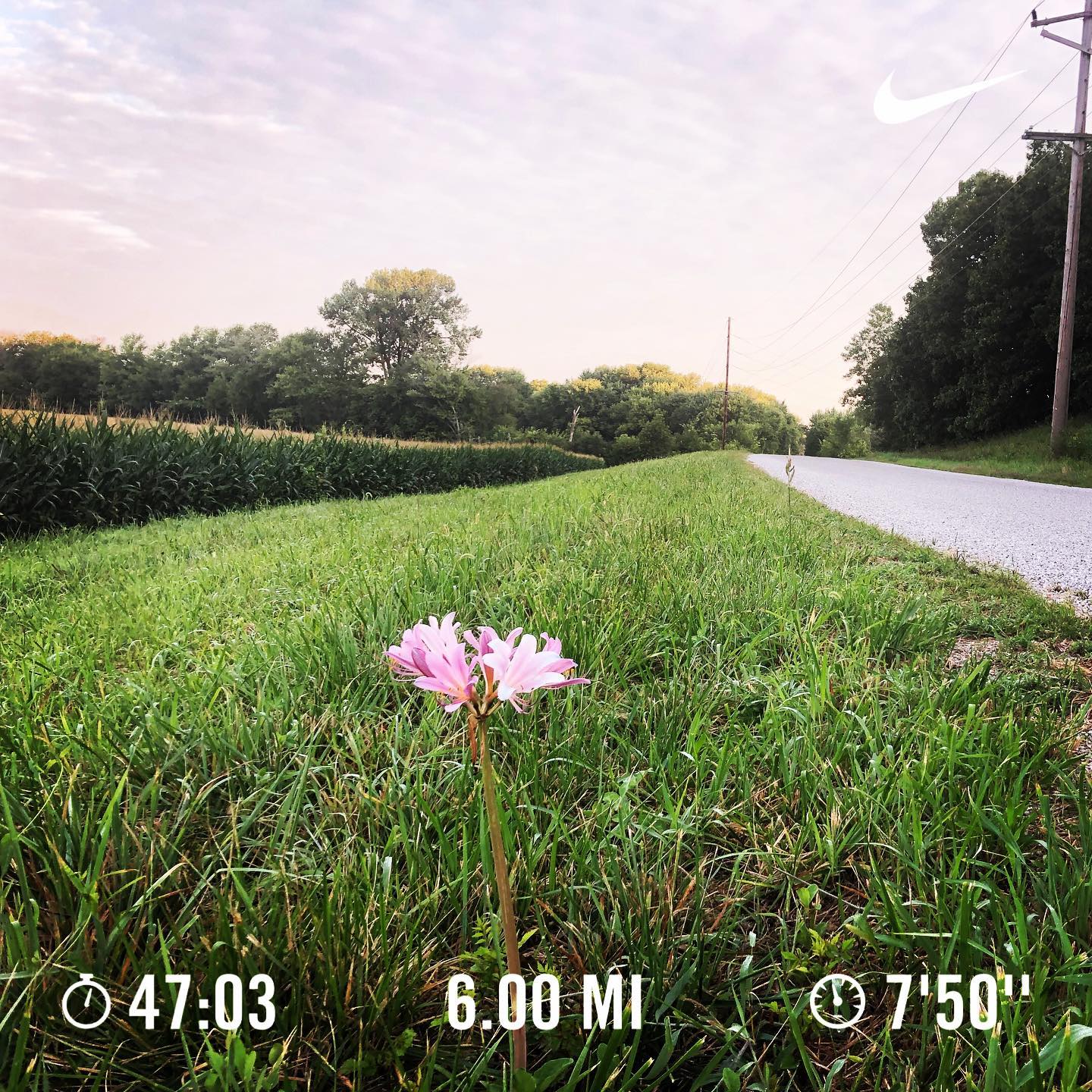
And I also remember that someone shared the Nike Run Club app with me even though I never used GPS. And then the app itself remembers that it was July 2, 2013, when I first used it, jogging 1.27 miles with my wife on Malibu Road, which led to thousands and thousands of miles shared with that app over the past twelve years.

But what I don’t remember is the first time I decided to add a picture as a memory of one of my runs. I wish I remembered. Because that changed my life.

I am not a world-class photographer. And I am not a world-class runner. But what I have become is someone with a habit of going out into the world with open eyes, searching for the beauty that is everywhere once you start looking. I want to capture that beauty when I run. To remember.

I have a lot of running pictures now. A lot. And not to brag, but some of them are actually pretty good (if you take enough pictures, you get lucky every now and then). I have shared many running pictures on my social media accounts over the years, and periodically friends have encouraged me to collect them in a book—and I might do that someday. But today I have a different plan.

Today, I am launching a new Facebook page and an Instagram page titled, “Oh, the Places to Run!” (Imagine Humans of New York but for running places.) It will start small, I’m sure, sort of like my running habit, but I hope that it will grow to change the lives of other people, too.

My habit began in Malibu, California, and many said that I would struggle to find beautiful photo material once I moved away from breathtaking ocean and mountain scenery, and I took that as a personal challenge. I soon discovered that my suspicion was correct: There is beauty to be discovered everywhere. At least that’s what I discovered living in urban Tennessee, and then rural Illinois, and now rural Wisconsin—and actually everywhere I have traveled along the way.

I will keep taking pictures and sharing them on my new pages, and I hope you all will add the new pages to your algorithms and follow, like, share, and comment along the way. But my dream is much bigger. I hope that past, present, and future runners will share their favorite running place photos with me, too, and that these pages become places where everyone can discover that there is beauty everywhere when we have eyes to see.

So please click on the following links and follow along on Facebook and/or Instagram if you would be so kind. And, if you are willing to share some of your own running photos for consideration, submission guidelines are at the top of this blog post.

As Dr. Seuss famously wrote: “You’re off to great places! Today is your day! Your mountain is waiting…so get on your way!”

Let’s go!

Holy the Firm

We misplaced our hiking habit in our move to Wisconsin, but it magically reappeared last weekend during our trip to the Wisconsin Dells to celebrate Jody’s birthday. And that makes me happy.

“The Dells” refers to a scenic gorge on the Wisconsin River about an hour’s drive from our home, but the accompanying small town is widely known in the Midwest as a tourist destination, branding itself as the “Waterpark Capital of the World.” We found the touristy town hard to describe but fun to experience. You might imagine Gatlinburg and Las Vegas had a baby that loves cheese curds.

Jody had the brilliant idea of doing a weekend trip in the offseason as our introduction to the Wisconsin Dells, which worked out well. I’m really not sure that either of us can handle it when all the screaming children — um, I mean, when all the well-behaved children arrive en masse with their extraordinary parents on summer vacation. It might be best that we remain an hour’s drive away from Memorial Day to Labor Day.

We had a fantastic weekend. When we arrived on Saturday, we wandered through shops and bought peanut butter fudge. We had way too much fun taking selfies (in “totally rad” costumes) at Totally ’80s Immersive Experience. We had a lovely dinner and tried our luck at bowling afterward. But on Sunday morning, we drove a few miles out of town for a hike at Mirror Lake State Park. That was the best.

Winter is persistent in Wisconsin, as you might suspect, so a mid-April hike has a different appearance than past hikes in many of our former homes. But it was so lovely. We hiked for several miles and were alone the entire time. Nobody around but us.

And the snow birds returning overhead.

And the evergreen trees.

And the crunchy leaves.

And the bare branches with the tiniest buds.

And the mirror lake.

And the quietness and “peace of wild things,” as Wendell Berry called it.

The news seems pretty shitty these days. The rule of law is in question. The economy is drunk texting our 401ks. The government is making mistakes on who they deport to brutal prisons in El Salvador. If you add in a few personal problems, it is enough to make one consider despair.

Going for a walk in the woods might not solve the world’s problems, but I suggest it anyway. At least I found it worthwhile last Sunday morning.

Annie Dillard wrote the mystical masterpiece, Holy the Firm, in 1977 following news of a plane crash that disfigured a small child and got her to wrestling with the problem of pain and evil in the world. How does one carry on in a world that is often cruel and feels meaningless?

Her title, Holy the Firm, as I understand it, referred to something the earliest Christians believed existed beneath the Earth’s surface, something that was connected to their conception of God, which meant that it was connected to absolutely everything. That’s what Annie Dillard pointed toward in her little book. In her quest to find meaning in the meaningless, she went outside and ventured into nature, where she touched the actual planet in a quest to discover the “firm” that is “holy.”

I’m suggesting that, too, for what it is worth.

Last Sunday morning, I noticed the tiniest buds on the bare branches that seemed to say to me that all good things will return to life someday. I noticed the geese squawking above the treetops on their return trip home that seemed to say to me that loneliness won’t last forever. I noticed the evergreens standing proudly over the still water that seemed to say to me that some good things really do last forever. And I happened to notice all of this with my forever friend who was poised to celebrate yet another gorgeous trip around the sun.

As we hiked, we came to joke about the “Caution: Steep Hill” signs that we encountered often, signaling hills that really were somewhat challenging but not that difficult for us. Afterward, I noticed the Northwest Trail loop that we completed described as “the most difficult trail in the park.” We laughed, having navigated some far more difficult trails in our brief hiking careers.

Maybe that’s worth remembering, too. On this hike called life, the more that we experience, the better equipped we can be for the trails that are to come. When you find despair attempting to lock you indoors, crawl out the window and go on an actual hike. And just walk, and watch, and listen.

Is Contentment Overrated?

The Far Side, by Gary Larson

Happiness has me surrounded.

I have been married to my best friend in the world for 30+ years. We live in a cool, historic house in a cool, historic town, and we both work for a small college that we adore and hope to work at for the rest of our careers. We have two incredible daughters who are good and independent human beings who make us proud and do important work that truly makes a difference. We aren’t wealthy, but we have a comfortable income and money in the bank.

There is more.

I teach “sports law,” combining three things—teaching, sports, and law—that I have loved for a long time. I preach periodically for a church where I can fully be me. I am on the board of a nonprofit that once changed my life for good. I have developed a habit of reading good books that constantly teach me about life. My back is doing well, so I can once again engage my love for running. I have adopted a weird diet where I feel awesome every day.

I’m embarrassed to admit there is still more.

I have now lived long enough to do many things. I have lived all over this country, experiencing Gulf Coast sunrises and Malibu sunsets, Arkansas ridges and Tennessee lakes, Illinois harvests and Wisconsin winters. And I have traveled all over the world, too, from an African safari to a Brazilian rain forest, from the Eiffel Tower to the Taj Mahal, from a Mexican resort to a Spanish cathedral. And best of all, I have developed meaningful relationships with so many wonderful humans in so many wonderful places that reflect every imaginable aspect of the beauty in diversity. I have been loved, and I have loved.

So I am happy. As happy as I have ever been. And I wonder if I am the only person who can possibly be unhappy about being happy? I am the ridiculous cow in The Far Side cartoon informing Wendell that she is somehow not content.

I should explain what I have recently concluded: My true desire is neither happiness nor contentment. I desire living with passion and purpose instead.

David Brooks recently published a lengthy essay in the New York Times titled, “A Surprising Route to the Best Life Possible.” Brooks wonders why people choose “voluntary pain” and through exploring many examples, including himself, concludes that humans are better when taking on challenges and enduring difficulties in their quest for something significant. Brooks argues that there is somehow a “blessing” in “human instability” and that to be “enchanted” or “entranced” or “seized” by a great calling is preferable to the alternative, despite the inevitable pain.

You have no idea how much his essay means to me—especially at this stage of my life when I sense a temptation to count your blessings and call it a day, and especially when confronting my guilt for resisting contentment with so many reasons to be happy.

Maybe contentment is simply overrated. Brooks writes, “We want to be in love — with callings, projects and people. The opposite of love is not hate, it’s indifference, and indifference is an absolutely terrible state to endure. I guess there are some people who have earned the right to want contentment above all, to sit back and enjoy whatever prosperity they’ve achieved. But I rarely meet such people, even people in retirement.”

I really do appreciate all of the very good things in my happy life. (And no, I’m not silly enough to move again, giving up the beauty we have discovered.) And contentment is fine in a particular sense, i.e., not being greedy, accepting every moment for what it is. But I crave a challenge, and the bigger the better. I want more. I need to want more.

As Brooks chose to close his essay, “People tend to get melodramatic when they talk about the kind of enchantment I’m describing here, but they are not altogether wrong. The sculptor Henry Moore exaggerated but still captured the essential point: ‘The secret of life is to have a task, something you devote your entire life to, something you bring everything to, every minute of the day for your whole life. And the most important thing is — it must be something you cannot possibly do!’”

I’m really not content, and I’m happy to admit it. Even at my age, and even surrounded by so much good, I crave a monumental task instead.

A Line in the Sand

Confession: I struggle to keep up.

The well-orchestrated and rapid-fire actions of the second Trump administration are dizzying, and while I have many opinions on many issues, I just can’t seem to keep up. I have a job (that I love) that consumes a significant amount of time, and by the time I attempt to be informed enough to formulate thoughts potentially worth sharing, those issues are old news.  

And to be honest, part of me wants to remain silent, partly from the dizziness of it all, but also because I recognize that President Trump and his party won the election and have a relatively short amount of time to make their case for remaining in power before the American people render a verdict at the midterm elections. But another part of me wants to speak out constantly, not only because I care about so many of the issues, but also because I recognize that silence contributes to a gaslighting effect for those that suffer from certain words or actions, including many friends from historically-marginalized groups that wonder if anyone sees their pain.

Despite the tennis match going on in my mind, I have something to say today that I hope will be heard.

I’ll probably lose some of you at the start when I reference Erwin Chemerinsky. Erwin Chemerinsky is dean of the law school at UC-Berkeley, and just the mention of Berkeley will lead some to tune out, but I beg you to stay with me anyway. Chemerinsky is a constitutional law scholar, on the liberal side as you might suspect, but if one can recall such a time, he was also a good friend of the late Ken Starr, a constitutional law scholar on the conservative side who was dean at the law school I chose to attend in 2008. Chemerinsky and Starr rarely arrived at the same interpretive conclusions, but they shared a love and respect both for each other and the United States Constitution.

The New York Times published a guest essay from Chemerinsky two days ago titled, “The One Question That Really Matters: If Trump Defies the Courts, Then What?” Please recognize this title question is neither liberal nor conservative but a question of constitutional structure that is simultaneously an existential question for the American form of government.

It is a short essay that I suggest you read, but I will share the highlights. Chemerinsky writes:

“It is not hyperbole to say that the future of American constitutional democracy now rests on a single question: Will President Trump and his administration defy court orders? . . . [T]he Constitution gives judges no power to compel compliance with their rulings — it is the executive branch that ultimately enforces judicial orders. If a president decides to ignore a judicial ruling, the courts are likely rendered impotent . . .. It is unsettling even to be asking whether the president would defy a court order. Throughout American history, presidents have complied with mandates from the courts, even when they disagree . . .. [T]here are no definitive instances of presidents disobeying court orders. The line attributed to Andrew Jackson about the chief justice, that “John Marshall has made his decision, now let him enforce it,” is likely apocryphal . . .. In addition, modern scholarship has undermined the story that Abraham Lincoln defied an order from the chief justice invalidating a suspension of habeas corpus during the early days of the Civil War . . .. Thus far, the Trump administration has given conflicting signals as to whether it will defy court orders. On Feb. 11, Mr. Trump said, “I always abide by the courts, and then I’ll have to appeal it.” . . .But just one day prior, Mr. Trump posted on social media, “He who saves his Country does not violate any Law.” . . . The reality — and Mr. Trump and those around him know it — is that he could get away with defying court orders should he, ultimately, choose to do so. Because of Supreme Court decisions, Mr. Trump cannot be held civilly or criminally liable for any official acts he takes to carry out his constitutional powers. Those in the Trump administration who carry out his policies and violate court orders could be held in contempt. But if it is criminal contempt, Mr. Trump can issue them pardons . . .. Defiance of court orders could be the basis for impeachment and removal. But with his party in control of Congress, Mr. Trump knows that is highly unlikely to happen. If the Trump administration chooses to defy court orders, we will have a constitutional crisis not seen before. Perhaps public opinion will turn against the president and he will back down and comply. Or perhaps, after 238 years, we will see the end of government under the rule of law.”

I have repeatedly emphasized Chemerinsky’s question in private conversations for weeks now, and I wish I could elevate it above all the noise. It is an existential question for American democracy, and I want to have done my part at least to try to place it in the spotlight it deserves.

Let me be blunt: Presidents and parties come and go, but if any American president, ever, adopts an approach that defies the decisions of the courts, then we no longer have “the rule of law,” which has been the central feature of the United States government since the Constitution was adopted in 1787.

President Trump has famously said many things, including:

  • “I can find a cure to the most devastating disease . . . or announce the answers to the greatest economy in history or the stoppage of crime to the lowest levels ever recorded and these people sitting right here [Democrats in Congress] will not clap, will not stand, and certainly will not cheer for these astronomical achievements.”
  • “I could stand in the middle of Fifth Avenue and shoot somebody and I wouldn’t lose [MAGA] voters.”

Unfortunately, I think that for many he is correct on both counts. But I hope not for everyone.

I know full well that for many the support of a political party or a specific political leader is unwavering. But I hope that is not true for all. I hope that for many there are certain lines that cannot be crossed. And for anyone that values democracy as a form of government, this question regarding a respect for the “rule of law” has to be at the top of the list.

The Televised Revolution

“The revolution ‘bout to be televised. You picked the right time, but the wrong guy.” – Kendrick Lamar (New Orleans, February 9, 2025)

“He who saves his Country does not violate any Law.” – Donald J. Trump (Truth Social, February 15, 2025)

I consider myself a decent student of American history and a terrible interpreter of hip-hop music, but here goes anyway.

Last Sunday, while watching the Super Bowl Halftime Show featuring Kendrick Lamar, I recognized that the artistry on stage was communicating more than I understood. I was somewhat aware of the Kendrick v. Drake feud and that part of the performance concerned the former’s accusation of the latter’s possible relationships with underage girls (which is denied), but introducing Samuel L. Jackson as Uncle Sam and dancers forming the American flag signified much more than an artist feud. After considerable reading, learning, and reflecting, I have come to believe that the message from the Pulitzer-Prize-winning artist is both profound and sobering.

The message? We are experiencing an actual political revolution.

At the beginning of the performance, while standing on top of a Buick and in reference to a poem by Gil Scott-Heron in 1970, Lamar said: “The revolution ‘bout to be televised. You picked the right time, but the wrong guy.” The original poet had written “The Revolution Will Not Be Televised” and later explained his meaning, i.e., that true change originates in one’s mind, but Lamar flipped the script and left his lyrics for our interpretation.

I buy the following interpretation: We are watching a political revolution unfold, and although revolution might be called for, we picked the wrong revolutionary.

Maybe it is just me, but I had always imagined that a government overthrow involved guns and tanks, but it makes sense that a revolution can occur even through a peaceful transfer of power. We are now living through the subsequent dismantling of a government.

What many anti-Trumpers struggle to see is that many MAGA supporters either want the government destroyed or don’t mind that it is. It simply makes sense that those desiring to upend a constitutional system aren’t overly concerned if an action is unconstitutional. And lawsuits over checks and balances don’t mean much if you really don’t care about the checks and balances in the first place.

Whether MAGA fully appreciates the ramifications is beside the point. The reality is that a point exists where one despises government so much that its reform is uninteresting. 

Donald Trump’s post on Truth Social yesterday is telling: “He who saves his Country does not violate any Law.” He pinned it to the top of his page for emphasis, and I suspect that he is well aware of its association with Napoleon Bonaparte, who came to power in the French Revolution. Regardless, it suggests himself as an American savior who stands above the law that governs the nation.

What we are seeing unfold is fundamentally different from your typical debate between a conservative form of American government and a liberal form of American government. There have absolutely been power grabs before, but none that look like this, and the others, when rebuffed, have retreated under the veil of respect for the rule of law and our system of government.

The revolution is frightening for the groups that the revolution intends to marginalize, of course,  but it is also concerning for many more that do not know what an American government unmoored from constitutional checks and balances might be.

For those that desired revolution, their joy is logical, but it will be depressing for other supporters who may come to see that their beliefs, fears, and/or prejudices were played by an impressive propaganda machine to overturn rather than reform a system of government—and allow a small group of people to acquire immense power and wealth for themselves.

I am particularly disturbed by the  professed devotion to the flag and the public oath to preserve, protect, and defend the Constitution of the United States. I am convinced that what we are witnessing is an upending of that Constitution and the flag that has heretofore represented an imperfect but unique form of government.

I am not unequivocally devoted to the American style of government, nor am I opposed to nonviolent, revolutionary change. In fact, I desire revolutionary change for the poor and marginalized in this nation and around the world. But if I heard him correctly, I happen to agree with Kendrick Lamar. We picked the right time, but the wrong person.

A House (Still) Divided Against Itself Cannot Stand (Forever)

“A house divided against itself, cannot stand.” – Abraham Lincoln on the campaign trail in Springfield, Illinois, June 16, 1858

Our friend, Flo, graciously gave me a signed copy of Erik Larson’s latest book, “The Demon of Unrest: A Saga of Hubris, Heartbreak, and Heroism at the Dawn of the Civil War,” as a Christmas gift, and I read it with great interest, especially at this particular moment in American history. The book chronicles the few short months between the unlikely election of President Abraham Lincoln in November of 1860 and the outbreak of the American Civil War at Fort Sumter in April of 1861 by venturing beneath the headlines and into the lives of some of the key players in the unfolding tragedy. The stories are captivating, to say the least.

I finished the hefty book amid the rapid-fire headlines currently firing from our nation’s capital, wondering if the combination provided anything for me to say. And I think that I do, have something to say that is.

For starters, to state the obvious, our current political polarization with its cyclical outrage is not new. The American Civil War was deep polarization by definition, in that case producing a macabre debate over exactly how many hundreds of thousands of deaths followed, but I began to wonder if today’s toxic political climate is an instance of history repeating itself—or, is it better understood as an ongoing history?  I suspect the latter.

I have had eleven special opportunities to teach a course built by a fantastic professor named Peter Robinson, titled, “Apology, Forgiveness, and Reconciliation,” and in so doing I stumbled across a December 2019 article in The Atlantic by Adam Serwer with the provocative title, “Civility Is Overrated.” The article’s premise is that the aftermath of the American Civil War—an era popularly called Reconstruction—was not, in fact, a time of healing and reconciliation, but a time that perpetuated the original division through its “false promise of civility” that then evolved into Jim Crow, and a century later, the American Civil Rights Movement of the 1960s. In the final paragraph, Serwer writes: “In the aftermath of a terrible war, Americans once purchased an illusion of reconciliation, peace, and civility through a restoration of white rule. They should never again make such a bargain.”

Well . . .

So I’m just thinking here: President Lincoln’s famous campaign speech in the important prelude to the American Civil War warned of what happens to divided houses, and a century later, Reverend King’s most famous speech continued to lament the maintenance of that divided house (read the first few paragraphs of his speech, at least) and dreamed an inspiring dream of a yet-to-be-realized undivided house. I think that today we’re on the next stanza of the same tragic song.

But if President Lincoln’s famous line (citing Jesus) from his famous speech is correct, the song does not have unlimited stanzas.

President Trump is a fascinating phenomenon. His now larger-than-life persona is venerated by many and reviled by many others—and his flurry of provocative executive actions during his first few weeks back in office naturally produces both reactions. But what I find disturbing is that even many of the Republicans that vehemently oppose President Trump—the RINO (“Republicans in name only” as he calls them)—although in opposition to most of his initial actions, seem to agree with his assault on one thing: DEI (Diversity, Equity, and Inclusion). Instead of multiple nuanced perspectives on the general concept of DEI, there seem to be only two: Good. Or, Bad.

Let me be clear: While money/power always lurks behind the curtain, the American Civil War was fought specifically over DEI. Make no mistake. And the Civil Rights Movement was without question a DEI movement. And amid the sweeping number of issues on the table today, I believe that DEI as a cause or concern, broadly speaking, remains at the center of it all.

One telling example is to recall the home stretch anti-DEI emphasis of the 2024 Trump campaign commercials that helped secure his clear victory at the polls.1 2 And as another specific but dramatic example, you may have seen recently that new Secretary of State Marco Rubio hired an undersecretary for public diplomacy that wrote the following less than four months ago: “Competent white men must be in charge if you want things to work. Unfortunately, our entire national ideology is predicated on coddling the feelings of women and minorities, and demoralizing competent white men.”

My friend, Dr. Richard T. Hughes, published “Myths America Lives By” in 2018, and in discussing various foundational myths identifies white supremacy as “the primal American myth.” One of the blurbs for his book was written by theologian, Dr. James H. Cone, who himself authored one of the most devastating books I have ever read, titled, “The Cross and the Lynching Tree.” For Dr. Hughes’s book, Dr. Cone wrote: “It takes a whole lot of courage for white theologians and scholars to speak the truth about race. If we had more white theologians and religion scholars like Hughes who would break their silence about white supremacy and face it for what it is, we–together–could make a better world.”

I, for one, wish to have more courage, for such a reason.

Now I should state my belief that our nation’s troubling supremacist foundations include more characteristics than simply white, although white is major, and that it is no coincidence that DEI work engages those very conversations. That a visceral response to such conversations comes from many otherwise thoughtful individuals simply reveals to me the depth of the foundations.

So did the Democrats lose the presidential election in large part because their diversity, equity, and inclusion arguments were unpopular? I think so. I know without a doubt that Reverend King and the Civil Rights Movement’s diversity, equity, and inclusion arguments were unpopular. And I know that President Lincoln and the Republicans of the 1860s’ diversity, equity, and inclusion arguments were unpopular, too.

I’m imagining a similar speech to that President Lincoln delivered long ago but in today’s divided land, not that our house/nation “cannot endure, permanently half slave and half free,”3 but that we cannot endure half engaging diversity, equity, and inclusion conversations and half silencing them.

I think there is something demonic in the political unrest today, and I do not think that it has much to do with the typical liberal and conservative approaches to domestic, economic, or foreign policy. Instead, I believe that there is a foundational aspect of American history that has always existed and continues to divide us today, a foundation that seeks to reserve power and privilege for certain “types” of people through misusing words like “meritocracy.” And while this divided house has persisted for a very long time now, I agree with Jesus and Reverend King and President Lincoln and many others who were quoted as saying that divided houses cannot survive forever. But if there truly is this fundamental design feature that continues to divide us, and if we truly “face it for what it is,” as Dr. Cone wrote, I share his hope that “we—together—could make a better world.”

—————————————————————————————————————–

  1. Poltico.com on Election Day: “The border and inflation have been GOP mainstays in advertising all year. But there was one other late entry into the Republican onslaught against Harris: More than a quarter of GOP spots that have aired in battleground states since Oct. 1 mentioned transgender issues in some way — most seeking to tie Harris to the concept of prison inmates, including immigrants, receiving gender-affirming surgery. It’s not a new playbook for Republicans, who leaned into transgender issues in key races in the 2022 midterms with little electoral success. It represented a shift in the presidential race: The first TV ad mentioning the issue did not air until mid-September. Still, it became one of the top issues in Republican presidential ads in the final stretch, though the economy and immigration still loomed larger. ↩︎
  2. See also, The Democrats Show Why They Lost. ↩︎
  3. https://www.nps.gov/liho/learn/historyculture/housedivided.htm ↩︎

Days of Reckoning

With so many statements vying for limited headline space, it seems that President Trump’s audacious assertions about Canada, Greenland, Gulf of Mexico, and the Panama Canal have been characterized by many as mostly “Trump being Trump,” which may very well be true. And I probably would not have given it much more thought had I not at the same time been reading my favorite college professor’s sweeping history of the American West titled, Continental Reckoning. 

For future reference, when you hear that someone has written a “sweeping history,” you can safely assume that it is a big ass book, which this one is. But it is a worthwhile read, especially for Americans to “be closer to understanding ourselves and how we have come to be.” (Prelude, page xxx — that’s Roman numeral thirty, not something dirty!)

I confess an added personal interest in the American West having lived in California for a dozen years in the past, and as I dove into the sweeping history in early January, it seemed all the more relevant when historic wildfires devastated the large numbers of people that have been drawn westward to what has become extremely valuable properties there. But it was reading of historic American expansion (and its consequences) alongside President Trump’s bold expansionist rhetoric that really began to capture my attention. 

A book review is not my intention, but I will explain that the mid-1800s witnessed incredible American expansion and transformation, and while historians typically focus on the violent and fateful American Civil War from that era, Dr. West encourages us to “broaden our view in space and time.” He writes, “The Civil War and the birth of the West . . . should be given something like equal billing in this crucial transition in national life. Each event has its own story and deserves its own narrative, but each was often in conversation with the other, and when each is properly considered in its broadest context, neither can be understood without the other.” (Prelude, page xx)

The extraordinary experience of the American West erupted from the discovery of California gold just as the territory became an American possession in 1848, something Dr. West calls, “The Great Coincidence.” (i.e., “Within two hundred hours of its becoming part of the republic . . . California began to be revealed as the most valuable real estate on the continent.” – page 5) 

It is no surprise that significant expansion is often an economic flex, but the consequences often extend much further.

For example, in the story of the American West, in addition to the vast increase in power, opportunity, and affluence, there were incredible advances in communication, science, technology, and transportation — but the costs were enormous: “hundreds of thousands dead or dispossessed” (454), “land stolen and turned into poisoned grotesqueries” (454), and an appalling racial ordering with devastating effects for Native communities, Black Americans, Hispanic Americans, and Chinese immigrants — Dr. West even shared another historian’s observation that the architects of Nazi Germany admired the United States and “believed they were ‘not so much inventing a race-obsessed state as catching up with one’” based on the U.S. treatment of those considered non-“white.” (453)

I recognize that this is the 2020s and not the 1850s, and that talk of expansion might be the bluster of a negotiator, but my thought for those of us used to a flag with fifty stars is this: Don’t take expansion rhetoric lightly. Be aware. Expansion produces consequences, often significant, and we should not allow our unfamiliarity with it and the possible allure of new acquisitions to prevent us from careful consideration of past experiences in our own days of reckoning, particularly if the proposed expansion is broad and, well, sweeping.

Faulkner’s famous line, “The past is never dead. It’s not even past,” seems apropos. Or, as Dr. West suggests near the end of this volume that he subtitled, The American West in the Age of Expansion: “The consequences remain; yesterday makes today. As for tomorrow and how best to use it, the stories and their voices offer up hints and provocations.” (454)

Well… (Or, Facing Reality)

I fancy myself an early riser and enjoy getting to the office before the campus comes to life, but I often encounter a wonderful member of our custodial staff who has been at work long before my arrival. Recently, we struck up a conversation about the bitterly cold temperatures in the forecast for today, and as our conversation concluded, my colleague said with a smile and as a matter of fact, “Well, we are in Wisconsin.”

I love it. I’m going to use that phrase a lot.

Later, it occurred to me that the sentiment that undergirds that statement reflects a deeply held value of mine regarding life in general.

I am a Christian, but being raised in a specific Christian tradition that encouraged me to think deeply and arrive at my own conclusions, my personal journey has led me to become a different kind of Christian than expected, possibly different than you picture when you hear the term, and probably much to the dismay of several teachers along the way. But I have found great sustenance in the writings of unique thinkers from days gone by, and one of those is William Stringfellow (1928-1985). Near the end of his 1966 book, Dissenter in a Great Society, the lawyer and lay theologian wrote:

“[T]he Christian knows . . . that this world is a fallen world, not an evil world but the place in which death is militant and aggressive and at work in all things. . . . Of all people, Christians are the most blunt and relentless realists. They are free to face the world as it is without flinching, without shock, without fear, without surprise, without embarrassment, without sentimentality, without guile or disguise. They are free to live in the world as it is.” (page 161, updated with gender neutral terms)

Now that has not been my natural experience as a Christian or with Christians, so I apologize for cutting to the chase with that reading because there is much to be understood from Stringfellow prior to such a conclusory passage, but trust me when I say that once I got the full impact of Stringfellow’s theological framework, that passage made a deep impression on me. One way to put it is that it led to a desire to say to myself when life seems unhinged, “Well, we are on Planet Earth.”

I sincerely aspire not to be shocked by what happens in this world, and although a work in progress, I do make progress. And while the limits are often tested, I am less and less surprised by elections, politicians, business tycoons, crimes, illnesses, and disasters. I still feel the deep disappointment, pain, and sadness that acts of injustice produce, but importantly, I am less likely to despair and less likely to live in fear.

As Stringfellow put it, I strive to accept the world we live in for what it is. That’s accept, not approve; in fact, as Stringfellow writes later, I am in perpetual protest. But as a “blunt and relentless realist” who is less likely to be debilitated by current events, I can protest with a steady resolve and with inexplicable hope.

It is bitterly cold outside today in my new home state, but saying “Well, we are in Wisconsin” reminds me that cold weather is to be expected and allows me to bundle up and face the hard reality.

That general idea gets me through life, too.