Recently, at a lovely dinner with new friends, our experience with Hurricane Katrina came up in conversation, which unleashed, of course, a thousand stories from the two of us, not to mention the associated emotions and special memories. I am not ashamed to admit that in the twenty years since the storm I have regularly referred to that time period as the most fantastic experience of my life—but saying so always seemed bizarre. That my fondest memories are located in an historic disaster confirmed in my mind that I am a certified weirdo.
And yet, this very thought reminded one of our dinner hosts of a book that she then loaned to me at the end of the evening, and reading it has been a revelation. It turns out that I am not alone.
Rebecca Solnit published A Paradise Built in Hell: The Extraordinary Communities That Arise in Disaster back in 2009, and through examining five historic disasters—the San Francisco Earthquake (1906): the Halifax Explosion (1917); the Mexico City Earthquake (1985); the September 11 Attacks (2001); and Hurricane Katrina (2005)—the author challenges the assumption that communities inevitably collapse into chaos by sharing stories of incredible altruism and cooperation instead.
My wonderful memories following the destruction wrought by Katrina might actually be, dare I say, normal.
I remember being royally pissed off two times after Katrina (well, three if you count the day I tried to call FEMA, but that’s beside my point). The first was months after the storm when we left the Gulf Coast for the first time and well-meaning friends asked if “things were getting back to normal.” No fault on their part, but the inability to comprehend that our community had been permanently and fundamentally changed was jarring. But the second was far worse for me personally, and it was harder to comprehend myself why it produced such strong emotions. When I heard someone from the Gulf Coast wish for things to get back to normal, I was livid. When I calmed down enough to reflect on why that statement made me so furious, as strange as it seemed even then, it occurred to me that I never wanted the “new normal” to end.
To be candid, I am still sorry that it did.
Solnit refers to this as a disaster utopia. She writes: “When I ask people about the disasters they have lived through, I find on many faces that retrospective basking as they recount tales of Canadian ice storms, midwestern snow days, New York City blackouts, oppressive heat in southern India, fire in New Mexico, the great earthquake in Mexico City, earlier hurricanes in Louisiana, the economic collapse in Argentina, earthquakes in California and Mexico, and a strange pleasure overall. It was the joy on their faces that surprised me. And with those whom I read rather than spoke to, it was the joy in their words that surprised me. It should not be so, is not so, in the familiar version of what disaster brings, and yet it is there, arising from rubble, from ice, from fire, from storms and floods. The joy matters as a measure of otherwise neglected desires, desires for public life and civil society, for inclusion, purpose, and power.”
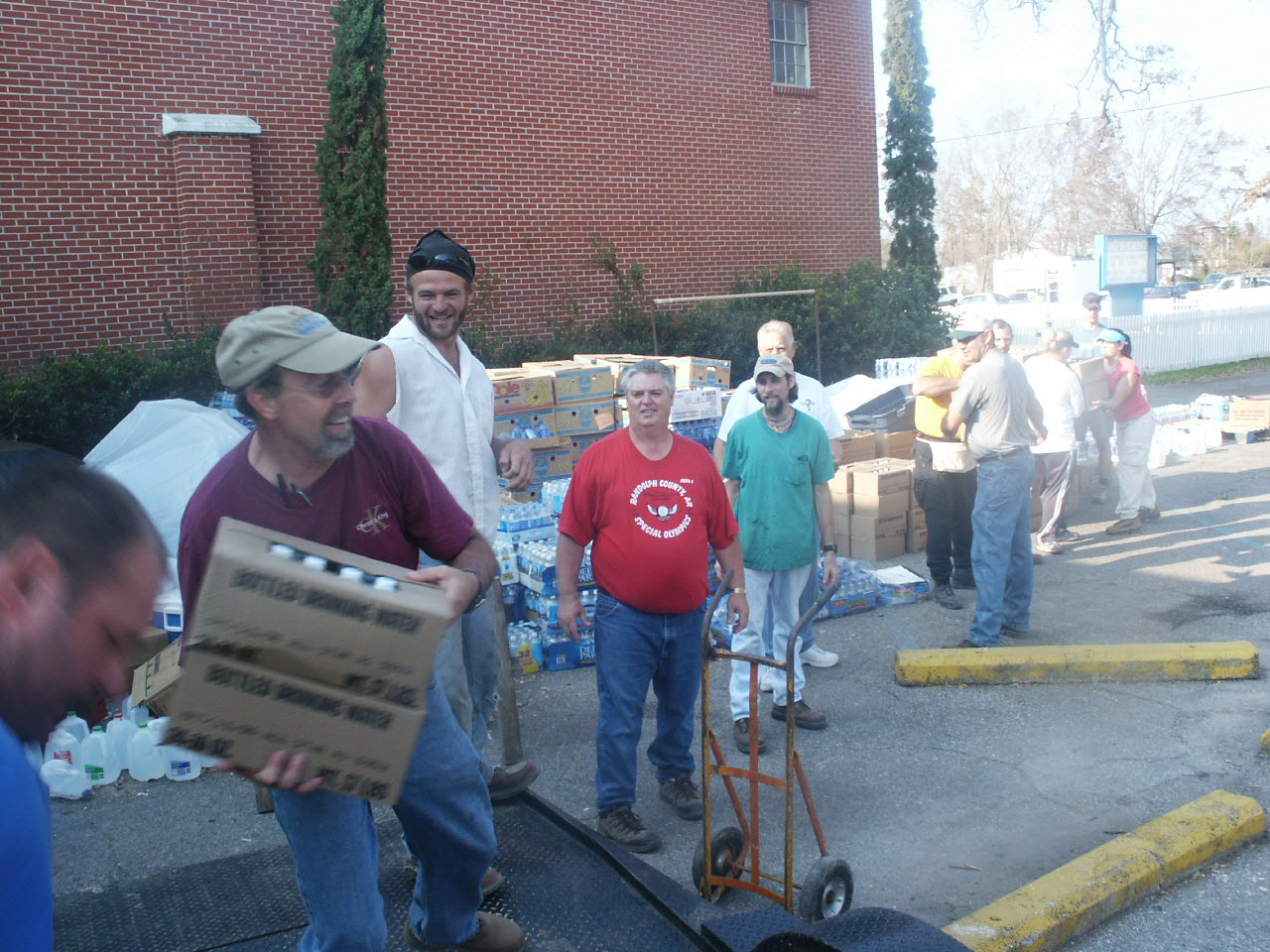
From time to time, I stroll down memory lane and look through pictures from our Katrina experience. The one above is one of many that make me smile. Look closely, and what you will see there is joy. Old friends, new friends, and complete strangers coming together to share and care for no other reason than good and noble hearts. We all worked together, ate together, lived together, loved together. Defying expectations, in the midst of incredible suffering, we laughed together and actually had fun. I can’t explain it, but I experienced it, and it is more comforting than you know to learn that our experience was not an anomaly.
I cannot say that the future is bright. Our climate crisis is predicted to unleash more disasters than ever. Our national debt crisis is predicted to destroy our economy in twenty years. And artificial intelligence is declared by its own people as an existential threat to the planet. But take heart, and I speak from experience, humanity has the inherent ability to respond in beautiful ways specifically in the very worst of times. That may not sound encouraging, but it is true.
As Solnit described, “These remarkable societies suggest that, just as many machines reset themselves to their original settings after a power outage, so human beings reset themselves to something altruistic, communitarian, resourceful, and imaginative after a disaster, that we revert to something we already know how to do. The possibility of paradise is already within us as a default setting.”
Put another way, it is a great comfort that I actually believe in the beautiful metaphor of resurrection. And when it occurs, it is a sight to behold.


Proud to be a “weirdo” too.
I was only there for a week or so, but I stood where that picture was taken and I remember the “irrational” joy that you can still see on the faces of those volunteers.
Those who were there understand already, but it’s probably impossible explain it to those who weren’t.
You were there from the beginning. I can’t imagine how it must have affected you & your family.
LikeLiked by 1 person