Tag Archives: resilience

Let Me Live Bravely

I could not have told you that the song was titled, Tubthumping, nor did I know that the band was Chumbawamba, but as all good earworm songs do, if you simply say the phrase, “I get knocked down,” then by pure instinct I will start singing, “But I get up again / You’re never gonna keep me down.” And I will sing those three phrases over and over and over for days on end.

I watched America’s Funniest Home Videos last night, a show that has made good use of that particular tune on several occasions, and a child said the sentence “I get knocked down, but I get up again” into the microphone at an elementary school performance and then promptly walked back to the risers and tripped on the first step and face planted. (Yes, she got up again.)

Timing is everything.


Timing is everything with me as well. Early yesterday morning, I had a moment. I had decided that I would do my weekend run at the Green Lake Conference Center, a spectacular property featuring 900 acres of unspoiled beauty, and with a recent snow and ice storm I surmised that it might be particularly beautiful right now. And it was. It was also really cold, a wind chill of negative one to be exact, but that hasn’t stopped me from running just yet.

The main roads were mostly clear when I began my run, and the main roads were the path that I chose for the first mile. But I really wanted to get to a particular place in the woods where you can climb a small tower for breathtaking views of the lake, and I determined that the path to said tower was up a snow-covered road. So I left the mostly clear paved road, and on my very first step I went down hard. I don’t mind if you laugh picturing the scene, but it was a scary moment that could have ended so badly for me. For starters, “snow-covered” is a poor word choice: it was ice-covered, so the landing was hard. Further, I have proven to be quite breakable in my life, and my right leg went in a different direction than the rest of my body as I went down, and I tossed my phone and used my right wrist to brace for the fall.

There on the ice, alone, I first determined that I had not died, which was a good start, and I was fairly certain that nothing was broken, which was even better. I was, however, down on the ice in the middle of the woods in sub-zero temps, which is not the best of circumstances. And my right knee hurt, as did my right wrist, particularly my ring finger. I slowly got up, thankful that I could walk, and decided to walk the mile back to my car and call it a day.

However, although my right ring finger continued to hurt quite a bit (and turned out simply to be jammed), as I walked I realized that my knee wasn’t hurting that much. So I started to run again. And before I made it back to my car, I decided that I could run quite a bit more and started to explore the woods, more carefully this time. I saw a trail for a Woodland Cathedral and thought that sounded interesting, and in so doing discovered a snow-covered outdoor chapel in the middle of nowhere — nobody but me will ever know what that looked like on that beautiful morning. I was then excited to get my bearings enough to locate a road leading to the tower that I originally wanted to see, and before long I was up in the tower admiring breathtaking views.

By the time I finished, I got in a four-mile run after all that included vistas that are too incredible to describe. Later that night my body regretted it when my knee began throbbing in pain and my wrist decided to join the party. But to tell the truth, although my body objected, my mind and spirit cast the majority votes and decided not to regret it at all.

But there is more. Let me explain how a hard and scary fall on ice all alone in the woods can be an instance of “good timing.”


Rob Shaver was my star high school point guard in 1994. I was twenty-four, and he was eighteen, so even though I was technically his “coach,” we are basically the same age. Rob was an incredible athlete on the basketball floor as well as on the track, but he was also a great student, great on the stage, great fun, and a great conversation partner. Rob was filled with all sorts of talent and obviously headed for great things.

Unfortunately, Rob was also headed for cancer. Rob has spent the last two decades of his life battling stage four cancer. Several months ago a mutual friend shared the trailer of a documentary that REI produced on Rob’s life titled, The Life We Have, but I couldn’t figure out how to see the full film. Then late last week, several of Rob’s former classmates and teammates began sharing links to the documentary that is now available on YouTube. My wife and I watched it right away, and I quickly began spreading the word about this inspiring work of art.

In the film, Rob is willing to be so vulnerable with the world. So vulnerable. And it takes anyone about two seconds to see that Rob is an extraordinary human. The focus of the documentary is on Rob’s decision to pursue what he called a “modest” goal of running a mile every single day until he died. There is something about that statement that captures hearts: It is an act of resilience. Running a mile every day is a pretty good goal for anyone, but for someone with stage four cancer? Just to think it is inspiring, but to lace up the shoes, open the door, and hit the road? It is a refusal to surrender. It is getting knocked down, getting up again, and declaring that you won’t stay down.

I thought of Rob three days later when I was alone and facedown on the ice and wondering if I was going to be able to get up and walk. No, absolutely nothing like stage four cancer, but Rob and his extraordinary story made me consider how to respond when life knocks you down hard. And thanks to my inspirational old friend, I chose to get up and start running again, too.


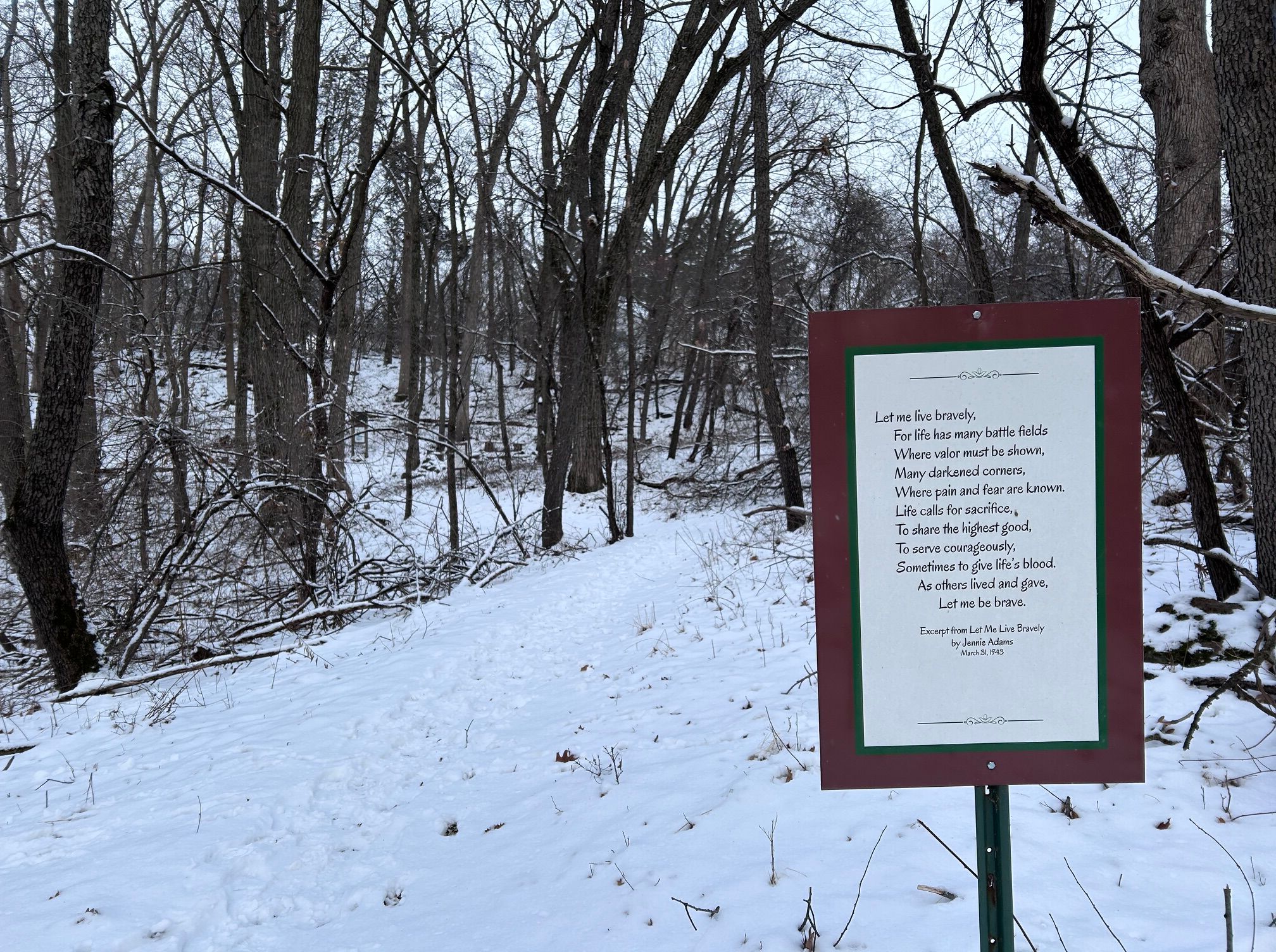
In the snowy woods on Sunday morning, as I mentioned earlier, inspiration overcame reason and I decided to head down the path to something called the Woodland Cathedral. I didn’t know that to expect, but along the way I encountered signs featuring poetry written by someone named Jennie Adams during the Second World War. I read each entry, and I was particularly struck by an excerpt from one that she titled, Let Me Live Bravely. In that excerpt, the poet recognizes that life involves “Many darkened corners / Where pain and fear are known” and that “Life calls for sacrifice” before ending with the prayer: “As others lived and gave / Let me be brave.”

There is a fine line between bravery and stupidity, and don’t worry, I have been contemplating that distinction when it comes to running alone on icy trails in deep woods. But I can tell you that people are inspired by Rob’s story because there is no question that his life reflects bravery. I’m simply hoping to follow his lead when I, too, encounter darkened corners, pain and fear.

Let me be brave, too.
Resilient in Adversity

IMG_2200

I realize there are a few people who still think COVID-19 is a hoax because I have a diverse set of acquaintances and a Facebook account, but it is safe to say that the reality of the global pandemic has hit almost everyone. And hit hard. No one needs me to list the unpredictable disappointments and challenges that have combined to produce predictable emotions like anger, frustration, grief, and fear. Nevertheless, here we are.

And as we sit in this universal timeout, we find ourselves considering our individual purposes on this planet. For many, like grocery store workers, housekeeping staff, truck drivers, and healthcare providers, there is no longer a question whether what they do is important or appreciated. But as the rest of us reconsider how we work, we are forced to drill down to remember what our work is. I have surely been thinking about mine.

The student affairs profession in higher education exists to complement the academic work of faculty in educating the leaders of tomorrow. We complement by teaching outside the classroom and focusing on “life” competencies. In my new role and with my new team, we identified nine things we are trying to teach—our “mission”—and it is not difficult to understand how each is valuable during this time of crisis. We want every student to be:

* Spiritually disciplined
* Professionally prepared
* Resilient in adversity
* Intellectually curious
* Socially skilled
* Culturally competent
* Physically fit
* Financially literate
* Environmentally aware

Every single one of those matters now more than ever. But today, I am particularly interested in the one that says—resilient in adversity.

Adversity: A state or instance of serious or continued difficulty or misfortune.

Resilience: An ability to recover from or adjust easily to misfortune or change.

Well, here we are. Practice is over, and it is game time for RESILIENCE. Even if ESPN is busy showing reruns.

But if any of us needs a little in-game coaching, I offer once again the famed quote from neurologist, psychiatrist, and Holocaust survivor, Viktor Frankl, who said: “Everything can be taken from a [human being] but one thing: the last of the human freedoms—to choose one’s attitude in any given set of circumstances, to choose one’s own way.”

Resilience begins with the choice of attitude—the one freedom that, regardless of any virus, cannot be taken away.

Manzanar

ManzanarI elbowed my way through afternoon L.A. traffic to begin a four-hour mountain drive that ended in a surprising thunderstorm and finally some peace and quiet. Early the next morning I drove the few remaining miles to my destination: Manzanar.

I forget exactly when I learned about Manzanar, but it should have been sooner.

Asian-Americans endured prejudicial treatment prior to Pearl Harbor in 1941 but that terrible attack brought specific ethnic hostility to those of Japanese ancestry. In early 1942, FDR signed Executive Order 9066 that authorized the military to remove “any or all persons” from the West Coast and ultimately over 110,000 people of Japanese ancestry were incarcerated in ten American concentration camps simply because of their ethnicity. Ten thousand of those Japanese-Americans and Japanese immigrants were incarcerated in California at Manzanar.

My interest in visiting Manzanar intensified a few years ago when I learned that two of the ten wartime camps were located in Arkansas—I grew up in Arkansas and taught history in Arkansas and had never been told that Arkansas incarcerated 17,000 people of Japanese descent from California, half at Camp Jerome and half at Camp Rohwer. I knew then that I needed to visit Manzanar to feel the pain of a camp and ponder this terrible connection between my two “home” states—and my native country.

Manzanar is easy to visit on one hand: It is free, uncrowded, and only takes an hour or two to see everything there is to see. But it is difficult to visit as well. For what it represents, and what it proclaims.

Out of the 110,000+ imprisoned out of fear of espionage or sabotage, exactly zero were convicted of espionage or sabotage. That unwarranted fear destroyed many lives and families and even flirted with destroying a culture. In Hawaii where 158,000 Japanese-Americans faced less prejudice and enjoyed more freedom than those on the mainland, they were still discouraged from speaking the Japanese language and practicing the Buddhist religion. Hawaii’s military governor explained why: “We must remember that this is America and we must do things the American Way.”

And what, pray tell, did this chapter of American history communicate about the American Way?

The barbed wire at Manzanar stands as a reminder of how fear and power work together. But Manzanar also reminds us of the potential resilience of oppressed people and that even when fear and power lace up on the same team that victims can band together and rise above their circumstances. Possibly my favorite poster in the visitor’s center hung outside the theater and featured a quote from Hank Umemoto: “We were screwed, but then we made the most out of it and we turned Manzanar into a community.”

May there be no more Manzanars. But in the meanwhile, may all such peoples find that kind of courage and hope.

The Invincible Soul

“You may not control all the events that happen to you, but you can decide not to be reduced by them.” – Maya Angelou (Letter to My Daughter, 2009)

With apologies to my wife, I have a crush on Maya Angelou, so when Apple resurrected her inimitable voice reading excerpts from her poem, Human Family, during the opening ceremonies of the Olympics to remind us that “we are more alike, my friends, then we are unalike,” I was happy.  (If you’d like to listen to her read the full poem without the iPhone sales pitch, click HERE.)

I can’t remember my introduction to Angelou, although it was probably her reading of On the Pulse of Morning for the Clinton inauguration in 1993.  What I can remember is that something led me to read I Know Why the Caged Bird Sings, the first of seven autobiographies that is worth it just for the title (although she snagged it from a Paul Laurence Dunbar poem).  But the book itself, my goodness, it sucker punched my heart.  It tells of Angelou’s first seventeen years of life set in Arkansas, St. Louis, and California.  Her story is interesting, sure, but as a white man now with ties to all three areas, it was (and continues to be) heart-wrenching.

If you didn’t know, Angelou’s childhood included being a victim of rape, racism, and sexism, and if that wasn’t enough, abandonment, guilt, and homelessness, all culminating in giving birth to a son at age sixteen.  And then there was the rest of her life, where she experienced fame and prestige as actor and activist, author and poet, composer and director, professor and speaker—among other things.  As the epigraph proclaims, her life is a testament to the idea that it is not required that difficult circumstances diminish your soul.

Or, more poetically stated, though caged, you can always sing.

In 2014, I was thrilled to see that Angelou was scheduled to speak at a Pepperdine event, and with my wife’s blessing, purchased three (expensive) tickets so that I could introduce Maya Angelou to my daughters, too.  Sadly, the event was canceled due to her poor health not long before she passed on from this life.

I thought about crying.

But I chose to sing.

Not Yet

“Success is not final, failure is not fatal: it is the courage to continue that counts.”
– Winston Churchill

The State Bar of California released its July 2015 bar exam results over the weekend, which impacted the lives of a large number of people that I know and love. California is famously the last state to release results and the one with the lowest passing statistics (and this year’s was the lowest July pass rate in three decades). This combination produces enhanced euphoria for some and a particularly hard punch in the gut to others. It is a weekend of tremendous highs and tremendous lows, and with friends in both places, I never know exactly how to feel. It is easy to celebrate the good news, but it is those who are hurting who maintain center stage in my mind.

I try to do all the right things: Give time, then reach out, then wait patiently, and then, when engaged, try to be helpful. As a former pastor, grief counseling is familiar territory.

Truth be told, the answer in the end is simple and involves climbing back on to the bicycle or horse or whatever metaphor you prefer to have fallen from and go at it again. “If at once you don’t succeed…” is technical truth, but it takes time to hear it without punching someone.

There is more. Success after failure is even sweeter. I recall an old article that identified resilience as a key characteristic of the most spectacular figures in history who overcame great challenges and failures on their unforgettable journeys. Of course failure can destroy a person, too. But it doesn’t have to.

Dr. Carol Dweck of Stanford University tells of a high school in Chicago that gives the grade Not Yet as opposed to Fail. I know this makes some people scream, “Kids need to learn how to fail!” Exactly, and then they need to learn how to get back up again. That is the genius of Dr. Dweck’s groundbreaking research on the importance of mindset when facing failure, which she describes as having a “growth” mindset instead of a “fixed” mindset.

How do you respond to failure? Those with a fixed mindset typically take it personally (e.g., “I’m a failure.”) or blame some external factor (e.g., “It’s your fault that I failed.”). Those with a growth mindset respond with “Not Yet” and determine how to improve to reach the goal.