Tag Archives: peace

Invisible Places

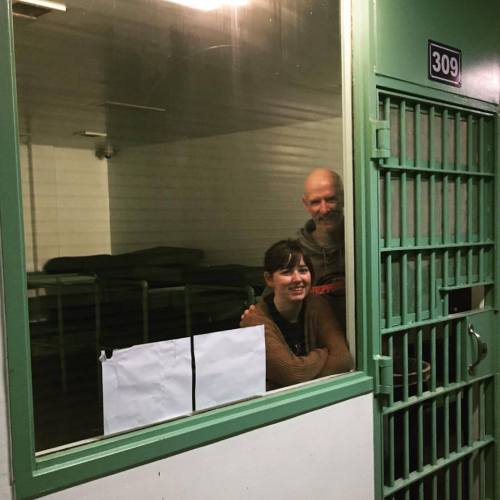
jailLike any good American, I went to jail the day after Christmas.  Well, maybe it was a strange thing to do.  My youngest daughter, a college sophomore, crawled out of bed on a Monday morning to join me because she just might share my unconventional approach to interesting holiday activities.  But you have to give us the “interesting” at least.  When our host asked his colleague at the beginning of our tour if an older gentleman escorted past us was the murder suspect, we were pretty sure we weren’t returning gifts to Macy’s.
The Straus Institute for Dispute Resolution at Pepperdine Law has conducted conflict resolution trainings for the LAPD over the past couple of years—a most important work to be sure.  As a result, several officers have enrolled as students in our Master of Dispute Resolution program, including the officer that commands the particular LAPD jail that we visited.  In our interactions at Pepperdine, he offered to give me a tour, and I jumped at the opportunity.

The jail we visited is one of several that process and hold arrestees for a couple of days until their court appearances, which means that all manner of folks pass through, from benign offenders to death row convicts.  We saw everything.  On the lighter side, we played with the equipment, tried on riot gear, held a Taser, and posed for smiling pictures behind bars knowing we were free to leave.  On the sobering side, we saw the padded cells and the strip search rooms, but more poignantly the prisoners who were not free to leave: the voices yelling for attention; the disembodied hands sticking out from behind the bars, one my daughter saw mimicking a gun; faces behind the glass that embarrassingly felt like zoo exhibits, including the bloodied face of a man booked for assault with a weapon who looked like he lost the assault.

I didn’t feel like saying Happy Holidays very often.  I was impressed by the professionalism of the staff.  I felt, almost surprisingly, a measure of pride in being an American, what with the processed turkey dinner served on Christmas as opposed to the regular fare, the prominent posting of prisoner rights throughout the complex, the attention to cleaning the facility (despite the horrid smell by the shower in the men’s block), and the detailed cataloging of the personal items of the prisoners.  Gary Haugen taught me that the developing world rarely needs better laws, just (non-corrupt) law enforcement, and I was pleased to see a place led by an officer dedicated to enforcing the law with integrity.  But, still.  A jail is intentionally not a happy place to be, which was psychologically jarring on the day after Christmas.

Our world is full of unsettling, invisible places.  There are things we would rather not see, but we don’t have to travel far to find them.  We just don’t hang out in jails very often.  We rarely visit hospitals or nursing homes.  We avoid the homeless and hungry and lonely and stay away from poverty-stricken parts of town.  Heck, there are parts of ourselves we choose to ignore.  If we don’t look, I guess we can pretend these places don’t exist, which I’m fairly positive is a less than healthy approach.

In the women’s block of the jail, we met a young female correctional officer completing the probationary portion of her new job.  She was impressive in uniform, professionalism, and personality.  We instantly liked her.  She is also twenty years old, basically the same age as my daughter.  This young officer sees (and does) things in her work every day that I would rather not think about very often, if at all.  We learned that the LAPD desperately needs more female officers like this, and it struck me that the world must need lots of public servants in lots of invisible places.

I am humbled by those already there.

In 2017, I intend to spend more time in invisible places.  The tourist spots are just too crowded anyway.

Peace on Earth

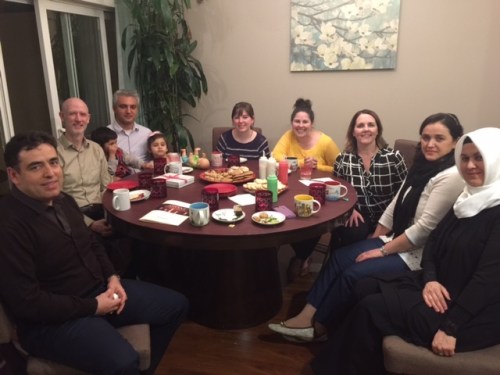
img_4126Thanks to our friend, John, and the Pacifica Institute, we recently hosted Muslim families for a Christmas dinner at our house.  That’s right, Muslim families for a Christmas dinner.  It was wonderful.  The stated purpose of the dinner was to build bridges of respect, understanding, and friendship between Muslims and Christians—and it sure worked.  We instantly have new friends and were honored to accept a return offer to visit their homes in the new year.

All of our guests came to the United States from Turkey, and as we talked over dinner it was sobering to sense the sadness in their hearts when they spoke of conditions related to terrorism in their home country.  And it was even more sobering to sense the fears they live with in this country when the actions of religious extremists lead others to associate such terrible violence with the religion they practice and love.

Possibly my favorite moment of the evening came when one of our guests slipped money to our youngest daughter when she shared about her work in Kenya last summer with street kids from Nairobi slums.  It seems that our guest has a soft spot in his heart for poor African children, and he couldn’t help but give money to support the Christian organization when he heard about the good work it is doing.

I shared with our guests the story from Kenya at this time last year when the terrorist group, Al-Shabaab, commandeered a bus that held Christian and Muslim passengers.  The terrorists demanded that the passengers separate by religion so they could execute the Christians, and the Muslim passengers, mostly women, led the refusal to answer by saying that if they would execute one they would have to execute all.  They were neighbors after all.  Miraculously, no one was killed.

Our guests had not heard the story and were visibly encouraged by it.  One of our new friends said that such reactions should be the standard response.

I sense that many are wary of the concept of interfaith dialogue, thinking that it means a dilution of religious conviction—a sort of “I’m-okay-you’re okay” approach to religious belief.  If you spend much time with any religious belief system you’ll realize that would be sort of silly.  Instead, I have to wonder what is terribly wrong with moving toward a world where we have “join us for dinner” relationships across all sorts of lines that purport to divide us.

Sharing dinner in our homes with new friends would sure go a long way toward a world where the scene that occurred on that Kenyan bus will be the standard response to those who deal in violence.  Not uniformity or watered-down beliefs, but neighborliness and solidarity for peace on earth and good will toward all.  I am a Christian, and at this time of year we remember an angelic proclamation to a group of shepherds about such things.  This particular dinner sure felt like a step in that direction.

Better Days Ahead?

1

Well, mad props to TIME magazine for mastering the double entendre.

Regardless of the outcome, tomorrow’s presidential election will be historic, and although nobody will remember this bizarre campaign with affection, I suspect that its conclusion will not cool the bubbling hatred that threatens to erupt and make an awful mess.  In other words, I’ll be glad when it’s over, but I don’t think it will be over when it’s over.

So, what to do?  Although Canada is nice this time of century, flight doesn’t inspire a heck of lot more hope than the ugly fight we have endured.  There must be a third way to a better future.

My personal vote is for a commitment to reduce hatred (whether or not it is on the official ballot), beginning in my own heart and extending to actions that will have a similar effect on others.  That seems particularly worthwhile to me.

Don’t be fooled into thinking that life will instantly be better once the results are final.  But don’t be fooled into thinking that things cannot be better.  Better is surely worth the struggle.

I mean, the Cubs won the World Series.  The possibilities are endless.

What Is Your Potential, and How Do You Get There?

14561809_1566746046684481_2882562503231930368_n1

My second post comes early this week because my friend, Tim, died, and I am heartbroken.  His sweet wife, Peggy, called with the tragic news this morning.  It is such a sad day.

Tim and I were close and shared many deep conversations.  For me, this made him special, but from Tim’s perspective, it made me one of hundreds if not thousands of people who felt close to him.  Tim had a way of creating space for deep, meaningful conversations, and all who responded to his invitation to “pull up a chair” helplessly found themselves baring their souls to this kind, sweet man.

Tim’s favorite part of his job was counseling people, mostly students, and I was privileged to be his office neighbor for the past four months.  Today, several grieving souls made a pilgrimage to the place where they shared their deepest fears and greatest dreams to a man full of wisdom and love.

Last week, Tim popped his head in my office with a new idea.  He shared that his typical approach to counseling students had always been to ask about their goals and dreams, which led to all sorts of meaningful moments.  But he had a new idea.  He asked what I thought about a new approach that asks students about their potential instead of their dreams.  He thought that just might be the better approach.

I’m not sure what I loved more, the idea itself, or the fact that this counseling maestro never stopped refining his craft.  Well, what I loved more was him.

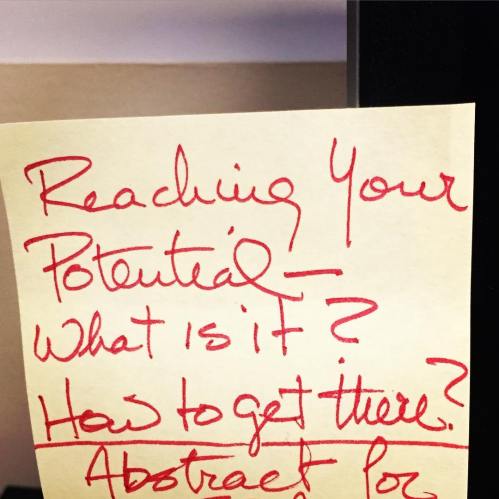
Today, after absorbing the shocking phone call and then sharing the news with his loving colleagues, I walked into Tim’s office just to feel his presence.  I breathed in the spirit of the room and silently took in the sights of the pictures and books and stacks of work waiting for him this Monday morning.  And in that moment I noticed a little sticky note on the side of his computer monitor with the following notes: Reaching your potential – What is it?  How to get there?

I am sad that Tim won’t be able to work this new approach like a street magician, but from this day forward I will use these questions with students to tap into the magic that was Tim Pownall.  I am honored that he left me this final gift to use for good before moving on.


Everyday People

I have often wondered what it would have been like to be an adult in the 1960s, what with the crazy headlines of war, protests, riots, assassinations, and struggles for civil rights.  Half a century later, my imagination doesn’t have to work very hard.

In 1968, Sly and the Family Stone released the song “Everyday People” as a call for peace.  Recently, the great organization, Playing for Change, released a timely rendition of the classic song featuring celebrities and school children.

Today, I share it with hope, and for hope.  Hope that I somehow correctly embedded the video so that it shows up on the blog and in the automatic emails, but more importantly, hope that we might learn to live together.  “And so on and so on and scooby dooby doo.”


The Greatest

ALIDAYS1

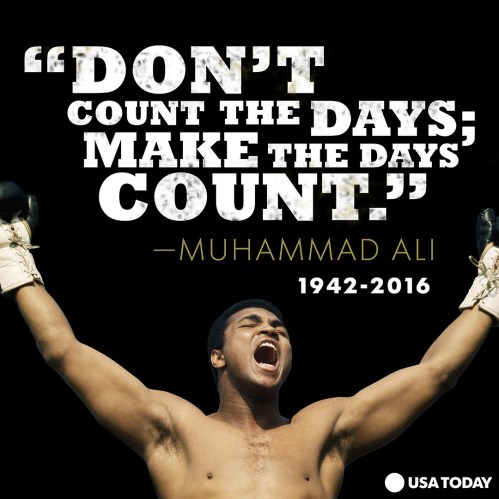
My dad was a boxing fan, which made sense for a member of what Tom Brokaw termed “the greatest generation.”  Boxing was the American sport when he was a boy in the 1920s and 1930s, and I remember his tales of the great Jack Dempsey as we watched fights together a half century later.  I somehow failed to inherit his love for the sport, but the combination of his love and the golden age of heavyweight boxing that coincided with my childhood unleashed personal memories when Muhammad Ali’s passing was announced last Friday.  Elvis Presley, John Wayne, and Muhammad Ali—those were the names that seemed larger than life to this little boy in small-town Arkansas.  Now, all three are gone.

That Ali is a popular American hero is fascinating.  I doubt that his outspoken racial pride and conversion to Islam in the 1960s endeared him to all who now mourn his passing.  I doubt that his refusal to accept military service makes him a hero to all patriotic Americans.  And his brash, in your face, “I am the greatest” trash talking is not typically the personality that leads to universal love and admiration, the Donald Trump phenomenon notwithstanding.

Maybe America just likes a winner?  I don’t buy it.  Call me crazy, but I’m guessing that Barry Bonds, Bill Belichick, and Floyd Mayweather, Jr. will not be universally adored when they ultimately move on from this life.

So, why did Muhammad Ali die an American hero?  Some say it is his social activism, his willingness to stand up for what he believed in.  Maybe so.  That has to be a part of it.  But I suggest there is something more to Ali’s universal appeal.

Muhammad Ali embraced life.

He was fun and funny and full of joy.  He lived without fear.  Think about it: the religious conversion, the brash statements in an era of racial violence, the thumbing his nose at the government’s draft, and the claims of boxing greatness all displayed that he was not afraid of any threat.

More importantly, he lost in the boxing ring multiple times—but came back for more with a smile.  Over time, in what seemed to be the cruelty of fate, the powerful and eloquent athlete lost his famed strength and good health and bold voice—but he came out in public with a smile.

Check it out: Muhammad Ali was not afraid of any threat, but he was also not afraid of any consequence.

I believe that is why we loved him so.  We want to live without fear, too.  We want to face both the goods and bads of life with unshakable joy.

Wouldn’t that be the Greatest?

First Day, Fresh Start

After four wonderful years as Dean of Students at Pepperdine School of Law, I am transitioning to a completely new position as Dean of Graduate Programs.  I am still at the law school, same wonderful people, but new office, new role, and new adventures.  My new job involves joining forces with the amazing team at the world-renowned Straus Institute for Dispute Resolution as we design, market, and deliver new non-JD programs while continuing to expand the reach of the Institute’s world class dispute resolution program.

Any sadness over leaving such a great job is relieved because my friend, Steve Schultz, will be a rock star successor and allow me to focus on the excitement of the new opportunity.  (I just hope that the students wait to dance until my back is turned!)  I am particularly excited by my new role because the Straus Institute drew me to Pepperdine in the first place, and the opportunity to join the day-to-day work of the Straus family is really a dream come true.  Blessed are the peacemakers.

In the dizzying swirl of activity as I attempt to absorb massive information for the new role and hand off the responsibilities of the fading role, I can test an old trick that I have recommended to many along the way.  Here’s the trick: When cynicism starts to settle in at work and you start to think snippy thoughts about everyone and everything… (Wait, I’m not alone here, right?  This has happened to me once or twice in the past quarter century.)  Anyway, when you notice that teensy bit of bitterness about your work, that why-try-because-who-really-cares-and-I-sure-don’t-anymore sort of fun mood that your colleagues find so endearing, my trick is to imagine that it is suddenly your first day on the job.

Go ahead.  Give it a shot.  Imagine it is your first day.

What do you do?

What you don’t do on your first day is think “well that will never work because so-and-so, blah, blah, blah…”  No, on your first day you have no idea what will work.  Instead, what you do is take a good look around and size up your new colleagues, resources, and surroundings and imagine the possibilities before you.  It is a somewhat scary but always exhilarating time.  Who knows what might come?

I am once again embarking on a fresh start, and just as I remembered, it is a pretty great/queasy feeling, so I think my old trick is still a good one.  If you are in a rut in your present circumstances, you don’t have to quit an old job and start a new one to get the benefit of a fresh start.  Starting to look up simply requires an active imagination.

Life Expectancy

An online life expectancy calculator concluded that my check-out time is age ninety-two, but I don’t believe it for a second.  For one thing, that would mean enduring eleven more presidential campaigns, which is unimaginable, but more importantly, the calculation did not include that both of my parents died in their early seventies, that I seek out stressful jobs, and that my childhood diet consisted of fried baloney sandwiches, nacho cheese Doritos, Little Debbie snack cakes, and Dr. Pepper.  But hey, I’ll shoot for ninety-two and see what I get.

One thing in my favor is that I am not easily angered, and word on the street is that this is good for longevity.  Other than the peaceful people on the maternal side of my family tree, I have no idea why it is difficult to get under my skin.  But I’m happy it is true.  (Of course I am, or at least I’m not upset about it!)

Frederick Buechner once wrote:

Of the seven deadly sins, anger is possibly the most fun.

To lick your wounds, to smack your lips over grievances long past, to roll over your tongue the prospect of bitter confrontations still to come, to savor to the last toothsome morsel both the pain you are given and the pain you are giving back—in many ways it is a feast fit for a king.

The chief drawback is what you are wolfing down is yourself.

The skeleton at the feast is you.

Anger simply isn’t worth it.  This is easier said than done, although I have a suggestion that seems a bit counter-intuitive to a happy life at first: lower your expectations.  I don’t mean lower your drive or goals or dreams, the fuel that makes life worth actually crawling out of bed in the morning, but I do mean living in reality enough to know that things rarely go as planned, and that that is okay.

Anger happens when life lets you down.  Expect that life will let you down.  Of all things, don’t let that come as a surprise.

For instance, I was told that I should live to age ninety-two.  I’m not counting on it.  (Cue Tim McGraw as I choose to live like I am dying!)

Race

DCF 1.0

Go see “Race.” The critics apparently do not think it is the greatest movie in the history of movies, but the story of Jesse Owens is one of the greatest stories in the history of stories, so there. But be prepared. American race relations in the 1930s is not fun to watch, and then you encounter Nazi Germany. It is a tough, hard, heroic story well worth the price of admission, not to mention the attention of your heart.

I traveled to northern Alabama in June 2007 to speak at a church that had supported our church during Hurricane Katrina, and while there, noticed that the Jesse Owens Memorial Park & Museum was nearby. I had to go. Jesse, a grandson of slaves, was born into a family of sharecroppers in tiny Oakville, Alabama, and the museum grounds contains a replica of his childhood home. Mr. & Mrs. Owens had nine children in that tiny house, and the children had no beds. Eventually, the family relocated to Cleveland, Ohio, where life was bad, but better, and it was there that Jesse’s spectacular high school track and field performances catapulted him on to the world stage where he forever defied Hitler’s claim of Aryan supremacy.

This picture is my personal favorite from the museum (and my favorite scene in the movie):

DCF 1.0

The friendship that formed between blond-haired, blue-eyed Luz Long from Nazi Germany and African-American, Jesse Owens, from the United States in the long jump competition at the Olympic Games stands as a testament of hope for the world.

An article on ESPN.com shared the following quote from Owens: “It took a lot of courage for him to befriend me in front of Hitler. You can melt down all the medals and cups I have and they wouldn’t be a plating on the 24-karat friendship I felt for Luz Long at that moment. Hitler must have gone crazy watching us embrace. The sad part of the story is I never saw Long again. He was killed in World War II.”

Eighty years after the 1936 Olympic Games, the world sure seems to remain a mess. But there is hope. There is always hope. And it begins when people defy social expectations and form the most unlikely friendships.

2

1

Adversity

My youngest daughter gave me a LARGE PRINT (appreciated!) book of David Foster Wallace essays titled, “Both Flesh and Not.” She knows that I may have developed a reader crush on Wallace. Among other admirable qualities, Wallace’s conventional knowledge is astounding, but his unconventional approach is stunning. For instance, one of the essays included in the book is composed entirely of bullet points. Twenty-five pages’ worth of bullet points (well, LARGE PRINT, so maybe two pages, but still).

So if the imitation/flattery cliché is true, then consider the following as feeble-yet-genuine praise.

• Adversity: Simple definition: “a difficult situation or condition.”
• Synonyms: misfortune; mishap; tragedy.
• First known use: 13th century.
• Probability that you (and me, but I’m writing here, so you) will encounter adversity: 100%.
• Leading responses to adversity: Popularly (and boring-ly), fight or flight. More descriptively, nausea; all versions of weeping, from softly into a dark pillow to convulsive wailing; bitterness; rage; blaming, from self to upbringing to society to presidents/candidates to God to karma to your stupid ex-whatever; prayer; tubs of ice cream; throwing things; liquid courage; television binge; a life of crime; join the circus.
• Approximate amount of fun in any of these responses at least by the next day: Zero. (Except possibly the circus, which depends so much on your new job description.)
• Common themes from an “adversity” search on Google Images: Mountains; tightropes; Martin Luther King, Jr., loneliness.
• Strangest return item from an “adversity” search on Amazon: Adversity Board Game.
• Opening line of product description for Adversity Board Game: “Become the greatest advertising mogul the world has ever seen!” (Oh, it is AD-versity. Clever.)
• Most fun line of opening customer description of Ad-versity Board Game: “We tried this game both while drinking and while sober, and both times it sort of stank.”
• Why I’m thinking/writing about adversity: Life, lately. Some personal, some observational, from many corners of life.
• What to do when the tendency to criticize how others handle adversity rears its ugly head: Slip on their moccasins. (Figuratively of course, although a literal situation is conceivable, like if maybe someone gets bad news from the doctor and runs screaming on to a sizzling hot highway, and if you’re barefoot and their moccasins are right there anyway… This all seems highly unlikely.)
• How I want to handle inevitable adversity: With love; head on; with courage and strength; at peace.
• Probability that I will do so: Unknown, but greatly increased with resolve, preparation, practice, and reflection.