
Tag Archives: matthew walker

2024: My Year in Books

I started tracking the books that I read in 2017 and have maintained that habit ever since. I typically read twenty-to-thirty each year, although that jumped to forty during the crazy COVID year of 2020. This year will end at thirty; however, I must say that as a whole the quality of this year’s list was remarkable, which is really saying something given what I have read in the past.

I made it a point several years ago to read just as much fiction as nonfiction, and I am proud that has become a habit, too. I tended to veer toward nonfiction, but I equally love and benefit from works of fiction, so I am glad to have achieved a balanced reading diet.

I don’t like to rank the books and declare favorites for multiple reasons. Well, actually, I do like to rank books and declare favorites, but for multiple reasons I try to avoid that tendency. Instead, I think I will just share the list below — divided by fiction/nonfiction in the order I read them — and share a note about each one. If anyone has follow-up questions, please feel free to ask publicly or privately.

Nonfiction:

  1. Spirit Run by Noe Alvarez (a gift from my daughter, Hillary, and a gift for runners who want to go on a crazy cool travel journey)                                       
  2. How to Know a Person by David Brooks (a gift from a former coworker, Shelley, and to risk sounding overly dramatic, should possibly be required reading for U.S. citizens in the 21st Century)                             
  3. Why We Sleep by Matthew Walker (fascinating insight into an underrated health crisis)                          
  4. Boys in the Boat by Daniel James Brown (a gift from my daughter, Erica, and a wonderful story of endurance and triumph through sport)                  
  5. Why We Love Baseball by Joe Posnanski (a gift from my daughter’s boyfriend, Quentin, and a perfect illustration of how a book’s title can capture its essence)                            
  6. The Servant Lawyer by Robert Cochran, Jr. (written by a friend and colleague that I deeply admire and helpful for any Christian in the legal profession)             
  7. Amusing Ourselves to Death by Neil Postman (recommended by my friend, Sandi, and it blew my mind that Postman’s remarkable insights predated the computer revolution — another on my required reading list for present-day Americans)                                 
  8. Somehow by Anne Lamott (another gift from my former coworker, Shelley, who is a fellow Anne Lamott fan; saying that this wasn’t my favorite Anne Lamott book would be like saying a sunset was slightly less spectacular than another)
  9. Eight Keys to Forgiveness by Robert Enright (Enright is a pioneer in examining forgiveness, which is a conflict resolution course I have taught for years, and I finally got around to reading one of his books, which was well worth it)                       
  10. Sapiens by Yuval Noah Harari (my friend/student, Laura, gave me Sapiens as a special gift, and both the gift and the book meant so much to me: it challenges everything, which is right up my alley, and I will be thinking on it forever)                                             
  11. The Universal Christ by Richard Rohr (Rohr is a gift to so many of us disillusioned by conservative Christianity, and while this book wasn’t the book I expected it to be for me personally, I found his thesis both compelling and helpful)                                              
  12. The Warmth of Other Suns by Isabel Wilkerson (a gift from my daughter, Erica, and while I said I wasn’t going to rank the books, this extraordinary telling of the Great Migration is probably the most impactful book that I read this year — yet another on the required reading list for all Americans)           
  13. Academic Coaching by Marc Howlett & Kristen Rademacher (recommended by two separate friends/colleagues, Tim and Brenda, and I was more than impressed that a book can be simultaneously well-researched, succinct, and practical)            
  14. Never Givin’ Up by Kurt Dietrich (an outstanding book from a new friend in Wisconsin chronicling the life of the sensational entertainer (and Ripon College alum), Al Jarreau)                             
  15. Introduction to Sport Law by Spengler, Anderson, Connaughton, and Baker (a textbook in preparation for a course that I get to teach this semester!)

Fiction:

  1. Clock Dance by Anne Tyler (I have long loved Anne Tyler novels)
  2. Elevation by Stephen King (King is a writing hero, and this novella was entertaining as expected, but not one of my favorites)
  3. The Midnight Library by Matt Haig (not what I expected, but a good read)
  4. Memphis by Tara Stringfellow (really good, probably especially if you are from near Memphis like me)
  5. Heaven and Earth Grocery Store by James McBride (a truly outstanding book, and possibly my favorite novel of all time, except that I kept reading more novels this year)
  6. Malibu Rising by Taylor Jenkins Reid (well, guilty pleasure reading maybe (?), but I enjoyed it since I knew all the Malibu references)
  7. The Lonely Hearts Book Club by Lucy Gilmore (stumbled on this book, characterized as a “feel-good” novel, which must be my kind of book since I like feeling good)
  8. Tom Lake by Ann Patchett (so, so good — Nashville author writing of an older couple living on a cherry farm in rural Michigan and recalling experiences of the glitz and glamor of Hollywood in younger years — that we moved from Malibu to rural Wisconsin later this year might suggest that this book is personally special)
  9. Our Town by Thornton Wilder (Tom Lake was based on Our Town, so I had to get around to finally reading it)
  10. Hula by Jasmin Iolani Hakes (picked this up during Asian American and Pacific Islander Heritage Month, and glad that I did — a challenging story that spans three generations of women)
  11. The Poisonwood Bible by Barbara Kingsolver (a recommendation from my daughter, Hillary, and I wondered how I had missed Kingsolver all of these years — so much that I wondered if it was better than Heaven and Earth Grocery Store)
  12. Demon Copperhead by Barbara Kingsolver (now all into Kingsolver, and based on a recommendation from my wife, I decided that Demon Copperhead is the best novel I have ever read)
  13. The Beginner’s Goodbye by Anne Tyler (did I say that I love Anne Tyler novels?)
  14. James by Percival Everett (my goodness, what a year of reading novels — this one won the National Book Award for fiction this year for good reason, and I absolutely loved it — a retelling of Adventures of Huckleberry Finn from Jim’s perspective, which is just brilliant)
  15. Atonement by Ian McEwan (I ended the year with a re-reading of Atonement, which I had said prior to 2024 was my favorite novel of all time — not sure I can still say that, but reading it again reminded me of why I loved it so much)
Good Night, and Good Luck

“Sleep is the single most effective thing we can do to reset our brain and body health each day.” – Dr. Matthew Walker, Ph.D.

In early 2015, I asked the following question to Pepperdine’s law students: In comparison to when you first entered Pepperdine School of Law, how would you now describe your practice of rest (e.g., time off, relaxing, Sabbath)? The results: 40% indicated no change; 19% answered stronger; but 41% said weaker. When disaggregated, 52% of first-year students said their practice of rest was poorer than when they started law school. I was not even close to surprised. As the Australians taught us children of the Eighties to say: Been there, done that.

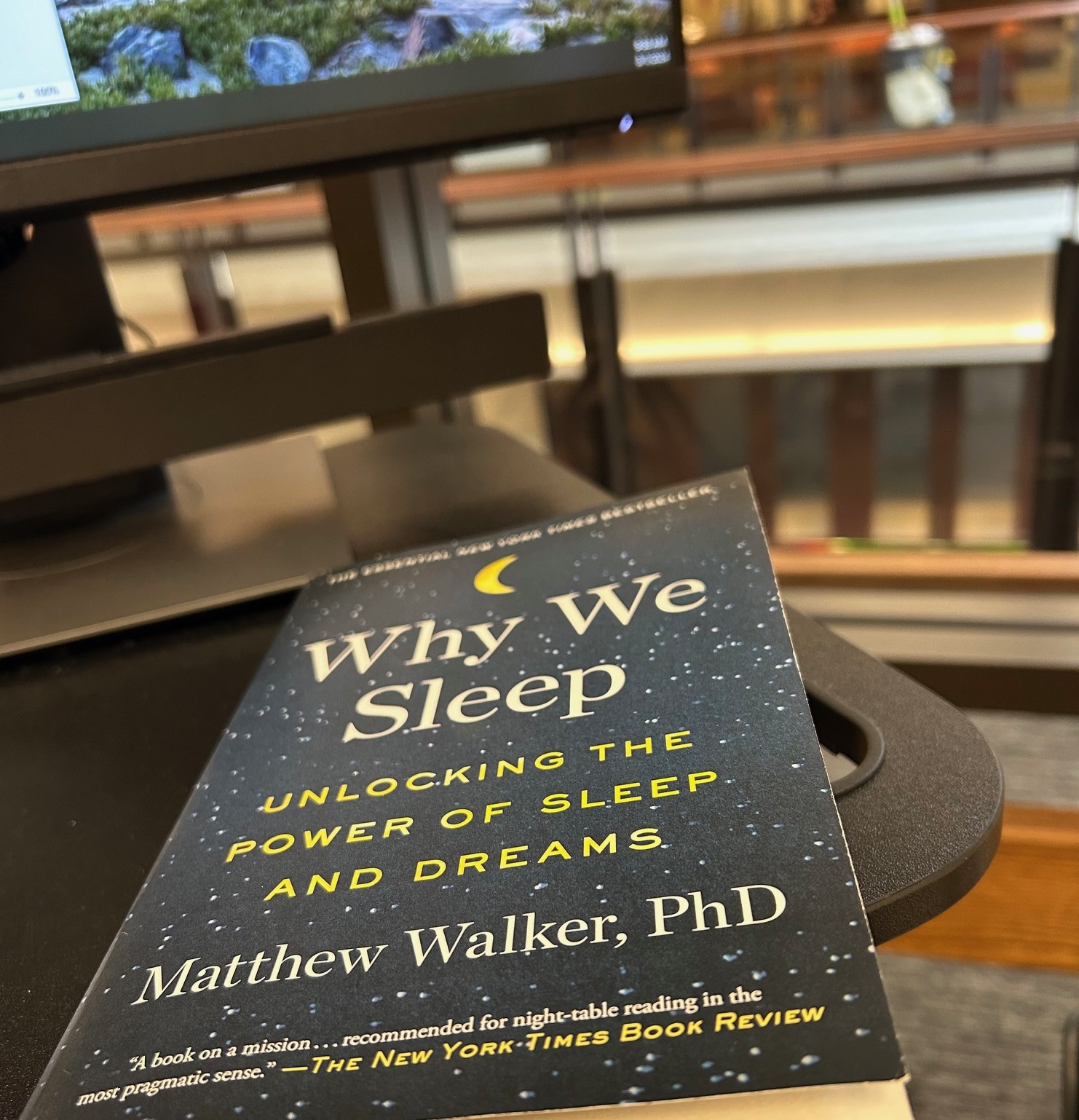
But I was never happy about it. Last semester, nearly a decade later, after discussing sleep troubles with a new law student, I decided that I should at least try to learn something about sleep, so I tracked down a book: Why We Sleep: Unlocking the Power of Sleep at Dreams, by Matthew Walker, Ph.D. I don’t know enough about science to confirm its veracity (there have been critics and controversy), but I do know that after reading it, now I’m having trouble sleeping. But because I don’t want to leave you out of the misery, let me share some of the disturbing (though sometimes cool) information that I read with you. You’re welcome in advance.

For starters, and on a positive note, all animal species seem to sleep, and part of why we humans are awesome may be because of our unique and natural sleep patterns. Specifically, compared to other primates, we sleep in a bed or on the ground instead of perched on tree branches, which allows us a disproportionate amount of REM sleep (the sleep when we dream) because the body is completely paralyzed during REM sleep, which isn’t a terrific idea if you are perched on a tree branch. And while in the cool facts portion of my essay, Walker claimed that the reason we are completely paralyzed during REM sleep is so that we won’t act out our dreams!

Our inordinate amount of REM sleep seems to set us apart in a couple of major ways: First, it heals and helps our mental and emotional health; and second, it enhances our creative and problem-solving abilities. Remember being told to “sleep on it?” Actually, great advice! Although in fact, all sleep phases are beneficial, and messing with any of them causes actual brain impairment.

The human body is fascinating. Just before a baby is born, its amount of REM-sleep is at an all-time high, approximately twelve hours a day. In year one, that declines while deep NREM sleep begins to increase, peaking just before puberty before retreating. The deep NREM sleep during childhood is sculpting the brain, but we all probably remember that it seems like construction halts during the teenage years when all sorts of irrational silliness ensued. Actually, the brain is still maturing then, but rationality is the last to arrive on the scene. Sleep then naturally settles into a predictable pattern in early adulthood. When left to our natural tendencies, human sleep is apparently “biphasic”—about seven actual hours of sleep at night, followed by an hour nap in the early afternoon—but that train apparently left our sociocultural station a long time ago.

In all our societal advancement, however, we have apparently created ways to screw up everything. Have you ever wondered why American life expectancy sucks relative to our immense economic and medical resources? The myriad ways we have created to destroy natural, human sleep patterns and a fingers-stuck-in-the-ears-while-bellowing-la-la-la-la-la-in-the-face-of-research posture toward the importance of sleep may be teensy reasons worthy of consideration.

O sleep, how do I screweth-uppeth thee? Let me count a couple of ways: Darn Thomas Edison for saying let there be light when there shouldn’t be light, and darn alarm clocks (and especially snooze buttons) for daily shocks to our hearts and nervous systems, sometimes multiple times a morning, telling us to get up when we aren’t done sleeping. And since REM sleep is disproportionate toward the end of the seven-to-nine hours of daily sleep we reportedly should be experiencing, about half of all adults in developing countries may be missing out on the unique human benefits that purportedly helped us develop in the first place.

And the consequences are tragic: Weakened immune systems, including an increased risk for certain cancers. Contributions to depression, anxiety, and suicidality. Impaired memory (and while I’m on memory, sleep aids memory both before and after learning, so all-nighters for work or school may be completely counterproductive). Cardiovascular disease. Increased propensity for weight gain, obesity, and developing type 2 diabetes. Drowsy driving—a driver that got up at 7am and heads home from the club at 2am without a single drink is reportedly just as impaired as a legally-drunk driver.

The result? As Dr. Walker wrote, “Relative to the recommended seven to nine hours, the shorter your sleep, the shorter your life span.”

Now we aren’t completely oblivious to our sleeping problems, but it seems that we are unfortunately ignorant to both the extent of the problems and the actual solutions. We typically mitigate with substances, including sleeping pills and/or alcohol and/or caffeine, that can actually do real harm instead of help.

So, what can I do about this to help our law students? I’ll have to get back to you on that one. This seems to be a larger problem than my present work environment, so that’s a major challenge to undertake. But I like major challenges. And it seems far too important to ignore.

What I will do is share with you my summation of the twelve tips for healthy sleep that Dr. Walker shared from the National Institute of Health at the end of his book and hope that someone finds them helpful:

  • Go to bed and wake up at the same time every single day.
  • Exercise, but not too late in the day.
  • Avoid nicotine (period) and caffeine in the afternoon/evening.
  • Avoid alcohol before bedtime.
  • Don’t got to bed too full or too hungry, and avoid beverages late at night.
  • Avoid medicines that disrupt sleep as much as possible.
  • Don’t nap after 3pm.
  • Do something relaxing before bed (not on a phone or computer).
  • Take a hot bath before bed.
  • Make your bedroom dark, cool (e.g., 65 degrees), and gadget-free.
  • Get at least 30 minutes of natural sunlight each day (ideally, an hour each morning).
  • If still awake in bed after 20 minutes, get up and do something relaxing until you are sleepy.

To quote the late, great Edward R. Murrow, “Good night, and good luck.”