
Tag Archives: law school

Season of Giving (Exams)

final-exams-yes-1euhhlv

The end of November launches a holiday season in these United States, but for those involved in formal education it is also a season of papers, projects, and examinations.  Thanksgiving break does provide a break from classes, but not from work, as our youngest daughter bemoaned on her short trip home from college.  There is no rest for the wicked.  There are turkey sandwiches, sure, but no rest (yet).

Law school is particularly relentless.  The killer combination of a single grade-determining final exam and a pernicious grading curve that pits all-star students against one another for a handful of A’s produces a motivation that is not helpful for proper digestion.  If you want to experience stress with all of your senses, visit your neighborhood law library.

During this season of final exams, popular metaphors include heads down, noses to grindstones, shoulders to wheels, and so on, but not much related to actually looking up.  Unless looking up information or in desperation count.  From my seat in a law school, while I strongly recommend long hours and hard work, I also advocate periodically looking up for a little perspective.  Specifically, the following perspective:

Carol Dweck famously teaches the advantage of a “growth mindset” as compared to a “fixed mindset.”  For the latter, final exams are personal evaluations (i.e., I am good at this or bad at this; smart or stupid; etc.), but for the former, the exams merely reveal information helpful for growth and improvement (i.e., How can this make me better?).  And in case you are wondering, growth mindset leads to greater success than is ever possible with a fixed mindset.

This is a season of giving—professors giving assignments/exams, and students giving their very best effort—but the frenzied effort from the students is misspent if motivated by fear of failure as defined by a letter or number.  Instead, everyone is better off if the heroic efforts are motivated by the capacity to grow and learn.

Study hard, my friends, and look up long enough to remember that you are here to learn and not to be graded like cattle.  And learn well.  A real break will be here soon.
Universal Ideals of Human Dignity

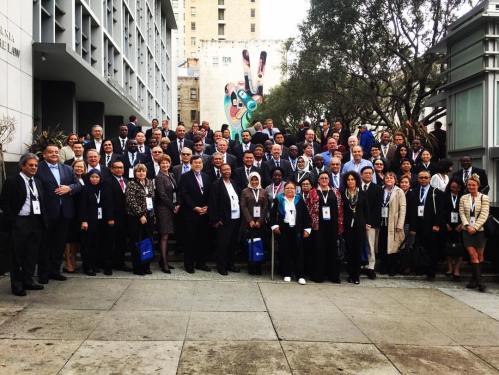
1I traveled to San Francisco last weekend with my friend and colleague, Ahmed, to represent our dean at the annual conference of the International Association of Law Schools and was humbled to gather with people from all over the world who are responsible for training the next generation of lawyers.  It is no exaggeration to say that the world depends on this good work.

Neither is it a statement of pride since I was obviously out of my element in a conference full of legal scholars.  This was particularly obvious when we were asked to divide into small groups based on our areas of expertise, and, um, I don’t have one.  But, I had to choose something so, given the choices, I chose “human rights” because, well, I’m for them.

But what an honor.  In two separate sessions, I sat in a small classroom with a handful of individuals who consider it their life calling to teach human rights to law students.  There were professors from South Africa and India, Australia and Italy, Russia and Canada, Indonesia and the United States.  Can you imagine?

The Office of the United Nations High Commissioner for Human Rights claims that “[h]uman rights are rights inherent to all human beings, whatever our nationality, place of residence, sex, national or ethnic origin, colour, religion, language, or any other status” and purports to represent “the world’s commitment to universal ideals of human dignity.”

I like that phrase—universal ideals of human dignity.

What I found surprising in the privileged opportunity afforded me at this unique conference was what that special group of people found surprising in their visit to San Francisco.  And that was the homelessness on full display in the short walk from the hotel to the conference location.

I have often been told that the poverty in these United States does not compare to poverty in the developing world, and I’ve traveled enough now to understand the proposition.  But please slap me if I ever fail to remember that the universal ideals of human dignity apply to the people on the American margins, too.


Forging Pathways

2

“Law and order exist for the purpose of establishing justice and when they fail in this purpose they become the dangerously structured dams that block the flow of social progress.” – Martin Luther King, Jr.

Waze calculates thirty-four miles from Pepperdine University to East Los Angeles College; the Pacific Coast Highway to East Cesar E. Chavez Avenue; the celebrity-populated western side of Los Angeles to Cheech Marin’s East L.A.; Malibu to Monterey Park.  It sure seems longer, even in rush hour traffic.  They are two different worlds.

I serve on the advisory council for the East Los Angeles College (“ELAC”) Pathway to Law School Transfer Program, a coalition of educators and practitioners brought together to destroy obstacles that stand in the way of a young person advancing from high school to community college, from community college to a four-year college, and from a four-year college to law school.  It is an inspiring group, and I am honored to be a part.

It is also personally disconcerting.  I’m not exactly sure how I, a first-generation college student from rural Arkansas, the son of a butcher who dropped out of high school to provide for his family during the Great Depression, am suddenly the picture of white privilege in a room full of impressive human beings, but as a lawyer who drove over from his condo in Malibu, even my expertise in denial simply tossed in the towel and admitted the truth.  I may be the most reluctant privileged person around.

It was dark when the meeting ended, and on the stroll across the ELAC campus to drive back to idyllic Malibu, I noticed several classes in session.  Maybe I was wanting it to be so, but it sure looked like all of the students in those classes were engaged in the instruction and not bored on Facebook.  I’m just sure of it.  I then wandered by the math tutoring center, and it was undeniably a hub of academic activity late on a weekday evening.  All this made me feel particularly hopeful in this perplexing world of ours.

If I must come to terms with privilege, and I just might have to, I must use it to help those inspiring students hungry for knowledge in those hushed classrooms gleaming in the darkness.

Life in the Outside Lane

Anyone with track and field experience knows that the 400 meters is a brutal, gut-wrenching, death sprint, and those same people know that the absolute worst draw is the outside lane, that lonely place where the only sounds one hears after the starter’s gunfire are screaming lungs and the invisible footsteps of your competitors—invisible until that terrible moment when they enter your peripheral vision stage left and you realize all is lost.

Which is why South African Wayde Van Niekirk’s world record in the Rio Olympics is so remarkable: his shocking destruction of the seventeen-year-old record occurred in lane eight.  Afterward, ESPN.com quoted the new world-record holder as saying, “I was running blind all the way . . . and it gave me motivation to keep on pushing.”

Last week, I told an auditorium full of new law students that law school is designed to be run from Lane One where you keep an eye on all your competitors, um, I mean, colleagues, and constantly compare yourself to them.  I encouraged them to do law school in Lane Eight, and who knows, they might set a world record, too.

Sometimes law school is a lot like life.  I say give life in the outside lane a shot and see if you  find in the loneliness some “motivation to keep on pushing” toward accomplishments previously beyond anyone’s imagination.

Bar Eve. Or, Don’t Shrink from a Challenge.

[Note: This is a repeat from last year, but purposely so.]

We always opened presents on Christmas Eve. I like Christmas Eve. New Year’s Eve ends with confetti-drenched smooching, and who can argue with that? But Bar Eve—the night before the bar exam—is more of a pain in the hind quarters.

I was abnormally slow to matriculate to law school so the bar exam remains a somewhat fresh wound. I sat for the California version, statistically the hardest in the country, an eighteen-hour torture device spread out over three days that begins tomorrow for many of my good friends.

Truth be told, the exam is the easy part. It is the anticipation, the fear-filled, guilt-infested, never-ending dread that drives a person to inquire about openings with the circus. So Bar Eve is significant, the pinnacle of the real challenge. When the exam begins tomorrow morning, life will actually begin to improve. And when the exam ends on Thursday afternoon, delirious excitement abounds, although the emphasis is on delirious.

To riff the old Tony Campolo sermon, it’s Bar Eve, but Thursday’s a-comin’.

Accounting for the delirium, I prize two important memories from that Thursday afternoon when I emerged from the Pasadena Convention Center (sidebar: we pronounce it PASS-adena for the good vibes; thankfully, we didn’t sit for the exam in FAIL-adelphia).

Memory #1: I sincerely thought there should have been a parade for us. I mean it. It was a strong feeling that, regardless of how we did on the exam, the simple fact that we endured that hell of a summer and survived the three-day exam called for a parade. We were heroes.

Memory #2: Driving home, stuck in traffic on the 101 and not caring about traffic for the first time ever, I knew what I wanted to say when I arrived home. My youngest daughter was in eighth grade at the time and had declared to my hearty approval while observing the bar summer that she would never go to law school. But on the drive home, I knew what I had to tell her. When I made it, after the hugs and kisses, I mustered all the seriousness in me to communicate what I hoped she would receive as one of those few life lessons that you just cannot miss: Never run away from a challenge simply because it looks daunting.

I could not say such a thing until that Thursday afternoon, but I never felt any life lesson more strongly than I did at that moment. On this Bar Eve, I hope my hero friends will finish strong and experience that same sense of accomplishment.

First Day, Fresh Start

After four wonderful years as Dean of Students at Pepperdine School of Law, I am transitioning to a completely new position as Dean of Graduate Programs.  I am still at the law school, same wonderful people, but new office, new role, and new adventures.  My new job involves joining forces with the amazing team at the world-renowned Straus Institute for Dispute Resolution as we design, market, and deliver new non-JD programs while continuing to expand the reach of the Institute’s world class dispute resolution program.

Any sadness over leaving such a great job is relieved because my friend, Steve Schultz, will be a rock star successor and allow me to focus on the excitement of the new opportunity.  (I just hope that the students wait to dance until my back is turned!)  I am particularly excited by my new role because the Straus Institute drew me to Pepperdine in the first place, and the opportunity to join the day-to-day work of the Straus family is really a dream come true.  Blessed are the peacemakers.

In the dizzying swirl of activity as I attempt to absorb massive information for the new role and hand off the responsibilities of the fading role, I can test an old trick that I have recommended to many along the way.  Here’s the trick: When cynicism starts to settle in at work and you start to think snippy thoughts about everyone and everything… (Wait, I’m not alone here, right?  This has happened to me once or twice in the past quarter century.)  Anyway, when you notice that teensy bit of bitterness about your work, that why-try-because-who-really-cares-and-I-sure-don’t-anymore sort of fun mood that your colleagues find so endearing, my trick is to imagine that it is suddenly your first day on the job.

Go ahead.  Give it a shot.  Imagine it is your first day.

What do you do?

What you don’t do on your first day is think “well that will never work because so-and-so, blah, blah, blah…”  No, on your first day you have no idea what will work.  Instead, what you do is take a good look around and size up your new colleagues, resources, and surroundings and imagine the possibilities before you.  It is a somewhat scary but always exhilarating time.  Who knows what might come?

I am once again embarking on a fresh start, and just as I remembered, it is a pretty great/queasy feeling, so I think my old trick is still a good one.  If you are in a rut in your present circumstances, you don’t have to quit an old job and start a new one to get the benefit of a fresh start.  Starting to look up simply requires an active imagination.

One at a Time

Today marks the end of this semester’s last full week of classes at Pepperdine School of Law.  Two more days next week, several “dead” days, and a couple of weeks of final exams remain so we surely aren’t done, but today feels significant because this academic year is almost, pardon the pun, in the books.  The 1Ls will soon be rising 2Ls, the 2Ls will soon be rising 3Ls, the 3Ls will soon be law school graduates, and the faculty and staff will still be faculty and staff.

So most of us are in a mood.

I like to think of it as an antsy-yet-over-it, needy-but-don’t-touch-me, slightly nauseous, hyperactive zombie sort of mood.

There is something terrible about being so close in time to a finish line while remaining so far away in the amount of work.  All you can think about is being finished with it all, but that simply distracts you from making any progress on the pile of whatever that stands before you.  It is as if the nightmare where you are trying to run to safety but for some reason cannot get your legs to work came true.

One of my favorite books on writing (and just, ever) is Anne Lamott’s Bird by Bird: Some Instructions on Writing and Life.  She describes the book’s title this way:

“Thirty years ago my older brother, who was ten years old at the time, was trying to get a report written on birds that he’d had three months to write, which was due the next day. We were out at our family cabin in Bolinas, and he was at the kitchen table close to tears, surrounded by binder paper and pencils and unopened books about birds, immobilized by the hugeness of the task ahead. Then my father sat down beside him put his arm around my brother’s shoulder, and said, “Bird by bird, buddy. Just take it bird by bird.”

That is my advice to law students as well as life students when the sheer amount of what lies ahead seems a bit daunting.  Just take it one step/day/hour/bird/whatever at a time.

Your Very Best

It is final exam season at Pepperdine University School of Law, and you can cut the tension with a knife (except we are a weapons-free campus, so I suggest doing your best with a spork). I am almost embarrassed to admit that I kind of like the feeling of stress in the air because it reminds me of the fluttery feelings associated with the big game or big performance, but there is a particular weirdness to law school final exam stress brought on by a forced curve, a brilliant set of students, and a solitary grade for an entire course. Admittedly, that kind of stress feels more like an unexpected phone call from your doctor than a piano recital.

As a law student, I discovered that worrying about finals was not particularly helpful, although I sure gave it a good try. The better approach consists of a good strategy, discipline, and the many hours that follow.

My law school days came later than most and happened to coincide with my youngest daughter’s matriculation to middle school. It was nice to go school shopping for pencils together. I remember a day when my daughter received an uncharacteristic poor grade on a school assignment, and in my best attempt at being “dad,” I asked if she had truly done her best. When she said that she had, I told her not to worry about it: that her very best was all anyone could expect, and that’s all she has to give anyway. I was proud of my good advice—and then went back to sulking about my prospects of doing poorly in law school.

Thankfully, two seconds later, it occurred to me that I should heed my own advice: Give it my very best, and be satisfied. For the most part, I did, and I was.

Fear is the enemy of life, and fear of failure is troublesome because popular definitions of success are such that so much is out of our control. But what if success and failure were based on doing your very best with what you have been given?

I’m spreading that word in a law school, on social media, and in my own little brain: Reach for the stars. Take what you get. Learn from it. Reach for the stars again.

Exquisite

[Note: I used to write a lot until, well, law school.  But, one year ago tonight, at the end of a long day, a moment happened in the law school that unleashed an intense desire to write about that particular moment.  That impromptu essay opened the door in my heart that with time became “Starting to Look Up.”  So, in honor of that moment, here is my essay from one year ago.]

The word exquisite doesn’t come to my mind very often.

It has been a long day, at the end of a long week. Our students are in final exams, and I feel about that weary, too. I made it to work around half past seven this morning and walked out around half past nine this evening. That isn’t normal, but it isn’t abnormal. Another long day.

But there were some great moments. I served on an important panel judging a Christmas cookie contest for our staff: public service at its most delicious. And tonight, I attended a swearing-in ceremony for our graduates who passed the bar exam. There may not be a happier occasion, and the celebratory hugs and high fives from such special people made my heart happy.

So it was a good, solid, long day.

But it came time to go home. I closed down my office, grabbed my work bags, and headed toward the exit with a weariness that comes with a fourteen-hour work day.

There was music as I walked toward the door.

The law school received a piano as a gift last year, and we have several talented pianists in our community who put it to good use, so this was not surprising. I noticed three first-year students standing on the second floor near the law school entrance, weary from a never-ending battle to learn the Federal Rules of Civil Procedure, still at school at half past nine on a Friday evening. They were listening to the music that filled the three-story building emanating from the back corner of the first floor.

I joined their group to listen, too.

I am embarrassed not to know piano tunes. This one was lively and reminded me of a Scott Joplin sort of song. But I don’t know. I do know that the young pianist was into it, and soon, we were too.

Two other law students came out of the library, pulled to the railing by the music.

And we just listened. We all stood quietly, mesmerized, weary, but captivated, and listening.

It was really just a moment. The impromptu performance couldn’t have lasted more than a couple of minutes, but there was a moment somewhere therein, somewhere before the song’s rousing conclusion and the surprising ovation from the six-person audience up in the balcony. It may not have made an impression on anyone else, but it is now well after ten o’clock, and although I am still tired, I had to write about this moment because I don’t want to forget it.

It was exquisite.

Some moments are worth the trouble of life. And the one tonight, when the intense and elegant music of an artist captivated a group of stranded travelers on a Friday evening, qualifies in my book.

Not Yet

“Success is not final, failure is not fatal: it is the courage to continue that counts.”
– Winston Churchill

The State Bar of California released its July 2015 bar exam results over the weekend, which impacted the lives of a large number of people that I know and love. California is famously the last state to release results and the one with the lowest passing statistics (and this year’s was the lowest July pass rate in three decades). This combination produces enhanced euphoria for some and a particularly hard punch in the gut to others. It is a weekend of tremendous highs and tremendous lows, and with friends in both places, I never know exactly how to feel. It is easy to celebrate the good news, but it is those who are hurting who maintain center stage in my mind.

I try to do all the right things: Give time, then reach out, then wait patiently, and then, when engaged, try to be helpful. As a former pastor, grief counseling is familiar territory.

Truth be told, the answer in the end is simple and involves climbing back on to the bicycle or horse or whatever metaphor you prefer to have fallen from and go at it again. “If at once you don’t succeed…” is technical truth, but it takes time to hear it without punching someone.

There is more. Success after failure is even sweeter. I recall an old article that identified resilience as a key characteristic of the most spectacular figures in history who overcame great challenges and failures on their unforgettable journeys. Of course failure can destroy a person, too. But it doesn’t have to.

Dr. Carol Dweck of Stanford University tells of a high school in Chicago that gives the grade Not Yet as opposed to Fail. I know this makes some people scream, “Kids need to learn how to fail!” Exactly, and then they need to learn how to get back up again. That is the genius of Dr. Dweck’s groundbreaking research on the importance of mindset when facing failure, which she describes as having a “growth” mindset instead of a “fixed” mindset.

How do you respond to failure? Those with a fixed mindset typically take it personally (e.g., “I’m a failure.”) or blame some external factor (e.g., “It’s your fault that I failed.”). Those with a growth mindset respond with “Not Yet” and determine how to improve to reach the goal.