
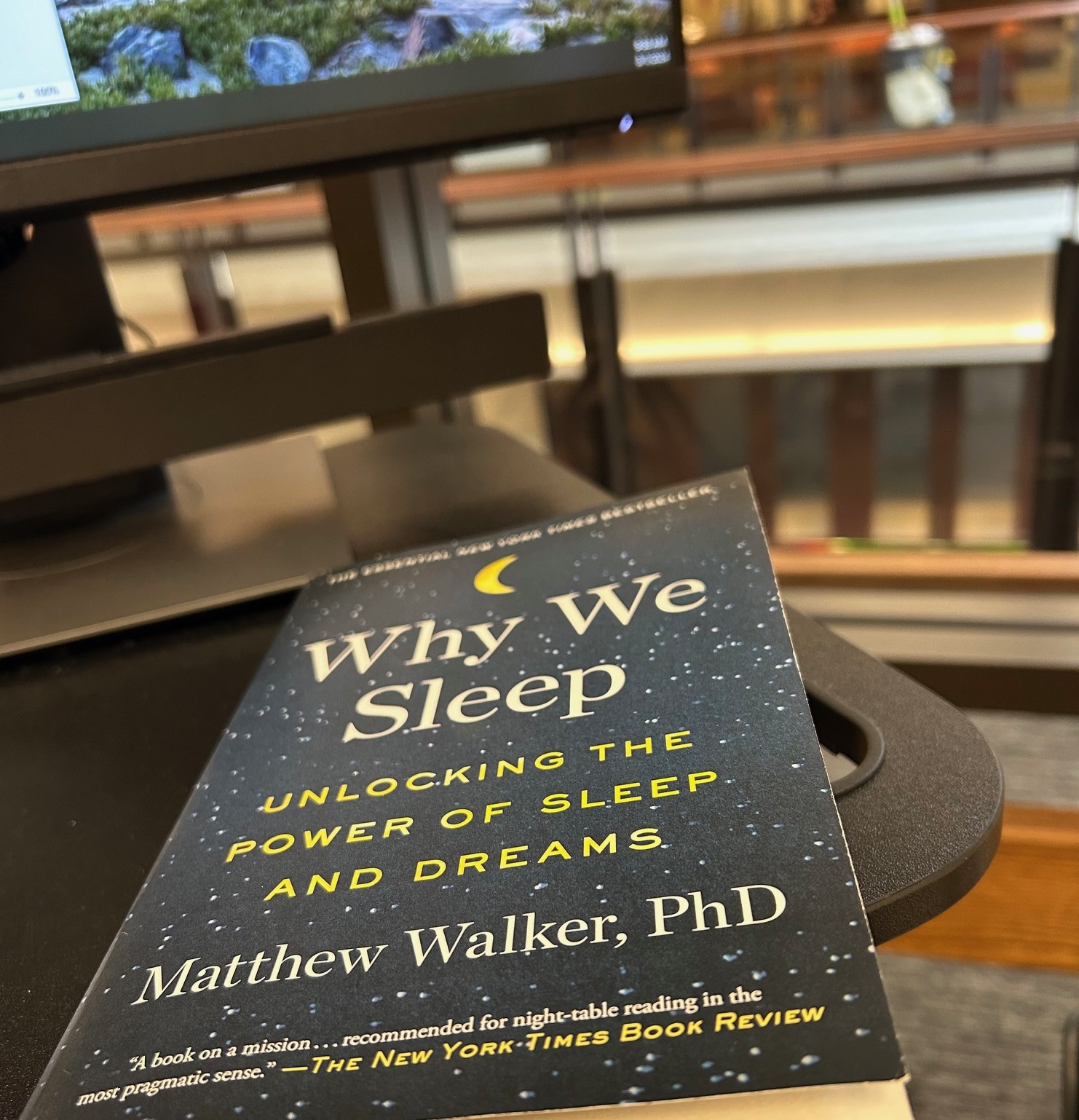
“Sleep is the single most effective thing we can do to reset our brain and body health each day.” – Dr. Matthew Walker, Ph.D.
In early 2015, I asked the following question to Pepperdine’s law students: In comparison to when you first entered Pepperdine School of Law, how would you now describe your practice of rest (e.g., time off, relaxing, Sabbath)? The results: 40% indicated no change; 19% answered stronger; but 41% said weaker. When disaggregated, 52% of first-year students said their practice of rest was poorer than when they started law school. I was not even close to surprised. As the Australians taught us children of the Eighties to say: Been there, done that.
But I was never happy about it. Last semester, nearly a decade later, after discussing sleep troubles with a new law student, I decided that I should at least try to learn something about sleep, so I tracked down a book: Why We Sleep: Unlocking the Power of Sleep at Dreams, by Matthew Walker, Ph.D. I don’t know enough about science to confirm its veracity (there have been critics and controversy), but I do know that after reading it, now I’m having trouble sleeping. But because I don’t want to leave you out of the misery, let me share some of the disturbing (though sometimes cool) information that I read with you. You’re welcome in advance.
For starters, and on a positive note, all animal species seem to sleep, and part of why we humans are awesome may be because of our unique and natural sleep patterns. Specifically, compared to other primates, we sleep in a bed or on the ground instead of perched on tree branches, which allows us a disproportionate amount of REM sleep (the sleep when we dream) because the body is completely paralyzed during REM sleep, which isn’t a terrific idea if you are perched on a tree branch. And while in the cool facts portion of my essay, Walker claimed that the reason we are completely paralyzed during REM sleep is so that we won’t act out our dreams!
Our inordinate amount of REM sleep seems to set us apart in a couple of major ways: First, it heals and helps our mental and emotional health; and second, it enhances our creative and problem-solving abilities. Remember being told to “sleep on it?” Actually, great advice! Although in fact, all sleep phases are beneficial, and messing with any of them causes actual brain impairment.
The human body is fascinating. Just before a baby is born, its amount of REM-sleep is at an all-time high, approximately twelve hours a day. In year one, that declines while deep NREM sleep begins to increase, peaking just before puberty before retreating. The deep NREM sleep during childhood is sculpting the brain, but we all probably remember that it seems like construction halts during the teenage years when all sorts of irrational silliness ensued. Actually, the brain is still maturing then, but rationality is the last to arrive on the scene. Sleep then naturally settles into a predictable pattern in early adulthood. When left to our natural tendencies, human sleep is apparently “biphasic”—about seven actual hours of sleep at night, followed by an hour nap in the early afternoon—but that train apparently left our sociocultural station a long time ago.
In all our societal advancement, however, we have apparently created ways to screw up everything. Have you ever wondered why American life expectancy sucks relative to our immense economic and medical resources? The myriad ways we have created to destroy natural, human sleep patterns and a fingers-stuck-in-the-ears-while-bellowing-la-la-la-la-la-in-the-face-of-research posture toward the importance of sleep may be teensy reasons worthy of consideration.
O sleep, how do I screweth-uppeth thee? Let me count a couple of ways: Darn Thomas Edison for saying let there be light when there shouldn’t be light, and darn alarm clocks (and especially snooze buttons) for daily shocks to our hearts and nervous systems, sometimes multiple times a morning, telling us to get up when we aren’t done sleeping. And since REM sleep is disproportionate toward the end of the seven-to-nine hours of daily sleep we reportedly should be experiencing, about half of all adults in developing countries may be missing out on the unique human benefits that purportedly helped us develop in the first place.
And the consequences are tragic: Weakened immune systems, including an increased risk for certain cancers. Contributions to depression, anxiety, and suicidality. Impaired memory (and while I’m on memory, sleep aids memory both before and after learning, so all-nighters for work or school may be completely counterproductive). Cardiovascular disease. Increased propensity for weight gain, obesity, and developing type 2 diabetes. Drowsy driving—a driver that got up at 7am and heads home from the club at 2am without a single drink is reportedly just as impaired as a legally-drunk driver.
The result? As Dr. Walker wrote, “Relative to the recommended seven to nine hours, the shorter your sleep, the shorter your life span.”
Now we aren’t completely oblivious to our sleeping problems, but it seems that we are unfortunately ignorant to both the extent of the problems and the actual solutions. We typically mitigate with substances, including sleeping pills and/or alcohol and/or caffeine, that can actually do real harm instead of help.
So, what can I do about this to help our law students? I’ll have to get back to you on that one. This seems to be a larger problem than my present work environment, so that’s a major challenge to undertake. But I like major challenges. And it seems far too important to ignore.
What I will do is share with you my summation of the twelve tips for healthy sleep that Dr. Walker shared from the National Institute of Health at the end of his book and hope that someone finds them helpful:
- Go to bed and wake up at the same time every single day.
- Exercise, but not too late in the day.
- Avoid nicotine (period) and caffeine in the afternoon/evening.
- Avoid alcohol before bedtime.
- Don’t got to bed too full or too hungry, and avoid beverages late at night.
- Avoid medicines that disrupt sleep as much as possible.
- Don’t nap after 3pm.
- Do something relaxing before bed (not on a phone or computer).
- Take a hot bath before bed.
- Make your bedroom dark, cool (e.g., 65 degrees), and gadget-free.
- Get at least 30 minutes of natural sunlight each day (ideally, an hour each morning).
- If still awake in bed after 20 minutes, get up and do something relaxing until you are sleepy.
To quote the late, great Edward R. Murrow, “Good night, and good luck.”
 With the world apparently spinning out of control, I thought I might as well join the dizzying ride on an indoor bicycle.
 Starting to Look Up