
“People notice when he’s imitating a horn or a bass, but he’s also singing like water, like rain, singing like a piece of wood, or like a plate cracking on the floor . . . . These are all available to him. All these sounds, because he’s just always aware . . . . In life, he’s always observing things. [And] he doesn’t just see everything. He hears everything.” – Marcus Miller (on Al Jarreau, in Kurt Dietrich’s “Never Givin’ Up: The Life and Music of Al Jarreau,” p. 321)
When Jody and I moved to Malibu (the first time) in 2008, like countless others before and since, we experienced the welcome embrace of Hung and Corinne Le. We quickly felt like family as we shared many a meal in the Le home alongside so many others that received similar treatment. On one of our initial visits Hung said that when he first heard about this couple, “Al-and-Jody,” what he kept hearing was, “Al Jarreau.” So before long, we became known to the Le family as the Jarreaus, not the Sturgeons. It would crack us up when “the Jarreaus” would be invited over for dinner, or while there, hear Hung ask to get a picture of “the Jarreaus” before the evening ended.
You can imagine my reaction several months ago now when the opportunity to move to Wisconsin to work at Ripon College became a real possibility and I stumbled upon a list of the College’s famous alums and saw the name: Al Jarreau. I just had to laugh.
Everyone in my generation heard of Al Jarreau. Ten Grammy awards, sure, but it seemed like he was constantly on television for something or other during the Eighties: singing the theme song for the hit show, Moonlighting; wedging his contribution to the epic “We Are the World” performance between Willie Nelson and Bruce Springsteen; performing his hit song, “We’re In this Love Together.” Even I, a sports-obsessed teenager that paid little attention to the music industry, knew his name.
In our many moves, I developed a habit of reading some facet of an area’s history once we arrived. I read “The Age of Gold: The California Gold Rush and the New American Dream” by H.W. Brands when we lived in California. In Nashville, it was “The Children” by David Halberstam. In Illinois, it was “Life of Black Hawk” as dictated by the Sauk leader himself. Anticipating Wisconsin, I noticed someone had recently published a biography on Al Jarreau, and I knew that I had to track it down once there.
Well, I didn’t have to try very hard. On one of my first visits to First Congregational Church of Ripon, I happened to sit next to Kurt Dietrich, a retired music professor from Ripon College who decided to become Al Jarreau’s posthumous biographer in his retirement. And I soon learned that Professor Dietrich would give a presentation on his book at the Ripon Public Library. Jody and I not only attended but I also received an autographed copy of the book, which he graciously addressed to his “new friend Al.”
I finished reading it this morning and thoroughly enjoyed every page. Anyone with even a passing interest in Al Jarreau, or music in general, or stories of incredibly gifted human beings with fascinating journeys, will be glad that they tracked down a copy.
I also read Isabel Wilkerson’s “Warmth of Other Suns” recently, a brilliant history of The Great Migration of Black citizens from the American South during Jim Crow, so I recognized that Al Jarreau was yet another example of an enormously influential Black musician from places like Chicago (e.g., Nat King Cole; Sam Cooke; Quincy Jones) and Detroit (e.g., Aretha Franklin; Diana Ross; Stevie Wonder) whose very genius emanated from people having the courage to flee the racial terror of the South in hopes of better lives for their families. Jarreau’s family story included parents that left Alabama for Chicago with subsequent stops in both Flint and Indianapolis before eventually settling in Milwaukee, Wisconsin, where Al was born and raised.
Although my journey is so, so different, there were several personal connections in the book that made me wish that I had paid far more attention to Al Jarreau along the way. For starters of course, we both had unlikely journeys to Ripon College, but we also made major moves to Southern California that transformed our lives. I also smiled when I noticed that a musician named Willie Weeks played bass on Jarreau’s second album, and I remembered that it was Weeks who later in his career gave my childhood friend, Jon Conley, his big break in Nashville. I also learned that Jarreau’s last concert was in Austin, Texas, where my youngest daughter now lives, and sadly learned that when Jarreau went to the hospital with the illness that took his life in early 2017, he did so in Thousand Oaks, California, where our oldest daughter now lives.
But beyond the coincidences that provided small feelings of connection to this musical legend, I experienced a deeper connection that comes from the work of a good biographer like Professor Dietrich.
For as long as I can remember, I have had a million friends while still feeling a strong sense of loneliness that is hard to describe. I suspect that on a much larger level that describes the life of Al Jarreau.
Everyone felt drawn to Al Jarreau, but he never truly fit into a recognized box. He fit in everywhere, and nowhere. He had a smile and positivity that lit up wherever he happened to be, but he defied easy categorization. He was so loved at Ripon College, but he was nowhere near the typical Ripon College student. He was a phenomenal musical talent, but no one could decide if he was a jazz artist, or pop artist, or R&B artist. He was an incredible human being with extraordinary gifts that was one of a kind, which sounds like a compliment but might be easier to admire than to be.
What I learned about Al Jarreau the musician is that he had an incredible gift for live performance in part due to his magnetic personality, but also because of his unique improvisational ability. Professor Dietrich shared a story from tour director Jerry Levin about a concert in St. Louis in 1978: “Halfway through the concert, a severe thunderstorm materialized, and the power in the venue went out. Although crew and concert organizers went out to see about cranking up a generator and salvaging the concert, the power had gone out in that entire part of the city. As the promoters and Levin began negotiating about refunding ticket prices to the audience, Al started singing all alone on the stage. The band’s percussionist passed out instruments to band members. Audience members got out lighters and flashlights from their purses and backpacks, bathing the room with a kind of a warm glow. Al finished the set, singing seven or eight songs a cappella. At one point, he sat on the edge of the stage. Several rows back, there was a couple with a small child. The youngster was brought up to the stage, where he sat on Al’s knee, and Al sang directly to the boy. Levin finished the story by saying, ‘I don’t think anybody that was there will [ever] forget it.'”
I wasn’t there, but just by reading about it I don’t think I will forget it either.
But what showcased his improvisational abilities, as musician Marcus Miller described, was a special voice that could sound like anything and everything, which wowed his concert audiences. The quote from Miller near the end of the biography really struck me: Jarreau could do this especially well because he paid attention to everything. He listened to everything. He was fully and constantly aware.
That’s what was in my mind as I closed the book on the life of Al Jarreau this morning. I, too, would like to be fully aware, having learned the secret of how to listen to everything. I don’t have Al Jarreau’s unique voice, so I’m not referring to recreating actual sounds in a stage performance of course. No, I’m just imagining the magic of the self-aware life. Maybe it’s a foolish wish, but it sounds like it might even help with loneliness.
I’m glad that Hung Le refers to us as the Jarreaus. I’m glad that we moved to Ripon College and met Professor Dietrich so that I can feel a deeper connection to Al Jarreau through reading his life story. But mostly, I’m glad that all of the above has led me to commit to listening to everything better.

 “I had my first racial insult hurled at me as a child. I struck out at that child and fought the child physically. Mom was in the kitchen working. In telling her the story she, without turning to me, said, ‘Jimmy, what good did that do?’ And she did a long soliloquy then about our lives and who we were and the love of God and the love of Jesus in our home, in our congregation. And her last sentence was, ‘Jimmy, there must be a better way.’ In many ways that’s the pivotal event of my life.” – Reverend James M. Lawson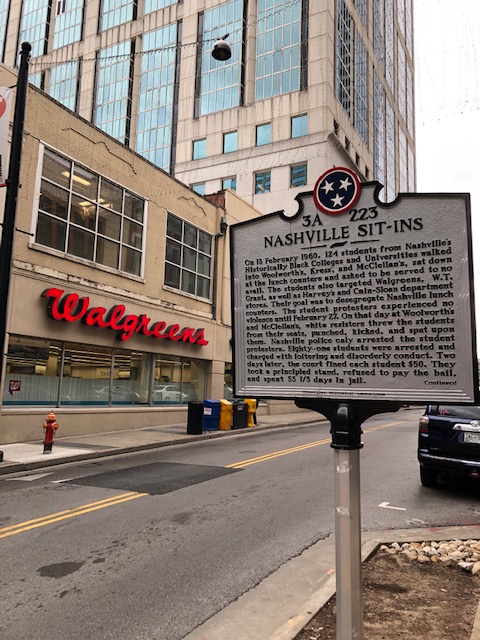

 Starting to Look Up