
Tag Archives: civil rights movement

A House (Still) Divided Against Itself Cannot Stand (Forever)

“A house divided against itself, cannot stand.” – Abraham Lincoln on the campaign trail in Springfield, Illinois, June 16, 1858

Our friend, Flo, graciously gave me a signed copy of Erik Larson’s latest book, “The Demon of Unrest: A Saga of Hubris, Heartbreak, and Heroism at the Dawn of the Civil War,” as a Christmas gift, and I read it with great interest, especially at this particular moment in American history. The book chronicles the few short months between the unlikely election of President Abraham Lincoln in November of 1860 and the outbreak of the American Civil War at Fort Sumter in April of 1861 by venturing beneath the headlines and into the lives of some of the key players in the unfolding tragedy. The stories are captivating, to say the least.

I finished the hefty book amid the rapid-fire headlines currently firing from our nation’s capital, wondering if the combination provided anything for me to say. And I think that I do, have something to say that is.

For starters, to state the obvious, our current political polarization with its cyclical outrage is not new. The American Civil War was deep polarization by definition, in that case producing a macabre debate over exactly how many hundreds of thousands of deaths followed, but I began to wonder if today’s toxic political climate is an instance of history repeating itself—or, is it better understood as an ongoing history?  I suspect the latter.

I have had eleven special opportunities to teach a course built by a fantastic professor named Peter Robinson, titled, “Apology, Forgiveness, and Reconciliation,” and in so doing I stumbled across a December 2019 article in The Atlantic by Adam Serwer with the provocative title, “Civility Is Overrated.” The article’s premise is that the aftermath of the American Civil War—an era popularly called Reconstruction—was not, in fact, a time of healing and reconciliation, but a time that perpetuated the original division through its “false promise of civility” that then evolved into Jim Crow, and a century later, the American Civil Rights Movement of the 1960s. In the final paragraph, Serwer writes: “In the aftermath of a terrible war, Americans once purchased an illusion of reconciliation, peace, and civility through a restoration of white rule. They should never again make such a bargain.”

Well . . .

So I’m just thinking here: President Lincoln’s famous campaign speech in the important prelude to the American Civil War warned of what happens to divided houses, and a century later, Reverend King’s most famous speech continued to lament the maintenance of that divided house (read the first few paragraphs of his speech, at least) and dreamed an inspiring dream of a yet-to-be-realized undivided house. I think that today we’re on the next stanza of the same tragic song.

But if President Lincoln’s famous line (citing Jesus) from his famous speech is correct, the song does not have unlimited stanzas.

President Trump is a fascinating phenomenon. His now larger-than-life persona is venerated by many and reviled by many others—and his flurry of provocative executive actions during his first few weeks back in office naturally produces both reactions. But what I find disturbing is that even many of the Republicans that vehemently oppose President Trump—the RINO (“Republicans in name only” as he calls them)—although in opposition to most of his initial actions, seem to agree with his assault on one thing: DEI (Diversity, Equity, and Inclusion). Instead of multiple nuanced perspectives on the general concept of DEI, there seem to be only two: Good. Or, Bad.

Let me be clear: While money/power always lurks behind the curtain, the American Civil War was fought specifically over DEI. Make no mistake. And the Civil Rights Movement was without question a DEI movement. And amid the sweeping number of issues on the table today, I believe that DEI as a cause or concern, broadly speaking, remains at the center of it all.

One telling example is to recall the home stretch anti-DEI emphasis of the 2024 Trump campaign commercials that helped secure his clear victory at the polls.1 2 And as another specific but dramatic example, you may have seen recently that new Secretary of State Marco Rubio hired an undersecretary for public diplomacy that wrote the following less than four months ago: “Competent white men must be in charge if you want things to work. Unfortunately, our entire national ideology is predicated on coddling the feelings of women and minorities, and demoralizing competent white men.”

My friend, Dr. Richard T. Hughes, published “Myths America Lives By” in 2018, and in discussing various foundational myths identifies white supremacy as “the primal American myth.” One of the blurbs for his book was written by theologian, Dr. James H. Cone, who himself authored one of the most devastating books I have ever read, titled, “The Cross and the Lynching Tree.” For Dr. Hughes’s book, Dr. Cone wrote: “It takes a whole lot of courage for white theologians and scholars to speak the truth about race. If we had more white theologians and religion scholars like Hughes who would break their silence about white supremacy and face it for what it is, we–together–could make a better world.”

I, for one, wish to have more courage, for such a reason.

Now I should state my belief that our nation’s troubling supremacist foundations include more characteristics than simply white, although white is major, and that it is no coincidence that DEI work engages those very conversations. That a visceral response to such conversations comes from many otherwise thoughtful individuals simply reveals to me the depth of the foundations.

So did the Democrats lose the presidential election in large part because their diversity, equity, and inclusion arguments were unpopular? I think so. I know without a doubt that Reverend King and the Civil Rights Movement’s diversity, equity, and inclusion arguments were unpopular. And I know that President Lincoln and the Republicans of the 1860s’ diversity, equity, and inclusion arguments were unpopular, too.

I’m imagining a similar speech to that President Lincoln delivered long ago but in today’s divided land, not that our house/nation “cannot endure, permanently half slave and half free,”3 but that we cannot endure half engaging diversity, equity, and inclusion conversations and half silencing them.

I think there is something demonic in the political unrest today, and I do not think that it has much to do with the typical liberal and conservative approaches to domestic, economic, or foreign policy. Instead, I believe that there is a foundational aspect of American history that has always existed and continues to divide us today, a foundation that seeks to reserve power and privilege for certain “types” of people through misusing words like “meritocracy.” And while this divided house has persisted for a very long time now, I agree with Jesus and Reverend King and President Lincoln and many others who were quoted as saying that divided houses cannot survive forever. But if there truly is this fundamental design feature that continues to divide us, and if we truly “face it for what it is,” as Dr. Cone wrote, I share his hope that “we—together—could make a better world.”

—————————————————————————————————————–

  1. Poltico.com on Election Day: “The border and inflation have been GOP mainstays in advertising all year. But there was one other late entry into the Republican onslaught against Harris: More than a quarter of GOP spots that have aired in battleground states since Oct. 1 mentioned transgender issues in some way — most seeking to tie Harris to the concept of prison inmates, including immigrants, receiving gender-affirming surgery. It’s not a new playbook for Republicans, who leaned into transgender issues in key races in the 2022 midterms with little electoral success. It represented a shift in the presidential race: The first TV ad mentioning the issue did not air until mid-September. Still, it became one of the top issues in Republican presidential ads in the final stretch, though the economy and immigration still loomed larger. ↩︎
  2. See also, The Democrats Show Why They Lost. ↩︎
  3. https://www.nps.gov/liho/learn/historyculture/housedivided.htm ↩︎

Miss Pittman

Miss Jane PittmanI read twenty-five books in 2017, another twenty-five in 2018, and another twenty-five in 2019. I share that with the pride that comes from the rarity of setting a long-term goal and sticking to it. My goal was another twenty-five in 2020 to make it an even hundred in four years, but much to my surprise I am already through twenty in just half a year, so the odds are in my favor.

It isn’t that work has even hinted at letting up. Instead, this sudden reading feast appears to be a combination of no evening events to attend, no sports to follow on television, and a persistent need to escape the present circumstances. I am reading constantly.

Book number twenty was The Autobiography of Miss Jane Pittman. Years ago, while living in Ocean Springs, Mississippi, my friend, Bruno, gave me a copy of A Lesson Before Dying by Ernest J. Gaines, one of those novels that crawls into your heart and builds a nest. Last Christmas, while stocking up on used books at McKays with my family, I couldn’t pass up a copy of Gaines’s Miss Pittman. However, it sat in a stack for the first several months of 2020, but as enduring racism claimed global attention alongside the raging pandemic, it seemed like the time to read this particular story.

The stunning plotline of the novel is the reflection of a 100+ year old woman whose life stretched from the 1860s to the 1960s, from birth into slavery through a life of unrelenting white supremacy and into the pain of the Civil Rights era. Alice Walker described it as “grand, robust, a rich and very big novel,” to which I add a humble Amen.

As I read the frustrating, humiliating, yet strong and courageous journey of the novel’s heroine, given the time in which I was reading I thought of decade after decade of so many thinking that the American Civil War ended something that it did not. And one does not even have to try very hard to connect the dots and recognize that the American Civil Rights Movement was not a finish line either.

It is shameful that we had to argue over such an innocuous phrase, Black Lives Matter. I guess that shows how deep-seated racism actually is.

Miss Jane Pittman is technically a fictional character, but of course she was oh so real. It occurred to me that many more Miss Pittmans were born in the 1960s and are now over halfway through another century’s journey. I wish their story was less painful than it is, but I have seen them on the television mourning the loss of their children, too.

I am thankful to Mr. Gaines for introducing me to Miss Pittman and teaching me that even being shown and told that one does not fully matter for over a hundred years is impotent compared to the capacity of the human spirit. May such extraordinary fortitude be rewarded in the lives of real people.

The Teacher

IMG_0452“I had my first racial insult hurled at me as a child. I struck out at that child and fought the child physically. Mom was in the kitchen working. In telling her the story she, without turning to me, said, ‘Jimmy, what good did that do?’ And she did a long soliloquy then about our lives and who we were and the love of God and the love of Jesus in our home, in our congregation.  And her last sentence was, ‘Jimmy, there must be a better way.’ In many ways that’s the pivotal event of my life.” – Reverend James M. Lawson
It took me nine days to read a 700+ page book from cover to cover. The bulk of that was made possible by a cross-country flight that included an unexpected six-hour layover, but it was the captivating story and skilled story-teller that really did the trick. I would steal a few pages when I awakened each day, and at bedtime, and any time possible in between.

When we accepted the opportunity to move to Nashville, I stumbled across The Children and purchased it immediately. I am fascinated/humbled by the civil rights movement and wanted to know the history of my new community, of course, but more than that, Halberstam wrote one of my all-time favorite books (October 1964), and I could not believe that he was a young reporter for The Tennessean assigned to cover this story when it happened.

The book cover states, “On the first day of the sit-ins in Nashville, Tennessee, eight young black college students found themselves propelled into the leadership of the civil rights movement, as the movement—and America—entered a period of dramatic change. The courage and vision of these young people changed history.”

Our move has been hectic but good, and I had been simply intimidated to open the cover and start on such a hefty book. But wow, all it took was reading the first page. I was immediately embarrassed not to know the significance of what occurred in Nashville. I knew of the horrific murder of Emmett Till in Mississippi, of Rosa Parks in Montgomery, the Little Rock Nine, Freedom Riders, the Selma marchers, and the murder of Dr. King in Memphis, among other famous events, but I was stunned to discover that what took place here in Nashville was at the heart of it all—because “the children” (aka college students)—were the heart of it all.

I knew some of Diane Nash’s heroism but had no idea that John Lewis started his amazing journey in Nashville, and I was especially shocked to know that the infamous Marion Barry was a part of that early group. I somehow knew nothing of Jim Bevel or Bernard Lafayette, Rodney Powell or Gloria Johnson, Curtis Murphy or Hank Thomas. But I will never forget them now.

However, what may have had the greatest impact on me was not one of the children—but their teacher, Jim Lawson. Lawson is now ninety years old and lives here in Nashville. Some of my new friends have met him, and though I am envious of that honor, it is almost too much to imagine.

Lawson grew up and attended college in Ohio as a young man with deep faith and convictions. Lawson was fascinated by Gandhi and conscientiously objected to serving in the military, which for his time in history, sent him to prison for two years. Afterward he was a Methodist missionary in India where he studied Gandhi more deeply and then returned to pursue graduate work in religion at Oberlin College. It was at Oberlin in 1957 that Lawson met a like-minded (and aged) visiting speaker in Martin Luther King, Jr. He told Dr. King of his plan to pursue graduate degrees and then come to The South to work for reconciliation, but Dr. King told him that he was needed now and not to wait.

So Jim Lawson moved to Nashville, where he started teaching nonviolence training workshops to a small and eclectic group of college students—who changed the world.

There are a thousand things to note about Jim Lawson’s life, not the least of which being that he was the Memphis pastor that hosted Dr. King’s fateful trip, and I am sure that many have wildly different opinions about the stances he has taken along the way. But what I will never get out of my mind is Lawson teaching that group of young college students there in Kelly Miller Smith’s church in Nashville. He absolutely knew the dangerous road these “children” were embarking on—and did not hide it from them. How did it feel to know that? But it was the road to a better way, so he taught them anyway.

I live in a different Nashville today because of Jim Lawson’s courageous teaching. But Nashville, as with any other city, is nowhere near what Lawson described as the “beloved community” that inspired his teaching. With his example forever imprinted on my mind, I hope in some small way to teach courageously, too.

Courage & Conviction

IMG_0125

“Nashville sure loves its breakfast places.” – Jody Sturgeon

Before arriving in Nashville my wife suggested that Saturday morning brunch serve as our weekly date, and so far we are two-for-two. We opened with Holler & Dash Biscuit House where I sampled/devoured the biscuits & gravy and a unique approach to beignets, and then on Saturday number two we drove past the long lines at two iconic brunch spots, The Pancake Pantry and Biscuit Love, and ended up at Frothy Monkey where I enjoyed bacon, eggs, and pancakes as well as a decent portion of my wife’s meal, too. I like this new tradition a lot. And as Jody observed, we are in no danger of running out of new places to try out anytime soon.

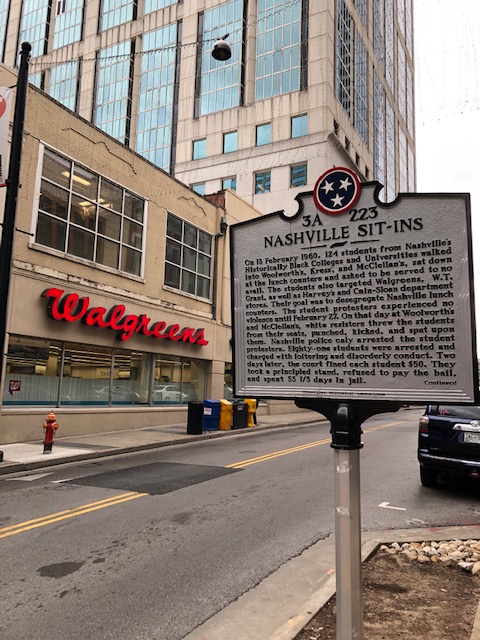
As we walked down Fifth Avenue toward our latest brunch adventure, we noticed the historical marker for the 1960 Nashville sit-ins across the street from the Walgreen’s. I confess to knowing little about the Nashville sit-ins prior to our decision to move, but when I discovered that David Halberstam was a reporter for The Tennessean during this critical time in history and had written a massive book about it titled, The Children, I bought the 783-page monster and am eager to dive in.

Our national sin of white supremacy and the Civil Rights Movement that literally placed it on public display have captivated me on multiple levels, not the least of which being the Movement’s proximity to my world both in location and time in history. It is mind-boggling to remember that not so long ago fellow citizens with black or brown skin could not have sat at the same table with me for brunch in Nashville—and that when a group tried and white citizens assaulted and degraded them, only the former were arrested.

I am both impressed and proud that Nashville marked the spot, but do not be mistaken: There is much more work to do. However, what struck me last Saturday was that the world did change, and it changed due to the courage and conviction of college students. That makes me want to go to work today even more.

Today is April Fool’s Day, so consider yourself warned about some good, clean fun out there today. But let’s remember the lessons from our yesterdays that the students taught us and look toward a tomorrow with the courage and conviction that eschews foolishness and embraces wisdom.

Unarmed Truth & Unconditional Love

94d5a3c3a1397d1a4df25f54640503c2

Ralph Abernathy and Will Campbell grieve the assassination of Dr. Martin Luther King, Jr. in the Lorraine Motel (April 1968)

“I believe that unarmed truth and unconditional love will have the final word.” – Dr. Martin Luther King, Jr.

I was deep in the heart of rural Texas when the chaos in Charlottesville unfolded last weekend and found myself in a conversation with a couple of local police officers about other matters. I mentioned that they should visit us in California sometime and one offered a kind smile and said, “Nah, Californians don’t like Southern Republicans.” We laughed, but there is some measure of truth to his statement. And vice-versa, of course. There is plenty of not liking to go around these days.

I am a Christian, which unfortunately means many things to many people, but for me it means that I must love everyone. No exceptions. So I stand in opposition to hate in any form, which most assuredly includes all versions of white supremacy. And because I must love everyone then I am necessarily opposed to acts of violence. It is a package deal. Violence toward a loved one is unfathomable, so when you choose to love everyone it kind of takes the wind out of Violence’s sails.

“‘Don’t the Bible say we must love everybody?’ / ‘O, the Bible! To be sure, it says a great many such things; but, then, nobody ever thinks of doing them . . .'” – In Uncle Tom’s Cabin by Harriet Beecher Stowe

Will D. Campbell is a personal hero of mine who was an important leader in the Civil Rights Movement and a fierce advocate for the victims of deep racism. However, Campbell started to notice that many of his fellow activists used the same dehumanizing language  and tone toward the “segregationists” that segregationists used toward African-Americans. Since Campbell was a Christian, he took a stand against that, too.

“With the same love that is commanded to shower upon the innocent victim of his frustration and hostility, the church must love the racist. Moreover, the church is called to love those who use and exploit both the racists and their victims for personal wealth and political gain. The church must stand in love and judgment upon the victim, the victimized, and those, both black and white, who exploit both, for they are all the children of God.” – Will D. Campbell, in Race and Renewal of the Church (1962)

Some things in this country have improved in the half century since the milestone moments of the Civil Rights Movement while many others have quite obviously not. And the version of Christianity touted by “Brother Will” and Dr. King often appears unopened in the shrink-wrapped box.

But I remain hopeful. For I, too, believe that unarmed truth and unconditional love will someday have the final word.

Freedom is Respect

As I reflect on last week’s inaugural (and wonderful) Diversity Week at Pepperdine Law, the following passage from my hero, Will D. Campbell, comes to mind.

“The civil rights gains we have made are largely cosmetic,” my old friend, Kelly Miller Smith, told me just before he died. One would have expected to hear those words in earlier times, when the gains of black people had been more modest than it seemed to me they had been during his lifetime and mine. He had been a pivotal figure in it all. Buses and taxicabs, schools, restaurants, theaters, parks, swimming pools, as well as participation in the political process had all been desegregated since he and I had come to Tennessee from Mississippi in the rigidly, segregated decade of the fifties. He from a black church in Vicksburg, I from a white university in Oxford. His little daughter had been one of the nine brave children who faced the violent mobs to begin the slow and painful process of integrated education. The church he pastored for thirty-four years was headquarters for the massive sit-in movement. Quietly or obstreperously, whatever the situation indicated, he negotiated with mayors, governors, merchants, and owners such issues as employment, housing, fairness, and decency in general.

All that he had been party to and more. Yet here he lay, a few weeks from death, saying that all his efforts had produced no more than a cosmetic coating over an inveterate malignancy as socially lethal as the one claiming his life. I protested with a roll call of the improvements he had presided over. He listened in his usual smiling, affable manner as I listed them one by one, beginning with public transportation in 1956 and concluding with his being a dean and teacher in one of the most prestigious universities in the South where he could not have been more than janitor not many years earlier.

“But they still don’t respect us,” he said sadly. After a long pause for needed oxygen, he continued. “Look at the television shows. Listen to the rhetoric on the streets. They still don’t respect us.”

His words were a startling awakening. How far I had missed the point of it all. How dissimilar the promised lands two Mississippi men had envisioned. To grant the truth of his words would be to acknowledge that the years of both of us had been wasted. He spoke with approval and gratefulness for the things I recited, but as he did it became clear to me that the one thing which was behind all else was never his. Respect.

Freedom is respect.

– Will D. Campbell, Forty Acres and a Goat 269-70 (2002).

That is what gave me great joy this past week—the giving and receiving of respect.