
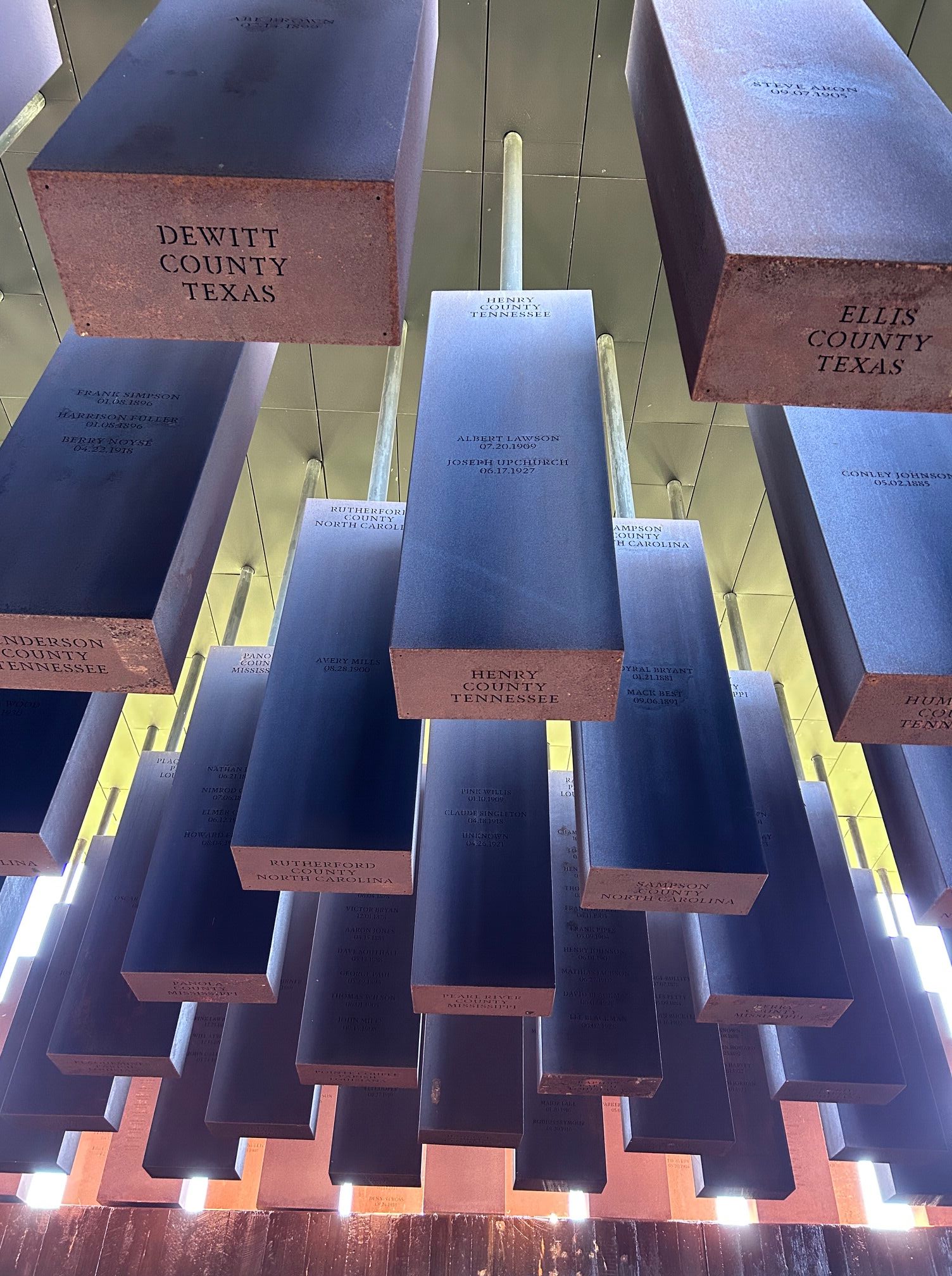
“At a time when some believe we should avoid any discourse about our history that is uncomfortable, we believe that an honest engagement with our past is essential if we are to create a healthy and just future.” – Bryan Stevenson, Executive Director, Equal Justice Initiative
I asked ChatGPT where the courthouse stood in Kennett, Missouri, during the 1920s, and it told me that it was “located in the center of the town square, essentially where the courthouse sits today.” It also shared that Dunklin County built the two-story structure in 1892 and that subsequent courthouses were built on the same location.
Why do I care?
My dad grew up in Kennett, Missouri. My dad was born in 1920, and when I was growing up just over the state line in Arkansas in the ’70s and ’80s he shared a gruesome story of a lynching that took place on the courthouse lawn when he was a child. Children were not supposed to attend, as he remembered it, but he was a precocious child who wiggled his way to the front to see what everyone was there to witness. My dad remembered that a Black man was lynched that day for allegedly raping a white woman and was asked if he had any final words. My dad remembered the man’s response: “Well, I didn’t do it, but I know that doesn’t matter to you all.”
My dad never forgot the sight. And I never forgot the story.
Why do I share such a horrible story today?
I recently returned from taking students and a fellow professor on a civil rights trip to Alabama. This is my third consecutive March to accompany students on such a trip, which includes time in both Montgomery and Selma, and one of the sites we visit each year is the National Memorial for Peace and Justice. It is a haunting, gut-wrenching place to visit. Bryan Stevenson, and his organization, Equal Justice Initiative, built the National Memorial as “the nation’s first comprehensive memorial dedicated to the legacy of Black Americans who were enslaved, terrorized by lynching, humiliated by racial segregation, and presumed guilty and dangerous.” The Memorial remembers the “[m]ore than 4,400 Black people killed in racial terror lynchings between 1877 and 1950” by engraving their names “on more than 800 corten steel monuments — one for each county where a racial terror lynching took place.”
I share the shameful story from my father because I am gutted each year when I see that Dunklin County, Missouri, is not represented. On such hallowed ground that does such beautiful and important work, the omission is scandalous.
And how many more are missing? What actually affects me more personally each year is that my native county — Greene County, Arkansas — is also missing. It should undoubtedly be there, too.
I have conflicting emotions about Paragould, Arkansas, my hometown. I cannot help but love it because of how it loved me. I was born in its hospital in 1970 and listed it as my permanent address until I moved away in 1999, so when I remember the ’70s, ’80s, and ’90s it was my home. Over the three decades I lived there I was honored and respected and valued, all of which continues through the first quarter of the next century since I moved away.
It called itself The Friendly City, and that was my personal experience. Its people taught and cared for me, but I loved other things about it, too: from fried pies at Batten’s to a chip and dip at Taco Hut; from reading Hardy Boys at the Greene County Library to summers full of ping-pong and basketball across the street at the old Community Center; from cruising Kingshighway on weekends to watching a movie at the Plaza Twin Cinema; from learning the old hymns in its churches to listening to the curfew whistle late at night; and from flipping baby burgers at Dairy Queen to learning how serious high school basketball action looks and feels—I have so many good memories.
But there are terrible memories, too, when I choose to remember. I still remember awful, shameful jokes that I learned as a child—an entire category devoted to a particular racial epithet—and I wish so badly that I could say that I never laughed. And I truly wish, and I wish this with everything within me, and I am sick to my stomach to admit it, but I truly wish that I never repeated the jokes. But I did. I block it from my memory as much as I can, but I know it is true.
My hometown did not sit me down and teach me white supremacy overtly, but I learned it growing up there nonetheless, and it took me far too long to unlearn it. And I’m still unlearning.
My hometown did not teach me its full history. I figured out from living there for thirty years that unlike many towns in the nearby Mississippi Delta, even Jonesboro just twenty miles away, it was for all intents and purposes 100% white—and that it was that way for a reason. Its website tells of its incorporation in 1883 and that it “took on a cosmopolitan appearance” during the early 1900s. But this leaves out an awful lot, and I say “awful” quite intentionally. No one ever told me about the Paragould Race Riots, and I am ashamed to confess that I came back to town after college as a young history teacher entirely ignorant of such racial terror in my own hometown, so I did not share the stories either. I probably suspected them and am shamefully complicit in that I never asked.
I learned of the Paragould Race Riots in the online Encyclopedia of Arkansas and learned that Paragould received national attention in 1899 when the Arkansas Gazette reported that “a self-appointed vigilance committee” told the significant number of free Black citizens of Paragould “to leave the city of Paragould, bag and baggage, on or before next Saturday night, and never return again, for any purpose whatsoever, or suffer the consequences of staying.”
Here are some of the headlines from the turn of that century:
“Attacked a Church.” Daily Soliphone, April 14, 1902, p. 1.
“Disgraceful If True.” Arkansas Gazette, April 21, 1888, p. 4.
“Negroes Are Leaving Paragould by Hundreds.” Arkansas Gazette, August 8, 1899, p. 1.
“Negroes Ordered out of Paragould.” Arkansas Gazette, April 9, 1908, p. 1.
“Ordered to Leave the County.” Arkansas Gazette, November 1, 1892, p. 3.
“The Paragould Outrage.” Arkansas Gazette, April 27, 1888, p. 3.
“Paragould Whitecappers.” Arkansas Gazette, August 9, 1889, p. 4.
“Race War in Paragould.” Baxter Springs News (Baxter Springs, Kansas), August 12, 1899, p. 2.
“A Serious Race Riot.” Houston Daily Post, August 7, 1899, p. 3.
“Troops Not to Interfere.” St. Louis Republic, May 23, 1902, p. 2.
So I am sad when I read the website’s version that it “took on a cosmopolitan appearance” during the early 1900s.
In 1908, the Arkansas Gazette shared the article titled, “Negroes Ordered out of Paragould,” and reported that the remaining Black citizens of Paragould had their homes attacked by the self-named “Dirty Dozen” and were ordered to “leave town on pain of death.” By 1930, there were only twenty Black citizens in Paragould out of a population of 5,966. When I was born in 1970, there were fourteen Black citizens in Paragould out of a population of 10,639. To be candid, my memory is of zero Black citizens in Paragould for the thirty years I lived there.
I am certain that Greene County, Arkansas, should be called out in the National Memorial for Peace and Justice.
Also in Montgomery, Alabama, is another of the Equal Justice Initiative projects: the Legacy Museum. I am not an emotional person by nature, but my initial visit to the Legacy Museum moved me to tears. In one memorable instance, I stood at a wall filled with newspaper ads from freed slaves seeking reunification with their family members that they were separated from by slavery. In the bottom righthand corner I was shaken to read an ad posted in The Christian Recorder (Philadelphia, PA) on August 24, 1893:
INFORMATION WANTED –
Of my people: mother father, broth-
er and uncle. My mothers name
was Nancy Slater, my father Carlisle
Slator, and my brother name was
Peter Slater, and uncle Moses Slat-
er. We all lived on Main street,
Richmond, Va. My uncle had a
caste in the eye. Now I will give
a description of Carlisle my father,
he was very bright with blonde
hair, my mother was dark my
brother was dark and uncle was
dark. I was separated from them
just before the war and sold to a
man by the name of John A. Beale
in Alabama. So my name was
Pleasant Slater until I was sold and
now I go by the name of Pleasant
Beale. Any information concern-
ing there whereabouts will be gladly
received.
Address
Pleasant Beale
Paragould, Green, Co., Ark.
I do not know what happened to Pleasant Beale in Paragould, Arkansas, but when I read of what happened in the late 1800s and early 1900s, I can imagine.
I love my hometown, and out of love I want it to engage its past. It is just over 400 miles from Paragould to Montgomery and the various Legacy Sites that feel like they were built for me and the people of my hometown. It is painful to visit, but as an EJI attorney once told me and a group of law students, painful is different than harmful. And facing the truth, though often painful, is critical. As Maya Angelou wrote in On the Pulse of Morning: History, despite its wrenching pain, / Cannot be unlived, but if faced / With courage, need not be lived again.
On my first visit to the National Memorial for Peace and Justice, I suddenly had the strong need to tell someone that I am sorry. Two of my African-American colleagues were nearby, and I walked over to each, sheepishly, to let them know. Hard-wired into my psyche is to think that historic racial terror was not my fault. That it was forever ago. That I wasn’t there. But I suddenly knew, standing in the Memorial, far too late, and all too clear now, that I have so many reasons to be sorry. I am sorry for the jokes that I laughed at—and retold. I am sorry that I did not teach my students the history that they deserved to know. I am sorry that the ancestors of so many people were terrorized and tortured and murdered by my ancestors and that they never heard someone that looks like me say, I’m sorry. And I am sorry that saying I’m sorry feels like the very least I can do.
I hope to return to the National Memorial for Peace and Justice, and I will continue to hope that somehow and someday the missing history from Dunklin County, Missouri, and Greene County, Arkansas, will be represented there. Those who were victimized deserve to be recognized, and the actions of those who terrorized others deserve to be called out, too.
We live in interesting times. In addition to both ignoring history and missing history, you probably know that there is also an active move to erase history. I do not find this surprising, but it does call for resistance. Let us not forget. Let us acknowledge the truth of what happened in our collective history. As Bryan Stevenson shared, “an honest engagement with our past is essential if we are to create a healthy and just future.”


 Starting to Look Up