Monthly Archives: September 2024

Bad Moons

I hear hurricanes a-blowin’ / I know the end is comin’ soon / I fear rivers overflowin’ / I hear the voice of rage and ruin / Don’t go around tonight / Well it’s bound to take your life / There’s a bad moon on the rise.

– John C. Fogerty

It’s guilt, I think. I get this odd feeling watching television coverage of hurricanes, you see, like the terrible destruction wrought by Helene yesterday. I’m guessing it’s guilt with maybe some weariness and empathy sprinkled in.

Empathy because although I dodged tornadoes in Arkansas, earthquakes and wildfires in California, a pandemic in Tennessee, and frigid winter temperatures in Illinois, a hurricane in Mississippi holds special status in the disaster-littered timeline of my life. I have absolutely been there.

And weary because thirty-four hurricanes made landfall in these United States since Katrina changed my life in 2005, including four just this year, and if climate change has shown its hand there are many more to come that will be more intense than ever. I feel weary when I see yet another video montage of roaring water, relentless wind, and devastated humans left behind. I know the exhaustion, and there will just be more and more.

But it must be mostly guilt because of the extraordinary response to Katrina. I don’t think there’s been anything like it before or since, and I had a front-row ticket to such incredible love and generosity. That is surely not everyone’s experience, including today. That Katrina turned out to be a highlight of my life is proof that my experience was abnormal.

But this reflection on my emotional salad is all for my personal therapy. I wonder what you think. How should you respond to these perennial tragedies on the evening news?

For starters, I’d say, give when you are so moved. Help the victims of Helene. I know exactly how they will feel when you do. Their hearts are broken. But I can also picture you giving away your piggy bank after one tragedy, then turn on the news the next day only to discover a new tragedy and one less piggy bank. I get not knowing how to respond to the never-ending trail of bad moons that we encounter through various media day after day after day.

I have a general thought.

I recall one of the amazing Katrina volunteers from somewhere in the world coming to tell me goodbye after his group spent several days working their tails off out of pure love. It was killing him to leave with so much undone, and it was my turn to play comforter to another’s tears. I fumbled for something helpful to say to someone so kind, and I mentioned that I suspected he could scratch that itch for helping others in great need back in his hometown, too. Sure, Katrina captured the attention and heart of the entire world, but there are people in great need all around us if we have the courage to look in the dark corners of our own communities. I truly believed that then, and I still do.

So I guess I don’t know how to cure all the problems in the world, including how one person can respond to all the problems in the world. I wish that I did. All I can offer is the idea of adopting a daily posture of keeping our eyes and hearts open to those all around us facing bad moons in their evening sky. Someone close by is in for nasty weather, and if we could imagine a world where we consistently love our neighbors, then maybe we can start to make a dent in the evening news, too.

Roses Are Red, Violets Are Blue, but Wisconsin Is Actually Purple

Purple haze all in my brain / Lately, things just don’t seem the same / Actin’ funny but I don’t know why / Scuse me while I kiss the sky.” – Jimi Hendrix

I stopped using social media to discuss politics a long time ago, mostly because I just didn’t love the desire to claw out my eyeballs. The following represents only a minor shift in personal policy, I hope.

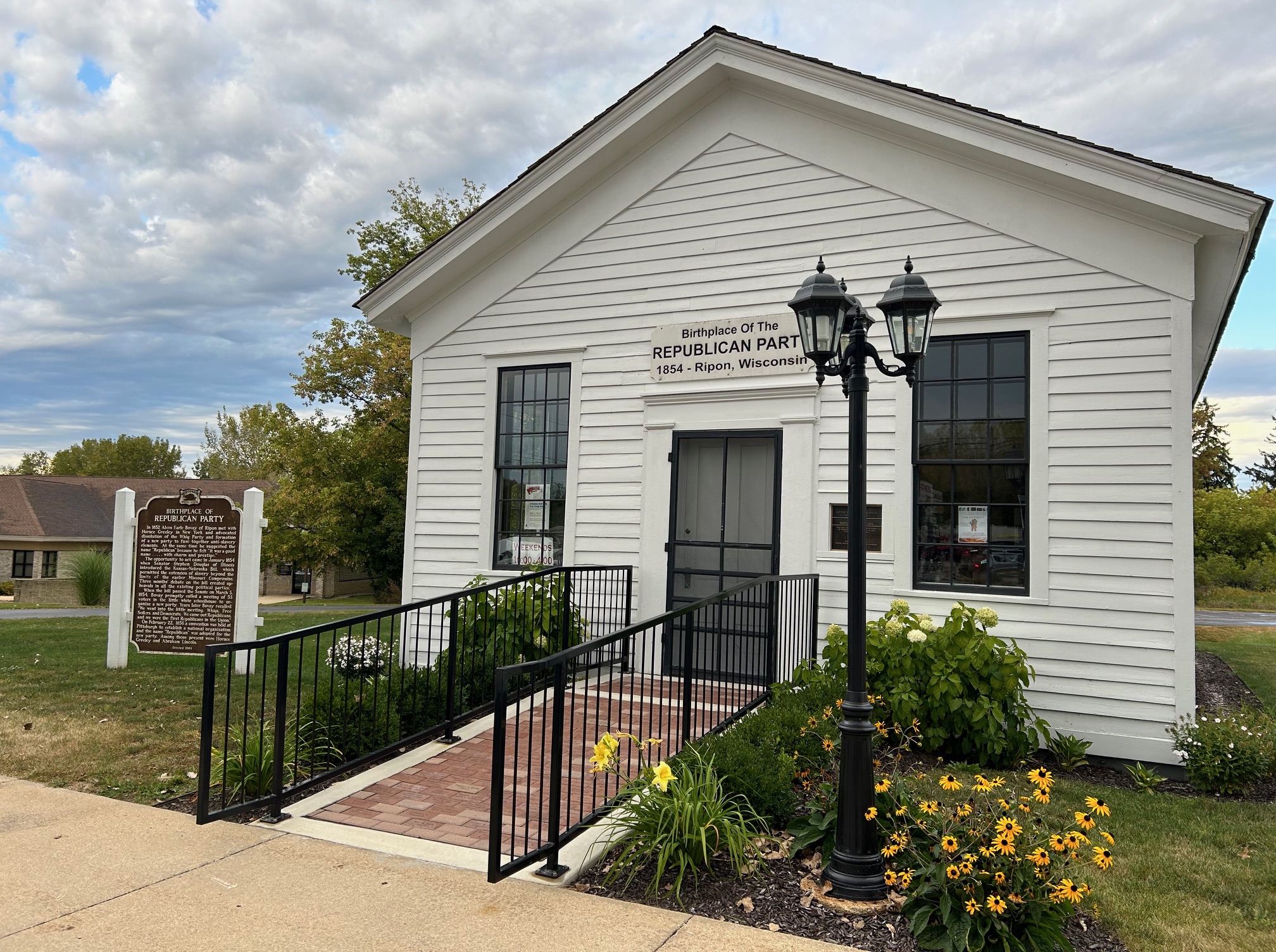
My new hometown is the birthplace of the Republican Party. Alvan Bovay, a lawyer and mathematician from New York City, moved to Ripon, Wisconsin, in 1850, one year after the city was founded, and in 1854, frustrated by the potential spread of slavery in the proposed Kansas-Nebraska Act, called a meeting at the First Congregational Church and proposed forming a new political party to oppose slavery if the bill passed. Well, the bill passed, and Bovay hosted a follow-up meeting at what is now known as the Little White Schoolhouse, a meeting that led to the establishment of the Republican Party. Six years later, the United States elected its first Republican president, Abraham Lincoln, and all hell broke loose soon thereafter.

As you might suspect, when I pass by the Little White Schoolhouse in my new hometown, I often see travelers there taking pictures from their respective pilgrimages. Ironically, I think supporters of both major political parties should take pilgrimages here, albeit for different reasons: Republicans, for obvious reasons, being the birthplace of their party, but Democrats, on the other hand, for historic reasons, too, i.e., to honor an early political movement that stood up for basic civil rights for Black citizens and then held the nation together during the bloodbath that ensued when Southern states seceded to preserve white supremacy. There’s much there for both to celebrate if they so choose.

In a way, I guess my new hometown serves as a nice microcosm of life in a purple state, having something that both Democrats and Republicans can honor.

With the 2024 presidential election on its final approach, Wisconsin, my new home state, is receiving a lot of attention as a “battleground” state. (My new academic department chair was quoted in Newsweek just last week.) Wisconsin is one of only five states (along with Arizona, Georgia, Michigan, and Pennsylvania) that voted for Trump in 2016 and Biden in 2020, displaying the capacity to vote for a presidential candidate from different parties. In addition, officially, and this may change following the next election, Wisconsin is one of only three states (along with Montana and Ohio) that has one United States Senator from the Democratic Party and one United States Senator from the Republican Party—down dramatically from twenty-seven split delegations in 1980.[1] Wisconsin is apparently the prototype of a “purple” state, a mixture of red and blue—even though when it comes to colors, this football-crazed state prefers the green and the gold to that associated with one of its historic rivals, the Minnesota Vikings.

I happen to like purple—when it comes to politics.

I’m actually quite blue, to be sure, when it comes to the political team I typically root for, and I have strong feelings along those lines about this particular presidential election, but as one who cares deeply about words like diversity, equity, inclusion, and belonging, and very much dislikes words like echo chamber, groupthink, and homogeneity, I am fond of what are now extraordinary places where people from different perspectives live in community and everyone has the chance to speak up and be heard. So, I like living in a place that is currently known as a purple state.

However, refusing to put my head in the sand, I’m well aware that these rarities are headed toward extinction, and I’m not sure that will change anytime soon.

I sort of like the idea of a purple party. (This is where my wife, a major Prince fan, perks up, and I confess that going back to (political) parties like its 1999 seems surprisingly nice given today’s crazy town carnival, but that’s not where I’m headed with this little essay.)

I sort of like the idea of a purple party, but I’m not going to call a meeting at the Little White Schoolhouse and try to start one, mostly because I only sort of like the idea and think it would turn out poorly. The idea of a purple party would probably end up as a gathering of all the moderates, those tired of the extremists on both sides—almost a call back to the political establishment once upon a time. Make America Moderate Again, if you will. I can see the purple MAMA hats already.

But actually, sometimes, I like extremes. Like, a lot. For example, all things considered, pretty much any landmark movement for human rights was a radical movement once upon a time, and I want to be on those teams.  

No, instead of a party for “those in the middle,” though an understandable wish for many, what I wish for instead is not even a party, just a place in this world where people from very different backgrounds with very different characteristics and very different perspectives can be in the same place and learn from each other and refuse to hate each other (which is where the train consistently derails) and choose to respect each other as human beings. Places where Justice Ginsburg and Justice Scalia go to the opera together, and where George W. Bush and Michelle Obama exchange hugs and cough drops, and where friendships develop like Snoop Dogg and Martha Stewart; Ella Fitzgerald and Marilyn Monroe; Sherlock Holmes and Dr. Watson; Harry and Sally; Bert and Ernie; Woody and Buzz.

Wishful thinking, I know, this notion of radical respect and radical friendship across dividing social lines. Who could really imagine that happening anywhere? But if anyone ever calls a meeting at a little schoolhouse somewhere with that in mind, please pass along the invitation.


[1] Sure, Maine and West Virginia also have split delegations, but theirs are Independent and Republican, not Democrat and Republican. And don’t even try with Vermont: nothing split about that delegation!

Small, but Mighty

Life in these United States involves immersion in a culture where bigger is typically considered better. That’s undeniable, I think. We naturally count likes and followers, poll numbers and votes, items sold and bottom lines, box office receipts and numbers of thumbs up, runs/goals/points leading to wins and losses—and judge what is “successful” accordingly. The more, the merrier, so they say. I have yet to see someone enter the Shark Tank and say: My dream is a nice, small business. Hell, no one gets to be a “shark” on Shark Tank for having a small business. Like I said, everywhere we turn: bigger = better.

Not surprising. Our foundational institutions are based on competition: a capitalistic economic system; an adversarial justice system; a democratic political system: in a competitive world, bigger numbers are how we establish the winners and the losers. That is just what we do.

I opened my laptop last Friday to the New York Times article, “Trump Claims Harris’s Rallies are Smaller. We Counted.” Of course, you did. That’s what we do: count sizes of things. It is like we all wear glasses with special lenses so that every person and everything that we see is on one side or the other of a greater-than or less-than sign. Those familiar mathematical signs sit above the commas and periods on our keyboard, and even the words themselves imply value. Greater than. Less than.

This is all well and good (I guess), unless you are on the less-than side. Unless you are (brace yourself)—small. In a competition-based society, the underlying idea is that being small and coming up short is unfortunate and that such misfortune provides the motivation to do more, to grow bigger, based on the assumption, of course, that bigger is better. I mean, one of the very definitions of “small” is “insignificant and unimportant.”

I’m not sure that I buy the entire premise.

__________________________________________

Ten years ago, during the college search journey with our youngest daughter, we learned about small, liberal arts colleges. I confess: as a first-generation, Pell-eligible student myself, I knew very little about an awful lot, and these small colleges were a revelation. My primary experience had been with large, public universities, community/junior colleges, or generally mid-sized, private, faith-based universities. But as we searched, we found these cool, tiny places fascinating.

We learned of the work of Loren Pope, an independent college counselor who said, “The smaller the school, the more impact it can have on a kid. My mission in life is to change the way people think about colleges.” Pope wrote a book titled, Colleges that Change Lives, and we visited several on his list, including a tiny place in rural Wisconsin. We loved our visit to Wisconsin, but our daughter ultimately decided that that particular college was not the place for her college education. But she said to my wife and I: “You two should work there someday.”

Well, life is funny. Several years later, my wife and I did find ourselves working at a small, liberal arts college in rural Illinois that we loved very much. And now, hot off the presses, we are working at a small, liberal arts college in rural Wisconsin — not the same one we visited a decade ago, but nearby, and for us, even better.

I can say from personal experience that, despite today’s disturbing rhetoric, colleges of all shapes and sizes can change lives for the better, but I must also say that I find myself enthusiastically agreeing with Loren Pope that these small colleges can have an extra special sort of impact. In my short time at Ripon College, I have watched the presidential debate and considered the future of our nation with an intimate group of students; watched a football game on a lovely Saturday afternoon where none of the players involved had an athletic scholarship; attended an activities fair and visited with students promoting interests ranging from paranormal activity to equestrian sports, from Greek Life to service organizations, from physics to art, from College Democrats to College Republicans, and affinity groups representing Black students, LatinX students, Asian students, LGBTQIA+ students, and more. All on a campus with less than a thousand students, and all on a campus where these students with diverse backgrounds and diverse interests know one another and the professional educators that love what they get to do here.

There is a particular beauty in something small, but to be small is to be at risk in this world. Small businesses, small farms, small towns, and small colleges are all at constant risk of extinction. But I think there is a corresponding and greater risk on the other side of the equation. In my early days of full-time ministry, I stumbled on some writings of a youth pastor/theologian named Mike Yaconelli, who was considered sort of edgy in a way that I found interesting. It was the heyday of “church growth” strategies, and I remember that he wrote something like, “The only thing you need to worry about with church growth is not to grow too big.”

I liked that then, and I like it now, more than ever.

Aristotle had a similar idea, from what I understand, and wrote extensively on his belief that a city-state should be big enough, but not too big, and that maybe 500-1,000 people was, to quote the philosopher Goldilocks, just right. To present day, Simon Sinek makes a similar argument. In his wonderful book, Leaders Eat Last, in Part 5 he outlines “the abstract challenge,” i.e., as civilizations and organizations grow large, the people the leaders purportedly protect tend to become abstract, invisible to the leaders. Sinek doesn’t hold back on the ramifications and titles chapter thirteen: Abstraction Kills.

All I hear is Yaconelli saying to literally take care not to get “too” big, i.e., so big that you cannot know one another. Don’t grow so big that people become just a number.

What is it that I find so special in the small college setting, the thing about small anything that transcends the typical experience in our particular “advanced” culture? It reminds us to truly see each other.

I often wonder if the world is losing its marbles, and although questioning institutions is one of my favorite things to do, the warlike drumbeat questioning the age-old assumption that a college education is a good thing sort of blows my mind. Is college for everyone? No. Is college too expensive for many? Yes. Should we work to improve things? Sure. But my goodness, I could write forever about the impact of college on the world as well as individual lives and families, including mine.

Instead of feeding our tendency to ask poorly-framed questions (which, ironically, college can help address), maybe the overly broad “Is college worth it?” should be reframed as “Which colleges are worth it?” And if so, I humbly suggest that we check our culturally-influenced tendency to evaluate an answer thinking that bigger is better and be willing to look to the small places. You just might discover a gem.

“Here it is again, the Great Reversal: many of the first ending up last, and the last first.” – Jesus (Matthew 20:16, MSG)
The Presence of Still Water

When despair for the world grows in me / and I wake in the night at the least sound / in fear of what my life and my children’s lives may be, / I go and lie down where the wood drake / rests in his beauty on the water, and the great heron feeds. / I come into the peace of wild things / who do not tax their lives with forethought / of grief. I come into the presence of still water. / And I feel above me the day-blind stars / waiting with their light. For a time / I rest in the grace of the world, and am free. – Wendell Berry, The Peace of Wild Things And Other Poems (Penguin, 2018).

I read Tom Lake. I should see Swan Lake. I have seen the Great Salt Lake. I remember Ricki Lake. There’s a British steeplechaser named Iona Lake (what a terrific name). For a few more days, I live in a town named Green Lake. It is my favorite lake so far.

Green Lake is a cool little place. It is four miles from Ripon, which is where I work and will live, and it boasts a population of 1,001. (I like to think the 1 is just for me.) But, in the summer, the population of Green Lake explodes. The “Travel Wisconsin” website explains why:

Visit the deepest lake in Wisconsin and the welcoming city on its shore. Located in the central region of the state, the outdoor recreational opportunities here are endless. Fish for trout and walleye, paddle, hike or bike the 27 miles of pristine shoreline, and stay a while with your crew to experience all the area has to offer. Relax after a long day of adventures at one of the resorts and spas and be sure to take a swing at one of the four scenic golf courses.

Not your typical tiny town. Bottom line: I’m not roughing it.

Growing up poor, we never went to “the lake” like many of our more affluent friends, but growing up in deep church culture, I recall the tsk-tsking of church members who I understood needed to spend less time at “the lake” and pay more attention to regular church attendance. Who knew that poverty could actually be a built-in advantage in the eyes of the Lord? I’m quickly learning now what I was missing then.

I have enjoyed several early morning runs along the lake here, listening to its gentle gurgle, the yawning chirps from the trees, and the occasional splash somewhere nearby, while seeing lazy birds glide by alone, an occasional squawking duck, and the wild turkeys trot clumsily across the road. And I have enjoyed a lovely meal with friends at a popular restaurant here, relaxing at the fire pit together while waiting for a table, watching dark clouds roll across the sky. And I have enjoyed watching the day end at Sunset Park here with a boater returning to shore for the evening, the sun painting the horizon with lavender and salamander brushes, and an elderly couple joining me in awe.

I hear that the winter is a little different, with an average high of 26 degrees and the activities transformed into ice fishing and ice skating, snowmobiling and snowshoeing, skiing and sledding. I may be crazy, but I think that sounds lovely, too.

Why is life at the lake so special? The word peaceful comes to mind. And Wendell Berry’s poem seems to capture it best: somehow, mystical though it may be, it is a magical place of still water that moves you from disturbed despair to rest, grace, and freedom.

I’m just thinking about it all today. And the thought occurred to me: When you sense despair someday, and odds are that it could happen, you might remember to visit a lake. Even if it is on a Sunday.