Tag Archives: wisconsin

Small, but Mighty

Life in these United States involves immersion in a culture where bigger is typically considered better. That’s undeniable, I think. We naturally count likes and followers, poll numbers and votes, items sold and bottom lines, box office receipts and numbers of thumbs up, runs/goals/points leading to wins and losses—and judge what is “successful” accordingly. The more, the merrier, so they say. I have yet to see someone enter the Shark Tank and say: My dream is a nice, small business. Hell, no one gets to be a “shark” on Shark Tank for having a small business. Like I said, everywhere we turn: bigger = better.

Not surprising. Our foundational institutions are based on competition: a capitalistic economic system; an adversarial justice system; a democratic political system: in a competitive world, bigger numbers are how we establish the winners and the losers. That is just what we do.

I opened my laptop last Friday to the New York Times article, “Trump Claims Harris’s Rallies are Smaller. We Counted.” Of course, you did. That’s what we do: count sizes of things. It is like we all wear glasses with special lenses so that every person and everything that we see is on one side or the other of a greater-than or less-than sign. Those familiar mathematical signs sit above the commas and periods on our keyboard, and even the words themselves imply value. Greater than. Less than.

This is all well and good (I guess), unless you are on the less-than side. Unless you are (brace yourself)—small. In a competition-based society, the underlying idea is that being small and coming up short is unfortunate and that such misfortune provides the motivation to do more, to grow bigger, based on the assumption, of course, that bigger is better. I mean, one of the very definitions of “small” is “insignificant and unimportant.”

I’m not sure that I buy the entire premise.

__________________________________________

Ten years ago, during the college search journey with our youngest daughter, we learned about small, liberal arts colleges. I confess: as a first-generation, Pell-eligible student myself, I knew very little about an awful lot, and these small colleges were a revelation. My primary experience had been with large, public universities, community/junior colleges, or generally mid-sized, private, faith-based universities. But as we searched, we found these cool, tiny places fascinating.

We learned of the work of Loren Pope, an independent college counselor who said, “The smaller the school, the more impact it can have on a kid. My mission in life is to change the way people think about colleges.” Pope wrote a book titled, Colleges that Change Lives, and we visited several on his list, including a tiny place in rural Wisconsin. We loved our visit to Wisconsin, but our daughter ultimately decided that that particular college was not the place for her college education. But she said to my wife and I: “You two should work there someday.”

Well, life is funny. Several years later, my wife and I did find ourselves working at a small, liberal arts college in rural Illinois that we loved very much. And now, hot off the presses, we are working at a small, liberal arts college in rural Wisconsin — not the same one we visited a decade ago, but nearby, and for us, even better.

I can say from personal experience that, despite today’s disturbing rhetoric, colleges of all shapes and sizes can change lives for the better, but I must also say that I find myself enthusiastically agreeing with Loren Pope that these small colleges can have an extra special sort of impact. In my short time at Ripon College, I have watched the presidential debate and considered the future of our nation with an intimate group of students; watched a football game on a lovely Saturday afternoon where none of the players involved had an athletic scholarship; attended an activities fair and visited with students promoting interests ranging from paranormal activity to equestrian sports, from Greek Life to service organizations, from physics to art, from College Democrats to College Republicans, and affinity groups representing Black students, LatinX students, Asian students, LGBTQIA+ students, and more. All on a campus with less than a thousand students, and all on a campus where these students with diverse backgrounds and diverse interests know one another and the professional educators that love what they get to do here.

There is a particular beauty in something small, but to be small is to be at risk in this world. Small businesses, small farms, small towns, and small colleges are all at constant risk of extinction. But I think there is a corresponding and greater risk on the other side of the equation. In my early days of full-time ministry, I stumbled on some writings of a youth pastor/theologian named Mike Yaconelli, who was considered sort of edgy in a way that I found interesting. It was the heyday of “church growth” strategies, and I remember that he wrote something like, “The only thing you need to worry about with church growth is not to grow too big.”

I liked that then, and I like it now, more than ever.

Aristotle had a similar idea, from what I understand, and wrote extensively on his belief that a city-state should be big enough, but not too big, and that maybe 500-1,000 people was, to quote the philosopher Goldilocks, just right. To present day, Simon Sinek makes a similar argument. In his wonderful book, Leaders Eat Last, in Part 5 he outlines “the abstract challenge,” i.e., as civilizations and organizations grow large, the people the leaders purportedly protect tend to become abstract, invisible to the leaders. Sinek doesn’t hold back on the ramifications and titles chapter thirteen: Abstraction Kills.

All I hear is Yaconelli saying to literally take care not to get “too” big, i.e., so big that you cannot know one another. Don’t grow so big that people become just a number.

What is it that I find so special in the small college setting, the thing about small anything that transcends the typical experience in our particular “advanced” culture? It reminds us to truly see each other.

I often wonder if the world is losing its marbles, and although questioning institutions is one of my favorite things to do, the warlike drumbeat questioning the age-old assumption that a college education is a good thing sort of blows my mind. Is college for everyone? No. Is college too expensive for many? Yes. Should we work to improve things? Sure. But my goodness, I could write forever about the impact of college on the world as well as individual lives and families, including mine.

Instead of feeding our tendency to ask poorly-framed questions (which, ironically, college can help address), maybe the overly broad “Is college worth it?” should be reframed as “Which colleges are worth it?” And if so, I humbly suggest that we check our culturally-influenced tendency to evaluate an answer thinking that bigger is better and be willing to look to the small places. You just might discover a gem.

“Here it is again, the Great Reversal: many of the first ending up last, and the last first.” – Jesus (Matthew 20:16, MSG)

The Presence of Still Water

When despair for the world grows in me / and I wake in the night at the least sound / in fear of what my life and my children’s lives may be, / I go and lie down where the wood drake / rests in his beauty on the water, and the great heron feeds. / I come into the peace of wild things / who do not tax their lives with forethought / of grief. I come into the presence of still water. / And I feel above me the day-blind stars / waiting with their light. For a time / I rest in the grace of the world, and am free. – Wendell Berry, The Peace of Wild Things And Other Poems (Penguin, 2018).

I read Tom Lake. I should see Swan Lake. I have seen the Great Salt Lake. I remember Ricki Lake. There’s a British steeplechaser named Iona Lake (what a terrific name). For a few more days, I live in a town named Green Lake. It is my favorite lake so far.

Green Lake is a cool little place. It is four miles from Ripon, which is where I work and will live, and it boasts a population of 1,001. (I like to think the 1 is just for me.) But, in the summer, the population of Green Lake explodes. The “Travel Wisconsin” website explains why:

Visit the deepest lake in Wisconsin and the welcoming city on its shore. Located in the central region of the state, the outdoor recreational opportunities here are endless. Fish for trout and walleye, paddle, hike or bike the 27 miles of pristine shoreline, and stay a while with your crew to experience all the area has to offer. Relax after a long day of adventures at one of the resorts and spas and be sure to take a swing at one of the four scenic golf courses.

Not your typical tiny town. Bottom line: I’m not roughing it.

Growing up poor, we never went to “the lake” like many of our more affluent friends, but growing up in deep church culture, I recall the tsk-tsking of church members who I understood needed to spend less time at “the lake” and pay more attention to regular church attendance. Who knew that poverty could actually be a built-in advantage in the eyes of the Lord? I’m quickly learning now what I was missing then.

I have enjoyed several early morning runs along the lake here, listening to its gentle gurgle, the yawning chirps from the trees, and the occasional splash somewhere nearby, while seeing lazy birds glide by alone, an occasional squawking duck, and the wild turkeys trot clumsily across the road. And I have enjoyed a lovely meal with friends at a popular restaurant here, relaxing at the fire pit together while waiting for a table, watching dark clouds roll across the sky. And I have enjoyed watching the day end at Sunset Park here with a boater returning to shore for the evening, the sun painting the horizon with lavender and salamander brushes, and an elderly couple joining me in awe.

I hear that the winter is a little different, with an average high of 26 degrees and the activities transformed into ice fishing and ice skating, snowmobiling and snowshoeing, skiing and sledding. I may be crazy, but I think that sounds lovely, too.

Why is life at the lake so special? The word peaceful comes to mind. And Wendell Berry’s poem seems to capture it best: somehow, mystical though it may be, it is a magical place of still water that moves you from disturbed despair to rest, grace, and freedom.

I’m just thinking about it all today. And the thought occurred to me: When you sense despair someday, and odds are that it could happen, you might remember to visit a lake. Even if it is on a Sunday.

A Time to Plant, and a Time to Uproot: A Couple of Thoughts from a Frequent Flier

Well, at least no one can say that Jody and I were boring in the first half of the 2020s.

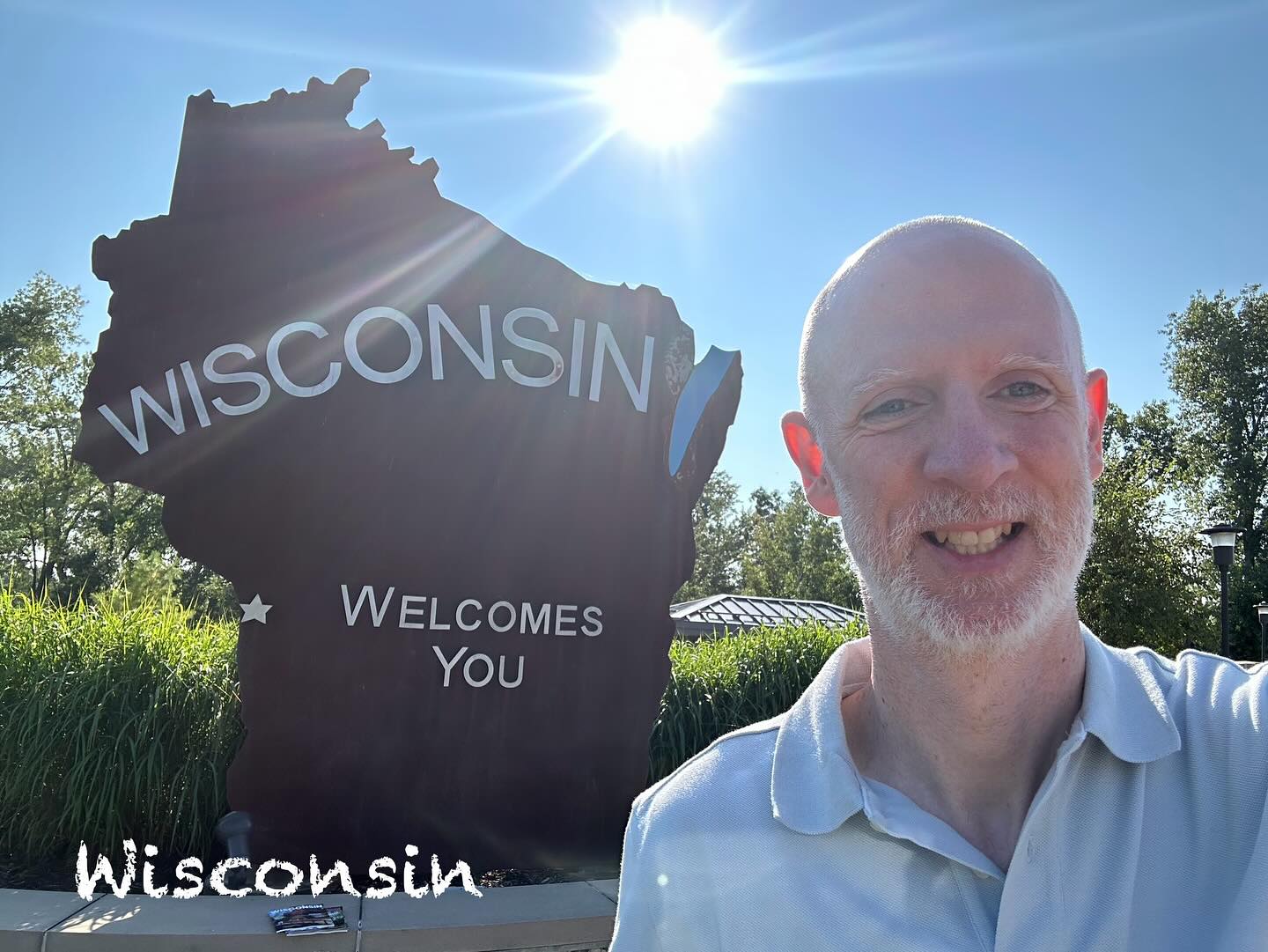
All that to say: I recently moved to Wisconsin. [Pause for predictable reactions.] And, Jody will join me here soon. We anticipated the jokes about our pinball-machine behavior over the past few years,1 but in all candor, a certain Rhett Butler quote comes to mind. It has been a bumpy road that led to Wisconsin, but it is our road and only our road, and we are grateful for the ride as well as its destination.

Six states now. Six! Six DMV visits. Six license plates, and no, we’re not aiming for the complete set.

You won’t believe me, but as a general rule I believe that staying put should be the default life position. Chasing greener grass is a fool’s game. (Although, full disclosure: I have found that the grass in Wisconsin actually is greener than the grass in Southern California (but that’s beside the point).) Chasing excitement and/or fleeing boredom is not the way to live in my opinion, but sometimes . . . some-times . . . there may come a time to move on.2 I cannot say when that might be for anyone else, if ever, but I can say that if the call ever becomes clear, my experience is that it is worth listening.

For dramatic example, I am currently reading Isabel Wilkerson’s beautiful and important book, The Warmth of Other Suns, a masterful chronicling of “The Great Migration” of Black American citizens to the North and West from the Jim Crow South between 1915-1970.3 I am astounded both by the relentless instances of racial terror that led to the diaspora and the incredible courage required to undertake the harrowing journey.4 Your possible journey to some version of freedom (and mine) will be ridiculously less challenging, less dramatic, and less heroic than the stories Wilkerson shares of other journeys that led human beings, for instance, from Arkansas to Wisconsin, but their stories display in unforgettable fashion that human beings can pursue freedom in even the most terrible of circumstances.

Our journey is not book-worthy, but it is incredibly special to us. I love my Arkansas roots, but if you became a part of our life story in Mississippi, or California, or Tennessee, or Illinois, or California (again) — and you know who you are — then each move was more than worth it for us. I know I speak for Jody when I say that our lives are incomplete and unimaginable without you in it.

So you can laugh at us for moving again all you want, because we know what awaits us here in Wisconsin before it even happens: More special people. Plus, this time, in private and personal ways, our own unique type of freedom.

Stay tuned if you are at all interested as I resume my blogging habit, and I will be sure to narrate as our life unfolds in this new and beautiful part of the country.

And Good Lord, if I might put in (another) request, may whatever years we have left see far more planting and much less uprooting.

  1. Yes, I am eating the words that I posted less than a year ago, “Moving ever again sounds like a terrible idea.” ↩︎
  2. Ecclesiastes 3: 1-2. ↩︎
  3. Nearly six million human beings made the journey. ↩︎
  4. Wilkerson shares the story of Arrington High, a native of Mississippi who was imprisoned in an insane asylum in the 1950s for speaking against injustice, helped to escape and cross the state line into Alabama, and then nailed into a coffin and shipped on a train to Chicago. ↩︎

These United States

33

The United States of America is 242 years old today. It seems to be in a bit of a cranky stage but those of us who love her hope she will grow out of it someday (soon). It is a spectacular country in about every way you define spectacular. I have now traveled to five continents and have a better frame of reference—enough to recognize that the land of my birth is unique in its global influence.

And I have now spent time in thirty-six of these United States and hope to complete the set someday. I already have remarkable memories.

I stood outside the Dexter Avenue Baptist Church in Alabama and threw snowballs on the Fourth of July in Alaska. I stood at the Grand Canyon in Arizona and called the Hogs in Arkansas. I watched the sunset in California and ran in the snow in Colorado. I saw a rocket launch in Florida and ate peach cobbler in Georgia. I ran along the Snake River in Idaho and sang Take Me Out to the Ballgame at Wrigley Field in Illinois. I shot hoops at Larry Bird’s restaurant in Indiana and drove by corn fields in Iowa.

I saw the wide open horizon in Kansas and watched horses run behind white fences in Kentucky. I ate beignets in Louisiana and crab cakes in Maryland. I toured the Ford Museum in Michigan and the Mall of America in Minnesota. I saw a hurricane in Mississippi and the Gateway Arch in Missouri. I sang in the capitol rotunda in Nebraska and walked the Las Vegas Strip in Nevada. I drove Route 66 across New Mexico and ran Central Park in New York.

I ate banana pudding in North Carolina and had a VIP tour of the Pro Football Hall of Fame in Ohio. I dodged tornadoes in Oklahoma and crossed breathtaking rivers in Pennsylvania. I saw Fort Sumter in South Carolina and the Lorraine Motel in Tennessee. I witnessed Monday Night Football in Texas and the Golden Spike National Monument in Utah. I crossed the Potomac in Virginia and ascended the Space Needle in Washington. I drove up a winding mountain in West Virginia and ate cheese curds in a bar in Wisconsin.

I am ready for more.

This is an incredible country, and I choose to celebrate these United States today. And I choose to do my part in making it better tomorrow.