
Tag Archives: new york times

Can I Be Broccoli?

My frequent critique of social media (and repeated reference to the dire predictions of Jacques Ellul) often feel justified when examining my Facebook feed, but I also try to admit the irony that I bemoan social media on social media, which just feels wrong. 

As is typical, others say what I hope to say better, and I recently stumbled across a YouTube video from author John Green titled, Am I Cigarettes?

Am I Cigarettes? – YouTube

Green had the courage to ask whether the content he posts contributes to societal demise in a similar way that cigarettes served as a pathway to cancer. Am I cigarettes? he asked.

His brother took the bait and countered with a separate video and different metaphor, arguing that those that contribute content, including he and his brother, are more like food than cigarettes, with food possessing the potential to be good or bad, while cigarettes are always bad. As Green described to the New York Times, his brother argued, “We’re food, and there’s a lot of bad food, but hopefully we’re good food.”

You’re Not Addicted to Content, You’re Starving for Information – YouTube

I found their exchange interesting and now ask about my use of social media: Can I be broccoli?

Once upon a time in my twenties, in a decade far, far away, a biographical sketch of Abraham Lincoln argued that Lincoln had a “passion for distinction.” That phrase had a major impact on me because I thought that maybe I did, too. The author proposed that Lincoln used his personal passion for noble purposes, and I wondered at the time if others would look back at the life in front of me with similar positive reviews.

Now, playing the back nine of life, it seems rather obvious that no one is going to name the capital of Nebraska after me. And I figured out a long time ago that this was a good thing. I recently watched the new Charlie Sheen biopic and remembered that fame would have gone poorly for me, too.

I grew up naive. I guess everyone does to some extent, but I grew up extra naive. I was raised in a small town in a family with little money that kept to ourselves. My Dad was a provider but also a shelterer and reclusive. My Mom successfully taught me to be a good boy and raised me in a religious environment with the stated goal to protect us from a scary world. All that to say it took me a long, long time to grow up, to use that tired phrase, but as an adult, moving to new places, reading a lot of books, and the introduction of the internet combined to procure a long, slow education. My life turned out okay, and I cannot complain, but it is now abundantly clear that any acceleration that would have come with fame would have been disastrous.

So while the desire to produce something significant on a major scale still pokes its head up periodically, I now tend to play whack-a-mole with it more often than not. I may be a slow learner, but I want to remain a learner.

Which brings me back to my little blog and personal social media presence. What I write and share does not attract high-profile attention, and not only am I okay with that (now), what I do does not fit the popularity profile anyway.

But I hope it is good. I hope it is not part of the destructive side of social media. To return to the metaphor, if what I do is a bit of food, can it be broccoli? Something not very popular, but healthy?

Should I get to retire someday, I plan to have already done all the traveling that I want to do. Should I get to retire someday, my plan does not involve golf or fishing. Instead, should I get to retire someday, if my mind and health permits, I want to write.

And I have come to terms with the fact that it is not to write the great American novel or a blockbuster movie screenplay. If you can believe it, I am not even that invested in writing to be remembered. No, if I get the privilege of looking back and sharing my thoughts in written form, it would primarily be for my daughters, should they be interested, and whether they are or not, I want whatever I leave behind to be healthy and good. 

In the meantime, for now at least, I plan to keep contributing to the produce aisle of the world and go to sleep at night hoping that my meager contributions produce more good than bad.

Although to be transparent, I’m not 100% convinced that the cigarettes idea is entirely wrong.
Cultivate the Bright Passions

I find it especially important in dark and troubled times to closely monitor personal emotions, and we seem to live in dark and troubled times. This came to mind as I drove to the office before eight o’clock on this Sunday morning. My wife is out of town, so I felt justified putting in early Sunday work hours, but such behavior indicates that my emotions could get out of whack.

But it was sixty-three degrees on a lovely morning, and I lowered the window to feel the cool breeze while listening to a station that features soothing acoustic music. And as I drove past farmland I was surprised to see several normally-stationary horses galloping together on a gentle morning run. And then I rounded a curve and noticed that the self-serve produce stand is now decorated with pumpkins and flowers on this first day of autumn. And I sensed in a powerful form the intoxicating feeling of peace.

There was more.

A little farther along, I met an older woman riding her bike on the lonely back roads. We have passed one another on several mornings and now wave with smiles as if we are dear friends, which we did with even more enthusiasm this morning. I then turned toward the office and noticed my friend, Kelly, out walking her dog, which led to another wave and another smile. And as if the world was conspiring for my good, I then noticed a wonderful student, Emma, walking across campus on a Sunday morning, and I stuck my arm out the window with another wave and smile.

And for a moment, if I didn’t know better, I sensed every reason in the world to be happy.

David Brooks published a column in The New York Times three days ago titled, “The Era of Dark Passions.” I surely do not agree with David Brooks on many things, but I typically benefit from reading his thoughts, and I especially appreciated that particular opinion piece. Brooks shared his belief that “something awful has been unleashed” in our current times and that “[e]ven before the Charlie Kirk assassination it was obvious that the dark passions now pervade the American psyche, and thus American politics.” Brooks identified dark passions as Anger, Hatred, Resentment, Fear, and the Urge to Dominate, and he distributed blame for stirring dark passions for personal benefit to his own industry, the media, and to both sides of the political aisle. Brooks then posed the question:

Why does politics feel so different now than in times past? My short answer is that over these years, demagogues in politics, in the media and online have exploited common feelings of humiliation to arouse dark passions, and those dark passions are dehumanizing our culture and undermining liberal democracy. My intuition is that we’re only at the beginning of this spiral, and that it will only get worse.

With that cheery outlook, what is there to do? Well, for starters, Brooks begins:

First, let me tell you how not to reverse it. There is a tendency in these circumstances to think that the other side is so awful that we need a monster on our side to beat it. That’s the decision Republicans made in nominating Trump. Democrats are moving in that direction too. Back in 2016 Michelle Obama asserted that Democrats to go high when Republicans go low, but the vibe quickly shifted. As former Attorney General Eric Holder put it in 2018: “When they go low, we kick ’em. That’s what this new Democratic Party is about.” If Republicans soil our democracy with extreme gerrymandering in Texas, Gavin Newsom and the Democrats will soil our democracy in California. The problem with fighting fire with fire is that you’re throwing yourself into the cesspool of dark passions. Do we really think we won’t be corrupted by them? Do we really think the path to victory lies in becoming morally indistinguishable from Trump? Do we really think democracy will survive? Surveys consistently show that most Americans are exhausted by this moral race to the bottom and want an alternative; do we not trust the American people?

Brooks then advises as “the most effective way to fight dark passions”…

History provides clear examples of how to halt the dark passion doom loop. It starts when a leader, or a group of people, who have every right to feel humiliated, who have every right to resort to the dark motivations, decide to interrupt the process. They simply refuse to be swallowed by the bitterness, and they work — laboriously over years or decades — to cultivate the bright passions in themselves — to be motivated by hope, care and some brighter vision of the good, and to show those passions to others, especially their enemies. Vaclav Havel did this. Abraham Lincoln did this in his second Inaugural Address. Alfred Dreyfus did this after his false conviction and Viktor Frankl did this after the Holocaust. You may believe Jesus is the messiah or not, but what gives his life moral grandeur was his ability to meet hatred with love. These leaders displayed astounding forbearance. They did not seek payback and revenge. Obviously, Martin Luther King Jr. comes to mind: “To our most bitter opponents we say: We shall match your capacity to inflict suffering by our capacity to endure suffering. We shall meet your physical force with soul force. Do to us what you will, and we shall continue to love you. We cannot in all good conscience obey your unjust laws, because noncooperation with evil is as much a moral obligation as is cooperation with good. Throw us in jail, and we shall still love you.”

You might not be surprised that this resonates with me given my latest blog post published a few days prior to Brooks’s column. But it especially came to mind this morning on a lovely ride into work. I place no value on being unrealistic or ignoring the obvious, but I place great value on noticing the good and living with hope, for what is the future without hope?

I guess what I’m saying is that I unexpectedly caught a glimpse of the bright passions on a drive to work this morning, and I am now extra inspired to resist the forces that push the dark passions and choose to cultivate the bright passions more and more instead. As David Brooks concluded his recent column:

The dark passions look backward toward some wrong committed in the past and render people hardhearted. The bright passions look forward toward some better life and render people tough-minded but tenderhearted.

May we look forward toward some better life as tough-minded and tenderhearted people.

Is Contentment Overrated?

The Far Side, by Gary Larson

Happiness has me surrounded.

I have been married to my best friend in the world for 30+ years. We live in a cool, historic house in a cool, historic town, and we both work for a small college that we adore and hope to work at for the rest of our careers. We have two incredible daughters who are good and independent human beings who make us proud and do important work that truly makes a difference. We aren’t wealthy, but we have a comfortable income and money in the bank.

There is more.

I teach “sports law,” combining three things—teaching, sports, and law—that I have loved for a long time. I preach periodically for a church where I can fully be me. I am on the board of a nonprofit that once changed my life for good. I have developed a habit of reading good books that constantly teach me about life. My back is doing well, so I can once again engage my love for running. I have adopted a weird diet where I feel awesome every day.

I’m embarrassed to admit there is still more.

I have now lived long enough to do many things. I have lived all over this country, experiencing Gulf Coast sunrises and Malibu sunsets, Arkansas ridges and Tennessee lakes, Illinois harvests and Wisconsin winters. And I have traveled all over the world, too, from an African safari to a Brazilian rain forest, from the Eiffel Tower to the Taj Mahal, from a Mexican resort to a Spanish cathedral. And best of all, I have developed meaningful relationships with so many wonderful humans in so many wonderful places that reflect every imaginable aspect of the beauty in diversity. I have been loved, and I have loved.

So I am happy. As happy as I have ever been. And I wonder if I am the only person who can possibly be unhappy about being happy? I am the ridiculous cow in The Far Side cartoon informing Wendell that she is somehow not content.

I should explain what I have recently concluded: My true desire is neither happiness nor contentment. I desire living with passion and purpose instead.

David Brooks recently published a lengthy essay in the New York Times titled, “A Surprising Route to the Best Life Possible.” Brooks wonders why people choose “voluntary pain” and through exploring many examples, including himself, concludes that humans are better when taking on challenges and enduring difficulties in their quest for something significant. Brooks argues that there is somehow a “blessing” in “human instability” and that to be “enchanted” or “entranced” or “seized” by a great calling is preferable to the alternative, despite the inevitable pain.

You have no idea how much his essay means to me—especially at this stage of my life when I sense a temptation to count your blessings and call it a day, and especially when confronting my guilt for resisting contentment with so many reasons to be happy.

Maybe contentment is simply overrated. Brooks writes, “We want to be in love — with callings, projects and people. The opposite of love is not hate, it’s indifference, and indifference is an absolutely terrible state to endure. I guess there are some people who have earned the right to want contentment above all, to sit back and enjoy whatever prosperity they’ve achieved. But I rarely meet such people, even people in retirement.”

I really do appreciate all of the very good things in my happy life. (And no, I’m not silly enough to move again, giving up the beauty we have discovered.) And contentment is fine in a particular sense, i.e., not being greedy, accepting every moment for what it is. But I crave a challenge, and the bigger the better. I want more. I need to want more.

As Brooks chose to close his essay, “People tend to get melodramatic when they talk about the kind of enchantment I’m describing here, but they are not altogether wrong. The sculptor Henry Moore exaggerated but still captured the essential point: ‘The secret of life is to have a task, something you devote your entire life to, something you bring everything to, every minute of the day for your whole life. And the most important thing is — it must be something you cannot possibly do!’”

I’m really not content, and I’m happy to admit it. Even at my age, and even surrounded by so much good, I crave a monumental task instead.

A Line in the Sand

Confession: I struggle to keep up.

The well-orchestrated and rapid-fire actions of the second Trump administration are dizzying, and while I have many opinions on many issues, I just can’t seem to keep up. I have a job (that I love) that consumes a significant amount of time, and by the time I attempt to be informed enough to formulate thoughts potentially worth sharing, those issues are old news.  

And to be honest, part of me wants to remain silent, partly from the dizziness of it all, but also because I recognize that President Trump and his party won the election and have a relatively short amount of time to make their case for remaining in power before the American people render a verdict at the midterm elections. But another part of me wants to speak out constantly, not only because I care about so many of the issues, but also because I recognize that silence contributes to a gaslighting effect for those that suffer from certain words or actions, including many friends from historically-marginalized groups that wonder if anyone sees their pain.

Despite the tennis match going on in my mind, I have something to say today that I hope will be heard.

I’ll probably lose some of you at the start when I reference Erwin Chemerinsky. Erwin Chemerinsky is dean of the law school at UC-Berkeley, and just the mention of Berkeley will lead some to tune out, but I beg you to stay with me anyway. Chemerinsky is a constitutional law scholar, on the liberal side as you might suspect, but if one can recall such a time, he was also a good friend of the late Ken Starr, a constitutional law scholar on the conservative side who was dean at the law school I chose to attend in 2008. Chemerinsky and Starr rarely arrived at the same interpretive conclusions, but they shared a love and respect both for each other and the United States Constitution.

The New York Times published a guest essay from Chemerinsky two days ago titled, “The One Question That Really Matters: If Trump Defies the Courts, Then What?” Please recognize this title question is neither liberal nor conservative but a question of constitutional structure that is simultaneously an existential question for the American form of government.

It is a short essay that I suggest you read, but I will share the highlights. Chemerinsky writes:

“It is not hyperbole to say that the future of American constitutional democracy now rests on a single question: Will President Trump and his administration defy court orders? . . . [T]he Constitution gives judges no power to compel compliance with their rulings — it is the executive branch that ultimately enforces judicial orders. If a president decides to ignore a judicial ruling, the courts are likely rendered impotent . . .. It is unsettling even to be asking whether the president would defy a court order. Throughout American history, presidents have complied with mandates from the courts, even when they disagree . . .. [T]here are no definitive instances of presidents disobeying court orders. The line attributed to Andrew Jackson about the chief justice, that “John Marshall has made his decision, now let him enforce it,” is likely apocryphal . . .. In addition, modern scholarship has undermined the story that Abraham Lincoln defied an order from the chief justice invalidating a suspension of habeas corpus during the early days of the Civil War . . .. Thus far, the Trump administration has given conflicting signals as to whether it will defy court orders. On Feb. 11, Mr. Trump said, “I always abide by the courts, and then I’ll have to appeal it.” . . .But just one day prior, Mr. Trump posted on social media, “He who saves his Country does not violate any Law.” . . . The reality — and Mr. Trump and those around him know it — is that he could get away with defying court orders should he, ultimately, choose to do so. Because of Supreme Court decisions, Mr. Trump cannot be held civilly or criminally liable for any official acts he takes to carry out his constitutional powers. Those in the Trump administration who carry out his policies and violate court orders could be held in contempt. But if it is criminal contempt, Mr. Trump can issue them pardons . . .. Defiance of court orders could be the basis for impeachment and removal. But with his party in control of Congress, Mr. Trump knows that is highly unlikely to happen. If the Trump administration chooses to defy court orders, we will have a constitutional crisis not seen before. Perhaps public opinion will turn against the president and he will back down and comply. Or perhaps, after 238 years, we will see the end of government under the rule of law.”

I have repeatedly emphasized Chemerinsky’s question in private conversations for weeks now, and I wish I could elevate it above all the noise. It is an existential question for American democracy, and I want to have done my part at least to try to place it in the spotlight it deserves.

Let me be blunt: Presidents and parties come and go, but if any American president, ever, adopts an approach that defies the decisions of the courts, then we no longer have “the rule of law,” which has been the central feature of the United States government since the Constitution was adopted in 1787.

President Trump has famously said many things, including:

  • “I can find a cure to the most devastating disease . . . or announce the answers to the greatest economy in history or the stoppage of crime to the lowest levels ever recorded and these people sitting right here [Democrats in Congress] will not clap, will not stand, and certainly will not cheer for these astronomical achievements.”
  • “I could stand in the middle of Fifth Avenue and shoot somebody and I wouldn’t lose [MAGA] voters.”

Unfortunately, I think that for many he is correct on both counts. But I hope not for everyone.

I know full well that for many the support of a political party or a specific political leader is unwavering. But I hope that is not true for all. I hope that for many there are certain lines that cannot be crossed. And for anyone that values democracy as a form of government, this question regarding a respect for the “rule of law” has to be at the top of the list.

Transcendent Experiences

1

Famed journalist, David Brooks, was the featured speaker at a recent conference at Pepperdine, and much of the conversation focused on an op-ed he wrote a year ago in The New York Times titled, “The Big University.”  The thought behind the article is summed up in a single sentence/paragraph:

In short, for the past many decades colleges narrowed down to focus on professional academic disciplines, but now there are a series of forces leading them to widen out so that they leave a mark on the full human being.

Brooks applauded this development and prescribed four tasks for colleges and universities:

  1. Reveal moral options.
  2. Foster transcendent experiences.
  3. Investigate current loves and teach new things to love.
  4. Apply the humanities.

While all four are worthy of reflective conversation, I am particularly drawn to the call to foster transcendent experiences.  Brooks wrote:

If a student spends four years in regular and concentrated contact with beauty—with poetry or music, extended time in a cathedral, serving a child with Down syndrome, waking up with loving friends on a mountain—there’s a good chance something transcendent and imagination-altering will happen.

Yeah, I dig it.

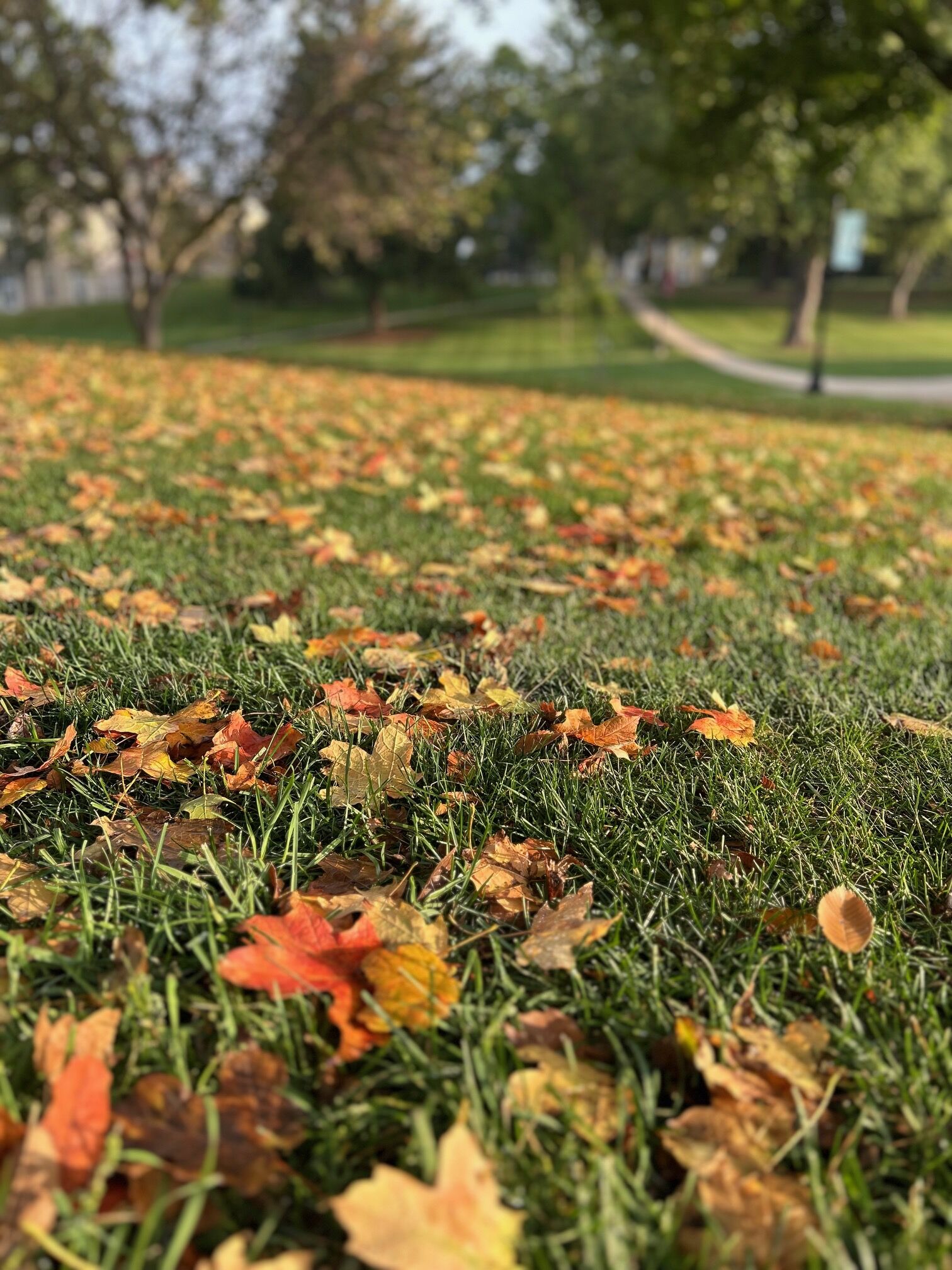
Last week, I was thousands of miles from home in Akron, Ohio, with a couple of unexpected hours and zero plans and somehow ended up hiking through a beautiful park amid the blazing colors of autumn.  The very next day, even farther from home in the heart of Manhattan in New York City, I had more unexpected time to spend while awaiting a meeting in a Fifth Avenue skyscraper and wandered into iconic St. Patrick’s Cathedral to experience an early afternoon Mass in that stunning venue.

A peaceful forest.  A majestic cathedral.  Two good choices.  And why did I have to travel so far to make such choices?

Brooks’s encouragement may have simply been intended for college students, but seeing that I feel a little thirsty for transcendence myself, my choices in those two moments make me wonder what might happen if I altered my routines to create “regular and concentrated contact with beauty.”

I just might do it.  And if nothing else, fostering transcendent experiences in my own life might make me more effective in fostering such moments for others.