Tag Archives: love

#PrayForOrlando

[Note: I’m taking a blog vacation for a couple of weeks and anticipate returning to action at the first of July.]

I will travel to Kenya this week with family and friends to spend the last half of June with an inspiring organization called Made in the Streets.  The U.S. State Department issued a travel warning for those traveling to Kenya, potential violence, terrorism, and whatnot.  I very much take such warnings seriously, and yet, in Santa Monica, California, this morning, fifteen miles from my house, a man was caught with chemicals, assault weapons, and ammunition on his way to terrorize a gay pride parade—just hours after the deadliest mass shooting in American history occurred at a nightclub in Orlando, Florida.  Where exactly are the safe places in the world right now?

For reasons specific to my personal belief system, I am neither shocked by nor afraid of the violence that currently dominates the headlines, but I do find it terribly sad, and my heart goes out to the victims and those who love them.  I join the chorus that urges everyone to #PrayForOrlando.

There are things that should be done, and we (however defined) should do them, but there is no easy fix in this world for hatred and violence.  I continue to believe that the complicated solution is a revolution of indiscriminate love and maintain my commitment to such a revolutionary practice.

I really do believe that love, eventually, wins.

The Greatest

ALIDAYS1

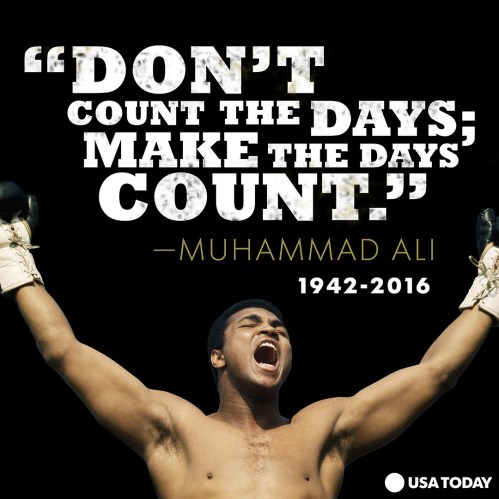
My dad was a boxing fan, which made sense for a member of what Tom Brokaw termed “the greatest generation.”  Boxing was the American sport when he was a boy in the 1920s and 1930s, and I remember his tales of the great Jack Dempsey as we watched fights together a half century later.  I somehow failed to inherit his love for the sport, but the combination of his love and the golden age of heavyweight boxing that coincided with my childhood unleashed personal memories when Muhammad Ali’s passing was announced last Friday.  Elvis Presley, John Wayne, and Muhammad Ali—those were the names that seemed larger than life to this little boy in small-town Arkansas.  Now, all three are gone.

That Ali is a popular American hero is fascinating.  I doubt that his outspoken racial pride and conversion to Islam in the 1960s endeared him to all who now mourn his passing.  I doubt that his refusal to accept military service makes him a hero to all patriotic Americans.  And his brash, in your face, “I am the greatest” trash talking is not typically the personality that leads to universal love and admiration, the Donald Trump phenomenon notwithstanding.

Maybe America just likes a winner?  I don’t buy it.  Call me crazy, but I’m guessing that Barry Bonds, Bill Belichick, and Floyd Mayweather, Jr. will not be universally adored when they ultimately move on from this life.

So, why did Muhammad Ali die an American hero?  Some say it is his social activism, his willingness to stand up for what he believed in.  Maybe so.  That has to be a part of it.  But I suggest there is something more to Ali’s universal appeal.

Muhammad Ali embraced life.

He was fun and funny and full of joy.  He lived without fear.  Think about it: the religious conversion, the brash statements in an era of racial violence, the thumbing his nose at the government’s draft, and the claims of boxing greatness all displayed that he was not afraid of any threat.

More importantly, he lost in the boxing ring multiple times—but came back for more with a smile.  Over time, in what seemed to be the cruelty of fate, the powerful and eloquent athlete lost his famed strength and good health and bold voice—but he came out in public with a smile.

Check it out: Muhammad Ali was not afraid of any threat, but he was also not afraid of any consequence.

I believe that is why we loved him so.  We want to live without fear, too.  We want to face both the goods and bads of life with unshakable joy.

Wouldn’t that be the Greatest?

Don’t Keep Score

My friend, Andrew, gave me a gift titled, appropriately, The Gift, a book of poetry from Hafiz, the Great Sufi Master.  Reportedly, the poems may be more Daniel Ladinsky (the author/translator) than Hafiz, but either way the poetry is great fun.  I try to read a few each morning, and although I am not ready to call it yet, an early favorite has emerged.  Other than a meager attempt at a title for this blog entry, I leave this short poem to your individual interpretations.

THE SUN NEVER SAYS

Even
After
All this time
The sun never says to the earth,

“You owe
Me.”

Look
What happens
With a love like that,
It lights the
Whole
Sky.

Real Love

mom2

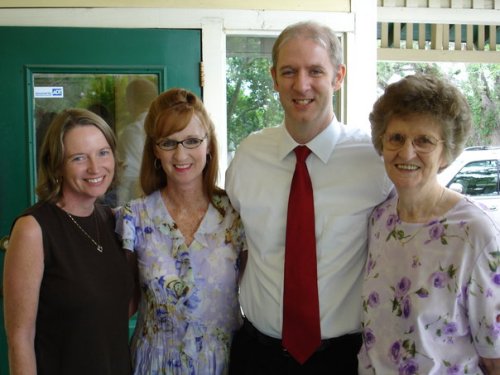
I am almost certain that Mother’s Day was not created for my personal enjoyment, but I have to say that it was pretty lonely this time around.  It marked the fourth Mother’s Day since my mother’s passing, and this year my wife was in Arkansas for a high school graduation so even that was limited to a text message celebration.

Of all my mom’s wonderful characteristics, that she was always there for me ranks near the top, which makes her absence more pronounced.  I know that I have tons of people still there for me, including an amazing wife, beautiful daughters, and a bevy of family and friends, but no one, biologically speaking, has “been there” like your mother.  It is a special, indescribable bond.

Pardon my boasting, but mine was the very best.  You can arm wrestle over second place, which is still a pretty great accomplishment given the billions of mothers in world history, but the gold medal stand is already occupied.

One story that describes my mom:  I moved my little family five-hundred miles away from my widowed mother in 1999, which she handled well.  Not long after our move, a job opportunity emerged in my hometown (near mom), and I submitted an application.  The organization decided to interview two final candidates, including me, but after deep reflection, I decided to pull out prior to the interview.  My mom was so happy.

That last line is neither a typo nor sarcasm—it is truth.  Even though my mom missed us very much (well, honestly, probably the grandkiddos most of all), she felt that I would not be happy in the potential job, and she would rather I be far away and happy than nearby and not.

That is how I define real love.  The happiness of the object of your love > personal happiness.

Mother’s Day may have been a bit lonely this year, but it remains very, very special.

Life-Changing Moments

I often say that I do my best work by accident, which is true, and there is no better example than the afternoon I as a young high school basketball coach said hello to the most adorable six-year-old little girl. We were standing in the gym, she in an after-school program and I awaiting the bus to take the team to a road game, and unaware of the massive implications for my life initiated the following conversation:

“What’s your name?”

“Erica.”

“What grade are you in?”

“First grade.”

“Oh, do you know my nephew, Josh?”

“Yes!”

“Is he your boyfriend?”

“No.”

“Do you have a boyfriend?”

“Yes”

“Who is your boyfriend?”

(Without pause) “Aaron Farley.”

Note: This was particularly interesting since Aaron was one of my junior high basketball players.

My life was forever changed. Erica and I soon became buddies. She brought me Christmas candy. I met her mother. In less than five months, I married her mother. A couple of decades later, I am the luckiest man on the planet and owe it all to that innocent conversation with a cute little girl in a smelly high school gymnasium.

Erica is a beautiful woman now who teaches/loves adorable little children as a career, and even though birthdays have come and gone (and another of hers will come and go tomorrow), to me she will always be that adorable little girl who changed my life for good.

Be careful out there today. It is entirely possible that an innocent conversation can change your life for good, too.
Erica 1


Hope for the World

As Valentine’s Day bled into Presidents’ Day, I decided to give up any love of politics for Lent. This may be the perfect year for such a sacrifice.

The tragic loss of Justice Scalia over the weekend was quickly followed by the tragic politicization of his passing.  There is political work to do, of course, but it was sad, though not surprising, that a presidential candidate had tweeted an opening shot before the Supreme Court had even published an official statement on the loss of their colleague.

This presidential campaign cycle? Wow.

Best I can tell, nine viable candidates remain—two Democrats (Clinton; Sanders), six Republicans (Bush; Carson; Cruz; Kasich; Rubio; Trump), and one lurking independent (Bloomberg). It is possible that Batman or a Muppet or One Direction (campaign slogan alert?) may enter the field, too, given this unpredictable election cycle.

If the presidential field took the field as a baseball team, I’d put Sanders in left (of course), Bloomberg in center (of course), and Cruz in right (of course). Trump would have to play first because it has a #1 in it. Bush and Kasich would necessarily be the (Republican Establishment’s) double-play combination, and Clinton would be a natural at the hot corner given her experience with controversy. I’d put Carson behind the plate (i.e., coming from behind now anyway), and Rubio could take the mound since he is the youngest candidate and may have the most lively arm.

American presidential politics is both fascinating and disturbing, sort of like a roadside accident elicits a peek. Although I vote and appreciate our system, my personal philosophy is best summed up by the late Will D. Campbell (and speaking of baseball): “I watch the political process pretty much as I watch baseball. I have a favorite team, but I know that ultimately it makes no difference who wins. I gave up on politics offering any hope for the world’s problems a long time ago.”

There is a complex thought system that underlies the quote. Just so you know.

Well, I’ll risk oversimplification and explain it this way: I stand with Will D. Campbell and Dr. King in believing that the hope for the world lies in our ability to see one another as brothers and sisters.

Watching our prospective leaders in a democracy speak as they do is a direct reflection of our own hearts, and it seems that we hate each other. Well, maybe not hate (yes, I do mean hate), but at least we resent or despise or fear each other. Surely not family.

I am happy that the inspiring friendship between Justice Scalia and Justice Ginsburg has received some attention this weekend.  It is unfortunate that it appears to have zero effect on the presidential campaign.

My best bet as to who will win in November? Nobody. Oh, someone will be elected president of these United States, but in this political climate, I’m not predicting any real winners. I am predicting a lot of angry people. (I’m also predicting a large number of folks will renege on their pledge to move to Canada if ________ is elected.)

It is personally comforting that I do not believe the “hope for the world’s problems” lies in a presidential election, but at the same time, it is troubling that the hope I believe in appears to have zero traction, Scalia/Ginsburg notwithstanding.

I’m going to see everyone as brothers and sisters anyway.
Permanence

Nothing says next stage of life quite like receiving a text/picture of/from your youngest child in her Seattle tattoo parlor of choice. It is a real attention-grabber. The gentleman/artist in the photograph with her did appear to be wearing surgical gloves, which felt like a win all things considered.

She may or may not be my child; I am without tattoo, at least none that I have discovered, and I have been with me at almost all times. My tattoo-less status is not a moral stand, however; instead, my particular phobias include in no particular order: fear of physical pain, fear of permanent markers, and fear of misspelled words. If the tattoo artist was an actual boa constrictor, it would be my worst nightmare.

My dad had a large, prominent tattoo of a battleship on his bicep, which made perfect sense for a WWII sailor, but I am embarrassed to say that it took me a couple of decades to realize that “Ruby” was probably not the name of the battleship. The lack of texting technology during the Second World War worked in favor of the emotional state of my grandmother.

But our daughter is so cool. She carefully chose her tattoo, a Swahili phrase, and described it this way:

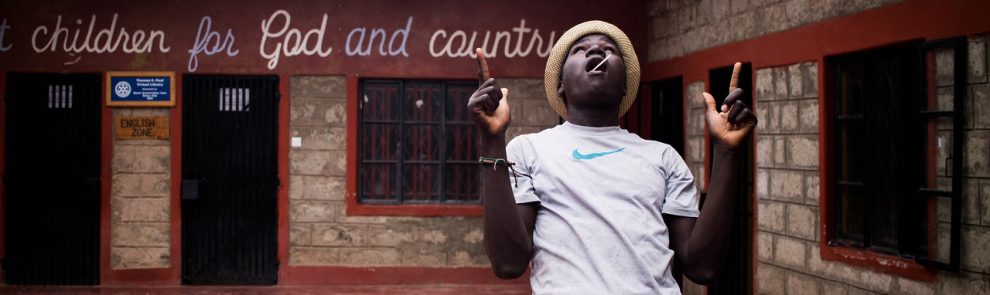
Nakupenda was the first Swahili phrase I learned on my first trip to Kenya back in 2012. It means “I love you” and is a constant reminder of my love for Kenya, for the students at MITS, for travel, for education, and for doing all I can to help bring more love to the world. This phrase has meant so much to me for the past 4 years and now, in the handwriting of my Kenyan brother, Paul, it will always be a part of me.

I love it. And her. But I confess that my first thought upon hearing that she was actually going through with it was, “Are you sure that’s a good idea?” Which, actually, was not a conscious thought, but a deeply-repressed and possibly unspoken lesson from childhood that said, “No, that is not a good idea.” Why not? The voices in my head said something about permanence. This youngest child of ours now has a message permanently imprinted on her body (laser removal technology notwithstanding).

Here’s the funny thing: She chose it because of its permanence. That’s the point.

“…it will always be a part of me.”

Yes, it will, sweetheart, and that makes me smile. You know, come to think of it, ink or no ink, all of us are tatted up by our life experiences and the deep values that shape who we are and what we hope to become.

Permanence has a negative side, but it has a glorious side, too.

Indomitable Freedom

post1Christmas added several items to my sports movie collection, and the first new flick into the DVD player was The Hurricane, a 1999 movie featuring Denzel Washington as Rubin “Hurricane” Carter, a boxer and convict whose triple murder conviction was set aside after decades in prison due to the love and dedication of others. It was Rocky meets Shawshank Redemption meets To Kill a Mockingbird, which is quite the inspirational combination.

The most memorable scene occurs just prior to Carter’s exoneration when he and his young friend, Lesra, have a brief conversation through prison bars. Carter utters the most famous line in the movie: “Hate put me in prison; love’s gonna bust me out.” His young friend brazenly-yet-facetiously responds, “Just in case love doesn’t; I’m gonna bust you out of here.” Carter erupts in laughter, and then, tenderly, reaches through the prison bars to wipe tears from his young friend’s face, and says, softly, “You already have.”

Yes.

This entire blog is predicated on the idea that humanity can be liberated from any circumstance that aims to imprison us—that in our hearts, we can rise above anything. I believe that in the depths of my soul. Argue with me all you want.

But even those who buy the premise may want to argue with me on how we rise above our circumstances, but as we square off, know that my contention is that it is love that busts us out.

Hate imprisons. Love liberates.

————————————————————————————————–

• Click HERE to see Bob Dylan in 1975 singing his protest song, “The Hurricane,” while Carter sat in prison (and remained there for another decade).

Joy to the World

My family traditionally opened presents on Christmas Eve, so the Twelve Days of Christmas confused me. Heck, we barely did one. But I never found leaping lords and diverse birdlife, i.e., laying geese, swimming swans, turtle doves, calling birds, partridges housed in pear trees, and hens of French origin all that appealing in the first place.

But I get it now. No, not the lords and birds. I get the Twelve Days of Christmas because I counted and my calendar contains at least twelve holiday-themed events before we even make it to family on Christmas Day.

This observation comes with zero complaints, but it does feel a little disjointed with all the violence and fears and anger and arguments in the world right now—especially since the most recent tragedy occurred at a holiday party. Peace on Earth seems a little, well, laughable, if it wasn’t so sad.

The feeling is familiar. When Hurricane Katrina devastated our community in 2005, it seemed a little odd to have a holiday party that year, too. (We may have worn ugly sweaters, but mostly because that’s what arrived on the relief truck!) But I concluded then that we needed to celebrate even more. After all, given my particular faith tradition, the story of the season revolved around a family with nowhere to sleep.

Maybe that works this year, too. (There was after all a violent infanticide in the Christmas story.) I’m not thinking that “Peace on Earth” is such a terrific phrase right now, at least not if we expect signs of that coming true anytime soon. But, any celebration that talks about Hope seems timely. And anything at all that produces a measure of Joy sounds pretty good, too. As many songs and gifts and love and light as we can muster is a pretty fantastic idea when it’s dark outside.

If it takes twelve-plus days and parties to make a little dent in the darkness, then bring on the egg nog!

Love Your Neighbor

If the world had a Facebook account, its relationship status would read, “It’s Complicated.” Unfortunately, my contribution to the dizzying conversation will not magically clear things up.

Mourning is the appropriate response to tragedy, but the proud defiance by ISIS in the most recent attacks in Paris does not allow the world to sit beyond a moment of silence before responding to the ongoing threat. I was traveling when the attacks occurred, and best I could tell, the talking heads apparently agree that the real ISIS threat is its ability to recruit homegrown terrorists everywhere. They emphasized everywhere.

Who is attracted to such a thing? It is far too convenient to ascribe the attraction to abstract “evil.” Evil is easy to condemn and easy to hate, but this is no DC comic book. Further, even calling the tragedies “senseless” is far too easy. The acts, unfortunately, make all too much sense to those who carry them out, and any hope of prevention requires us to seek first to understand. I propose that those attracted to ISIS across the world are people who feel deeply marginalized, outside, silenced, and unimportant in their respective communities, and that any hope of removing the threat at the critical grassroots level requires us to love and respect everyone.

I’m a pretty hopeful guy in general, but this one has me less than chipper.

It is a catch-22 at the top. The powers that be must condemn and respond to terrorist attacks and have a specific responsibility to stop those already plotting violence. That response, however, inevitably fuels those who already feel marginalized by those very powers. ISIS thrives on the strong response its actions generate. We should remember that the next time we celebrate a necessary response.

So, surprisingly, the real, long-term hope for the world is in the hands of its regular citizens. If you want to make the world a safe place beyond a temporary Facebook profile picture, the answer lies not in forming camps by religion, race, sexual orientation, age, or God forbid, political party. In fact, I suggest the exact opposite—that the answer lies in breaking down the social walls that divide us in Everyday World and caring for those who live on the other side.

Division fuels hatred. Reconciliation generates hope. My advice is to seek out the outsiders in your community, including those who may already be angry, bitter souls. Befriend them. Walk beside them. Listen. Care about their cares. That, my friends, is where you and I can make a real difference in this complicated world.