Tag Archives: jesus

Swimming in a Culture of Violence

At the beginning of David Foster Wallace’s famed commencement speech at Kenyon College in 2005, two young fish encounter an older fish as they are swimming along, and the older fish says to them in passing, “Morning, boys, how’s the water?” As they swim on, one of the young fish eventually looks at the other and asks, “What the hell is water?”

The profundity of Wallace’s illustration has many applications, but I’m thinking today of how we swim in a culture of violence.

At almost the exact same time on Wednesday and hundreds of miles apart, two acts of violence occurred in school settings: a 16-year-old with reportedly anti-Semitic and white supremacist views murdered two high school students before taking his own life, and a 22-year-old with reportedly anti-fascist views murdered an enormously popular politically-conservative speaker on a college campus. And both happened on the day before the anniversary of the terrorist attacks on September 11, 2001. The confluence of these terrible tragedies produced a flood of emotion, naturally, and many in their grief offered expressions like “this is not who we are” and “how did we get here” and “who have we become.” Sadly, my thoughts turned to Wallace’s little parable.

I am (always saddened but) no longer surprised by acts of violence, although I am often surprised when others are surprised by acts of violence. We live in a culture of violence, and I’m not talking about the United States of America (only), and I’m not talking about something that has occurred in the past few years, or even in our lifetimes. I believe that humanity itself, at least human civilization as we understand it, has historically and continually believed at its core that violence can make things better, that violence solves problems, that violence produces justice. We condemn certain acts of violence and condone (sometimes celebrate) others as good, and as a result, violence is as ubiquitous to our lives as water is to a fish.

Governments seek the death penalty under the banner of justice. Nations go to war under the banner of justice. Cartoons and movies and television series create heroes who beat the hell out of villains and in so doing make the world a better place. Logically, while we (can and should and do) condemn the actions of abusers and assassins and terrorists, it should not surprise us when others perform terrible, violent acts that they believe will somehow make something better, too. This is water, as Wallace might say.

Theologian Walter Wink called this “the myth of redemptive violence” and claims that this really is who we are, at least in the sense that this concept is the water in which we swim unaware.

I was a pastor in my early thirties when the 9/11 attacks shocked our nation. At the time, my job was to think deeply about Christianity and translate that into the life of a church. I recall that I quickly became troubled by the natural (and national) response to the tragedy. To be specific, I had understood that my faith tradition looked at war as a terrible event, although for many the just war theory stood as a reluctant option that was developed in an attempt to wrestle with the moral challenges with classic pacifism. All that went out the window quickly when our nation was attacked, and shortly, even preemptive attacks on nations unaffiliated with the attacks seemed justified by large swaths of Christians regardless of the wisdom of centuries of church teachings.

Wink clarified for me at the time that a belief that “violence is both necessary and effective for resolving conflict and achieving justice” may be a far deeper value for many who claim Christianity than Jesus’s call to “love your enemies.” Wink went so far as to claim that “[i]t, and not Judaism or Christianity or Islam, is the dominant religion in our society today.” I recommend his book “The Powers That Be” if you truly want to wrestle with his thoughts and address the “what-ifs” that probably come to mind first (i.e., What if someone breaks into your house to threaten your family? What if nobody stands up to Hitler?). Those are valid questions, and Wink takes them on, but that is not my point today. Instead, I simply point toward the ocean that we swim in together. Violence is an ugly word that we condemn in times of tragedy, yet violence undergirds and defines our culture, and we should at least be aware.

The diagnosis runs deep, and the prognosis is not encouraging, but after decades of wrestling I have adopted an approach to life that does not include despair. While I personally support pathways leading to fewer dangerous weapons instead of more, and while I long for vast improvements in mental health care, neither strike at the root of the redemptive violence mindset. So, what to do?

My choice is simply to reject violence in all its forms, including those popularly conceived of as redemptive. I choose, if you will pardon the metaphor, to attempt to live as a fish out of water.

How to do that is ridiculously complicated, but at least the why is not. Why I choose to pursue a path that rejects all forms of violence is because the ocean I would like to swim in is one where every human being is imbued with dignity and respect and worthy of love. With that perspective, violence is no longer an option because violence is inconceivable toward someone that you truly love.

I know. When someone told me I live in fantasy land, I nearly fell off my unicorn. But I’m not talking love in the silly sentimental sense. I’m talking love in all its messiness. The sort of love that will do the hard work of creative resistance, but never attack or demean or destroy. How can you attack someone you love?

This is how I still claim to be a Christian, despite myriad reasons to disassociate based on popular conceptions of what that means. I believe that indiscriminate love, which includes your worst enemies, is the heart of Jesus’s message, and I am bought in. I cannot imagine that such a radical thought would ever be popular, but I can imagine what it would be like if it were, and that is enough for me.

A House (Still) Divided Against Itself Cannot Stand (Forever)

“A house divided against itself, cannot stand.” – Abraham Lincoln on the campaign trail in Springfield, Illinois, June 16, 1858

Our friend, Flo, graciously gave me a signed copy of Erik Larson’s latest book, “The Demon of Unrest: A Saga of Hubris, Heartbreak, and Heroism at the Dawn of the Civil War,” as a Christmas gift, and I read it with great interest, especially at this particular moment in American history. The book chronicles the few short months between the unlikely election of President Abraham Lincoln in November of 1860 and the outbreak of the American Civil War at Fort Sumter in April of 1861 by venturing beneath the headlines and into the lives of some of the key players in the unfolding tragedy. The stories are captivating, to say the least.

I finished the hefty book amid the rapid-fire headlines currently firing from our nation’s capital, wondering if the combination provided anything for me to say. And I think that I do, have something to say that is.

For starters, to state the obvious, our current political polarization with its cyclical outrage is not new. The American Civil War was deep polarization by definition, in that case producing a macabre debate over exactly how many hundreds of thousands of deaths followed, but I began to wonder if today’s toxic political climate is an instance of history repeating itself—or, is it better understood as an ongoing history?  I suspect the latter.

I have had eleven special opportunities to teach a course built by a fantastic professor named Peter Robinson, titled, “Apology, Forgiveness, and Reconciliation,” and in so doing I stumbled across a December 2019 article in The Atlantic by Adam Serwer with the provocative title, “Civility Is Overrated.” The article’s premise is that the aftermath of the American Civil War—an era popularly called Reconstruction—was not, in fact, a time of healing and reconciliation, but a time that perpetuated the original division through its “false promise of civility” that then evolved into Jim Crow, and a century later, the American Civil Rights Movement of the 1960s. In the final paragraph, Serwer writes: “In the aftermath of a terrible war, Americans once purchased an illusion of reconciliation, peace, and civility through a restoration of white rule. They should never again make such a bargain.”

Well . . .

So I’m just thinking here: President Lincoln’s famous campaign speech in the important prelude to the American Civil War warned of what happens to divided houses, and a century later, Reverend King’s most famous speech continued to lament the maintenance of that divided house (read the first few paragraphs of his speech, at least) and dreamed an inspiring dream of a yet-to-be-realized undivided house. I think that today we’re on the next stanza of the same tragic song.

But if President Lincoln’s famous line (citing Jesus) from his famous speech is correct, the song does not have unlimited stanzas.

President Trump is a fascinating phenomenon. His now larger-than-life persona is venerated by many and reviled by many others—and his flurry of provocative executive actions during his first few weeks back in office naturally produces both reactions. But what I find disturbing is that even many of the Republicans that vehemently oppose President Trump—the RINO (“Republicans in name only” as he calls them)—although in opposition to most of his initial actions, seem to agree with his assault on one thing: DEI (Diversity, Equity, and Inclusion). Instead of multiple nuanced perspectives on the general concept of DEI, there seem to be only two: Good. Or, Bad.

Let me be clear: While money/power always lurks behind the curtain, the American Civil War was fought specifically over DEI. Make no mistake. And the Civil Rights Movement was without question a DEI movement. And amid the sweeping number of issues on the table today, I believe that DEI as a cause or concern, broadly speaking, remains at the center of it all.

One telling example is to recall the home stretch anti-DEI emphasis of the 2024 Trump campaign commercials that helped secure his clear victory at the polls.1 2 And as another specific but dramatic example, you may have seen recently that new Secretary of State Marco Rubio hired an undersecretary for public diplomacy that wrote the following less than four months ago: “Competent white men must be in charge if you want things to work. Unfortunately, our entire national ideology is predicated on coddling the feelings of women and minorities, and demoralizing competent white men.”

My friend, Dr. Richard T. Hughes, published “Myths America Lives By” in 2018, and in discussing various foundational myths identifies white supremacy as “the primal American myth.” One of the blurbs for his book was written by theologian, Dr. James H. Cone, who himself authored one of the most devastating books I have ever read, titled, “The Cross and the Lynching Tree.” For Dr. Hughes’s book, Dr. Cone wrote: “It takes a whole lot of courage for white theologians and scholars to speak the truth about race. If we had more white theologians and religion scholars like Hughes who would break their silence about white supremacy and face it for what it is, we–together–could make a better world.”

I, for one, wish to have more courage, for such a reason.

Now I should state my belief that our nation’s troubling supremacist foundations include more characteristics than simply white, although white is major, and that it is no coincidence that DEI work engages those very conversations. That a visceral response to such conversations comes from many otherwise thoughtful individuals simply reveals to me the depth of the foundations.

So did the Democrats lose the presidential election in large part because their diversity, equity, and inclusion arguments were unpopular? I think so. I know without a doubt that Reverend King and the Civil Rights Movement’s diversity, equity, and inclusion arguments were unpopular. And I know that President Lincoln and the Republicans of the 1860s’ diversity, equity, and inclusion arguments were unpopular, too.

I’m imagining a similar speech to that President Lincoln delivered long ago but in today’s divided land, not that our house/nation “cannot endure, permanently half slave and half free,”3 but that we cannot endure half engaging diversity, equity, and inclusion conversations and half silencing them.

I think there is something demonic in the political unrest today, and I do not think that it has much to do with the typical liberal and conservative approaches to domestic, economic, or foreign policy. Instead, I believe that there is a foundational aspect of American history that has always existed and continues to divide us today, a foundation that seeks to reserve power and privilege for certain “types” of people through misusing words like “meritocracy.” And while this divided house has persisted for a very long time now, I agree with Jesus and Reverend King and President Lincoln and many others who were quoted as saying that divided houses cannot survive forever. But if there truly is this fundamental design feature that continues to divide us, and if we truly “face it for what it is,” as Dr. Cone wrote, I share his hope that “we—together—could make a better world.”

—————————————————————————————————————–

  1. Poltico.com on Election Day: “The border and inflation have been GOP mainstays in advertising all year. But there was one other late entry into the Republican onslaught against Harris: More than a quarter of GOP spots that have aired in battleground states since Oct. 1 mentioned transgender issues in some way — most seeking to tie Harris to the concept of prison inmates, including immigrants, receiving gender-affirming surgery. It’s not a new playbook for Republicans, who leaned into transgender issues in key races in the 2022 midterms with little electoral success. It represented a shift in the presidential race: The first TV ad mentioning the issue did not air until mid-September. Still, it became one of the top issues in Republican presidential ads in the final stretch, though the economy and immigration still loomed larger. ↩︎
  2. See also, The Democrats Show Why They Lost. ↩︎
  3. https://www.nps.gov/liho/learn/historyculture/housedivided.htm ↩︎

How President Jimmy Carter Changed My Life for Good

Biloxi, Mississippi (2008)

After a hundred years of life and a week’s worth of funeral activities, President Jimmy Carter’s remains will finally be laid to rest in his Georgia hometown this evening. Many memories have been shared by many people, so I might as well add mine, too.

I was six years old when Governor Carter was elected President Carter in 1976, marking the first presidential election that I remember, but my childhood memories related to him are few and scattered, including peanut jokes, gas no longer thirty cents a gallon, and wearing yellow ribbons for the hostages. Twenty years later, however, he changed my life for good.

As a young adult wrestling with my Christian faith in the early 1990s, I became convinced that Jesus’s primary news was that all people matter to God and that God’s business is setting right what has gone wrong in the world for all people, particularly the poor and marginalized. And as I wrestled to reconcile that belief with what appeared to be a different primary business of organized churches, my new wife and I soon found personal meaning by moving into a home serving children who were abused, neglected, or troubled.

While there, sometime in 1996, I read a U.S. News & World Report interview with President Carter about his new book, “Living Faith.” In the interview, President Carter shared that his home church once wanted to do something nice for a poor family at Thanksgiving, but they had one problem: Nobody knew a poor family. So, undeterred, they approached the local social services office to get the name of a poor family that they could approach. It occurred to President Carter that something was very wrong with that picture, i.e., a church having to go to the government to find the poor families.

That observation cut straight to my heart.

I must have spoken about that article in the weeks that followed because my mother bought “Living Faith” for me that Christmas, which turned out to be one of the most important gifts of my life. As I devoured the book, I read the chapter titled, “Faith in Action,” and discovered Habitat for Humanity. As I read about the organization’s mission to alleviate poverty housing, it struck me that my hometown, Paragould, Arkansas, an all-white sundown town with railroad tracks that segregated the community even further along socioeconomic lines, could really use Habitat for Humanity.

This changed my life forever.

I set out to establish a Habitat for Humanity affiliate in my hometown in early 1997, only to discover that the national organization required new affiliates to be diverse and a representation of the entire community, which challenged my heretofore wholly homogenous life. And as a result, I soon learned that so many people representing labels that I had been taught were bad or lost or wrong were in reality good and found and right, at least as much as my folks were, and often more so.

This has been the great lesson of my life, and I have been joyfully benefiting from its reality for the past three decades as we have lived all over these United States, traveled all over this planet, and befriended so many people that I can no longer even imagine that labels are dependable.

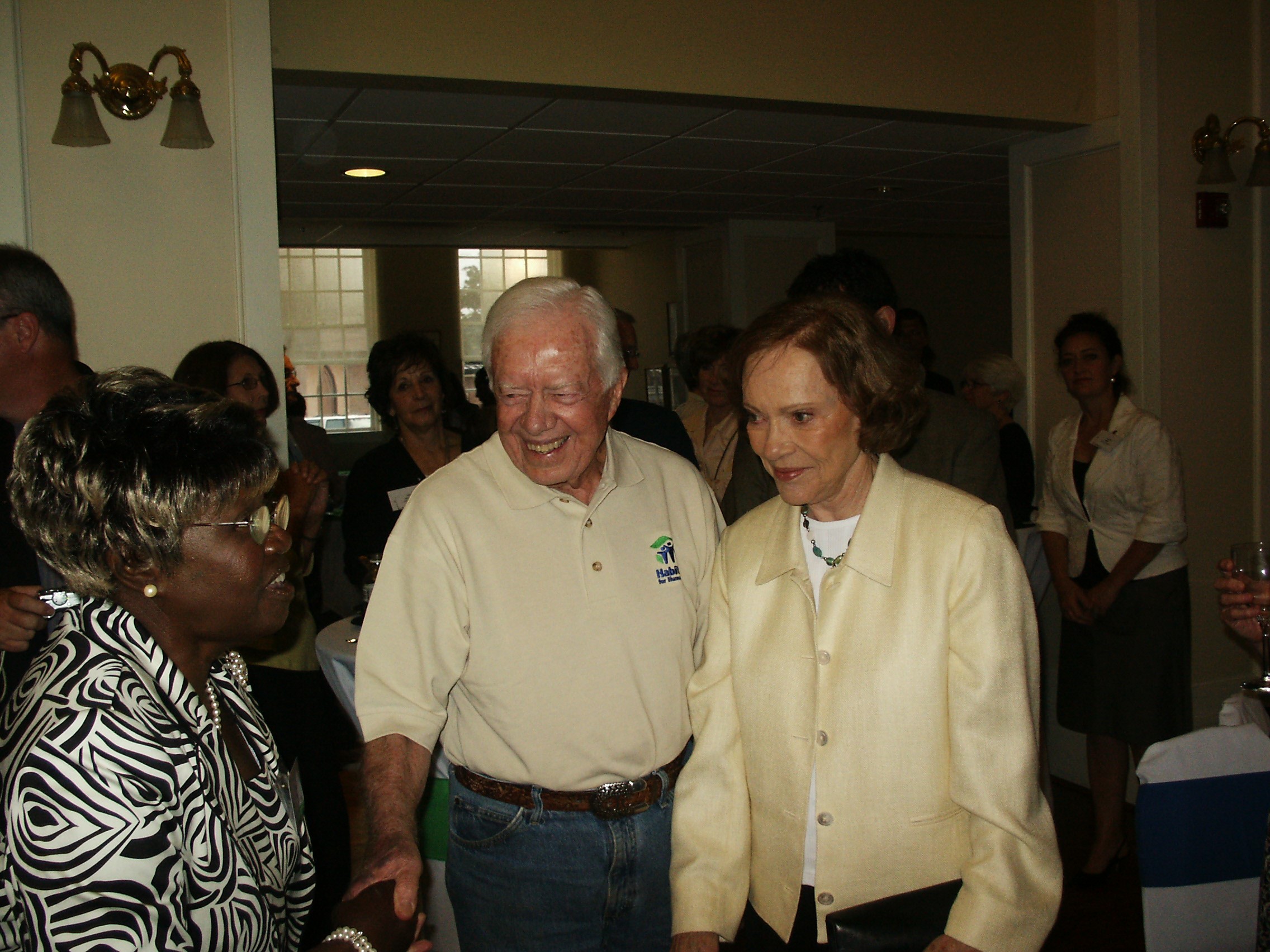
I never introduced myself to President Carter, although the picture above shows how close I came when another Habitat for Humanity affiliate that I helped establish hosted the Jimmy & Rosalynn Carter Work Project in 2008 to address the devastation wrought by Hurricane Katrina. As a board member, I was honored to attend a VIP event that evening and see the Carters up close, but it never worked out to shake his hand and say thank you.

That’s okay. But I will say it today on the day that President Carter’s remains are finally laid to rest in his Georgia hometown after a hundred years and a week’s worth of funeral activities.

Thank you, Mr. President. You changed my life for good, and I am forever grateful.

Small, but Mighty

Life in these United States involves immersion in a culture where bigger is typically considered better. That’s undeniable, I think. We naturally count likes and followers, poll numbers and votes, items sold and bottom lines, box office receipts and numbers of thumbs up, runs/goals/points leading to wins and losses—and judge what is “successful” accordingly. The more, the merrier, so they say. I have yet to see someone enter the Shark Tank and say: My dream is a nice, small business. Hell, no one gets to be a “shark” on Shark Tank for having a small business. Like I said, everywhere we turn: bigger = better.

Not surprising. Our foundational institutions are based on competition: a capitalistic economic system; an adversarial justice system; a democratic political system: in a competitive world, bigger numbers are how we establish the winners and the losers. That is just what we do.

I opened my laptop last Friday to the New York Times article, “Trump Claims Harris’s Rallies are Smaller. We Counted.” Of course, you did. That’s what we do: count sizes of things. It is like we all wear glasses with special lenses so that every person and everything that we see is on one side or the other of a greater-than or less-than sign. Those familiar mathematical signs sit above the commas and periods on our keyboard, and even the words themselves imply value. Greater than. Less than.

This is all well and good (I guess), unless you are on the less-than side. Unless you are (brace yourself)—small. In a competition-based society, the underlying idea is that being small and coming up short is unfortunate and that such misfortune provides the motivation to do more, to grow bigger, based on the assumption, of course, that bigger is better. I mean, one of the very definitions of “small” is “insignificant and unimportant.”

I’m not sure that I buy the entire premise.

__________________________________________

Ten years ago, during the college search journey with our youngest daughter, we learned about small, liberal arts colleges. I confess: as a first-generation, Pell-eligible student myself, I knew very little about an awful lot, and these small colleges were a revelation. My primary experience had been with large, public universities, community/junior colleges, or generally mid-sized, private, faith-based universities. But as we searched, we found these cool, tiny places fascinating.

We learned of the work of Loren Pope, an independent college counselor who said, “The smaller the school, the more impact it can have on a kid. My mission in life is to change the way people think about colleges.” Pope wrote a book titled, Colleges that Change Lives, and we visited several on his list, including a tiny place in rural Wisconsin. We loved our visit to Wisconsin, but our daughter ultimately decided that that particular college was not the place for her college education. But she said to my wife and I: “You two should work there someday.”

Well, life is funny. Several years later, my wife and I did find ourselves working at a small, liberal arts college in rural Illinois that we loved very much. And now, hot off the presses, we are working at a small, liberal arts college in rural Wisconsin — not the same one we visited a decade ago, but nearby, and for us, even better.

I can say from personal experience that, despite today’s disturbing rhetoric, colleges of all shapes and sizes can change lives for the better, but I must also say that I find myself enthusiastically agreeing with Loren Pope that these small colleges can have an extra special sort of impact. In my short time at Ripon College, I have watched the presidential debate and considered the future of our nation with an intimate group of students; watched a football game on a lovely Saturday afternoon where none of the players involved had an athletic scholarship; attended an activities fair and visited with students promoting interests ranging from paranormal activity to equestrian sports, from Greek Life to service organizations, from physics to art, from College Democrats to College Republicans, and affinity groups representing Black students, LatinX students, Asian students, LGBTQIA+ students, and more. All on a campus with less than a thousand students, and all on a campus where these students with diverse backgrounds and diverse interests know one another and the professional educators that love what they get to do here.

There is a particular beauty in something small, but to be small is to be at risk in this world. Small businesses, small farms, small towns, and small colleges are all at constant risk of extinction. But I think there is a corresponding and greater risk on the other side of the equation. In my early days of full-time ministry, I stumbled on some writings of a youth pastor/theologian named Mike Yaconelli, who was considered sort of edgy in a way that I found interesting. It was the heyday of “church growth” strategies, and I remember that he wrote something like, “The only thing you need to worry about with church growth is not to grow too big.”

I liked that then, and I like it now, more than ever.

Aristotle had a similar idea, from what I understand, and wrote extensively on his belief that a city-state should be big enough, but not too big, and that maybe 500-1,000 people was, to quote the philosopher Goldilocks, just right. To present day, Simon Sinek makes a similar argument. In his wonderful book, Leaders Eat Last, in Part 5 he outlines “the abstract challenge,” i.e., as civilizations and organizations grow large, the people the leaders purportedly protect tend to become abstract, invisible to the leaders. Sinek doesn’t hold back on the ramifications and titles chapter thirteen: Abstraction Kills.

All I hear is Yaconelli saying to literally take care not to get “too” big, i.e., so big that you cannot know one another. Don’t grow so big that people become just a number.

What is it that I find so special in the small college setting, the thing about small anything that transcends the typical experience in our particular “advanced” culture? It reminds us to truly see each other.

I often wonder if the world is losing its marbles, and although questioning institutions is one of my favorite things to do, the warlike drumbeat questioning the age-old assumption that a college education is a good thing sort of blows my mind. Is college for everyone? No. Is college too expensive for many? Yes. Should we work to improve things? Sure. But my goodness, I could write forever about the impact of college on the world as well as individual lives and families, including mine.

Instead of feeding our tendency to ask poorly-framed questions (which, ironically, college can help address), maybe the overly broad “Is college worth it?” should be reframed as “Which colleges are worth it?” And if so, I humbly suggest that we check our culturally-influenced tendency to evaluate an answer thinking that bigger is better and be willing to look to the small places. You just might discover a gem.

“Here it is again, the Great Reversal: many of the first ending up last, and the last first.” – Jesus (Matthew 20:16, MSG)

An Emma Lazarus Poem in the Heart of Malibu

She was disruptive, to say the least. A woman, scowling, mentally unstable, stalked the parking lot like a cornered tiger, roaring words at full volume toward the universe, at least half-threatening, and seemingly half-afraid. We were celebrating the thirtieth anniversary of the Malibu Community Labor Exchange with a big fiesta, complete with delicious food from Kristy’s, a troupe performing traditional Oaxacan dances in festive costumes, and a highly-energetic mariachi band. But, as I mentioned, she was disruptive, to say the least.

Some tried to help, appropriately, and unsuccessfully. At times, her behavior escalated toward a possible physical confrontation, and several of the workers on hand rose and drew near like tender bouncers, ready to assist. Oscar, a friend and protégé of the legendary Cesar Chavez, who for six days a week for thirty years now—that’s something like nine thousand times—has driven to Malibu from South Central Los Angeles to direct the center and handle situations exactly like this one, stood close, observing, listening, caring. At the conclusion of the dance performance, the teenage dancers shared a special dance involving pineapples, which triggered a barrage of the verbal outbursts, but the young dancers kept their composure and performed flawlessly, while occasionally darting an eye to the woman lurking at stage left. But nothing stopped the beauty of the night; and, in fact, the uncomfortable interruptions seemed somehow to complete a full picture of the three decades of the Labor Exchange in Malibu: humanity, in all its complicated forms.

I loved being there alongside workers and supporters, as always, and at night’s end was talking to Oscar who, speaking of the woman, leaned in to share with that trademark magical twinkle in his eye like he is witnessing special things in the universe: “Do you know what she shared with me when she left? She said, kindly, ‘Oscar, thank you for tonight.’”

As she stalked out into the night, alone, she said, Thank you.

I know there are many ways of making sense of the universe, but I happen to be a follower of Jesus. I have often thought of the Malibu Community Labor Exchange as a modern version of the story that Jesus told about the Rich Man and Lazarus, but at the party on Saturday night, the scene was more like the wild story where a man called Legion because of his many demons screamed and screamed at Jesus in a cemetery—or a later version where a follower named Paul had a similar encounter with a woman in Greece. In those stories, the demons got tossed out. I really wish that I could toss out her demons, too.

In the meantime, I am glad to know that there is a place right here in Malibu that is willing to offer patient hospitality to those battling demons who accept an open invitation to the party.

“Give me your tired, your poor,
Your huddled masses yearning to breathe free,
The wretched refuse of your teeming shore.
Send these, the homeless, tempest-tost to me,
I lift my lamp beside the golden door!”

By Emma Lazarus, from The New Colossus

Yes, I’m Still Running

IMG_0384

I wonder if I am losing the capacity for wonder? I know, the question appears to answer itself.

Life often presents as one massive scavenger hunt for achievements, experiences, knowledge, possessions, and relationships, but I am pretty sure that’s a fool’s game that pays out in colorful erasers at a Chuck E. Cheese. Even if there is a grand prize for the most tickets, I get the impression that when all is said and done those cashing in aren’t that interested.

The problem is that the Life Acquisition Train disembarks in a lonely neighborhood without many obvious options for alternative travel. But at least wandering the streets provides some quality time to think.

My latest thought is that childhood is for dreaming and adulthood is for chasing, but there just may be a mysterious third act of life for something else. I’m not there just yet, but chasing grows less and less interesting all the time. And I hear the third act calling.

Maybe the third act is meant to point back to the first and recover that childlike imagination but with a new perspective? Maybe. So far I just can’t be sure. But I know that I want to find it.

I sometimes worry that I am losing my capacity for wonder, but on good days I consider that maybe I am just finally shedding the first kind.

Yet I don’t want to give up on the one without locating the other, so I keep walking the nameless streets with Bono in my head because there remains an elusive something to look for.

Student Life

student life pic

The plan worked. Starting the new job on spring break week was the right call. New house, new office, new computer, new work phone, new cell phone, new business cards, new driver’s license—even a new car with new a Tennessee license plate—all taken care of last week. But today is the day that I targeted all along: The first day on the job—with students.

I am a university vice president whose area of responsibility is listed as “student life.” I love those two words so much — independently, but especially, together. For those unfamiliar with the lingo of higher education, student life, also called student affairs or student development, refers to the large number of student experiences outside of the formal academic setting. From dorm room to intramural field, from student organization to fraternity/sorority, from career counseling to intercultural experience, from campus ministry to veterans’ services, from student government to campus safety, from disciplinary action to behavioral intervention—all this and more is our world. Student “life.”

We are educators. At times we stand in front of a group of students in some formal way (for instance, I speak to approximately 1400 students in Allen Arena tomorrow!), but our teaching posture is far more often one-on-one, or small group, or even side by side. And the lessons we teach are often the kind that, to risk sounding overly dramatic, the world needs and that you never forget. “Life” lessons.

I am raring to go this morning, and I hope you can catch a glimpse of how I can be so energized about this new work so quickly after leaving such an amazing community two thousand miles away. To put it simply, there are over four thousand students here, and I get to lead a fantastic team doing important work in an exciting place at a crucial time in history. That is why I am ready to go.

Jesus once said about his intent for humanity: “I came so they can have real and eternal life, more and better life than they ever dreamed of.” (John 10:10, MSG)

Today, on my first day here with students, I aim for that, too. Student “life”—that authentic, permanent, full, and better life that defies imagination.

Star Searching

Xmas Pic

“Christmas comes during a season when the Earth is in its darkest time.”
– Melissa Etheridge

We have three Christmas parties on the calendar this week and three more next. I used to make fun of such things, but not this year. This past season has been rough, and we are more than ready for a season that is merry and bright.

So do what you will, but I suggest: Decorate the tree. Play the music. Bake the cookies. String the lights. Wrap the presents. Wear the sweater. Watch the movie. Mail the cards. Hang the wreath. Dream the dreams.

Does this make everything magically wonderful?  No, I’m afraid not. Is it simply an act of denial? Well, not necessarily. What I’m suggesting is to look despair in its face and proclaim hope. We will not live in the darkness forever. There will be light. We expect it. In fact, we are counting on it.

I am reminded each year that the story behind the Christmas season does not actually feature Jimmy Stewart. Instead, it is of a displaced family in a barn delivering a baby in a feed trough—and against all odds that turned out to be the hope of the world.

There were a few wise dudes back then with enough hope in their hearts to scan the night sky for a star. They spotted it right away, and I suspect it’s because they were looking for it.

So join me in some star searching this year. Because this year I’m going to look up so that I can see it, too.

Jesus, Malibu, and the Immigrant

8592897_origOn Wednesday evening I will join several friends to present Jesus, Malibu, and the Immigrant at Pepperdine.  The event will focus on the Malibu Community Labor Exchange and discuss its work in the context of a Christian worldview of immigration and current political debates about immigration in the United States.  It should be a fascinating evening.

Speakers will include MCLE director Oscar Mondragon (a Malibu legend), Professors Cindy Miller-Perrin and Robin Perrin (Pepperdine legends), yours truly (a legend in my own mind), and Hollywood legend and MCLE supporter Martin Sheen.

I joined Mr. Sheen and several MCLE friends for lunch at Marmalade Café recently, and it was a delightful opportunity to hear entertaining stories from President Bartlet’s, um, I mean, Mr. Sheen’s fascinating life and to witness his heart for service as inspired by his deep faith.  I looked across the restaurant to see Pat Riley having lunch with friends and realized that I really do live in Malibu.

You should come to Elkins Auditorium at 7pm on Wednesday for the conversation.  In addition to Mr. Sheen, I guarantee that listening to Cesar Chavez’s old friend, Oscar Mondragon, is worth it every single time.

For my part, I will focus on my stunning realization that the Parable of the Rich Man and Lazarus is played out every day by those of us who live behind gates in Malibu and the workers who gather in hope waiting for opportunities at the Malibu Community Labor Exchange.  Today, I will simply leave the story as Jesus told it here for your consideration:

“There once was a rich man, expensively dressed in the latest fashions, wasting his days in conspicuous consumption. A poor man named Lazarus, covered with sores, had been dumped on his doorstep. All he lived for was to get a meal from scraps off the rich man’s table. His best friends were the dogs who came and licked his sores. Then he died, this poor man, and was taken up by the angels to the lap of Abraham. The rich man also died and was buried. In hell and in torment, he looked up and saw Abraham in the distance and Lazarus in his lap. He called out, ‘Father Abraham, mercy! Have mercy! Send Lazarus to dip his finger in water to cool my tongue. I’m in agony in this fire.’ But Abraham said, ‘Child, remember that in your lifetime you got the good things and Lazarus the bad things. It’s not like that here. Here he’s consoled and you’re tormented. Besides, in all these matters there is a huge chasm set between us so that no one can go from us to you even if he wanted to, nor can anyone cross over from you to us.’ The rich man said, ‘Then let me ask you, Father: Send him to the house of my father where I have five brothers, so he can tell them the score and warn them so they won’t end up here in this place of torment.’ Abraham answered, ‘They have Moses and the Prophets to tell them the score. Let them listen to them.’ ‘I know, Father Abraham,’ he said, ‘but they’re not listening. If someone came back to them from the dead, they would change their ways.’ Abraham replied, ‘If they won’t listen to Moses and the Prophets, they’re not going to be convinced by someone who rises from the dead.’” – Jesus (Luke 16: 19-31, MSG)