Tag Archives: hiking

Holy the Firm

We misplaced our hiking habit in our move to Wisconsin, but it magically reappeared last weekend during our trip to the Wisconsin Dells to celebrate Jody’s birthday. And that makes me happy.

“The Dells” refers to a scenic gorge on the Wisconsin River about an hour’s drive from our home, but the accompanying small town is widely known in the Midwest as a tourist destination, branding itself as the “Waterpark Capital of the World.” We found the touristy town hard to describe but fun to experience. You might imagine Gatlinburg and Las Vegas had a baby that loves cheese curds.

Jody had the brilliant idea of doing a weekend trip in the offseason as our introduction to the Wisconsin Dells, which worked out well. I’m really not sure that either of us can handle it when all the screaming children — um, I mean, when all the well-behaved children arrive en masse with their extraordinary parents on summer vacation. It might be best that we remain an hour’s drive away from Memorial Day to Labor Day.

We had a fantastic weekend. When we arrived on Saturday, we wandered through shops and bought peanut butter fudge. We had way too much fun taking selfies (in “totally rad” costumes) at Totally ’80s Immersive Experience. We had a lovely dinner and tried our luck at bowling afterward. But on Sunday morning, we drove a few miles out of town for a hike at Mirror Lake State Park. That was the best.

Winter is persistent in Wisconsin, as you might suspect, so a mid-April hike has a different appearance than past hikes in many of our former homes. But it was so lovely. We hiked for several miles and were alone the entire time. Nobody around but us.

And the snow birds returning overhead.

And the evergreen trees.

And the crunchy leaves.

And the bare branches with the tiniest buds.

And the mirror lake.

And the quietness and “peace of wild things,” as Wendell Berry called it.

The news seems pretty shitty these days. The rule of law is in question. The economy is drunk texting our 401ks. The government is making mistakes on who they deport to brutal prisons in El Salvador. If you add in a few personal problems, it is enough to make one consider despair.

Going for a walk in the woods might not solve the world’s problems, but I suggest it anyway. At least I found it worthwhile last Sunday morning.

Annie Dillard wrote the mystical masterpiece, Holy the Firm, in 1977 following news of a plane crash that disfigured a small child and got her to wrestling with the problem of pain and evil in the world. How does one carry on in a world that is often cruel and feels meaningless?

Her title, Holy the Firm, as I understand it, referred to something the earliest Christians believed existed beneath the Earth’s surface, something that was connected to their conception of God, which meant that it was connected to absolutely everything. That’s what Annie Dillard pointed toward in her little book. In her quest to find meaning in the meaningless, she went outside and ventured into nature, where she touched the actual planet in a quest to discover the “firm” that is “holy.”

I’m suggesting that, too, for what it is worth.

Last Sunday morning, I noticed the tiniest buds on the bare branches that seemed to say to me that all good things will return to life someday. I noticed the geese squawking above the treetops on their return trip home that seemed to say to me that loneliness won’t last forever. I noticed the evergreens standing proudly over the still water that seemed to say to me that some good things really do last forever. And I happened to notice all of this with my forever friend who was poised to celebrate yet another gorgeous trip around the sun.

As we hiked, we came to joke about the “Caution: Steep Hill” signs that we encountered often, signaling hills that really were somewhat challenging but not that difficult for us. Afterward, I noticed the Northwest Trail loop that we completed described as “the most difficult trail in the park.” We laughed, having navigated some far more difficult trails in our brief hiking careers.

Maybe that’s worth remembering, too. On this hike called life, the more that we experience, the better equipped we can be for the trails that are to come. When you find despair attempting to lock you indoors, crawl out the window and go on an actual hike. And just walk, and watch, and listen.

West on “the West”

My friend, Lane, sends occasional texts with links to cool things, and the latest was an episode of the Joe Rogan podcast. Lane shared his caveat on Rogan himself but called this particular interviewee “fascinating,” so you can imagine my surprise when discovering that it was my favorite professor way back in 1990 at the University of Arkansas!

Dr. Elliott West is a retired history professor and is 78 years old now, which meant that he must have been around 45 when I sat mesmerized by his lectures in a course titled, History of the American Indian. I have told three Dr. West stories many times since: First, he would interject ridiculous things in his lectures to make sure we were paying attention but said that he stopped doing that with freshmen the day he was going on about how President Lincoln would wear a negligee in public, waiting for someone to interrupt, when one freshman finally raised his hand and asked, “How do you spell negligee?” Second, the day he brought the wrong lecture notes to class, shrugged his shoulders, then proceeded to deliver a seamless, fascinating lecture without missing a beat, which had quite an impact on a future educator. And, finally, and most memorably, the time I arrived to class to discover a note on the door that class was canceled that day—and was disappointed—which immediately signaled that to disappoint a 20-year-old by canceling a history lecture is the sign of an uncommon professor.

I spent two hours last Thursday evening listening to Joe Rogan interview Dr. West, and it was a beautiful trip down memory lane. Dr. West is known as one of the greatest historians of the American West and has recently published a 700+ page book titled, Continental Reckoning (that I will be purchasing and devouring), so you can imagine that there was plenty of interview material. I’ll just touch on one part toward the end—the movies known as “the Westerns.”

Dr. West explained to Rogan that Westerns aren’t really about the West: instead, much like what you see on the movie screen is actually something that is projected from a contraption behind you, the Westerns as we came to know them are projections, too—much more an idea than a reality. When you think in simple North-South-East-West terms from the perspective of the United States as it existed at the time of westward expansion, North-South were areas engaged in terrible conflict, the East represented where the young nation had been, so the West became a unifying and romanticized idea as to where the nation might could go. It became both an exciting, dramatic, hope-filled idea and, tragically, an opportunity to create a shared villain in the native inhabitants. The Western on the big screen projected all that and more.

On Saturday morning, Jody and I spent a few hours hiking in Wildwood Regional Park in Thousand Oaks, where many classic movies and television shows were filmed, including a crazy number of Westerns such as The Rifleman, Gunsmoke, Bonanza, and The Man Who Shot Liberty Valance, just to name a few. Well, maybe I’ll name one more just for the name: the epic movie titled, How the West Was Won. As we hiked the hills, picturing stagecoach robbery scenes, I kept hearing Dr. West’s voice explaining what the West was really like, and “how the West was (really) won,” and remembering how fortunate I was to have had the chance to learn directly from him. I’m glad that he is still teaching, and I’m glad that others have the opportunity to listen.

Me at Wildwood Regional Park in Thousand Oaks (PC: My sweet wife)

Hooray for (Mt.) Hollywood

I am pleased to report that we hiked the Mt. Hollywood Trail this morning (not to be confused with Mt. Lee of the famed HOLLYWOOD sign). To do so, we left Malibu just before sunrise and arrived in the Griffith Observatory parking lot before 8am, well before you have to pay to park there but nowhere nearly before significant numbers of folks arrive to enjoy the spectacular hike, e.g., as we approached the trailhead, a large high school cross country team was stretching in preparation for some serious hill work.

From one perspective it turned out to be an easy hike—wide trails, easy to follow, and just 1.2 miles to the summit—but the 550 feet of constant elevation is anything but simple. Case in point: The many runner passersby did not appear to be whistling show tunes. And although I refuse to complain about SoCal weather, while the weather app said it was 67 degrees, most of the trail was exposed to the sun and it was the hottest 67 degrees imaginable, maybe with our slowly approaching the sun and all.

There were fun, quirky parts of the hike, like the Berlin Forest, complete with a road sign sharing that it is 5,795 miles to Berlin, Germany, one of L.A.’s sister cities, and a rest stop sponsored by Tiffany & Company, but of course, where one can sit and enjoy a nice view of the HOLLYWOOD sign. But the panoramic views along the way were the real stars of the show: looking back down on the Observatory and Park, looking out at Downtown Los Angeles, and on a clear day like today, looking all the way to Catalina Island and the vast Pacific Ocean.

For our purposes, it was simply another nice day to be together, out in nature, seeing something special, and not to be overlooked, enjoying the beautiful human diversity found in this City of Angels. It was a good morning from start to finish.

We stopped at one point on the trail in an area ominously named Dante’s View, partly to see what was there, but mostly to stop going uphill for a minute, and in that brief moment yet another small pack of the young cross country team passed us by, and when they did I overheard one young leader encouraging his teammates by saying, “This is going to make us better.”

Well said, my young friend. Well said. That’s why Jody and I got up early today and drove across Los Angeles—to be better, both individually and together.

This morning, thanks to a young runner that I didn’t even look up to see, I was reminded that courageously pushing ourselves up the hills of life surely isn’t easy, but it makes us better, and the views from the top are absolutely worth the struggle.

Take a Hike

My wife and I are proof that opposites attract and can even be happily married forever (twenty-nine years and counting!). Our differences provide some independence, which we count as a strength; however, we battle against being too independent, so we periodically have ideas as to how we might do something together—not something mine or hers, but ours. The latest idea is hiking.

Oh, we have hiked off and on over the years in various parts of these United States, but intentional, regular hiking is a new adventure for us. We plan to target some spectacular part of Southern California once a month, and today was our first.

There’s a joke about camping as rich people pretending to be homeless, which I considered last night as I removed tags from the new hiking apparel we purchased at the super-hip store for outdoors enthusiasts, REI, which I also learned does not technically stand for Really Expensive Items (Recreational Equipment, Incorporated, but who knew?). This morning I slipped on my new forest-green REI hiking pants and my new black Salomon Speedcross 6 trail shoes and off we went to the Santa Ynez Mountains of Santa Barbara.

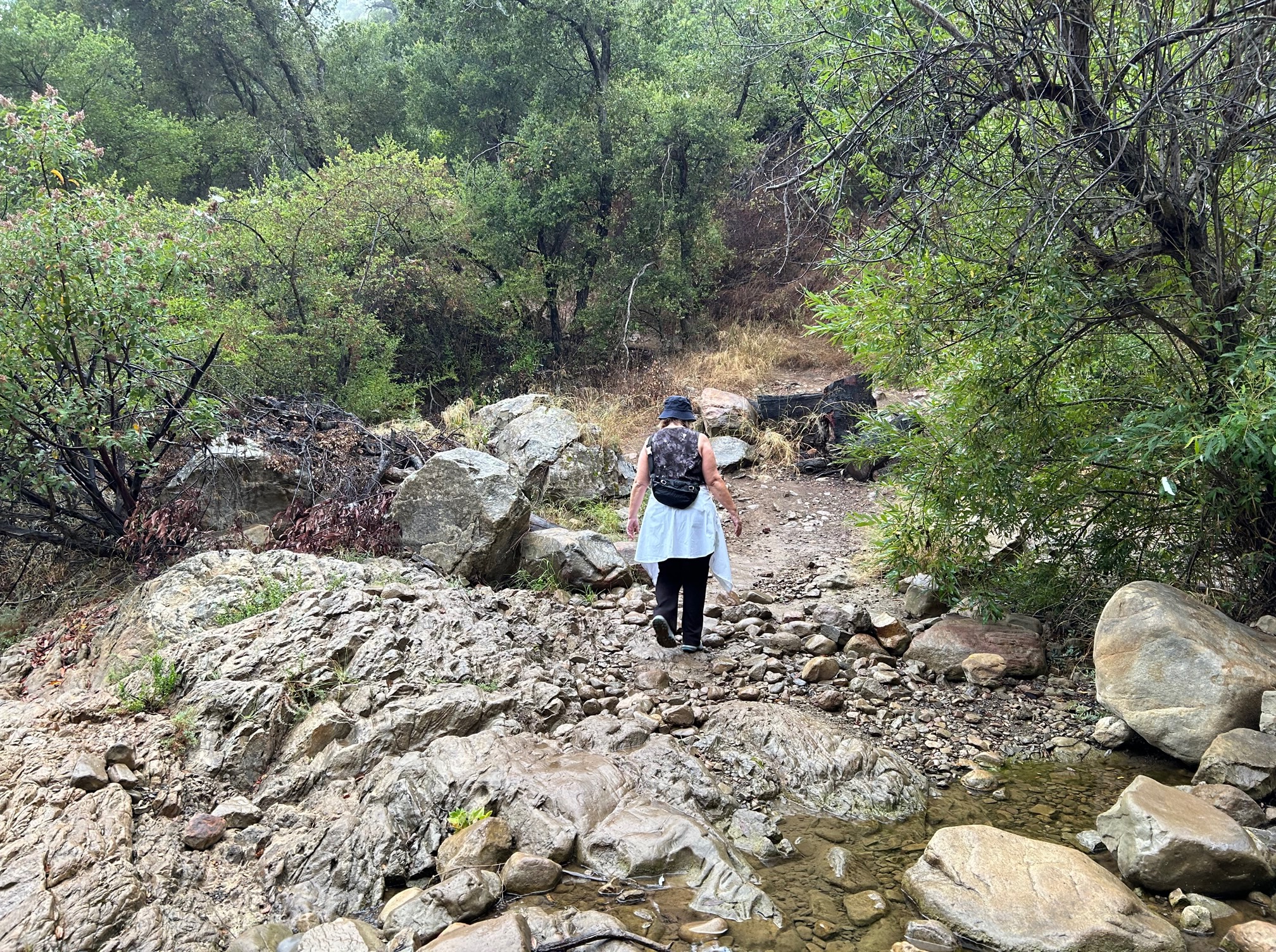
Because we are just getting started and not in great shape, we chose a “moderate” hike, and I’m sure that in some level of hell the four miles and 800-feet of elevation we encountered could be described as moderate, so I won’t quibble. But we struggled. When it comes to sure-footedness, I, for one, have the clumsy coordination of a baby giraffe. We were passed twice by the same young trail runner going up and down the trail we hoped to conquer once and felt a little intimidated by the parents carrying small children on their backs as well as the two guys carrying their mountain bikes up a switchback. We climbed, slowly, toward our destination, Inspiration Point, and I did discover inspiration on the journey: I felt a strong inspiration to curse. I felt inspired to consider a different activity to do together. I often felt inspired to stop.

But my goodness it turned out to be incredible. Somewhere between a heavy mist and a light rain accompanied us as we hiked our way up into the puffy, saturated clouds, and we reveled in the mesmerizing sound of nature, which included the breathtaking sound of silence. Slowly, deliberately, we climbed, and when we finally reached Inspiration Point, we discovered that we had it all to ourselves, which felt appropriate, since our initial inspiration was to do it for ourselves anyway.

I am embarrassed to say that I rarely touch the actual planet that we live on. My feet touch pavement and concrete, carpet and hardwood flooring, tile and vinyl, laminate and linoleum, but how often do I come into contact with Mother Earth? Not often enough. Not. Often. Enough.

But the best part of a remarkable day? Holding hands when the trail was wide enough. Simple conversations. Making each other laugh. Cheering each other on. Sharing spectacular scenes together. Feeling less alone in this world. Feeling more connected to each other, not to mention the universe.

We’ll be doing this again. And again, and again.

Don’t be offended, but if you asked us for a little marital advice, we’d tell you to take a hike.

Transcendent Experiences

1

Famed journalist, David Brooks, was the featured speaker at a recent conference at Pepperdine, and much of the conversation focused on an op-ed he wrote a year ago in The New York Times titled, “The Big University.”  The thought behind the article is summed up in a single sentence/paragraph:

In short, for the past many decades colleges narrowed down to focus on professional academic disciplines, but now there are a series of forces leading them to widen out so that they leave a mark on the full human being.

Brooks applauded this development and prescribed four tasks for colleges and universities:

  1. Reveal moral options.
  2. Foster transcendent experiences.
  3. Investigate current loves and teach new things to love.
  4. Apply the humanities.

While all four are worthy of reflective conversation, I am particularly drawn to the call to foster transcendent experiences.  Brooks wrote:

If a student spends four years in regular and concentrated contact with beauty—with poetry or music, extended time in a cathedral, serving a child with Down syndrome, waking up with loving friends on a mountain—there’s a good chance something transcendent and imagination-altering will happen.

Yeah, I dig it.

Last week, I was thousands of miles from home in Akron, Ohio, with a couple of unexpected hours and zero plans and somehow ended up hiking through a beautiful park amid the blazing colors of autumn.  The very next day, even farther from home in the heart of Manhattan in New York City, I had more unexpected time to spend while awaiting a meeting in a Fifth Avenue skyscraper and wandered into iconic St. Patrick’s Cathedral to experience an early afternoon Mass in that stunning venue.

A peaceful forest.  A majestic cathedral.  Two good choices.  And why did I have to travel so far to make such choices?

Brooks’s encouragement may have simply been intended for college students, but seeing that I feel a little thirsty for transcendence myself, my choices in those two moments make me wonder what might happen if I altered my routines to create “regular and concentrated contact with beauty.”

I just might do it.  And if nothing else, fostering transcendent experiences in my own life might make me more effective in fostering such moments for others.