Tag Archives: david brooks

Cultivate the Bright Passions

I find it especially important in dark and troubled times to closely monitor personal emotions, and we seem to live in dark and troubled times. This came to mind as I drove to the office before eight o’clock on this Sunday morning. My wife is out of town, so I felt justified putting in early Sunday work hours, but such behavior indicates that my emotions could get out of whack.

But it was sixty-three degrees on a lovely morning, and I lowered the window to feel the cool breeze while listening to a station that features soothing acoustic music. And as I drove past farmland I was surprised to see several normally-stationary horses galloping together on a gentle morning run. And then I rounded a curve and noticed that the self-serve produce stand is now decorated with pumpkins and flowers on this first day of autumn. And I sensed in a powerful form the intoxicating feeling of peace.

There was more.

A little farther along, I met an older woman riding her bike on the lonely back roads. We have passed one another on several mornings and now wave with smiles as if we are dear friends, which we did with even more enthusiasm this morning. I then turned toward the office and noticed my friend, Kelly, out walking her dog, which led to another wave and another smile. And as if the world was conspiring for my good, I then noticed a wonderful student, Emma, walking across campus on a Sunday morning, and I stuck my arm out the window with another wave and smile.

And for a moment, if I didn’t know better, I sensed every reason in the world to be happy.

David Brooks published a column in The New York Times three days ago titled, “The Era of Dark Passions.” I surely do not agree with David Brooks on many things, but I typically benefit from reading his thoughts, and I especially appreciated that particular opinion piece. Brooks shared his belief that “something awful has been unleashed” in our current times and that “[e]ven before the Charlie Kirk assassination it was obvious that the dark passions now pervade the American psyche, and thus American politics.” Brooks identified dark passions as Anger, Hatred, Resentment, Fear, and the Urge to Dominate, and he distributed blame for stirring dark passions for personal benefit to his own industry, the media, and to both sides of the political aisle. Brooks then posed the question:

Why does politics feel so different now than in times past? My short answer is that over these years, demagogues in politics, in the media and online have exploited common feelings of humiliation to arouse dark passions, and those dark passions are dehumanizing our culture and undermining liberal democracy. My intuition is that we’re only at the beginning of this spiral, and that it will only get worse.

With that cheery outlook, what is there to do? Well, for starters, Brooks begins:

First, let me tell you how not to reverse it. There is a tendency in these circumstances to think that the other side is so awful that we need a monster on our side to beat it. That’s the decision Republicans made in nominating Trump. Democrats are moving in that direction too. Back in 2016 Michelle Obama asserted that Democrats to go high when Republicans go low, but the vibe quickly shifted. As former Attorney General Eric Holder put it in 2018: “When they go low, we kick ’em. That’s what this new Democratic Party is about.” If Republicans soil our democracy with extreme gerrymandering in Texas, Gavin Newsom and the Democrats will soil our democracy in California. The problem with fighting fire with fire is that you’re throwing yourself into the cesspool of dark passions. Do we really think we won’t be corrupted by them? Do we really think the path to victory lies in becoming morally indistinguishable from Trump? Do we really think democracy will survive? Surveys consistently show that most Americans are exhausted by this moral race to the bottom and want an alternative; do we not trust the American people?

Brooks then advises as “the most effective way to fight dark passions”…

History provides clear examples of how to halt the dark passion doom loop. It starts when a leader, or a group of people, who have every right to feel humiliated, who have every right to resort to the dark motivations, decide to interrupt the process. They simply refuse to be swallowed by the bitterness, and they work — laboriously over years or decades — to cultivate the bright passions in themselves — to be motivated by hope, care and some brighter vision of the good, and to show those passions to others, especially their enemies. Vaclav Havel did this. Abraham Lincoln did this in his second Inaugural Address. Alfred Dreyfus did this after his false conviction and Viktor Frankl did this after the Holocaust. You may believe Jesus is the messiah or not, but what gives his life moral grandeur was his ability to meet hatred with love. These leaders displayed astounding forbearance. They did not seek payback and revenge. Obviously, Martin Luther King Jr. comes to mind: “To our most bitter opponents we say: We shall match your capacity to inflict suffering by our capacity to endure suffering. We shall meet your physical force with soul force. Do to us what you will, and we shall continue to love you. We cannot in all good conscience obey your unjust laws, because noncooperation with evil is as much a moral obligation as is cooperation with good. Throw us in jail, and we shall still love you.”

You might not be surprised that this resonates with me given my latest blog post published a few days prior to Brooks’s column. But it especially came to mind this morning on a lovely ride into work. I place no value on being unrealistic or ignoring the obvious, but I place great value on noticing the good and living with hope, for what is the future without hope?

I guess what I’m saying is that I unexpectedly caught a glimpse of the bright passions on a drive to work this morning, and I am now extra inspired to resist the forces that push the dark passions and choose to cultivate the bright passions more and more instead. As David Brooks concluded his recent column:

The dark passions look backward toward some wrong committed in the past and render people hardhearted. The bright passions look forward toward some better life and render people tough-minded but tenderhearted.

May we look forward toward some better life as tough-minded and tenderhearted people.

Is Contentment Overrated?

The Far Side, by Gary Larson

Happiness has me surrounded.

I have been married to my best friend in the world for 30+ years. We live in a cool, historic house in a cool, historic town, and we both work for a small college that we adore and hope to work at for the rest of our careers. We have two incredible daughters who are good and independent human beings who make us proud and do important work that truly makes a difference. We aren’t wealthy, but we have a comfortable income and money in the bank.

There is more.

I teach “sports law,” combining three things—teaching, sports, and law—that I have loved for a long time. I preach periodically for a church where I can fully be me. I am on the board of a nonprofit that once changed my life for good. I have developed a habit of reading good books that constantly teach me about life. My back is doing well, so I can once again engage my love for running. I have adopted a weird diet where I feel awesome every day.

I’m embarrassed to admit there is still more.

I have now lived long enough to do many things. I have lived all over this country, experiencing Gulf Coast sunrises and Malibu sunsets, Arkansas ridges and Tennessee lakes, Illinois harvests and Wisconsin winters. And I have traveled all over the world, too, from an African safari to a Brazilian rain forest, from the Eiffel Tower to the Taj Mahal, from a Mexican resort to a Spanish cathedral. And best of all, I have developed meaningful relationships with so many wonderful humans in so many wonderful places that reflect every imaginable aspect of the beauty in diversity. I have been loved, and I have loved.

So I am happy. As happy as I have ever been. And I wonder if I am the only person who can possibly be unhappy about being happy? I am the ridiculous cow in The Far Side cartoon informing Wendell that she is somehow not content.

I should explain what I have recently concluded: My true desire is neither happiness nor contentment. I desire living with passion and purpose instead.

David Brooks recently published a lengthy essay in the New York Times titled, “A Surprising Route to the Best Life Possible.” Brooks wonders why people choose “voluntary pain” and through exploring many examples, including himself, concludes that humans are better when taking on challenges and enduring difficulties in their quest for something significant. Brooks argues that there is somehow a “blessing” in “human instability” and that to be “enchanted” or “entranced” or “seized” by a great calling is preferable to the alternative, despite the inevitable pain.

You have no idea how much his essay means to me—especially at this stage of my life when I sense a temptation to count your blessings and call it a day, and especially when confronting my guilt for resisting contentment with so many reasons to be happy.

Maybe contentment is simply overrated. Brooks writes, “We want to be in love — with callings, projects and people. The opposite of love is not hate, it’s indifference, and indifference is an absolutely terrible state to endure. I guess there are some people who have earned the right to want contentment above all, to sit back and enjoy whatever prosperity they’ve achieved. But I rarely meet such people, even people in retirement.”

I really do appreciate all of the very good things in my happy life. (And no, I’m not silly enough to move again, giving up the beauty we have discovered.) And contentment is fine in a particular sense, i.e., not being greedy, accepting every moment for what it is. But I crave a challenge, and the bigger the better. I want more. I need to want more.

As Brooks chose to close his essay, “People tend to get melodramatic when they talk about the kind of enchantment I’m describing here, but they are not altogether wrong. The sculptor Henry Moore exaggerated but still captured the essential point: ‘The secret of life is to have a task, something you devote your entire life to, something you bring everything to, every minute of the day for your whole life. And the most important thing is — it must be something you cannot possibly do!’”

I’m really not content, and I’m happy to admit it. Even at my age, and even surrounded by so much good, I crave a monumental task instead.

2024: My Year in Books

I started tracking the books that I read in 2017 and have maintained that habit ever since. I typically read twenty-to-thirty each year, although that jumped to forty during the crazy COVID year of 2020. This year will end at thirty; however, I must say that as a whole the quality of this year’s list was remarkable, which is really saying something given what I have read in the past.

I made it a point several years ago to read just as much fiction as nonfiction, and I am proud that has become a habit, too. I tended to veer toward nonfiction, but I equally love and benefit from works of fiction, so I am glad to have achieved a balanced reading diet.

I don’t like to rank the books and declare favorites for multiple reasons. Well, actually, I do like to rank books and declare favorites, but for multiple reasons I try to avoid that tendency. Instead, I think I will just share the list below — divided by fiction/nonfiction in the order I read them — and share a note about each one. If anyone has follow-up questions, please feel free to ask publicly or privately.

Nonfiction:

  1. Spirit Run by Noe Alvarez (a gift from my daughter, Hillary, and a gift for runners who want to go on a crazy cool travel journey)                                       
  2. How to Know a Person by David Brooks (a gift from a former coworker, Shelley, and to risk sounding overly dramatic, should possibly be required reading for U.S. citizens in the 21st Century)                             
  3. Why We Sleep by Matthew Walker (fascinating insight into an underrated health crisis)                          
  4. Boys in the Boat by Daniel James Brown (a gift from my daughter, Erica, and a wonderful story of endurance and triumph through sport)                  
  5. Why We Love Baseball by Joe Posnanski (a gift from my daughter’s boyfriend, Quentin, and a perfect illustration of how a book’s title can capture its essence)                            
  6. The Servant Lawyer by Robert Cochran, Jr. (written by a friend and colleague that I deeply admire and helpful for any Christian in the legal profession)             
  7. Amusing Ourselves to Death by Neil Postman (recommended by my friend, Sandi, and it blew my mind that Postman’s remarkable insights predated the computer revolution — another on my required reading list for present-day Americans)                                 
  8. Somehow by Anne Lamott (another gift from my former coworker, Shelley, who is a fellow Anne Lamott fan; saying that this wasn’t my favorite Anne Lamott book would be like saying a sunset was slightly less spectacular than another)
  9. Eight Keys to Forgiveness by Robert Enright (Enright is a pioneer in examining forgiveness, which is a conflict resolution course I have taught for years, and I finally got around to reading one of his books, which was well worth it)                       
  10. Sapiens by Yuval Noah Harari (my friend/student, Laura, gave me Sapiens as a special gift, and both the gift and the book meant so much to me: it challenges everything, which is right up my alley, and I will be thinking on it forever)                                             
  11. The Universal Christ by Richard Rohr (Rohr is a gift to so many of us disillusioned by conservative Christianity, and while this book wasn’t the book I expected it to be for me personally, I found his thesis both compelling and helpful)                                              
  12. The Warmth of Other Suns by Isabel Wilkerson (a gift from my daughter, Erica, and while I said I wasn’t going to rank the books, this extraordinary telling of the Great Migration is probably the most impactful book that I read this year — yet another on the required reading list for all Americans)           
  13. Academic Coaching by Marc Howlett & Kristen Rademacher (recommended by two separate friends/colleagues, Tim and Brenda, and I was more than impressed that a book can be simultaneously well-researched, succinct, and practical)            
  14. Never Givin’ Up by Kurt Dietrich (an outstanding book from a new friend in Wisconsin chronicling the life of the sensational entertainer (and Ripon College alum), Al Jarreau)                             
  15. Introduction to Sport Law by Spengler, Anderson, Connaughton, and Baker (a textbook in preparation for a course that I get to teach this semester!)

Fiction:

  1. Clock Dance by Anne Tyler (I have long loved Anne Tyler novels)
  2. Elevation by Stephen King (King is a writing hero, and this novella was entertaining as expected, but not one of my favorites)
  3. The Midnight Library by Matt Haig (not what I expected, but a good read)
  4. Memphis by Tara Stringfellow (really good, probably especially if you are from near Memphis like me)
  5. Heaven and Earth Grocery Store by James McBride (a truly outstanding book, and possibly my favorite novel of all time, except that I kept reading more novels this year)
  6. Malibu Rising by Taylor Jenkins Reid (well, guilty pleasure reading maybe (?), but I enjoyed it since I knew all the Malibu references)
  7. The Lonely Hearts Book Club by Lucy Gilmore (stumbled on this book, characterized as a “feel-good” novel, which must be my kind of book since I like feeling good)
  8. Tom Lake by Ann Patchett (so, so good — Nashville author writing of an older couple living on a cherry farm in rural Michigan and recalling experiences of the glitz and glamor of Hollywood in younger years — that we moved from Malibu to rural Wisconsin later this year might suggest that this book is personally special)
  9. Our Town by Thornton Wilder (Tom Lake was based on Our Town, so I had to get around to finally reading it)
  10. Hula by Jasmin Iolani Hakes (picked this up during Asian American and Pacific Islander Heritage Month, and glad that I did — a challenging story that spans three generations of women)
  11. The Poisonwood Bible by Barbara Kingsolver (a recommendation from my daughter, Hillary, and I wondered how I had missed Kingsolver all of these years — so much that I wondered if it was better than Heaven and Earth Grocery Store)
  12. Demon Copperhead by Barbara Kingsolver (now all into Kingsolver, and based on a recommendation from my wife, I decided that Demon Copperhead is the best novel I have ever read)
  13. The Beginner’s Goodbye by Anne Tyler (did I say that I love Anne Tyler novels?)
  14. James by Percival Everett (my goodness, what a year of reading novels — this one won the National Book Award for fiction this year for good reason, and I absolutely loved it — a retelling of Adventures of Huckleberry Finn from Jim’s perspective, which is just brilliant)
  15. Atonement by Ian McEwan (I ended the year with a re-reading of Atonement, which I had said prior to 2024 was my favorite novel of all time — not sure I can still say that, but reading it again reminded me of why I loved it so much)

Abstraction Kills

What can lead one person to kill someone they have never met?

I suspect you saw the news. On December 4, a gunman in a hooded jacket shot and killed Brian Thompson, the 50-year-old CEO of UnitedHealthcare, as he left his hotel in New York City. The killer fled the scene, triggering a nationwide manhunt, and given the victim’s job, reports that the words deny, defend, and depose were on the shell casings furthered the suspicion that this was a targeted attack. And I suspect you saw the quick, troubling reactions to the murder afterward, like t-shirts for sale with the words deny, defend, and depose on them, and references to the shooter as a hero for murdering a health insurance company CEO. And you probably saw the subsequent arrest at a Pennsylvania McDonalds of 26-year-old Luigi Mangione, a prep school valedictorian and Ivy League grad from a prominent Baltimore family.

The entire story sounds more like a Grisham novel than real life, so the media attention is unsurprising.  

Murder is reprehensible. You might think that goes without saying, but it doesn’t; go without saying, that is. I strongly oppose all acts of violence and for both strategic and theological reasons promote creative nonviolent resistance as an alternative. I remain convinced that what theologian Walter Wink termed the “myth of redemptive violence” is descriptive not just of American history but all of human history, and I defy the claim that violence can be a source of good. So, I unequivocally condemn the murder of Brian Thompson.

As expected, the victim left behind heartbroken family and friends. I read the reactions of those who knew Brian Thompson the best and understand their bewilderment at the widespread popularity of the alleged killer. They described the victim as a small-town, blue-collar kid from Iowa who was a good student and then worked hard as he rose through the ranks to become the CEO of a major corporation. Thompson earned ten million dollars in salary and benefits last year and was in many ways the popularly-understood American success story. Rags to riches. How could anyone celebrate the cold-blooded murder of a Horatio Alger hero story?

If you find yourself so bewildered, there is another perspective that is helpful to understand. Consider, if you will, the perspective of countless human beings who have watched their loved ones suffer and die due to the cold denial of insurance coverage by a fabulously wealthy company whose chief executive was paid over ten million dollars last year. (To do the math, that’s well over $1,000/hour for every single hour of the year.) Some of you might not have to try very hard to imagine this alternative perspective, and to be honest, I didn’t have to try very hard either. To understand the anger and bitterness, that is.

When I consider the murder of an American rags-to-riches success story by someone who is representative of millions of wronged Americans using violent tactics characteristic of American history and popular culture, I ask myself how to make sense of it all, and it turns out that I do have a particular thought to share.

Ten years ago, Simon Sinek published a wonderful leadership book titled, Leaders Eat Last, and I was especially impressed by his chapter, The Abstract Challenge. [Note: I mentioned this book and chapter specifically in a recent and relevant post, Small but Mighty.] Sinek pictures the initial attempts of humans to live in groups and imagines a village deciding on a leader and granting the leader certain privileges but with an important understanding: When our village gets attacked by a lion or tiger, it’s your job to fight it for us! However, Sinek argues, as human civilization evolved over subsequent thousands of years, the leaders still received lots of privileges, but they also became further and further removed from the people they are there to protect. So, to the modern leader, those they are to protect often become more and more “abstract.” To illustrate, the CEO of a major corporation leads massive numbers of people whose names they will simply never know. And given this state of affairs, as Sinek concludes, in organizations—and he actually uses the following phrase as a chapter title—abstraction kills.

I was struck by how literal that may have become in this particular case.

What can lead a prep school valedictorian and Ivy League grad from a prominent Baltimore family to kill a hard-working rags-to-riches story from a blue-collar Iowa family when the two have never met?

Possibly, because abstraction kills.

There are many conversation topics that emerge from this popular true crime story, and I hope that on one hand we will remember to reaffirm the rule of law and condemn murder, and I hope that on the other hand we will at some point truly consider universal health care. But it seems to me that neither conversation will make a dent in The Abstract Challenge. We can hardly reverse millennia of sociological developments overnight to address such a fundamental reality.

But as I have argued before, I do think we can begin a grassroots effort toward that end and adopt a posture that consistently resists the powerful sociological inertia that constantly reduces actual human beings into invisible abstractions. To be candid, that is why I like living in a small town. And why I like working at a small college. And why I like being a part of a small church. In small towns, and small organizations, and small churches, it is exponentially more difficult for people—and their joys and their pains—to be invisible.

In a phrase, it is vital that we learn to truly see people.[1] All people. It’s a nearly impossible task in a modern world, but don’t let that stop us from trying. We are facing powerful forces that lead to violence and death, but I am convinced that life and love are worth the (creative, nonviolent) resistance.


[1] And I’ve also said this before, but I encourage you to read the latest book from David Brooks, How to Know a Person: The Art of Seeing Others Deeply, and Being Deeply Seen (2023).

An Historic Election: Looking Backward, Inward, and Forward

I confess a deep sadness following last week’s presidential election. It is a personal sadness, sure, but it is far more on behalf of those from historically-marginalized groups that feel especially vulnerable and afraid due to a resounding national stamp of approval for a candidate famous for hateful rhetoric offered in their specific direction. E.g., Stand back and stand by. Black jobs. Grab them by the ____. Too many direct quotes about specific women’s bodies to list. Mocking a reporter with arthrogryposis. Muslim bans. Shithole countries.

I felt especially sad for my two amazing daughters. Their professional lives and personal hearts are dedicated to teaching children who live in poverty in the urban core and who are now facing a promise of mass deportation that will rip immigrant families apart. It is hard to imagine a fear more fundamental than a powerful government separating you from your family. It was hard enough for me to communicate with my heartbroken daughters as they went to work the morning after the election and know that they love children by name who are facing those fundamental fears.

My sadness expands recognizing that my personal religion, Christianity, generally speaking, is openly and willingly associated with the national stamp of approval for the hateful rhetoric. Although I disagree with their conclusion, I can understand the thought processes of those who saw the election as a “lesser of two evils” vote, but there is never cause for celebration following a lesser-of-two-evils vote. And yet lots of Christians celebrated this one with euphoric joy; saw it as an answered prayer; used words like anointed. I unfortunately opened Facebook the day after the election.

I have been on a thirty-year journey with faith and politics, a journey that began in the early 1990s with me a young, questioning adult and the simultaneous rise of the Religious Right as a political movement. As Evangelical (for lack of a better term) churches gravitated toward the proselytization of a political strategy, I was saved from dismissing Christianity and moving on entirely, in part, by stumbling upon the writings of Will D. Campbell who demonstrated for me that there was a different way to be Christian, and I concluded that for me following Jesus meant that I must love everyone, regardless. Both sides. All humans. Even enemies. Learning to “live reconciled” became an important phrase to me, as did “indiscriminate love.”

But that really messed me up. Loving everyone is a recipe for loneliness in a culture insistent on choosing sides, winners and losers, us and them. On one hand, I could see the pain felt by those that experienced decades of cultural condescension and blindness to class inequality from the Political (and Religious) Left while on the other hand growing increasingly cognizant of the centuries of pain felt by those that experienced the terrible injustice and marginalization perpetuated by the Political (and Religious) Right. So, I eventually learned to bite my tongue a lot, choosing instead to plant seeds, attempting not to alienate either side in an attempt to love and maintain relationships with everyone. I chose to work within a lot, behind the scenes a lot. And I felt guilty a lot for not doing and/or saying more.

My interpretation of Christianity remains, but in time I sought a quiet freedom from a life where I am not allowed to be fully authentic, and I am grateful for the wonderful feeling of liberation that I now experience. But given my own emotional reaction this week, and given numerous private texts and conversations with friends from all over the country that we made on our long journey toward personal liberation, my personal freedom seems self-serving and wholly insufficient.

But what to do?

That question has dominated my thinking, and I am grateful for anything I have heard and read from Dr. Tressie McMillan Cottom in the aftermath of the election (like the full Daily Show interview). Dr. Tressie has helped me tremendously (and I thank my friend, Chalak, for telling me about her in the first place). And I have also benefitted from articles written by both David Brooks and David French after the election, white men from conservative backgrounds who through their columns have assured me that my visceral reactions to the election aren’t simply because I drank Kool-Aid at the Liberal Vacation Bible School.

Collectively, they pulled no punches in saying that chaos is coming but emphasized that despair cannot be allowed to be the mood for long. Dr. Tressie advised, “Don’t cry too long over a sinking ship,” and the subject of David French’s email read, “We don’t have time to waste time in despair.”

French wrote, “There’s a temptation to retreat. If you have a stable job, a good family and good friends, you can check out of politics. After all, politics can be painful. It’s not just the pain of loss, but also the pain of engagement itself. MAGA is extraordinarily cruel to its political opponents. But despair is an elite luxury that vulnerable communities cannot afford. If Trump was telling the truth about his intentions — and there is no good reason to think he wasn’t — then he will attempt a campaign of retribution and mass deportation that will fracture families, create chaos in American communities and potentially even result in active-duty troops being deployed to our cities.”

So, while sad and tempted to quit caring, even that, as depressing as it sounds, is “an elite [and selfish] luxury.” Here are my commitments instead:

#1: See. I choose not to give up on my faith commitment to see all people—i.e., to love neighbors, regardless of anything. David Brooks published an important book last year titled, “How to Know a Person,” and his post-election column explained something Will Campbell helped me see long ago, i.e., a “redistribution of respect” that led to a “vast segregation system” between the Political Left and those that now comprise the base of the MAGA movement. Brooks’s post-election column titled, “Voters to Elites: Do You See Me Now?,” reminds me that condescension creates problems and does not cure them, and I won’t abandon my desire to see all people as human beings equally worthy of sincere love and respect.

#2: Speak. This, I confess, feels like my greatest challenge. One change I must adopt moving forward is a willingness to speak up more, even though that will risk alienation from and dismissal by people that I love on every side. It is tempting to bite my tongue, especially when I want to remain in relationship with everyone, but I think David French is right when he says we are compelled to “speak the truth.” He explained it this way: “Telling the truth means combating deception and misinformation, but it also means publicly defending the dignity and humanity of the people and communities who are the object of Trump’s wrath. It means resisting malice when we encounter it in our churches and communities.” Remaining silent might appear to preserve relationships, but it forecloses all prospects for true justice and real harmony. This blog post is an initial and meager attempt to speak up more.

#3: Act. Finally, as hard as the first two are to do, they are insufficient without action. David French wrote that we must “protect the vulnerable,” but I like how Dr. Tressie said it best: “Don’t cry too long over a sinking ship. Build dinghies.” To continue the nautical metaphor, the Brooks column concluded this way: “[W]e are entering a period of white water. Trump is a sower of chaos, not fascism. Over the next few years, a plague of disorder will descend upon America, and maybe the world, shaking everything loose. If you hate polarization, just wait until we experience global disorder. But in chaos there’s opportunity for a new society and a new response to the Trumpian political, economic and psychological assault. These are the times that try people’s souls, and we’ll see what we are made of.”

I want my soul to pass this test, so with thanks to Dr. Tressie and the two Davids, and after much reflection, I have concluded that it takes all three: See. Speak. Act. Looking backward in despair, looking inward in contemplation, and now looking forward with resolve, that is what I commit to do.

Beneficence

bush-letter

“Our culture has made it harder to be good.” – David Brooks, The Road to Character

With the news that former president George H.W. Bush is in ICU and the worldwide attention on today’s presidential inauguration, I found this worth sharing today.

In one sense, today is simply a Republican president succeeding a Democrat president, something that has occurred three times in my lifetime (and three times vice-versa, too).  But everyone knows that this inauguration is almost indescribably different.  Donald Trump won the presidency by brazenly declaring that he is indescribably different.  And today is the day he moves into the White House.

President Obama will cede center stage today.  I have watched him navigate the post-election drama, and I may not be objective enough to comment, but it seems that he has been consistently gracious in what must be an awkward time.  Today will be particularly scrutinized.

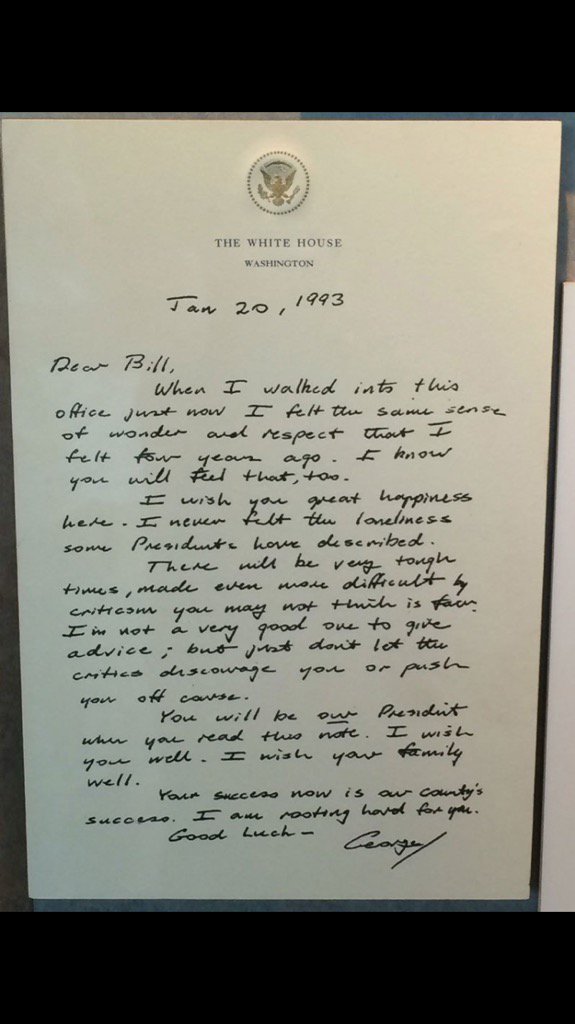
A couple of months ago at the height of the election drama, a handwritten letter that outgoing president George H.W. Bush left in the White House for incoming president Bill Clinton in 1993 made the rounds, and given the campaign histrionics this go around, it was almost shocking to read.

He wrote:

Dear Bill,

When I walked into this office just now I felt the same sense of wonder and respect that I felt four years ago.  I know you will feel that, too.

I wish you great happiness here.  I never felt the loneliness some Presidents have described.

There will be very tough times, made even more difficult by criticism you may not think is fair.  I’m not a very good one to give advice; but just don’t let the critics discourage you or push you off course.

You will be our President when you read this note.  I wish you well.  I wish your family well.

Your success now is our country’s success.  I am rooting hard for you.

Good luck,

George

In President (George H.W.) Bush’s autobiography, he describes that day: “And so time goes on and I’m sitting here now alone, the desk is clear and the pictures are gone.  I leave a note on the desk for Bill Clinton.  It looks a little lonely sitting there.  I don’t want to be overly dramatic, but I did want him to know that I would be rooting for him.”

I don’t want to be overly dramatic either, but the graciousness offered by President (George H.W.) Bush to President Clinton is something that in my opinion does more than transcend politics—it transcends life.  And it displays a depth of character not rewarded in our culture today.

I want to highlight it.  Especially today.

Transcendent Experiences

1

Famed journalist, David Brooks, was the featured speaker at a recent conference at Pepperdine, and much of the conversation focused on an op-ed he wrote a year ago in The New York Times titled, “The Big University.”  The thought behind the article is summed up in a single sentence/paragraph:

In short, for the past many decades colleges narrowed down to focus on professional academic disciplines, but now there are a series of forces leading them to widen out so that they leave a mark on the full human being.

Brooks applauded this development and prescribed four tasks for colleges and universities:

  1. Reveal moral options.
  2. Foster transcendent experiences.
  3. Investigate current loves and teach new things to love.
  4. Apply the humanities.

While all four are worthy of reflective conversation, I am particularly drawn to the call to foster transcendent experiences.  Brooks wrote:

If a student spends four years in regular and concentrated contact with beauty—with poetry or music, extended time in a cathedral, serving a child with Down syndrome, waking up with loving friends on a mountain—there’s a good chance something transcendent and imagination-altering will happen.

Yeah, I dig it.

Last week, I was thousands of miles from home in Akron, Ohio, with a couple of unexpected hours and zero plans and somehow ended up hiking through a beautiful park amid the blazing colors of autumn.  The very next day, even farther from home in the heart of Manhattan in New York City, I had more unexpected time to spend while awaiting a meeting in a Fifth Avenue skyscraper and wandered into iconic St. Patrick’s Cathedral to experience an early afternoon Mass in that stunning venue.

A peaceful forest.  A majestic cathedral.  Two good choices.  And why did I have to travel so far to make such choices?

Brooks’s encouragement may have simply been intended for college students, but seeing that I feel a little thirsty for transcendence myself, my choices in those two moments make me wonder what might happen if I altered my routines to create “regular and concentrated contact with beauty.”

I just might do it.  And if nothing else, fostering transcendent experiences in my own life might make me more effective in fostering such moments for others.