Tag Archives: courage

Bar Eve. Or, Don’t Shrink from a Challenge.

[Note: This is a repeat from last year, but purposely so.]

We always opened presents on Christmas Eve. I like Christmas Eve. New Year’s Eve ends with confetti-drenched smooching, and who can argue with that? But Bar Eve—the night before the bar exam—is more of a pain in the hind quarters.

I was abnormally slow to matriculate to law school so the bar exam remains a somewhat fresh wound. I sat for the California version, statistically the hardest in the country, an eighteen-hour torture device spread out over three days that begins tomorrow for many of my good friends.

Truth be told, the exam is the easy part. It is the anticipation, the fear-filled, guilt-infested, never-ending dread that drives a person to inquire about openings with the circus. So Bar Eve is significant, the pinnacle of the real challenge. When the exam begins tomorrow morning, life will actually begin to improve. And when the exam ends on Thursday afternoon, delirious excitement abounds, although the emphasis is on delirious.

To riff the old Tony Campolo sermon, it’s Bar Eve, but Thursday’s a-comin’.

Accounting for the delirium, I prize two important memories from that Thursday afternoon when I emerged from the Pasadena Convention Center (sidebar: we pronounce it PASS-adena for the good vibes; thankfully, we didn’t sit for the exam in FAIL-adelphia).

Memory #1: I sincerely thought there should have been a parade for us. I mean it. It was a strong feeling that, regardless of how we did on the exam, the simple fact that we endured that hell of a summer and survived the three-day exam called for a parade. We were heroes.

Memory #2: Driving home, stuck in traffic on the 101 and not caring about traffic for the first time ever, I knew what I wanted to say when I arrived home. My youngest daughter was in eighth grade at the time and had declared to my hearty approval while observing the bar summer that she would never go to law school. But on the drive home, I knew what I had to tell her. When I made it, after the hugs and kisses, I mustered all the seriousness in me to communicate what I hoped she would receive as one of those few life lessons that you just cannot miss: Never run away from a challenge simply because it looks daunting.

I could not say such a thing until that Thursday afternoon, but I never felt any life lesson more strongly than I did at that moment. On this Bar Eve, I hope my hero friends will finish strong and experience that same sense of accomplishment.

The Greatest

ALIDAYS1

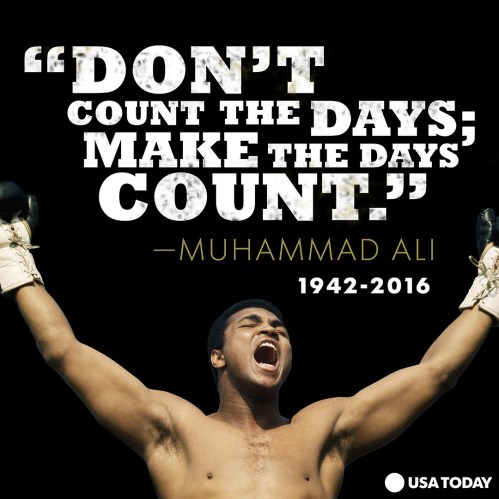
My dad was a boxing fan, which made sense for a member of what Tom Brokaw termed “the greatest generation.”  Boxing was the American sport when he was a boy in the 1920s and 1930s, and I remember his tales of the great Jack Dempsey as we watched fights together a half century later.  I somehow failed to inherit his love for the sport, but the combination of his love and the golden age of heavyweight boxing that coincided with my childhood unleashed personal memories when Muhammad Ali’s passing was announced last Friday.  Elvis Presley, John Wayne, and Muhammad Ali—those were the names that seemed larger than life to this little boy in small-town Arkansas.  Now, all three are gone.

That Ali is a popular American hero is fascinating.  I doubt that his outspoken racial pride and conversion to Islam in the 1960s endeared him to all who now mourn his passing.  I doubt that his refusal to accept military service makes him a hero to all patriotic Americans.  And his brash, in your face, “I am the greatest” trash talking is not typically the personality that leads to universal love and admiration, the Donald Trump phenomenon notwithstanding.

Maybe America just likes a winner?  I don’t buy it.  Call me crazy, but I’m guessing that Barry Bonds, Bill Belichick, and Floyd Mayweather, Jr. will not be universally adored when they ultimately move on from this life.

So, why did Muhammad Ali die an American hero?  Some say it is his social activism, his willingness to stand up for what he believed in.  Maybe so.  That has to be a part of it.  But I suggest there is something more to Ali’s universal appeal.

Muhammad Ali embraced life.

He was fun and funny and full of joy.  He lived without fear.  Think about it: the religious conversion, the brash statements in an era of racial violence, the thumbing his nose at the government’s draft, and the claims of boxing greatness all displayed that he was not afraid of any threat.

More importantly, he lost in the boxing ring multiple times—but came back for more with a smile.  Over time, in what seemed to be the cruelty of fate, the powerful and eloquent athlete lost his famed strength and good health and bold voice—but he came out in public with a smile.

Check it out: Muhammad Ali was not afraid of any threat, but he was also not afraid of any consequence.

I believe that is why we loved him so.  We want to live without fear, too.  We want to face both the goods and bads of life with unshakable joy.

Wouldn’t that be the Greatest?

Adversity

My youngest daughter gave me a LARGE PRINT (appreciated!) book of David Foster Wallace essays titled, “Both Flesh and Not.” She knows that I may have developed a reader crush on Wallace. Among other admirable qualities, Wallace’s conventional knowledge is astounding, but his unconventional approach is stunning. For instance, one of the essays included in the book is composed entirely of bullet points. Twenty-five pages’ worth of bullet points (well, LARGE PRINT, so maybe two pages, but still).

So if the imitation/flattery cliché is true, then consider the following as feeble-yet-genuine praise.

• Adversity: Simple definition: “a difficult situation or condition.”
• Synonyms: misfortune; mishap; tragedy.
• First known use: 13th century.
• Probability that you (and me, but I’m writing here, so you) will encounter adversity: 100%.
• Leading responses to adversity: Popularly (and boring-ly), fight or flight. More descriptively, nausea; all versions of weeping, from softly into a dark pillow to convulsive wailing; bitterness; rage; blaming, from self to upbringing to society to presidents/candidates to God to karma to your stupid ex-whatever; prayer; tubs of ice cream; throwing things; liquid courage; television binge; a life of crime; join the circus.
• Approximate amount of fun in any of these responses at least by the next day: Zero. (Except possibly the circus, which depends so much on your new job description.)
• Common themes from an “adversity” search on Google Images: Mountains; tightropes; Martin Luther King, Jr., loneliness.
• Strangest return item from an “adversity” search on Amazon: Adversity Board Game.
• Opening line of product description for Adversity Board Game: “Become the greatest advertising mogul the world has ever seen!” (Oh, it is AD-versity. Clever.)
• Most fun line of opening customer description of Ad-versity Board Game: “We tried this game both while drinking and while sober, and both times it sort of stank.”
• Why I’m thinking/writing about adversity: Life, lately. Some personal, some observational, from many corners of life.
• What to do when the tendency to criticize how others handle adversity rears its ugly head: Slip on their moccasins. (Figuratively of course, although a literal situation is conceivable, like if maybe someone gets bad news from the doctor and runs screaming on to a sizzling hot highway, and if you’re barefoot and their moccasins are right there anyway… This all seems highly unlikely.)
• How I want to handle inevitable adversity: With love; head on; with courage and strength; at peace.
• Probability that I will do so: Unknown, but greatly increased with resolve, preparation, practice, and reflection.

Vision Care

My optometrist is wonderful. Kind. Professional. Gentle. Brilliant. Compassionate. I hate him so much.

The hatred is obviously the It’s-not-you-it’s-me kind because he is great and all. It is simply that I wish never to see him again. That, of course, is the dilemma: that if I never see him again, then I may not see anyone again. It is a harder decision than it sounds when I say it out loud.

My first optometrist visit occurred in the third grade and taught me that I was blind in one eye. I remember quite well that my eyelids were turned inside out as part of the examination, which resulted in a more serious medical condition known as “the heebie jeebies” (self-diagnosis). The heebie jeebies is a terrible malady, and the chief treatment plan is to avoid all visits to an optometrist for as long as humanly possible. Seeing as I am nothing if not committed to a treatment plan, I did not visit another optometrist for thirty-three years (which, I’m just pointing out, Christians believe is the entire human life span of the Son of God, so I think that is a pretty good run).

But I caved several years back and that is when I met Dr. Wonderful, whom I hate if that was somehow left unclear. Oh, it is an irrational hatred. There were no eyelids turned inside out in the examination, so no heebie jeebies. The visit mostly consisted of rational adult conversation and semi-successful attempts to read tiny letters. I graduated to reading glasses, which wasn’t all that terrible either. There was only one negative . . . .

I have never been known for physical strength. That is probably because I have very little physical strength. But I’m telling you the truth, and you can ask my doctor, try to drop something into one of my eyes, and my eye muscles can lift a Buick—or at least a grown man wearing a miner’s hat holding a dropper.

(Why are all my superhero gifts so lame? Adding lists of numbers quickly, Olympic-strength eye muscles, 1980s-era NBA trivia, number of freckles…)

So, seeing as how dropping liquids into my eyes turns me into The Incredible Hulk, I took another few years between optometrist visits just out of respect for peace in the community, but last week in a moment of weakness I returned once more to the scene of the crime. It went as expected: I tossed Dr. Nice Guy around the examination room with my eye muscles like a professional wrestler and now have some new glasses on the way.

In sum, I guess it is clear that I avoid the very resource that helps me see the world more clearly because it creates a brief moment of discomfort. That doesn’t make a lick of sense for the eyes of my heart any more than it does for the eyes in my skull, and if clarity of vision means anything at all, I had just better learn to get over it.

Freedom Road

480x480xa_glitter_1.jpg.pagespeed.ic.gTwfajW_UJ

Random Glitter Beard Guy (Not Me. Yet.)

My inaugural participation in No Shave November would have ended today were it not for (a) my wife’s shocking declaration that she likes the beard; and (b) an entrepreneurial law student convincing me to wear a “glitter beard” for a full day if he raised a thousand dollars for the law school’s public interest student organization. He created a GoFundMe page for this effort, and as disturbing as a glitter beard on my face is to consider, last I checked he had raised ten bucks. You could change that, of course, with your donations (click HERE), but this is a classic win-win situation for me.

Glitter beard aside, my life is actually one long story of self-consciousness about physical appearance, but there has been great progress over the decades, and my path to baldness is particularly instructive.

My hair embarrassed me from the moment I realized people judged your appearance. I don’t know exactly how to describe my hair, other than terrible. It was thin, light brown, oily, and curled in all the wrong places with length, with a cowlick smack in the middle of my forehead. I hated it. I tried, without talent mind you, to make it look okay, hoping not to draw attention to it—ever—and in that effort spent more time than I care to know in front of a mirror. In effect, I was a butcher with a comb attempting brain surgery.

Worse, any time the wind blew or rain fell it somehow got worse, and both happened in my hometown on a regular basis. Wearing a hat was okay if it was stapled to my head and never came off in public. I wore out untold back pockets on blue jeans because I carried a comb everywhere I went. Everywhere. I guess I was vain in reverse, not consumed with looking good, just desperate not to be the object of laughter.

This went on for a few decades or so, give or take, and then I started going bald on top, too, as if being pale/skinny/freckly with bad hair wasn’t enough self-esteem for an American male.

And then one glorious day I was reading lovely Anne Lamott talk about her lifelong obsession with bad hair (although her particular malady was frizzy-ness). She mentioned that as an adult a friend with dreadlocks encouraged her to follow suit, but the idea of a middle-aged white woman in dreadlocks took some time to consider. Then, one day, while watching the climactic scene in The Shawshank Redemption when Andy Dufresne tunnels through sewage to escape from prison and stands in the pouring rain with his arms to the sky in glorious freedom, Lamott thought, “I could never do that. My hair would look terrible.” At that moment Lamott decided to go with dreadlocks. You laugh, but I had to catch my breath. It was me. In effect, it was that story that led me to shave my head.

Here is the kicker: It was so difficult to actually follow through with it because my entire life had been one long attempt to avoid calling attention to my personal appearance. (And let me tell you, shaving your head is one surefire way to draw attention to your personal appearance.) But I did it. Our friend, Devon, did the honors, and as expected, everyone had to comment. (My favorite was when meeting those who hadn’t seen me for some time. They were oddly quiet, and I am sure that my bald/pale/skinny self had them wondering if it was cancer or AIDS. I just let them wonder.) After some time, the comments went away, and all these years later, I could not be happier.

What I learned is that the path to freedom requires the courage to face your greatest fears. And that the freedom is worth it.

It is still difficult to say, but—look at me. I’m up to sporting a glitter beard now if the price is right.
Not Yet

“Success is not final, failure is not fatal: it is the courage to continue that counts.”
– Winston Churchill

The State Bar of California released its July 2015 bar exam results over the weekend, which impacted the lives of a large number of people that I know and love. California is famously the last state to release results and the one with the lowest passing statistics (and this year’s was the lowest July pass rate in three decades). This combination produces enhanced euphoria for some and a particularly hard punch in the gut to others. It is a weekend of tremendous highs and tremendous lows, and with friends in both places, I never know exactly how to feel. It is easy to celebrate the good news, but it is those who are hurting who maintain center stage in my mind.

I try to do all the right things: Give time, then reach out, then wait patiently, and then, when engaged, try to be helpful. As a former pastor, grief counseling is familiar territory.

Truth be told, the answer in the end is simple and involves climbing back on to the bicycle or horse or whatever metaphor you prefer to have fallen from and go at it again. “If at once you don’t succeed…” is technical truth, but it takes time to hear it without punching someone.

There is more. Success after failure is even sweeter. I recall an old article that identified resilience as a key characteristic of the most spectacular figures in history who overcame great challenges and failures on their unforgettable journeys. Of course failure can destroy a person, too. But it doesn’t have to.

Dr. Carol Dweck of Stanford University tells of a high school in Chicago that gives the grade Not Yet as opposed to Fail. I know this makes some people scream, “Kids need to learn how to fail!” Exactly, and then they need to learn how to get back up again. That is the genius of Dr. Dweck’s groundbreaking research on the importance of mindset when facing failure, which she describes as having a “growth” mindset instead of a “fixed” mindset.

How do you respond to failure? Those with a fixed mindset typically take it personally (e.g., “I’m a failure.”) or blame some external factor (e.g., “It’s your fault that I failed.”). Those with a growth mindset respond with “Not Yet” and determine how to improve to reach the goal.

The Heroic Life

We have grown weary of recounting where we were on September 11, 2001. There may come a day when new generations ask us to remember, and we most assuredly will for the memories are too strong to fade. But the jury is still out on whether the lessons will endure.

There is one image-turned-lesson that I have pledged never to let fade: Firefighters racing up the stairwells of the World Trade Center as the buildings crumbled. They were simply doing what they were trained to do, which was to be heroic. I want to live like that, too—racing toward danger and not away from it—so it stands to reason that I also want to die that way. That is neither thrill-seeking nor pushing limits nor adrenaline addiction; instead, it is a compelling desire to make the world better for those in great need, which I remain convinced requires leaving safety and venturing toward danger.

Years ago, I read a couplet that captures this goal and have shared it often:

Some want to live within sound of church and steeple bell.
I want to run a rescue shop within a yard of hell.

That.

Looking back, the times in life when I felt most alive were those spent at the Hellside Rescue Shop. In that shop, there must be a portrait of a New York City firefighter racing up those steps. The firefighter is young and brave and determined and has so much to live for, which is exactly what you find in that image—someone living for so much. Today, I spend extra time looking at that inspiring image.

I invite others to consider such a life, one that acknowledges fear but meets it head on. Living for others is preferable to living for self-indulgence, self-preservation, and self-promotion, and the lines to get in are way shorter.

Courage

Fear is humanity’s fountainhead of trouble. Courage is a virtue that celebrates triumph over fear. From personal experience, I believe that showing up for law school is in itself an act of courage. Today, as we come to end of the first week with our new students, I offer for all of us Anne Sexton’s fine poem appropriately titled, “Courage,” that describes our lifelong quest to find it.

It is in the small things we see it.
The child’s first step,
as awesome as an earthquake.
The first time you rode a bike,
wallowing up the sidewalk.
The first spanking when your heart
went on a journey all alone.
When they called you crybaby
or poor or fatty or crazy
and made you into an alien,
you drank their acid
and concealed it.

Later,
if you faced the death of bombs and bullets
you did not do it with a banner,
you did it with only a hat to
cover your heart.
You did not fondle the weakness inside you
though it was there.
Your courage was a small coal
that you kept swallowing.
If your buddy saved you
and died himself in so doing,
then his courage was not courage,
it was love; love as simple as shaving soap.

Later,
if you have endured a great despair,
then you did it alone,
getting a transfusion from the fire,
picking the scabs off your heart,
then wringing it out like a sock.
Next, my kinsman, you powdered your sorrow,
you gave it a back rub
and then you covered it with a blanket
and after it had slept a while
it woke to the wings of the roses
and was transformed.

Later,
when you face old age and its natural conclusion
your courage will still be shown in the little ways,
each spring will be a sword you’ll sharpen,
those you love will live in a fever of love,
and you’ll bargain with the calendar
and at the last moment
when death opens the back door
you’ll put on your carpet slippers
and stride out.

Bar Eve. Or, Don’t Shrink from a Challenge.

We always opened presents on Christmas Eve. I like Christmas Eve. New Year’s Eve ends with confetti-drenched smooching, and who can argue with that? But Bar Eve—the night before the bar exam—is more of a pain in the hind quarters.

I was abnormally slow to matriculate to law school so the bar exam remains a somewhat fresh wound. I sat for the California version, statistically the hardest in the country, an eighteen-hour torture device spread out over three days that begins tomorrow for many of my good friends.

Truth be told, the exam is the easy part. It is the anticipation, the fear-filled, guilt-infested, never-ending dread that drives a person to inquire about openings with the circus. So Bar Eve is significant, the pinnacle of the real challenge. When the exam begins tomorrow morning, life will actually begin to improve. And when the exam ends on Thursday afternoon, delirious excitement abounds, although the emphasis is on delirious.

To riff the old Tony Campolo sermon, it’s Bar Eve, but Thursday’s a-comin’.

Accounting for the delirium, I prize two important memories from that Thursday afternoon when I emerged from the Pasadena Convention Center (sidebar: we pronounce it PASS-adena for the good vibes; thankfully, we didn’t sit for the exam in FAIL-adelphia).

Memory #1: I sincerely thought there should have been a parade for us. I mean it. It was a strong feeling that, regardless of how we did on the exam, the simple fact that we endured that hell of a summer and survived the three-day exam called for a parade. We were heroes.

Memory #2: Driving home, stuck in traffic on the 101 and not caring about traffic for the first time ever, I knew what I wanted to say when I arrived home. My youngest daughter was in eighth grade at the time and had declared to my hearty approval while observing the bar summer that she would never go to law school. But on the drive home, I knew what I had to tell her. When I made it, after the hugs and kisses, I mustered all the seriousness in me to communicate what I hoped she would receive as one of those few life lessons that you just cannot miss: Never run away from a challenge simply because it looks daunting.

I could not say such a thing until that Thursday afternoon, but I never felt any life lesson more strongly than I did at that moment. On this Bar Eve, I hope my hero friends will finish strong and experience that same sense of accomplishment.

Choose Sanity

My high school buddies and I had great fun with the imagist poetry phase of William Carlos Williams. Wow, that makes us sound so intelligent. Instead, we were clueless teenage boys with no appreciation for anything resembling culture who simply made fun of the poem in our literature book about a wheelbarrow and chickens.

Now, in my mid-forties, well, not much has changed.

But in my advanced years I do at least make an effort. Each morning when I arrive at the office I read a poem from Garrison Keillor’s Good Poems, and a few weeks ago I stumbled across another popular poem from Williams’s imagist phase:

This Is Just To Say

I have eaten
the plums
that were in
the icebox

and which
you were probably
saving
for breakfast

Forgive me
they were delicious
so sweet
and so cold

I still think Williams was smoking something.

Regardless, the next poem Keillor shared was a reply to Williams from Erica-Lynn Gambino:

This Is Just To Say
(for William Carlos Williams)

I have just
asked you to
get out of my
apartment

even though
you never
thought
I would

Forgive me
you were
driving
me insane.

Gambino is my kind of poet.

Other than abstaining from your roommate’s frozen plums, please know that this is not an attempt at relationship advice. Instead, I’m aiming at a little life metaphor here when I ask: Are you willing to remove from your life the things that are driving you insane?

I’m not sure about you, but my life is filled to the brim with countless responsibilities, information overload, and myriad relationships, just to name a few major categories. It is more than possible that life can be so full that it explodes like a balloon, leaving an awful mess to clean up—unless, of course, we cull a few crazy-makers along the way.

My guess is that none of us are super hot at giving up the things that drive us nuts—as crazy as that alone is to admit. Author Bob Goff famously quits something every Thursday. I think he is on to something.

If you want things to start looking up, lighten the load by getting rid of some stuff that drains the life right out of you. Even if it isn’t Thursday.

(And, regardless, be careful around plums.)