
Tag Archives: contentment

Is Contentment Overrated?

The Far Side, by Gary Larson

Happiness has me surrounded.

I have been married to my best friend in the world for 30+ years. We live in a cool, historic house in a cool, historic town, and we both work for a small college that we adore and hope to work at for the rest of our careers. We have two incredible daughters who are good and independent human beings who make us proud and do important work that truly makes a difference. We aren’t wealthy, but we have a comfortable income and money in the bank.

There is more.

I teach “sports law,” combining three things—teaching, sports, and law—that I have loved for a long time. I preach periodically for a church where I can fully be me. I am on the board of a nonprofit that once changed my life for good. I have developed a habit of reading good books that constantly teach me about life. My back is doing well, so I can once again engage my love for running. I have adopted a weird diet where I feel awesome every day.

I’m embarrassed to admit there is still more.

I have now lived long enough to do many things. I have lived all over this country, experiencing Gulf Coast sunrises and Malibu sunsets, Arkansas ridges and Tennessee lakes, Illinois harvests and Wisconsin winters. And I have traveled all over the world, too, from an African safari to a Brazilian rain forest, from the Eiffel Tower to the Taj Mahal, from a Mexican resort to a Spanish cathedral. And best of all, I have developed meaningful relationships with so many wonderful humans in so many wonderful places that reflect every imaginable aspect of the beauty in diversity. I have been loved, and I have loved.

So I am happy. As happy as I have ever been. And I wonder if I am the only person who can possibly be unhappy about being happy? I am the ridiculous cow in The Far Side cartoon informing Wendell that she is somehow not content.

I should explain what I have recently concluded: My true desire is neither happiness nor contentment. I desire living with passion and purpose instead.

David Brooks recently published a lengthy essay in the New York Times titled, “A Surprising Route to the Best Life Possible.” Brooks wonders why people choose “voluntary pain” and through exploring many examples, including himself, concludes that humans are better when taking on challenges and enduring difficulties in their quest for something significant. Brooks argues that there is somehow a “blessing” in “human instability” and that to be “enchanted” or “entranced” or “seized” by a great calling is preferable to the alternative, despite the inevitable pain.

You have no idea how much his essay means to me—especially at this stage of my life when I sense a temptation to count your blessings and call it a day, and especially when confronting my guilt for resisting contentment with so many reasons to be happy.

Maybe contentment is simply overrated. Brooks writes, “We want to be in love — with callings, projects and people. The opposite of love is not hate, it’s indifference, and indifference is an absolutely terrible state to endure. I guess there are some people who have earned the right to want contentment above all, to sit back and enjoy whatever prosperity they’ve achieved. But I rarely meet such people, even people in retirement.”

I really do appreciate all of the very good things in my happy life. (And no, I’m not silly enough to move again, giving up the beauty we have discovered.) And contentment is fine in a particular sense, i.e., not being greedy, accepting every moment for what it is. But I crave a challenge, and the bigger the better. I want more. I need to want more.

As Brooks chose to close his essay, “People tend to get melodramatic when they talk about the kind of enchantment I’m describing here, but they are not altogether wrong. The sculptor Henry Moore exaggerated but still captured the essential point: ‘The secret of life is to have a task, something you devote your entire life to, something you bring everything to, every minute of the day for your whole life. And the most important thing is — it must be something you cannot possibly do!’”

I’m really not content, and I’m happy to admit it. Even at my age, and even surrounded by so much good, I crave a monumental task instead.
The Nashville Scene

22802054_1424706070960843_6066755586089811968_n
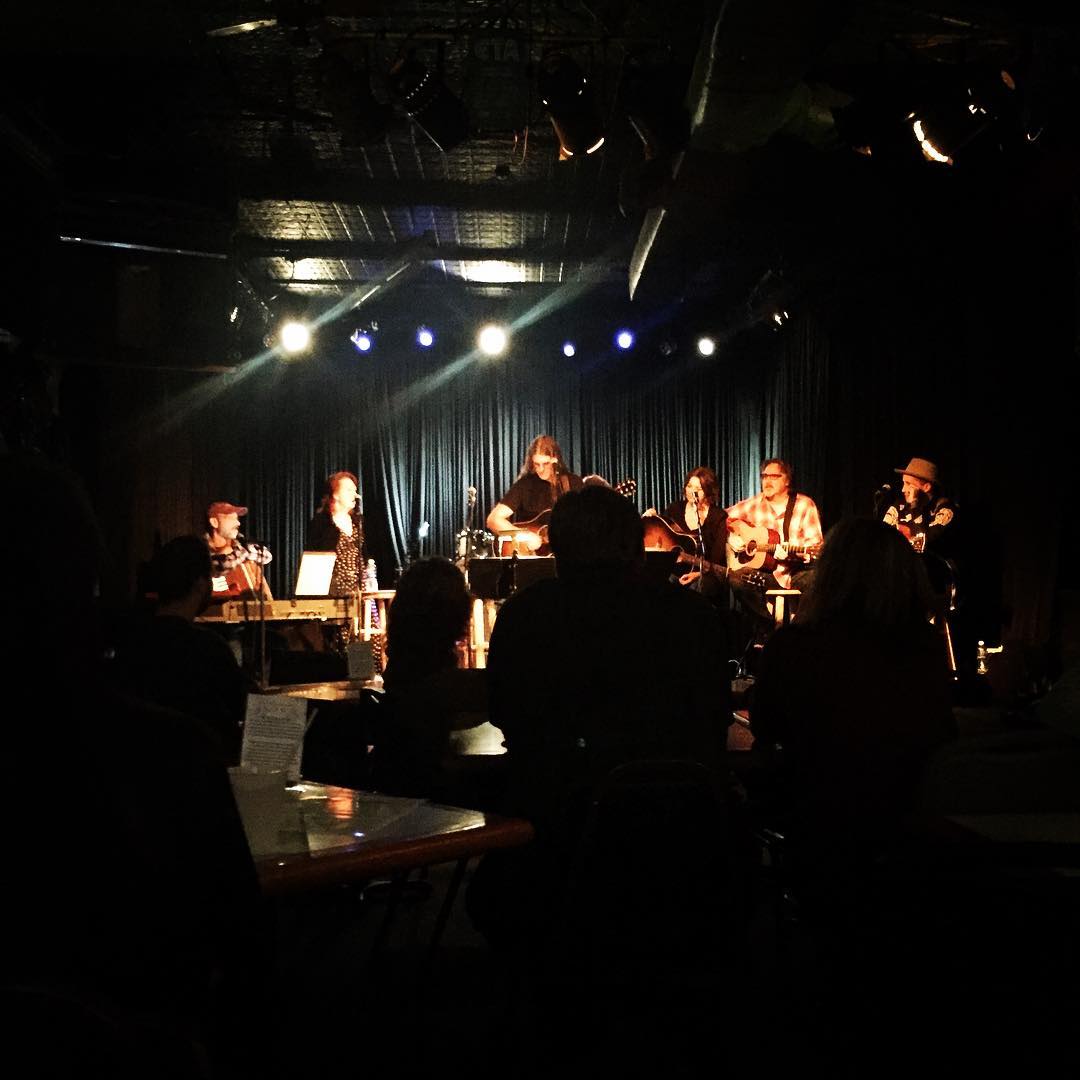
At Douglas Corner Cafe

Music City is apparently the popular kid in class these days due to its unique combination of live music, yummy food, Southern hospitality, and distinctive attractions. The Grand Ole Opry is an experience all by itself. I was told that you never know what you will see at the Opry, and when NFL Hall-of-Famer Terry Bradshaw and NASCAR legend Darrell Waltrip took the stage to sing an Eagles song, I had to admit that I never saw that one coming.

It was good to see several old friends during my recent visit to Nashville like Caleb, Ken, the entire Walker family, and my old buddy, Jon, from Arkansas. Jon is an accomplished musician, and since he wasn’t touring I also had the special opportunity to see him in action at a singer-songwriter night at the Douglas Corner Café (pictured above).  It was great to see these friends, but due to a limited schedule I missed many other friends who now live in Nashville, too.

In fact, it is hard to know who lives there now since lots and lots of folks are moving to Nashville. I went for an early morning run and noticed the new and cramped residential construction and heard somber talk of sharp increases in housing costs and the terrible traffic accompanying such rapid growth. It is the next Atlanta, they say, and if the speaker is really in a bad mood, maybe it is a future L.A.

Nashville is a cool city, but the collective concern is that it might have become so cool that it will inevitably lose its special appeal. It seems that contentment is an elusive virtue, so it is hard to blame anyone. It is the human condition to take something good and then push for more until it isn’t so great anymore.

But personally and ironically, I don’t want to be content with the inability to be content.  Try that one out on your therapist.

Be the Best of Whatever You Are

mlk2

Fifty years ago, and just one year before his assassination, Dr. Martin Luther King, Jr. preached a sermon at the New Covenant Baptist Church in Chicago titled, “The Three Dimensions of a Complete Life.”  Dr. King’s 3D sermon emphasized the height dimension of life (God) along with the length (self) and breadth dimensions (others).  Some of his thoughts about breadth made the entire sermon known as “the street sweeper speech.”  Today, on the holiday that remembers Dr. King, I ask you to remember this:

When I was in Montgomery, I went to a shoe shop quite often, known as the Gordon Shoe Shop. And there was a fellow in there that used to shine my shoes, and it was just an experience to witness this fellow shining my shoes. He would get that rag, you know, and he could bring music out of it. And I said to myself, “This fellow has a Ph.D. in shoe shining.” What I’m saying to you this morning, my friends, even if it falls your lot to be a street sweeper, go on out and sweep streets like Michelangelo painted pictures; sweep streets like Handel and Beethoven composed music; sweep streets like Shakespeare wrote poetry; sweep streets so well that all the host of heaven and earth will have to pause and say, “Here lived a great street sweeper who swept his job well.”

If you can’t be a pine on the top of a hill
be a scrub in the valley,
but be the best little scrub on the side of the hill,
be a bush if you can’t be a tree. 
If you can’t be a highway, just be a trail;
if you can’t be the sun be a star.
It isn’t by size that you win or fail— 
Be the best of whatever you are.

More vs. Enough

In the mid-1980s, despite pedagogical intentions, Coach Watson’s “Global Studies” course introduced me to The Far Side. We checked in on Gary Larson’s strange mind each day as we perused the newspaper for world events (and/or, read the sports page).

Although impossible to pick an all-time favorite, the cartoon featuring a courthouse broadcast where the reporter said something like, “Dramatic testimony against Mr. Pumpkineater was given today by his sister, Jeannie Jeannie Eatszucchini,” always makes me fall on the floor.

But today, for some reason, one of Larson’s anthropomorphic classics came to mind. Mr. and Mrs. Cow are in the living room, and Mr. Cow is in the easy chair with a beer in front of the television. Mrs. Cow is standing in front of the picture window, a fruit platter by her side, a string of pearls around her neck, and bracelets dangling from an arm holding a glass of wine. She looks over her shoulder and says to Mr. Cow, “Wendell…I’m not content.”

Hee-larious. The drawing itself, the absurdity of the scene, and maybe most especially something about a cow named Wendell is so outlandishly clever.

The disturbing part is when I identify with Mrs. Cow.

Once upon a time in a law school paper on Greed titled, “Enough Already,” I shared Dr. Stanley Hauerwas’s one-word definition of the deadly sin of greed—“more”—and juxtaposed that insatiable desire with the idea of “enough.” “More” vs. “Enough.” I’ll give you one guess which one characterizes my mind most often.

“Enough” is elusive, in part because death comes quickly if taken too far, i.e., life demands more air to breathe; more food to eat; more exercise to stay healthy; more money to pay bills; more goals to achieve; and so on and so forth, but the ability to be satisfied, in a given day or a given moment, is important for mental health if nothing else.

And when you are a cow with a glass of wine and a fruit platter, anything less is just ungrateful.