Category Archives: Uncategorized

Mile Markers

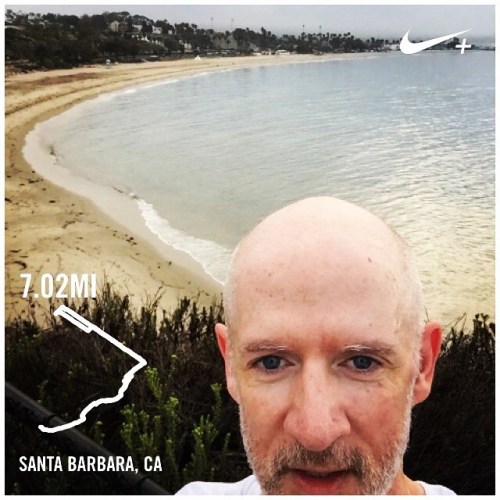
Running Santa Barbara

At Mile One I am running down Santa Barbara’s legendary State Street where local shops intersperse the mega-chains: the “Only in Santa Barbara” souvenir shop sits ironically just past Macy’s.  I stride by Anna’s Taco Kitchen and Whiskey Richards and notice a parking lot attendant semi-successfully attempting to stay awake next to a sign advertising the grand opening of Rusty’s Pizza Parlor, which doesn’t seem to generate much traffic at half past six on a Saturday morning.  Even State Street Coffee is without a customer.

At Mile Two I run by Santa Barbara Harbor and count the marinas down from four to one where sleepy sailboats sit silently like an ocean graveyard of naked flagpoles in the quiet of a new day.  The unmistakable smell of bacon wafts deliciously from the Breakwater Café while busy workers in neon vests pickup Friday night’s trash to make way for the Saturday crowds.

At Mile Three the tourist corridor has receded and I run southwest along the Pacific Ocean, listening only to my labored breathing occasionally punctuated by the squawk of a passing seagull.  Elderly couples who dreamed of retiring on the American Riviera stroll by on carefully manicured and palm tree lined pathways, occasionally  stopping to sit on the park benches facing the ocean where massive ships sit equidistant on the hazy horizon like a real-life game of Battleship.

At Mile Three-point-Five I reach the mid-life crisis of my run.  I am at the end of beautiful Shoreline Park and the beginning of what appears to be a normal residential area, as if residing along the Pacific Ocean in this remarkable city could ever be considered normal.  It is time to turn around.  I will see nothing new from here on.

At Mile Four everything is the same but now seen from a different angle.  The seagull still squawks, and the ships have not moved.

At Mile Five the sailboats are yawning awake, and I am more tired than when I first noticed them as they slept.  I still smell bacon.

At Mile Six the first customer has arrived at State Street Coffee.  The parking lot attendant is now walking laps to stay awake.  I am now running uphill and noticeably perspiring.

At Mile Seven my run is complete.  I see my wife out for a morning walk as I return to the bed and breakfast where we are staying so that I can officiate a wedding this afternoon.  It has been a good run.

My wedding remarks are complete and printed, but I could say all I need to say just from this morning run.  Life is exactly like a good, long run, and a wedding is an important mile marker along the way.  Run well, my friends, and enjoy every step of the journey.
The Invincible Soul

“You may not control all the events that happen to you, but you can decide not to be reduced by them.” – Maya Angelou (Letter to My Daughter, 2009)

With apologies to my wife, I have a crush on Maya Angelou, so when Apple resurrected her inimitable voice reading excerpts from her poem, Human Family, during the opening ceremonies of the Olympics to remind us that “we are more alike, my friends, then we are unalike,” I was happy.  (If you’d like to listen to her read the full poem without the iPhone sales pitch, click HERE.)

I can’t remember my introduction to Angelou, although it was probably her reading of On the Pulse of Morning for the Clinton inauguration in 1993.  What I can remember is that something led me to read I Know Why the Caged Bird Sings, the first of seven autobiographies that is worth it just for the title (although she snagged it from a Paul Laurence Dunbar poem).  But the book itself, my goodness, it sucker punched my heart.  It tells of Angelou’s first seventeen years of life set in Arkansas, St. Louis, and California.  Her story is interesting, sure, but as a white man now with ties to all three areas, it was (and continues to be) heart-wrenching.

If you didn’t know, Angelou’s childhood included being a victim of rape, racism, and sexism, and if that wasn’t enough, abandonment, guilt, and homelessness, all culminating in giving birth to a son at age sixteen.  And then there was the rest of her life, where she experienced fame and prestige as actor and activist, author and poet, composer and director, professor and speaker—among other things.  As the epigraph proclaims, her life is a testament to the idea that it is not required that difficult circumstances diminish your soul.

Or, more poetically stated, though caged, you can always sing.

In 2014, I was thrilled to see that Angelou was scheduled to speak at a Pepperdine event, and with my wife’s blessing, purchased three (expensive) tickets so that I could introduce Maya Angelou to my daughters, too.  Sadly, the event was canceled due to her poor health not long before she passed on from this life.

I thought about crying.

But I chose to sing.

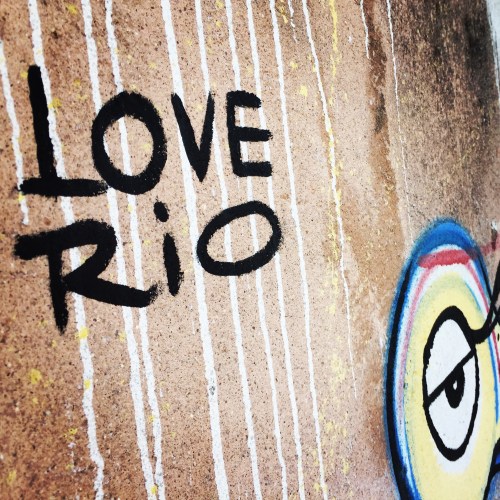
Love for Rio

Love Rio Pic

I love Rio.  Spectacular, natural beauty.  Dazzling, exploding colors.  Lovely, diverse people.  Steady, infectious rhythms.  Seemingly endless energy.

And I love the Olympics.  A global convention of dreamers.  Miracles on ice and dream teams.   Guts and glory.  World records.  Pedestals, wreaths, medals, anthems, and tears.

But Rio plus the Olympics has proven controversial with concerns over pollution, health, violence, political strife, economic recession, and corruption.

So, breathtaking beauty and contagious energy on one hand and social injustice and civil unrest on the other.  Heck, sounds like Rio is the world.  And if the true goal of Olympism is to keep us moving toward a peaceful planet, then why not assemble in a place that exemplifies both the goal and the challenge?

I watched a large chunk of the opening ceremonies but was too old to make it past Liechtenstein in the parade of nations.  Next morning, however, I was curious as to who lit the Olympic cauldron.  NBC told me it was Vanderlai de Lima, and although I’m a sports fan, I needed a little explanation.

De Lima is neither an Olympic champion nor a Brazilian sports legend.  Instead, de Lima competed for Brazil in the marathon at the 2004 Games in Athens and surprisingly led the race at the 22-mile mark.  With just four miles to go, however, a crazy dude jumped out of the crowd and attacked de Lima, pulling him into the crowd.  Although the attack only detained de Lima for several seconds, it threw him off his pace, and eventually, he was overtaken by two other runners and finished with the bronze medal.

What was striking about de Lima, however, was how he finished the race.  No complaints.  No anger.  Instead, he came down the home stretch blowing kisses and pretending to be an airplane, filled with joy.

That spirit is why he was given the great honor of lighting the cauldron to commence the 2016 Games in Rio.  That spirit personifies the Olympic creed that claims, “The important thing in the Olympic Games is not to win but to take part, just as the most important thing in life is not the triumph but the struggle.  The essential thing is not to have conquered but to have fought well.”

Maybe that spirit is what I sensed in Rio last summer, and why I love it so.

150805-vanderlei-de-lima-10

Jeremiah’s Joy

My daughter, Hillary, is in the middle of a summer photojournalism internship in Kenya and recently published her first blog post and set of photographs.  First off, she didn’t have to show up her dad by out-blogging him on the very first post, but what can you do with these millennials?  And second, her photographs are simply stunning.

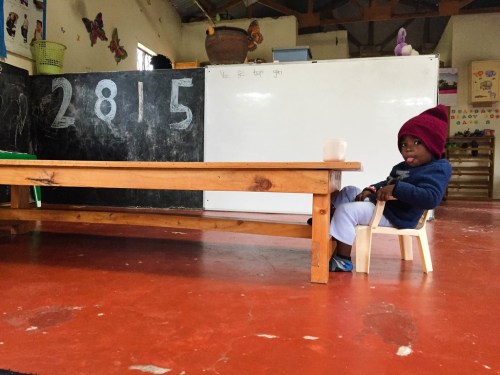
With no actual reason, I immediately set out to narrow the 150 pictures to my favorite one.  This proved impossible.  There are several that feature little kiddos that are just too awesome.  Like, for instance…

MITS 3

But my quest continued, and I succeeded in identifying two photographs that go together in my opinion to tell a powerful story.

As its website explains, “[t]he mission of Made in the Streets is rescuing children from the streets of Nairobi, Kenya, meeting their physical, emotional and spiritual needs, loving them fully, equipping them to earn a living and sending them out to a new life.”  It is a beautiful thing to observe firsthand, and what is full of beauty are the children.

Now don’t be mistaken.  This is not some make-believe world where staff members ride in on unicorns and pick up innocent children off puffy clouds and ride off on rainbows while angels sing.  No, it is messy work, and these children have seen and done and had done to them terrible things.  But what is striking when hanging out with these rescued kids are their good hearts in spite of such a painful past.  Their smiles are contagious.  Their basic human dignity is unmistakable.

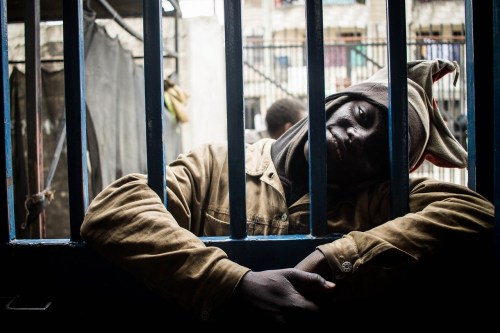
Which is why I narrowed down my daughter’s works of art to two particular photographs.  The first is of a young man still living on the streets, and I love this particular picture because his smile betrays that good heart although he remains in the frightful streets of Nairobi.

MITS 1

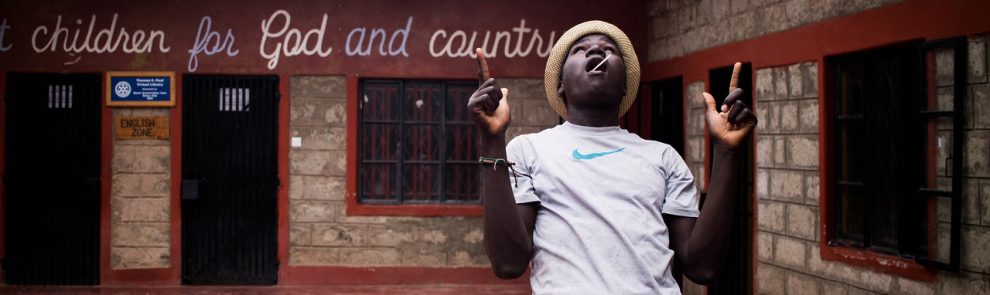
But there is a second picture that in my mind completes the story.  It is Jeremiah, the first student I met on my trip earlier this summer.  Jeremiah is a big boy, close to my height and twenty times stronger.  He could be intimidating, but he is just the opposite—a kind, thoughtful, funny, tender young man.  Jeremiah sits in the front row of his classes and is an eager learner.  He likes to act in drama productions.  He is a good friend to many.

Hillary took a picture of Jeremiah being silly, and I absolutely love it because at one point Jeremiah was that young man in the other photograph, living in abject poverty but with a smile that betrayed his good heart I’m sure.  And the “after” photograph powerfully shows Jeremiah’s joy.

MITS 2

(And, I can’t help but say it given the title of my entire blog, I love that he is looking up.)

On Exploiting Hopelessness

In addition to the steep learning curve associated with a new position at work, I have been preparing to teach a course titled, “Apology, Forgiveness, and Reconciliation,” for the Master of Dispute Resolution program at our West Los Angeles campus.  It is a fascinating and ever-timely topic in this world of ours with no shortage of moving literature, including the book I saved for last, The Sunflower: On the Possibilities and Limits of Forgiveness, by Simon Weisenthal.

Weisenthal survived the Holocaust and gained fame as a “Nazi hunter.”  The Sunflower tells of his being summoned to the bedside of a dying Nazi soldier while a prisoner in a concentration camp where the soldier confessed his deeds and asked for forgiveness.  Weisenthal offered only silence.  Soon afterward, he questioned his response, and in fact, ends his section of the book by placing the reader in his place and posing the heart-wrenching question, “What would I have done?”  The rest of the book shares answers to the penetrating question from fifty-three people around the world, from the Dalai Lama to Desmond Tutu.

Two days after finishing the book, I finally visited the Museum of Tolerance in L.A. and didn’t know whether to be amazed or embarrassed to notice that it was described as “A Simon Weisenthal Center Museum.”  Um, perfect timing?  Although it addresses a variety of topics, the heart of the Museum is the Holocaust Exhibit that guides visitors through the development of Nazi Germany and the terrible atrocities that followed.  It was sadly fascinating to learn that the Nazis began as a few guys sharing burgers in a beer joint, but what struck me most was the statement that this humble beginning grew to such perplexing power to influence fellow citizens to carry out unspeakable acts because they “exploited hopelessness.”

Well, my first inclination was far too easy: Write a blog lamenting how terrible it is to exploit hopelessness and title it, Exude Hopefulness.  But there’s a problem.  Exuding hopefulness is exactly how you exploit hopelessness.  Promise hopeless folks better days ahead.  That’s exactly what the Democrats, Republicans, Libertarians, Greens, and lots of other folks are doing at this very moment.

Hopeless people have to be wary, I guess, but I suspect that wariness is not high on the to-do list of hopeless people.

So, for the sake of the world, I have two thoughts to offer instead.

First, remain hopeful.  You.  Don’t tell others to be hopeful.  You remain hopeful yourself.  Losing hope is too dangerous, and we are susceptible to such terrible things.

Second, remove the reasons others are hopeless.  Actions over words.  Hopelessness is not to be used.  It is to be subverted.  Love people.  Seek justice.  Feed hungry folks.  Give someone a job.  Volunteer your time and your money.

Humanity is both capable of and susceptible to terrible things.  But wow, the possibilities for good are limitless.

Back from the Future

A couple of years ago I took StrengthsFinder 2.0 with our new law students as a part of their orientation.  StrengthsFinder is a test that reveals your greatest strengths, and the idea was to make sure that the new law students knew that they had strong points before law school did its thing and made them question whether they had any value at all.  I enjoyed the test and found it quite useful, but embarrassingly, messed up a bit at the first of the test, which kicked “brainiac” out of contention for one of my top five strengths.  Still, my top three—Discipline, Strategic, and Achiever—seemed spot on.

Recently, I retook the test alongside the entire law school staff and was careful to get it right from the start.  This time, my top three strengths from the first go-around came in as #1, #3, and #5—but #2 and #4 were new and spot on, too!  My second greatest strength, MIA the last time, is Futuristic according to StrengthsFinder.  “People who are especially talented in the Futuristic theme are inspired by the future and what could be.”  Oh yeah.  That’s me.

I have long believed that not only can our greatest strengths be our greatest weaknesses, but in fact they are our greatest weaknesses.  I don’t have to look hard at Futuristic to see how this is true with me—I can be so busy dreaming of the future that I miss out on the present.

A Wendell Berry poem in Given punches me in the gut on this particular point:

The Future

For God’s sake, be done
with this jabber of “a better world.”
What blasphemy! No “futuristic”
twit or child thereof ever
in embodied light will see
a better world than this, though they
foretell inevitably a worse.
Do something! Go cut the weeds
beside the oblivious road. Pick up
the cans and bottles, old tires,
and dead predictions. No future
can be stuffed into this presence
except by being dead. The day is
clear and bright, and overhead
the sun not yet half finished
with his daily praise.

I do think that looking ahead is important, and I value it as a strength, but looking ahead is important so that we see clearly how to act today.  If that element is missing, this supposed strength renders me nothing more than, to quote Berry, “a ‘futuristic’ twit.”

Bar Eve. Or, Don’t Shrink from a Challenge.

[Note: This is a repeat from last year, but purposely so.]

We always opened presents on Christmas Eve. I like Christmas Eve. New Year’s Eve ends with confetti-drenched smooching, and who can argue with that? But Bar Eve—the night before the bar exam—is more of a pain in the hind quarters.

I was abnormally slow to matriculate to law school so the bar exam remains a somewhat fresh wound. I sat for the California version, statistically the hardest in the country, an eighteen-hour torture device spread out over three days that begins tomorrow for many of my good friends.

Truth be told, the exam is the easy part. It is the anticipation, the fear-filled, guilt-infested, never-ending dread that drives a person to inquire about openings with the circus. So Bar Eve is significant, the pinnacle of the real challenge. When the exam begins tomorrow morning, life will actually begin to improve. And when the exam ends on Thursday afternoon, delirious excitement abounds, although the emphasis is on delirious.

To riff the old Tony Campolo sermon, it’s Bar Eve, but Thursday’s a-comin’.

Accounting for the delirium, I prize two important memories from that Thursday afternoon when I emerged from the Pasadena Convention Center (sidebar: we pronounce it PASS-adena for the good vibes; thankfully, we didn’t sit for the exam in FAIL-adelphia).

Memory #1: I sincerely thought there should have been a parade for us. I mean it. It was a strong feeling that, regardless of how we did on the exam, the simple fact that we endured that hell of a summer and survived the three-day exam called for a parade. We were heroes.

Memory #2: Driving home, stuck in traffic on the 101 and not caring about traffic for the first time ever, I knew what I wanted to say when I arrived home. My youngest daughter was in eighth grade at the time and had declared to my hearty approval while observing the bar summer that she would never go to law school. But on the drive home, I knew what I had to tell her. When I made it, after the hugs and kisses, I mustered all the seriousness in me to communicate what I hoped she would receive as one of those few life lessons that you just cannot miss: Never run away from a challenge simply because it looks daunting.

I could not say such a thing until that Thursday afternoon, but I never felt any life lesson more strongly than I did at that moment. On this Bar Eve, I hope my hero friends will finish strong and experience that same sense of accomplishment.

To Race or Not to Race: That Is the Question

I am competitive.  It’s not like I hip check small children to get ahead of them in line or anything.  I prefer creating distractions so they don’t notice.

On one hand, I treasure my competitive nature.  It motivates me to get out bed each day and leads to achievements otherwise beyond imagination.  But on the other hand, it drives me a little wackadoodle.  Sometimes, staying in bed would be a nice change of pace.

My ongoing affair with running is a prime example.  After a twenty-plus year break, I started running again in 2010 and in the past six years have completed four half-marathons and a variety of shorter races—and it has been awesome.  I love the thrill of the big race where all sorts of humanity gather on a weekend morning for a good cause, and I love the battle within myself to see if the long hours of training can produce a new PR (“personal record”).

But training for those races tends to make me a little nutty.  I do, mostly, enjoy those training runs, watching my times, seeing improvement, envisioning the big race, and counting down the days, but it has a tendency to become an obsession, which is a nicer way of saying that I become a little like Yosemite Sam but only in a bad mood.  And that’s no fun.

Recently, I have enjoyed running with friends all over the map—from Paul in Kenya to Dodie and Rusty in Arkansas to all sorts of friends in California.  With no race on the calendar, I simply enjoyed the company and stories and scenery without worrying about times or mileage or anything.  And yet, signing up for a race calls me like a siren.

I’ll do it.  I know I will.  And on certain days I will regret it, most notably on race day when my lungs are burning and I open up negotiations with God.  But when it’s over, and I inhale that intoxicating sensation of accomplishment, I will be glad.

This Old House

I realize that “old” is a state of mind and not a specific age.  I also realize that old is often my state of mind.  Some circumstances are less than helpful.  My parents are gone.  My sisters are grandparents.  My children are adults.  My hair color is Caucasian, and my beard is gray.  I am blind in one eye and increasingly cannot see out of the other.  I thought Pokemon GO was a statement granting a Jamaican proctologist permission to proceed.

But contrary to popular opinion, old isn’t necessarily bad.

If all went as planned, this post will publish as I fly back to California after a family visit in Arkansas.  It had been a couple of years since I visited, and it was good to go “home” for a few days, even though Arkansas has not really been home for nearly two decades.  On these increasingly sporadic trips, I always make a point to see the little place on West Mueller Street that I called home for the first couple of decades of my life.  My parents rented the tiny house for sixty dollars a month until I was in high school, and I still remember the day that the landlord increased the rent to ninety and my dad went apoplectic.  He took it as a personal insult given the thoughtful care he donated to the place.

The little house went downhill after the Sturgeon family moved out sometime around 1990, and it always made me sad to see its deteriorating condition.  An overgrown yard.  Broken down cars.  Peeling siding.  In particular, I would always look to see if the basketball goal my dad mounted on the roof of the garage was still there, and amazingly, year after year, it held on.  A couple of years ago, it appeared to be holding on by a thread, dangling from the plywood backboard looking more like a lone gymnastic ring than a basketball goal, but it was still there.

I won many dramatic NCAA and NBA championships on that goal, and I couldn’t tell you how many beautiful cheerleaders fell in love with me in my imagination given my astounding heroic feats on that cracked, cement driveway.  My dad often sat on the porch silently just watching me play.

Well, it finally happened.  The goal is gone now after a good run of forty years or so.  And it made me feel a little older.

But you know, in a sense, even without that old basketball hoop, I still feel like my dad is sitting on the porch watching me, and that provides great comfort.  And, in another sense, I get to take his place on the porch and watch my children live out their dreams in this life, and since he was my first hero, taking his seat is a pretty great thing to do.

Yes, contrary to popular opinion, old isn’t necessarily bad.

Everyday People

I have often wondered what it would have been like to be an adult in the 1960s, what with the crazy headlines of war, protests, riots, assassinations, and struggles for civil rights.  Half a century later, my imagination doesn’t have to work very hard.

In 1968, Sly and the Family Stone released the song “Everyday People” as a call for peace.  Recently, the great organization, Playing for Change, released a timely rendition of the classic song featuring celebrities and school children.

Today, I share it with hope, and for hope.  Hope that I somehow correctly embedded the video so that it shows up on the blog and in the automatic emails, but more importantly, hope that we might learn to live together.  “And so on and so on and scooby dooby doo.”