Category Archives: Uncategorized

On the Eve of an Historic Election

As my limited gambling history demonstrates, my best guesses are nowhere close to reliable. But on the eve of what promises to be an historic presidential election, I have what I can only describe as a sense of foreboding. Things could get ugly, as if the campaign wasn’t ugly enough.

If the election is as close as it appears, we may not know the outcome anytime soon, but that doesn’t prevent a little personal nostalgia. I recall a sense of foreboding the day before an unprecedented hurricane crashed through my community, and on that occasion I sent a mass email to let everyone know our plans in case things went badly. Apples and oranges, I know, but a similar feeling resurfaces today, as silly as that sounds.

I anticipate significant acts of violence should Donald Trump “not” be elected president again. I hope that such violence does not occur, but, you know, history. And I anticipate a very different but even greater set of dire consequences if he wins. That’s because, among other things, many of his former military commanders have spoken in no uncertain terms.

So again, pardon the PTSD, but I feel this strange desire to board up some windows and prepare for dangerous winds and waves.

While I have leaned Left for many years now, my concern regards Donald Trump the candidate and not the Political Right. I used to say that the winner of the presidential election didn’t matter nearly as much as we are expected to believe because winners tended to “govern toward the middle” in our clunky two-party system, but I don’t say that this time.

And my thoughts are further complicated because I understand a portion of the Trump appeal to those who for decades of their lives felt the sting of disdain from various types of “elite.” I don’t want to dismiss painful emotions and experiences.

But that we have come to the absurdity of yet another Donald Trump candidacy mostly makes me sad. As just one dramatic example, while Sean “Diddy” Combs understandably sits in prison as evidence of sexual assault mounts against him, Donald Trump expects to be the next president of the United States despite, well, everything. And if I had to bet a nickel, I’d bet that he wins.

I attended a panel discussion recently on the impending election, and one of the panelists said that the outcome of the election will say more about the American people than about the campaigns themselves. That seems about right, and I think that may do more to describe my sense of foreboding than anything else. 

Vote bravely and wisely, everyone, and then batten down the hatches. 

Thoughts as I Watch It Rain

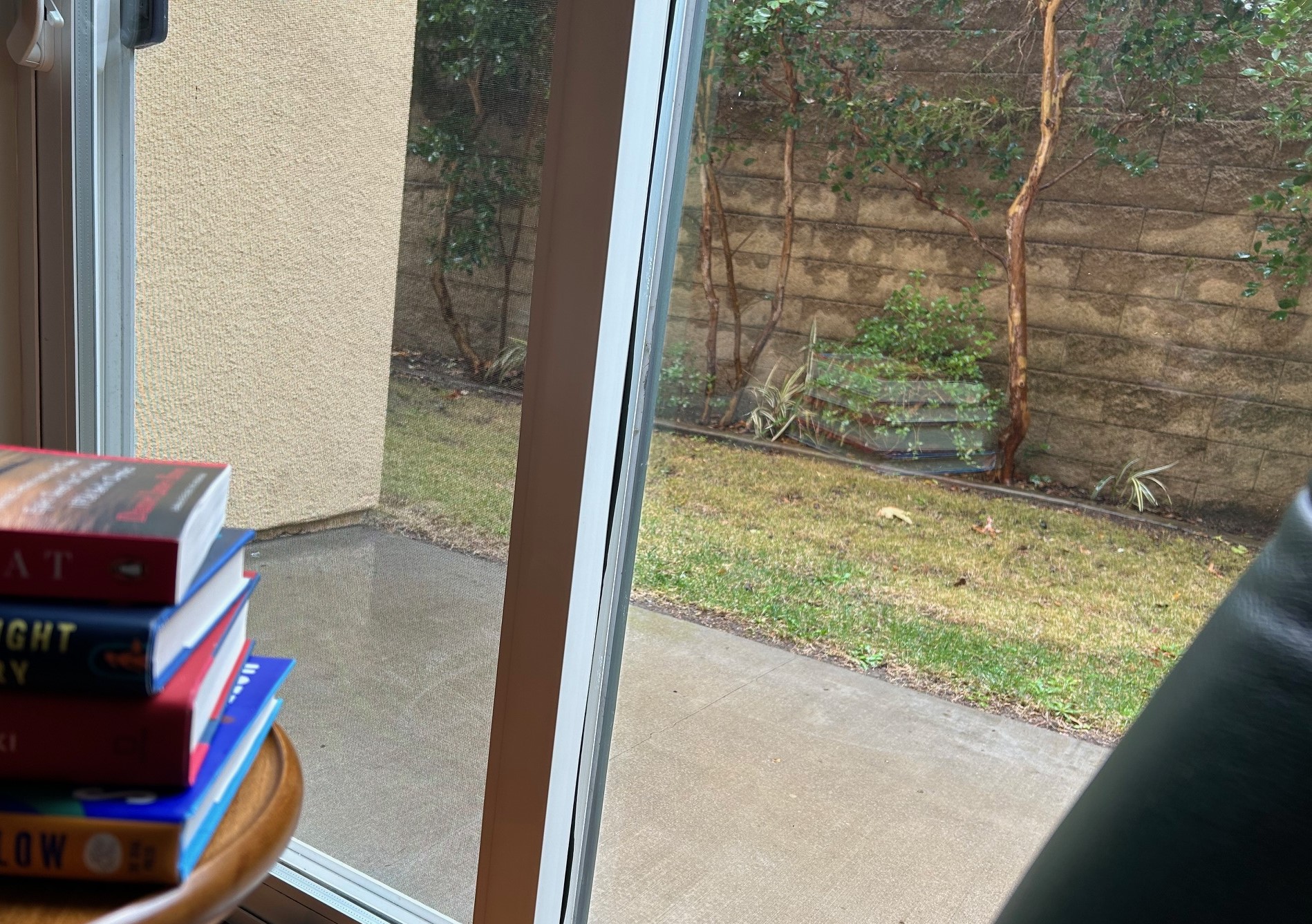
It doesn’t rain often in Southern California,
but when it does it’s a pretty big deal.
Headlines appear,
roads shimmer,
cars spin,
mud slides,
and people tend to lose their ever-loving minds.

The playoffs are rare in Detroit City,
but when in town it’s a pretty big deal.
Jerseys appear,
tickets inflate,
excitement builds,
parties proliferate,
and people tend to lose their ever-loving minds.

Not many people win the lottery,
but when they do it’s a pretty big deal.
Relatives appear,
interviews occur,
purchases transpire,
plans change,
and people tend to lose their ever-loving minds.

A hole-in-one can seem impossible,
but when it happens it’s a pretty big deal.
Astonishment appears,
laughter erupts,
joy abounds,
celebrations begin,
and people tend to lose their ever-loving minds.

I think of all the things that I haven’t done—yet.
They may seem impossible,
but if they ever happen, it will be a pretty big deal.

And that’s enough to keep trying.

Obstacles appear,
critics scoff,
fear mounts,
hope wanes,
and I want to lose my ever-loving mind.

But I won’t quit.
The wait just might make it better.

I Must Write

Joan Didion in Malibu in 1976

Among the cardboard boxes and mental/emotional somersaults that come with moving, three things happened. First, a distant friend commented on a Facebook post that decades later he still remembered one of the first essays I had ever shared. Seed planted. Then, a week later, a much-newer Illinois friend said that I ought to start a blog and share my thoughts from time to time. It struck me, of course, that a current friend would have no reason to know that I had started a thousand blogs. Friends made in our first three ports of call (Arkansas, Mississippi, and California) would list blogging as one of my primary characteristics, but friends made in Tennessee and now Illinois have no reason to make that association.

Finally, last night, we watched a Netflix documentary on the life of Joan Didion. I felt the fire kindling in my soul from the first frame, but when her friend said that she thought Joan wrote to understand her own thoughts and feelings, the words glared in my mind like a neon sign: I must write. Again.

When I think of myself as a writer, I am thinking of the short, observational life essays that I shared primarily during two life stretches: when I shared “a daily thought” religiously (using both meanings of the word religiously) for the ten years we lived in Mississippi, and when I started the blog, “starting to look up,” in 2015 while living in Malibu. Sure, I put together a couple of books, along with trying out other forms of writing like short stories and poetry, but when I heard the suggestion that Joan Didion wrote to understand what she thought and felt, I knew that was what I was doing when I blogged.

So, here we go again.

I have many, many friends all over the world now thanks to our rolling stone lifestyle, and I would be honored if any of them followed along by subscribing or simply catching the occasional Facebook share, but to be candid, and with all due respect, last night’s documentary convinced me that I need to write and why I need to write, and I do it for me.    

A Major Move

Jody and I have lived in The South and on both the Gulf Coast and West Coast, but in March we are relocating to a new region of the country—the Midwest—because I have recently accepted the role as Vice President of Diverse and Equitable Student Life, Dean of Students, and Title IX Coordinator at Blackburn College in Carlinville, Illinois.

We are very excited, but the move is bittersweet—sweetness from the deep confirmation that this is the exact right move for us, and the bitterness of leaving behind people at Lipscomb and in Nashville who in just two years loved us so well and captured our hearts, including friends, colleagues, and maybe especially, students.

Years ago, when Jody served on the board of the National Student Employment Association, she attended a conference at Berea College. Afterward, she could not stop talking about the idea of a “work college,” and as I listened, I fell in love with the work college concept, too. We actually said back then how amazing it would be if either of us ever had the opportunity to work in such a place.

Well, as you might surmise, Blackburn College is one of just a handful of work colleges in the United States, and in fact, the only one that is managed by students. Its unique arrangement promotes a cost structure that allows many of its students the opportunity to receive a college education, which reflects one of our deepest values.

When news of our transition emerged in the past few days, I thought people would not understand our decision. I was prepared to quote Parker Palmer, “Vocation at its deepest level says, ‘This is something I can’t not do, for reasons I’m unable to explain to anyone else and don’t fully understand myself but that are nonetheless compelling.’” And yet, those who know us best said they completely understood. Even many who don’t know us best knew us well enough to say the same. I found that most reassuring.

So that is our major news.

I doubt many of your post-pandemic travel plans route directly through Carlinville, Illinois, but if they ever do, please let us know. In the meanwhile, I will do my best to share glimpses of our new small-town life from time to time.

2020 = 40?

I’m not sure if the fond posture of Auld Lang Syne is the appropriate selection to drop kick 2020 out the door this evening, but there were undoubtedly silver linings somewhere in the dark clouds of the past year. Personally, I made a break from an unhealthy Facebook/Instagram obsession and like myself better this way. I also broke a positive weekly blogging habit but am excited to now be silently scheming to write short stories. And for the first time ever I followed through on my perpetual intention to read as much fiction as I read nonfiction. In fact, my 20/20 for 2020 was reading 40 books this year — 20 fiction, and 20 nonfiction (I typically read 25 books largely tilted toward nonfiction).

If I had to pick a personal book of the year, I would go with The Autobiography of Miss Jane Pittman, although the little Parker Palmer book might end up having the most enduring influence on my life. Regardless, here is my list for 2020 — many I loved, many were interesting, and a few were endured — and I will keep that categorization to myself (but full disclosure: the few that were written by friends were truly outstanding!).

NONFICTION:

  1. The Scotch-Irish: A Social History by James G. Leyburn (history) – 334 pages
  2. Jesus and the Disinherited by Howard Thurman (theology) – 112 pages
  3. Crying in the Wilderness: The Life & Influence of David Lipscomb by Robert E. Hooper (biography) – 280 pages
  4. Jesus Next Door by Dave Clayton (religion) – 133 pages
  5. Why Churches Need to Talk about Sexuality by Mark Wingfield (theology) – 176 pages
  6. Necessary Endings by Henry Cloud (leadership) – 230 pages
  7. Scandalous Witness: A Little Political Manifesto for Christians by Lee Camp (theology) – 177 pages
  8. Race Against Time by Jerry Mitchell (biography, true crime) – 386 pages
  9. Heaven is a Playground by Rick Telander (sports) – 220 pages
  10. The How of Happiness by Sonja Lyubomirsky (psychology) – 311 pages
  11. Centennial Celebration: A Century of Memories: David Lipscomb University, 1891-1991 by Robert Hooper & David England (history) – 195 pages
  12. 7 Men by Eric Metaxas (biography) – 191 pages
  13. The Games: A Global History of the Olympics by David Goldblatt (history/sports) – 446 pages
  14. The Motive by Patrick Lencioni (leadership/business) – 174 pages
  15. Let Your Life Speak: Listening for the Voice of Vocation by Parker Palmer (leadership) – 116 pages
  16. Student Services: A Handbook for the Profession by Susan R. Komives; Dudley B. Woodard, Jr. & Associates (education) – 684 pages  
  17. Things That Make White People Uncomfortable by Michael Bennett (social science) – 250 pages
  18. Hood’s Tennessee Campaign by James Knight (history) – 142 pages
  19. The Education of a Coach by David Halberstam (sports) – 283 pages
  20. Caste by Isabel Wilkerson (social science) – 395 pages

FICTION:

  1. The Call of the Wild by Jack London – 122 pages
  2. The Little Prince by Antoine de Saint Exupery – 113 pages
  3. Their Eyes Were Watching God by Zora Neale Hurston – 205 pages
  4. Haven by Jeff Baker – 146 pages
  5. On the Road by Jack Kerouac – 307 pages
  6. The Glad River by Will D. Campbell – 310 pages
  7. Some of Your Blood by Theodore Sturgeon – 192 pages
  8. Lord of the Flies by William Golding – 206 pages
  9. Nashville 1864 by Madison Jones – 129 pages
  10. The Autobiography of Miss Jane Pittman by Ernest Gaines – 259 pages
  11. The Dog of the South by Charles Portis – 266 pages
  12. The Catcher in the Rye by J.D. Salinger – 214 pages
  13. Don’t Tell Me You’re Afraid: A Novel by Giuseppe Catozzella – 250 pages
  14. Disappearing Earth by Julia Phillips – 256 pages
  15. The House on Mango Street by Sandra Cisneros – 110 pages
  16. If I Had Two Wings: Stories by Randall Kenan – 211 pages
  17. A Gathering of Old Men by Ernest Gaines – 213 pages
  18. Not Without Laughter by Langston Hughes – 231 pages
  19. Siddhartha by Herman Hesse – 128 pages
  20. 50 Great Short Stories, edited by Milton Crane – 560 pages

Social Media Distancing

Social-media-phoneMy recent time away was beneficial, and of the many thoughts that came to mind once I had an opportunity to think again was that I should find some way to disembark the social media train at the next station. It was a relief just to think it.
For years now I have harbored a secret fantasy of going off the grid and living a simple life in relative obscurity, and I’m pretty sure that fantasy is fueled by the complications produced by the time I have invested in social media. I’m not exactly sure what possessed a private person to lead a fairly public life, but I am pretty sure that it was not the smartest idea.

I had already dipped my toe in the water just a tiny bit. When the pandemic hit I upped my social media game and tried to post more content, telling myself that I was encouraging others. But when the deeply important racism conversation erupted—a conversation that I care about very much—I was soon exhausted and, to be candid, frustrated at rhetoric from a wide range of people that I love who vote differently from one another. So I shared less and less, and I wanted to see what others shared less and less, and I cared about social media less and less. So stepping away is no great sacrifice. It is more a move to maintain some measure of sanity.

And I get the irony that I am sharing this post on various forms of social media. Given my history, I felt it was kind to provide some type of notice.

There are positive attributes of social media, of course, which explains its ability to take over the world. But of the downsides, the most troubling may be the invitation to social comparison that has led to what Jonathan Haidt argues as the “decline of wisdom.” (Note: Haidt wrote “The Dark Psychology of Social Networks” in the December 2019 issue of The Atlantic—just before this crazy year began.) I kept trying to convince myself that I was aware of and immune to social media dangers, but I now confess that I was wrong.

This will be a work in progress, so the following is subject to change:

  1. I don’t plan to delete my Facebook or Instagram accounts (i.e., my primary drinks of choice), but I do plan to stop both posting and scrolling. Instead, I will simply use them as some sort of 21st century phone book and respond to messages.
  2. I don’t plan to stop my blog entirely, but I do plan to stop posting on a schedule, and I do plan to stop sharing my blog posts on Facebook. I will write and post when the feeling strikes and not worry about who sees what I write (for those who want to read what I write, you can sign up by email to receive the posts when they happen).
  3. Finally, I think I will keep sharing my running information with running friends on Nike Run Club and Strava as a little virtual running club, but if that ever turns into me trying to impress others, I’m out there, too.

That’s the plan for now. It is interesting how just the plan provides genuine stress relief.

“Social distancing” is the phrase of the year, of course, but I am employing “social media distancing.” If that catches on, trends, goes viral, or gets an incredible number of likes or retweets…well, to tell the truth, I don’t need to know.

Before & After

just mercy movie poster

Four years ago I posted about a powerful book and the opportunity to hear its author speak. The book was Just Mercy by Bryan Stevenson, and four years later I have never fully recovered. When I learned that a feature film based on the book would hit the box office, I made sure to be there opening night to soak it in. Like the book and the real life it represents, the movie is disturbing, emotional, and inspirational.

But it is this special day to remember Rev. King that has me thinking about Bryan Stevenson today. Stevenson has often been interviewed about King, been given awards named after King, and even been described as one whose work best embodies King’s legacy. Although we remember King today, examples like Stevenson remind us that his famous dream is still very much alive.

And then there is the other side of the MLK equation that is represented by Howard Thurman, the “before” to Stevenson’s “after.”

Howard Thurman was a classmate of Rev. King’s father and has been described as one who had a “profound influence” on his classmate’s famous son. Legend has it that King carried a copy of Thurman’s book, Jesus and the Disinherited, in his pocket during the trying days of the bus boycott in Montgomery (the city where Stevenson would later center his work).

I recently received a copy of Thurman’s important book and was stunned to consider his observation that Christianity appeared “as a technique of survival for the oppressed.” Thurman continued, “That it became, through the intervening years, a religion of the powerful and the dominant, used sometimes as an instrument of oppression, must not tempt us into believing that it was thus in the mind and life of Jesus.”

It is difficult for me even to imagine Christianity NOT as a religion of the powerful, much less consider that its entire presentation—the very idea of “salvation”—was a path to survival to Jesus’ original audience. But it wasn’t too difficult for Thurman to imagine. Or King. Or Stevenson. Considering their writings and speeches helps me read the Bible with fresh eyes.

Today our nation rightfully remembers Martin Luther King, Jr. I am also remembering the before and the after and considering what changes that demands of me.

All Good Things

As I rise each morning and retire at night, an unread book sits peacefully on the nightstand, white letters on a bright blue screaming its title in all caps: NECESSARY ENDINGS. My new friend Matt shared it with me, and I only have a general idea of what it has to teach me, but it sure seems appropriate.
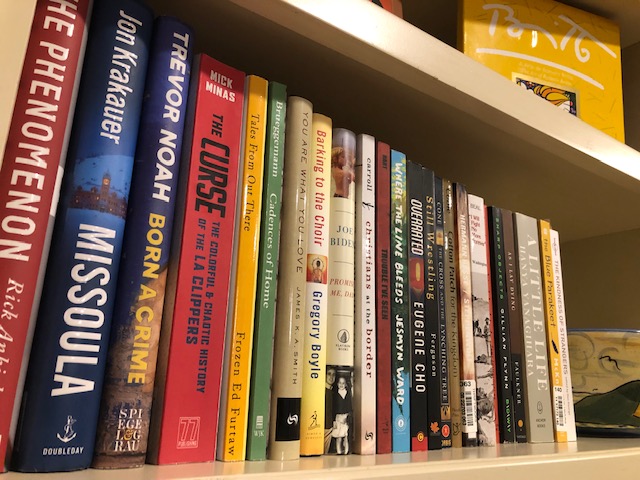
This has been quite a year for the ol’ family. Our cross-country move required saying goodbye to a special time in our lives. And then a few weeks ago our oldest daughter received her hard-earned credential to launch a new career teaching deaf and hard-of-hearing children—and that required saying goodbye to a community that loved and supported her, too. And a few days from now, our youngest daughter will hit the road toward San Antonio for a new adventure following her recent graduation from an incredible college experience in Seattle. In reverse chronological order, from oldest to youngest, each of our transitions necessarily involved an ending.

My wife and I smoothly shifted gears into Empty Nest four years ago, but I’m not sure what you call this new place where our children are full-fledged adults, out of college, not really children anymore. It struck me sitting among the masses at the Washington State Convention Center this past weekend that although these two remarkable young women we have tried so hard not to screw up still need us in certain ways, in certain other and very important ways, they do not. They are good, strong, capable human beings. In one specific way—raising self-sufficient humans—our work has ended, and necessarily so.

I confess a twinge of sadness as I sat there in that cavernous convention center and thought of such things, but there were other emotions in this mixed-up heart of mine. There was happiness. Relief. And pride. Oh yes, pride. A deep, full, exploding pride for those two amazing people—our sweet Erica and Hillary.

I hear that all good things must come to an end. It turns out that I’m okay with that after all. It is like that satisfying last page of a long, delicious novel, followed by slowly closing the book and sitting there in that pleasant pause full of reflection and relief—before the anticipation of what comes next.

Personal Book Awards for 2018

IMG_2891

“The more that you read, the more things you will know. The more that you learn, the more places you’ll go.” – Dr. Seuss

One year ago I shared the following: “I counted twenty-five books that I read in 2017, which is easily the most I have read in a very long time, and predictably more than I will read in 2018.” Well, here stands yet another reason not to pursue professional gambling: Last week I completed my twenty-fifth book in 2018. That’s over 7,000 pages this year, my friends. The total number of books is the same, but there was greater variety in the genres chosen and I’m pleased to see more fiction on the list: I always intend a 50/50 split but never even come close. This year was at least a step in the right direction.

Books written by friends are always favorites, of course, and I was honored to read Les Ferguson’s book, “Still Wrestling,” this year. Of the rest, I would bestow the following four awards:

HARDEST BOOK TO READ THAT I’M GLAD I READ: The Cross and the Lynching Tree by James Cone (referred by Ray Carr)

HARDEST BOOK TO READ THAT I’M GLAD I READ BUT WOULDN’T RECOMMEND AND NOT BECAUSE IT IS 834 PAGES LONG: A Little Life by Hanya Yanagihara (referred by a former student)

BEST COMBINATION OF HUMOR & INSPIRATION: Born a Crime by Trevor Noah (referred by my wife and a gift from my oldest daughter)

BEST GUILTY PLEASURE READ: Sharp Objects by Gillian Flynn (referred by Chris Doran)

But awards aside, I am glad that I read every book. Well, maybe one exception, but I’ll keep that to myself. 🙂 Here is my full list for 2018:

Books written by friends (1 this year; 6 last year)
Still Wrestling by Les Ferguson, Jr. (208 pages)

Novels (6 this year; 3 last year)
One Hundred Years of Solitude by Gabriel Garcia Marquez (417 pages)
As I Lay Dying by William Faulkner (267 pages)
A Little Life by Hanya Yanagihara (834 pages)
Steppenwolf by Hermann Hesse (237 pages)
Where the Line Bleeds by Jesmyn Ward (230 pages)
Sharp Objects by Gillian Flynn (254 pages)

Sports (3 this year; 3 last year)
Tales from Out There by Frozen Ed Furtaw (224 pages)
The Phenomenon by Rick Ankiel & Tim Brown (304 pages)
The Curse: The Colorful & Chaotic History of the LA Clippers by Mick Minas (558 pages)

History (1 this year; 1 last year)
I Will Fight No More Forever: Chief Joseph and the Nez Perce War by Merrill Beal (384 pages)

Biography/Memoir (3 this year; 5 last year)
Born a Crime by Trevor Noah (261 pages)
Promise Me, Dad by Joe Biden (210 pages)
Cotton Patch for the Kingdom by Ann Louise Coble (240 pages)

Theology/Church (8 this year; 6 last year)
Cadences of Home: Preaching among Exiles by Walter Brueggemann (176 pages)
Overrated by Eugene Cho (240 pages)
Barking to the Choir by Gregory Boyle (224 pages)
Trouble I’ve Seen by Drew G.I. Hart (198 pages)
The Blue Parakeet by Scot McKnight (240 pages)
The Cross and the Lynching Tree by James Cone (224 pages)
Christians at the Border by M. Daniel Carroll R. (176 pages)
You are What You Love by James K.A. Smith (224 pages)

Poetry/Essays (1 this year; 1 last year)
The Kindness of Strangers – edited by Don George (272 pages)

Writing (1 this year; 0 last year)
Bird by Bird by Anne Lamott (re-read) (272 pages)

Crime (1 this year; 0 last year)
Missoula: Rape and the Justice System in a College Town by Jon Krakauer (384 pages)

The View from Above

IMG_2777My daughter and I decided to hike the scorched hills behind our house on Thanksgiving Eve to get a firsthand look at the aftermath of the Woolsey Fire, and we witnessed the vast expanse of earth charred to smoldering nothingness. It was breathtaking, and I’m not even talking about air quality. Imagine strolling through a gigantic ashtray with a spectacular mountain view of the sun dropping into the Pacific Ocean and that pretty much captures the scene.

It had been an indescribable couple of weeks with one difficult to comprehend event stacked on top of another. Our daughter had not planned to visit for Thanksgiving, but the dramatic events at home led to a change of plans. That we were there together, standing on a mountain with a spectacular ocean view, surveying such immense devastation just steps above our house was more than a little surreal.

Standing there I realized on Thanksgiving Eve that I had much for which to be thankful. Friends and family. Life and love. Work and community. Health and safety. Even that moment. An unforgettable moment.

We walked back off of the mountain and returned home with that slight feeling of exhilaration that comes when you realize that you have just witnessed something special.

Later, looking out at that mountain ridge that from our window is the color of dark-roasted coffee grounds, it dawned on me that things look very different from the top of the mountain than they do just a few steps down here below. The perspective changes everything.

Sometimes it is a pretty comforting thing to realize that somewhere up above things look significantly different.