After a hundred years of life and a week’s worth of funeral activities, President Jimmy Carter’s remains will finally be laid to rest in his Georgia hometown this evening. Many memories have been shared by many people, so I might as well add mine, too.
I was six years old when Governor Carter was elected President Carter in 1976, marking the first presidential election that I remember, but my childhood memories related to him are few and scattered, including peanut jokes, gas no longer thirty cents a gallon, and wearing yellow ribbons for the hostages. Twenty years later, however, he changed my life for good.
As a young adult wrestling with my Christian faith in the early 1990s, I became convinced that Jesus’s primary news was that all people matter to God and that God’s business is setting right what has gone wrong in the world for all people, particularly the poor and marginalized. And as I wrestled to reconcile that belief with what appeared to be a different primary business of organized churches, my new wife and I soon found personal meaning by moving into a home serving children who were abused, neglected, or troubled.
While there, sometime in 1996, I read a U.S. News & World Report interview with President Carter about his new book, “Living Faith.” In the interview, President Carter shared that his home church once wanted to do something nice for a poor family at Thanksgiving, but they had one problem: Nobody knew a poor family. So, undeterred, they approached the local social services office to get the name of a poor family that they could approach. It occurred to President Carter that something was very wrong with that picture, i.e., a church having to go to the government to find the poor families.
That observation cut straight to my heart.
I must have spoken about that article in the weeks that followed because my mother bought “Living Faith” for me that Christmas, which turned out to be one of the most important gifts of my life. As I devoured the book, I read the chapter titled, “Faith in Action,” and discovered Habitat for Humanity. As I read about the organization’s mission to alleviate poverty housing, it struck me that my hometown, Paragould, Arkansas, an all-white sundown town with railroad tracks that segregated the community even further along socioeconomic lines, could really use Habitat for Humanity.
This changed my life forever.
I set out to establish a Habitat for Humanity affiliate in my hometown in early 1997, only to discover that the national organization required new affiliates to be diverse and a representation of the entire community, which challenged my heretofore wholly homogenous life. And as a result, I soon learned that so many people representing labels that I had been taught were bad or lost or wrong were in reality good and found and right, at least as much as my folks were, and often more so.
This has been the great lesson of my life, and I have been joyfully benefiting from its reality for the past three decades as we have lived all over these United States, traveled all over this planet, and befriended so many people that I can no longer even imagine that labels are dependable.
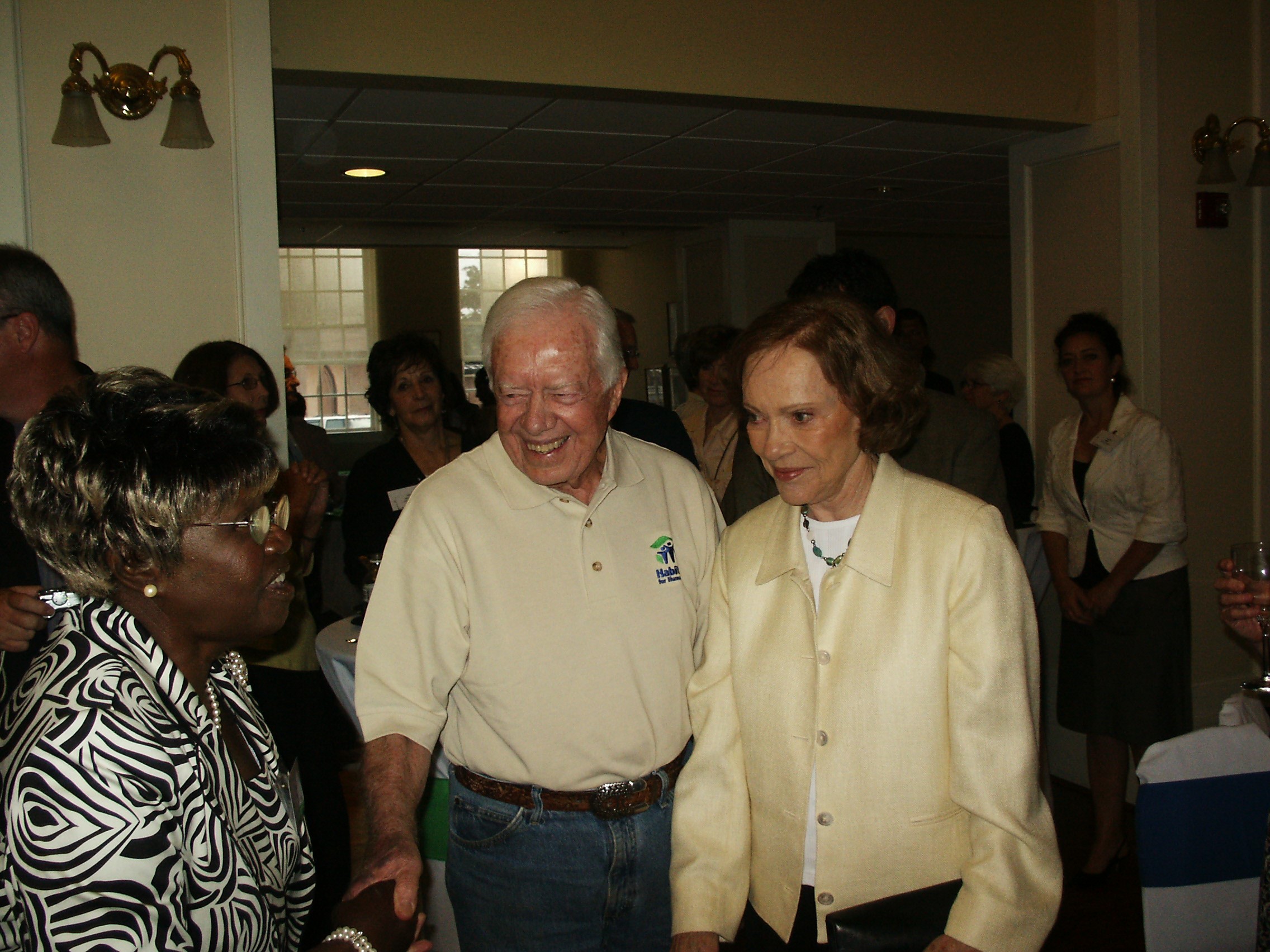
I never introduced myself to President Carter, although the picture above shows how close I came when another Habitat for Humanity affiliate that I helped establish hosted the Jimmy & Rosalynn Carter Work Project in 2008 to address the devastation wrought by Hurricane Katrina. As a board member, I was honored to attend a VIP event that evening and see the Carters up close, but it never worked out to shake his hand and say thank you.
That’s okay. But I will say it today on the day that President Carter’s remains are finally laid to rest in his Georgia hometown after a hundred years and a week’s worth of funeral activities.
Thank you, Mr. President. You changed my life for good, and I am forever grateful.


 Starting to Look Up