I could not have told you that the song was titled, Tubthumping, nor did I know that the band was Chumbawamba, but as all good earworm songs do, if you simply say the phrase, “I get knocked down,” then by pure instinct I will start singing, “But I get up again / You’re never gonna keep me down.” And I will sing those three phrases over and over and over for days on end.
I watched America’s Funniest Home Videos last night, a show that has made good use of that particular tune on several occasions, and a child said the sentence “I get knocked down, but I get up again” into the microphone at an elementary school performance and then promptly walked back to the risers and tripped on the first step and face planted. (Yes, she got up again.)
Timing is everything.
Timing is everything with me as well. Early yesterday morning, I had a moment. I had decided that I would do my weekend run at the Green Lake Conference Center, a spectacular property featuring 900 acres of unspoiled beauty, and with a recent snow and ice storm I surmised that it might be particularly beautiful right now. And it was. It was also really cold, a wind chill of negative one to be exact, but that hasn’t stopped me from running just yet.
The main roads were mostly clear when I began my run, and the main roads were the path that I chose for the first mile. But I really wanted to get to a particular place in the woods where you can climb a small tower for breathtaking views of the lake, and I determined that the path to said tower was up a snow-covered road. So I left the mostly clear paved road, and on my very first step I went down hard. I don’t mind if you laugh picturing the scene, but it was a scary moment that could have ended so badly for me. For starters, “snow-covered” is a poor word choice: it was ice-covered, so the landing was hard. Further, I have proven to be quite breakable in my life, and my right leg went in a different direction than the rest of my body as I went down, and I tossed my phone and used my right wrist to brace for the fall.
There on the ice, alone, I first determined that I had not died, which was a good start, and I was fairly certain that nothing was broken, which was even better. I was, however, down on the ice in the middle of the woods in sub-zero temps, which is not the best of circumstances. And my right knee hurt, as did my right wrist, particularly my ring finger. I slowly got up, thankful that I could walk, and decided to walk the mile back to my car and call it a day.
However, although my right ring finger continued to hurt quite a bit (and turned out simply to be jammed), as I walked I realized that my knee wasn’t hurting that much. So I started to run again. And before I made it back to my car, I decided that I could run quite a bit more and started to explore the woods, more carefully this time. I saw a trail for a Woodland Cathedral and thought that sounded interesting, and in so doing discovered a snow-covered outdoor chapel in the middle of nowhere — nobody but me will ever know what that looked like on that beautiful morning. I was then excited to get my bearings enough to locate a road leading to the tower that I originally wanted to see, and before long I was up in the tower admiring breathtaking views.
By the time I finished, I got in a four-mile run after all that included vistas that are too incredible to describe. Later that night my body regretted it when my knee began throbbing in pain and my wrist decided to join the party. But to tell the truth, although my body objected, my mind and spirit cast the majority votes and decided not to regret it at all.
But there is more. Let me explain how a hard and scary fall on ice all alone in the woods can be an instance of “good timing.”
Rob Shaver was my star high school point guard in 1994. I was twenty-four, and he was eighteen, so even though I was technically his “coach,” we are basically the same age. Rob was an incredible athlete on the basketball floor as well as on the track, but he was also a great student, great on the stage, great fun, and a great conversation partner. Rob was filled with all sorts of talent and obviously headed for great things.
Unfortunately, Rob was also headed for cancer. Rob has spent the last two decades of his life battling stage four cancer. Several months ago a mutual friend shared the trailer of a documentary that REI produced on Rob’s life titled, The Life We Have, but I couldn’t figure out how to see the full film. Then late last week, several of Rob’s former classmates and teammates began sharing links to the documentary that is now available on YouTube. My wife and I watched it right away, and I quickly began spreading the word about this inspiring work of art.
In the film, Rob is willing to be so vulnerable with the world. So vulnerable. And it takes anyone about two seconds to see that Rob is an extraordinary human. The focus of the documentary is on Rob’s decision to pursue what he called a “modest” goal of running a mile every single day until he died. There is something about that statement that captures hearts: It is an act of resilience. Running a mile every day is a pretty good goal for anyone, but for someone with stage four cancer? Just to think it is inspiring, but to lace up the shoes, open the door, and hit the road? It is a refusal to surrender. It is getting knocked down, getting up again, and declaring that you won’t stay down.
I thought of Rob three days later when I was alone and facedown on the ice and wondering if I was going to be able to get up and walk. No, absolutely nothing like stage four cancer, but Rob and his extraordinary story made me consider how to respond when life knocks you down hard. And thanks to my inspirational old friend, I chose to get up and start running again, too.
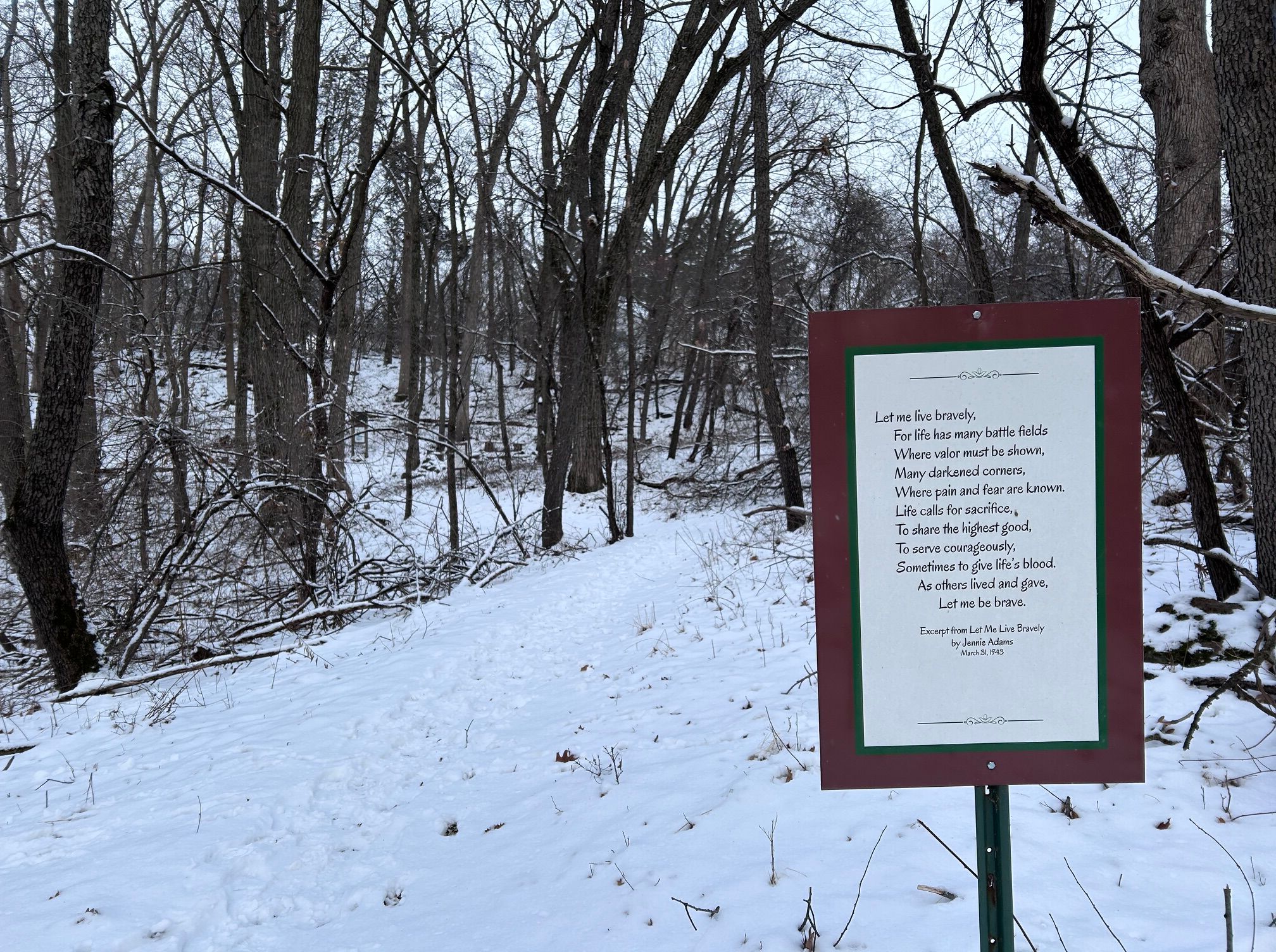
In the snowy woods on Sunday morning, as I mentioned earlier, inspiration overcame reason and I decided to head down the path to something called the Woodland Cathedral. I didn’t know that to expect, but along the way I encountered signs featuring poetry written by someone named Jennie Adams during the Second World War. I read each entry, and I was particularly struck by an excerpt from one that she titled, Let Me Live Bravely. In that excerpt, the poet recognizes that life involves “Many darkened corners / Where pain and fear are known” and that “Life calls for sacrifice” before ending with the prayer: “As others lived and gave / Let me be brave.”
There is a fine line between bravery and stupidity, and don’t worry, I have been contemplating that distinction when it comes to running alone on icy trails in deep woods. But I can tell you that people are inspired by Rob’s story because there is no question that his life reflects bravery. I’m simply hoping to follow his lead when I, too, encounter darkened corners, pain and fear.
Let me be brave, too.
 Peyton Manning hosted the 25th annual ESPY Awards about twenty-five miles from my television set a couple of nights ago in downtown Los Angeles. The ESPY phenomenon was conceived as the MTV Awards for sports, but the original show in 1993 instantly became so much more when Jim Valvano — Jimmy V — delivered

 Starting to Look Up