Monthly Archives: January 2025

Days of Reckoning

With so many statements vying for limited headline space, it seems that President Trump’s audacious assertions about Canada, Greenland, Gulf of Mexico, and the Panama Canal have been characterized by many as mostly “Trump being Trump,” which may very well be true. And I probably would not have given it much more thought had I not at the same time been reading my favorite college professor’s sweeping history of the American West titled, Continental Reckoning. 

For future reference, when you hear that someone has written a “sweeping history,” you can safely assume that it is a big ass book, which this one is. But it is a worthwhile read, especially for Americans to “be closer to understanding ourselves and how we have come to be.” (Prelude, page xxx — that’s Roman numeral thirty, not something dirty!)

I confess an added personal interest in the American West having lived in California for a dozen years in the past, and as I dove into the sweeping history in early January, it seemed all the more relevant when historic wildfires devastated the large numbers of people that have been drawn westward to what has become extremely valuable properties there. But it was reading of historic American expansion (and its consequences) alongside President Trump’s bold expansionist rhetoric that really began to capture my attention. 

A book review is not my intention, but I will explain that the mid-1800s witnessed incredible American expansion and transformation, and while historians typically focus on the violent and fateful American Civil War from that era, Dr. West encourages us to “broaden our view in space and time.” He writes, “The Civil War and the birth of the West . . . should be given something like equal billing in this crucial transition in national life. Each event has its own story and deserves its own narrative, but each was often in conversation with the other, and when each is properly considered in its broadest context, neither can be understood without the other.” (Prelude, page xx)

The extraordinary experience of the American West erupted from the discovery of California gold just as the territory became an American possession in 1848, something Dr. West calls, “The Great Coincidence.” (i.e., “Within two hundred hours of its becoming part of the republic . . . California began to be revealed as the most valuable real estate on the continent.” – page 5) 

It is no surprise that significant expansion is often an economic flex, but the consequences often extend much further.

For example, in the story of the American West, in addition to the vast increase in power, opportunity, and affluence, there were incredible advances in communication, science, technology, and transportation — but the costs were enormous: “hundreds of thousands dead or dispossessed” (454), “land stolen and turned into poisoned grotesqueries” (454), and an appalling racial ordering with devastating effects for Native communities, Black Americans, Hispanic Americans, and Chinese immigrants — Dr. West even shared another historian’s observation that the architects of Nazi Germany admired the United States and “believed they were ‘not so much inventing a race-obsessed state as catching up with one’” based on the U.S. treatment of those considered non-“white.” (453)

I recognize that this is the 2020s and not the 1850s, and that talk of expansion might be the bluster of a negotiator, but my thought for those of us used to a flag with fifty stars is this: Don’t take expansion rhetoric lightly. Be aware. Expansion produces consequences, often significant, and we should not allow our unfamiliarity with it and the possible allure of new acquisitions to prevent us from careful consideration of past experiences in our own days of reckoning, particularly if the proposed expansion is broad and, well, sweeping.

Faulkner’s famous line, “The past is never dead. It’s not even past,” seems apropos. Or, as Dr. West suggests near the end of this volume that he subtitled, The American West in the Age of Expansion: “The consequences remain; yesterday makes today. As for tomorrow and how best to use it, the stories and their voices offer up hints and provocations.” (454)

Well… (Or, Facing Reality)

I fancy myself an early riser and enjoy getting to the office before the campus comes to life, but I often encounter a wonderful member of our custodial staff who has been at work long before my arrival. Recently, we struck up a conversation about the bitterly cold temperatures in the forecast for today, and as our conversation concluded, my colleague said with a smile and as a matter of fact, “Well, we are in Wisconsin.”

I love it. I’m going to use that phrase a lot.

Later, it occurred to me that the sentiment that undergirds that statement reflects a deeply held value of mine regarding life in general.

I am a Christian, but being raised in a specific Christian tradition that encouraged me to think deeply and arrive at my own conclusions, my personal journey has led me to become a different kind of Christian than expected, possibly different than you picture when you hear the term, and probably much to the dismay of several teachers along the way. But I have found great sustenance in the writings of unique thinkers from days gone by, and one of those is William Stringfellow (1928-1985). Near the end of his 1966 book, Dissenter in a Great Society, the lawyer and lay theologian wrote:

“[T]he Christian knows . . . that this world is a fallen world, not an evil world but the place in which death is militant and aggressive and at work in all things. . . . Of all people, Christians are the most blunt and relentless realists. They are free to face the world as it is without flinching, without shock, without fear, without surprise, without embarrassment, without sentimentality, without guile or disguise. They are free to live in the world as it is.” (page 161, updated with gender neutral terms)

Now that has not been my natural experience as a Christian or with Christians, so I apologize for cutting to the chase with that reading because there is much to be understood from Stringfellow prior to such a conclusory passage, but trust me when I say that once I got the full impact of Stringfellow’s theological framework, that passage made a deep impression on me. One way to put it is that it led to a desire to say to myself when life seems unhinged, “Well, we are on Planet Earth.”

I sincerely aspire not to be shocked by what happens in this world, and although a work in progress, I do make progress. And while the limits are often tested, I am less and less surprised by elections, politicians, business tycoons, crimes, illnesses, and disasters. I still feel the deep disappointment, pain, and sadness that acts of injustice produce, but importantly, I am less likely to despair and less likely to live in fear.

As Stringfellow put it, I strive to accept the world we live in for what it is. That’s accept, not approve; in fact, as Stringfellow writes later, I am in perpetual protest. But as a “blunt and relentless realist” who is less likely to be debilitated by current events, I can protest with a steady resolve and with inexplicable hope.

It is bitterly cold outside today in my new home state, but saying “Well, we are in Wisconsin” reminds me that cold weather is to be expected and allows me to bundle up and face the hard reality.

That general idea gets me through life, too.

Chaos or Community?

It seems to me that a debate over where a nation’s flags should be positioned today should be about the national holiday’s namesake rather than two others who are not, the national holiday’s namesake that is.

To be fair, one of the two obviously did not invite the debate. In fact, just over forty-six years ago (January 14, 1979) President Jimmy Carter became the first president to propose a national holiday honoring Reverend King even though thirty such bills had been proposed and defeated in Congress in the decade following the assassination, with the first proposal coming just a few days after the national tragedy in 1968.

President Carter’s proposal was unsuccessful, too. There were repeated financial arguments against the holiday over the years (e.g., President Ronald Reagan cited cost concerns; i.e., it will cost too much money to give federal workers another day off), and there were repeated personal attacks (e.g., Senator Jesse Helms called Reverend King a “Marxist” — and even President Reagan, again, who eventually signed the 1983 national holiday bill that finally made it through Congress into law, dodged a question about Senator Helms’s accusations with a thinly-veiled slap, “We’ll know in thirty-five years, won’t we,” referring to the scheduled release of FBI surveillance recordings). Today’s youth are presumably ignorant of the long road to the national celebration of the life of Martin Luther King, Jr.

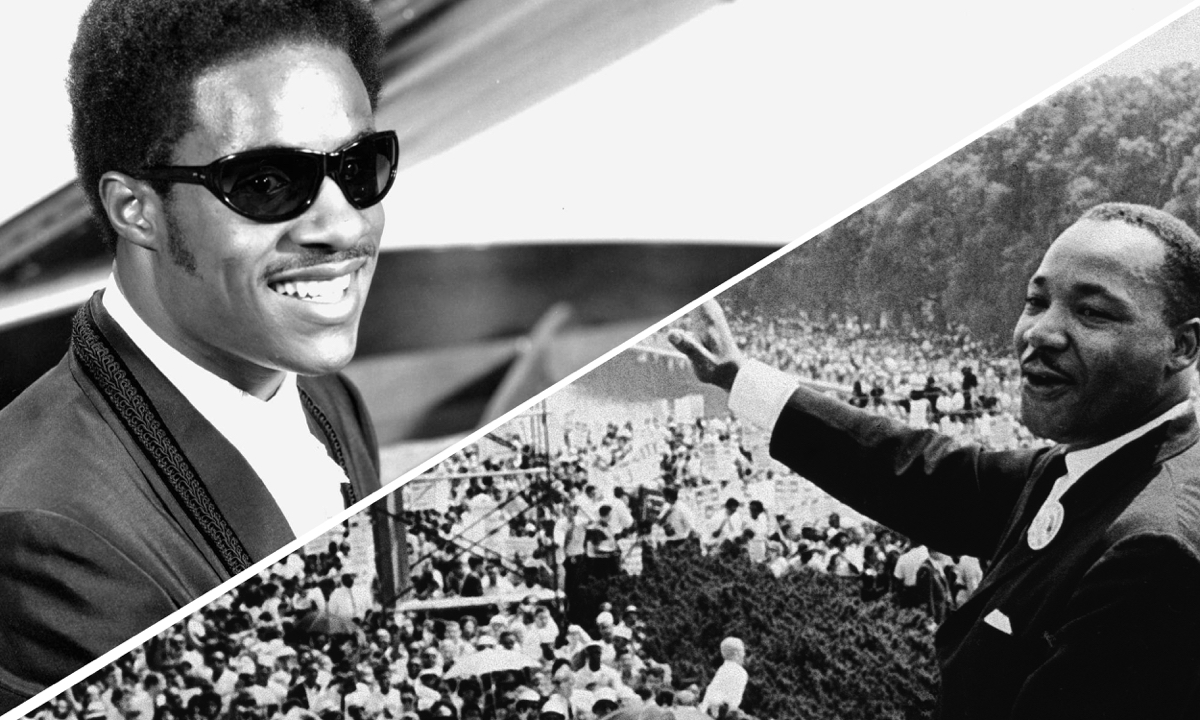
Key to generating the public pressure necessary to turn the tide on a national holiday, including a petition with an incredible six million signatures, was the extraordinary effort of musical legend, Stevie Wonder, who wrote and released his MLK-holiday-inspired version of the song, “Happy Birthday,” in 1981. “Happy Birthday” became one of his signature songs and has endured in beautiful ways. At the first official national MLK Day celebration in 1986, Stevie was the headline performer.

Still, even with the eventual declaration of a federal holiday, many states were reluctant to participate. It wasn’t until the year 2000 that every state officially came on board, although I am sad to report that both Alabama and Mississippi, in a breathtaking and ongoing insult, still combine the holiday to recognize both Martin Luther King, Jr. and Robert E. Lee, the Civil War general that led the fight to preserve Black slavery.

And if the fight for a day to recognize Reverend King wasn’t hard enough, we add a presidential inauguration today. Given the Twentieth Amendment to the United States Constitution’s specification for presidential inaugurations (January 20) and the designated date for MLK Day (third Monday in January, instead of his actual birthday, January 15), this will happen periodically. It happened with both President Bill Clinton’s second inauguration in 1997 and President Barack Obama’s second inauguration in 2013, and it won’t happen again until 2053, but it is happening today.

I listened to Stevie Wonder’s signature song, and given the persistent reluctance to fully celebrate the holiday and the bitter divisions in our nation, certain of his lyrics struck me with special force:

  • “the way to truth is love and unity to all God’s children”
  • “the whole day should be spent in full remembrance of those who lived and died for the oneness of all people”
  • “we know that love can win”
  • “the key to unity of all people is in the dream that you had so long ago that lives in all of the hearts of people that believe in unity”

I wish that those sentiments — sentiments that happen to reflect Reverend King’s understanding of Christian values — could be the full focus of a day like today.

Today, I do get to be a part of a lengthy reading to commemorate the holiday. We will gather in the “MLK Room” on the Ripon College campus and read aloud sections of the last book that Reverend King published prior to his assassination, titled, “Where Do We Go from Here: Chaos or Community?” That question — Reverend King’s question — reverberates today. Which will we choose?

Sometime between today’s presidential inauguration and tonight’s college football championship, I propose finding a few minutes to reflect on Stevie Wonder’s lyrical call to the world as set forth in his birthday song for Reverend King and truly consider the question: Where will we go from here — chaos, or the beloved community of which Reverend King so famously dreamed?

How President Jimmy Carter Changed My Life for Good

Biloxi, Mississippi (2008)

After a hundred years of life and a week’s worth of funeral activities, President Jimmy Carter’s remains will finally be laid to rest in his Georgia hometown this evening. Many memories have been shared by many people, so I might as well add mine, too.

I was six years old when Governor Carter was elected President Carter in 1976, marking the first presidential election that I remember, but my childhood memories related to him are few and scattered, including peanut jokes, gas no longer thirty cents a gallon, and wearing yellow ribbons for the hostages. Twenty years later, however, he changed my life for good.

As a young adult wrestling with my Christian faith in the early 1990s, I became convinced that Jesus’s primary news was that all people matter to God and that God’s business is setting right what has gone wrong in the world for all people, particularly the poor and marginalized. And as I wrestled to reconcile that belief with what appeared to be a different primary business of organized churches, my new wife and I soon found personal meaning by moving into a home serving children who were abused, neglected, or troubled.

While there, sometime in 1996, I read a U.S. News & World Report interview with President Carter about his new book, “Living Faith.” In the interview, President Carter shared that his home church once wanted to do something nice for a poor family at Thanksgiving, but they had one problem: Nobody knew a poor family. So, undeterred, they approached the local social services office to get the name of a poor family that they could approach. It occurred to President Carter that something was very wrong with that picture, i.e., a church having to go to the government to find the poor families.

That observation cut straight to my heart.

I must have spoken about that article in the weeks that followed because my mother bought “Living Faith” for me that Christmas, which turned out to be one of the most important gifts of my life. As I devoured the book, I read the chapter titled, “Faith in Action,” and discovered Habitat for Humanity. As I read about the organization’s mission to alleviate poverty housing, it struck me that my hometown, Paragould, Arkansas, an all-white sundown town with railroad tracks that segregated the community even further along socioeconomic lines, could really use Habitat for Humanity.

This changed my life forever.

I set out to establish a Habitat for Humanity affiliate in my hometown in early 1997, only to discover that the national organization required new affiliates to be diverse and a representation of the entire community, which challenged my heretofore wholly homogenous life. And as a result, I soon learned that so many people representing labels that I had been taught were bad or lost or wrong were in reality good and found and right, at least as much as my folks were, and often more so.

This has been the great lesson of my life, and I have been joyfully benefiting from its reality for the past three decades as we have lived all over these United States, traveled all over this planet, and befriended so many people that I can no longer even imagine that labels are dependable.

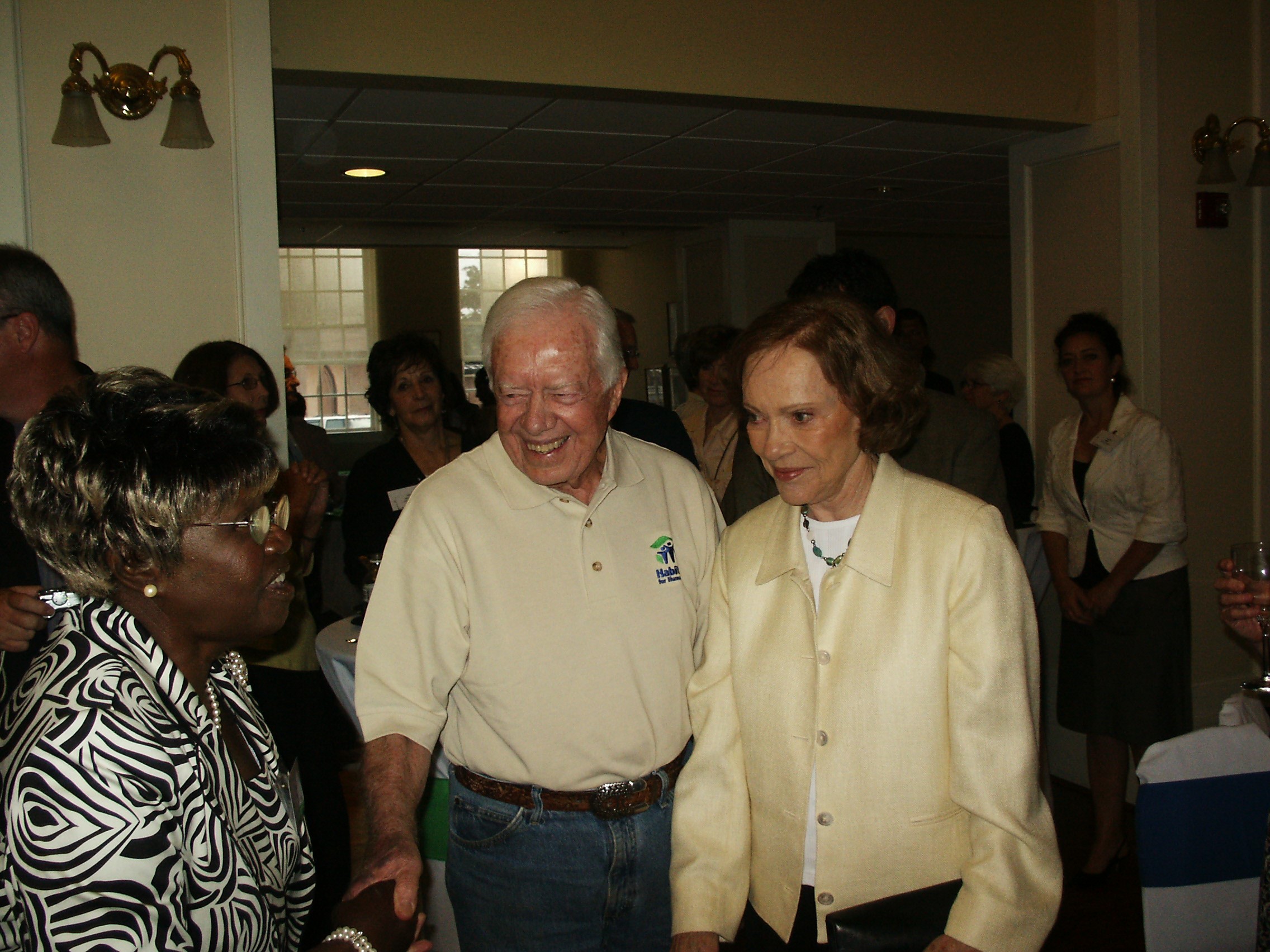
I never introduced myself to President Carter, although the picture above shows how close I came when another Habitat for Humanity affiliate that I helped establish hosted the Jimmy & Rosalynn Carter Work Project in 2008 to address the devastation wrought by Hurricane Katrina. As a board member, I was honored to attend a VIP event that evening and see the Carters up close, but it never worked out to shake his hand and say thank you.

That’s okay. But I will say it today on the day that President Carter’s remains are finally laid to rest in his Georgia hometown after a hundred years and a week’s worth of funeral activities.

Thank you, Mr. President. You changed my life for good, and I am forever grateful.